






Quick Read 21.co Tokenization Report: A Trillion-Dollar Market?


Original author: 21.co
Original text compiled by: BitpushNews, Yanan
The convergence between cryptocurrencies and traditional asset classes, including fiat currencies, stocks, government bonds and real estate, is experiencing unprecedented growth. The argument held by the industry is becoming increasingly clear, that is, blockchain is becoming the back-end infrastructure of every asset class, and its future application scenarios will exceed everyone’s imagination. Before the advent of the Bitcoin blockchain, tokenization was not possible. Subsequently, Ethereum introduced a global computing platform for smart contracts, leading to the rapid rise of various blockchain and distributed ledger technologies.
The following is a summary of the key information involved in the report:
Total assets: $118.57 billion
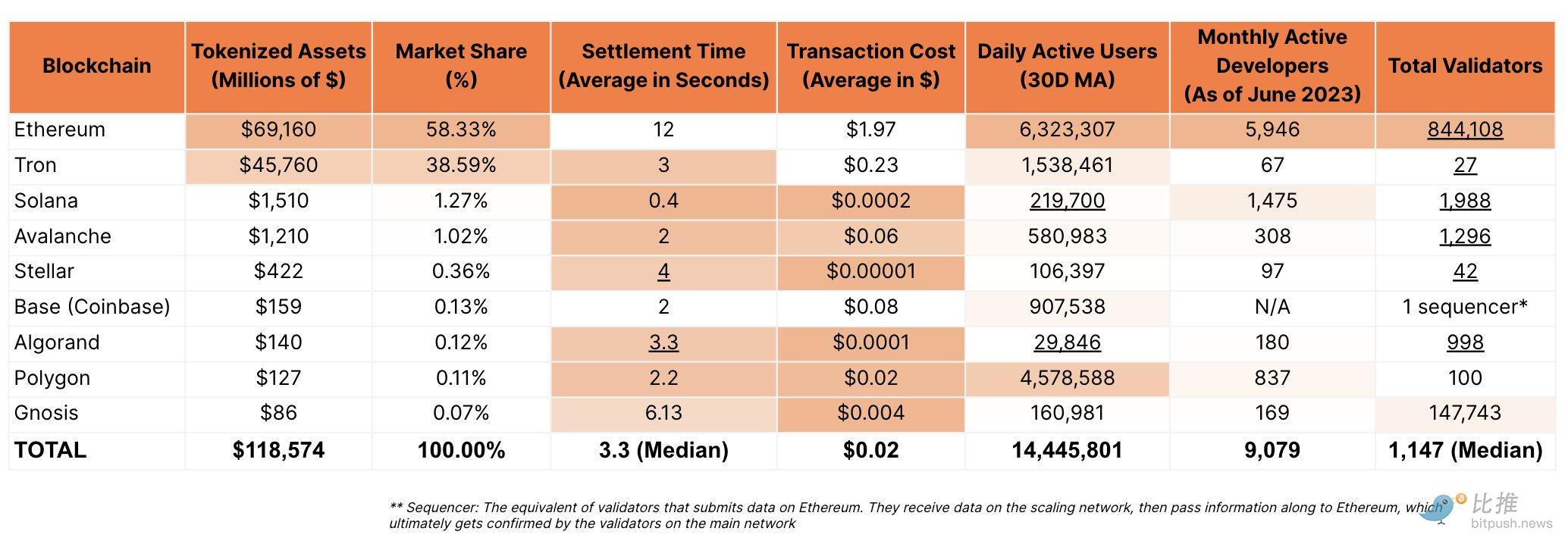
The tokenized assets of the public chain are worth US$118.57 billion. As of October 2023, Ethereum and Tron hold the largest share of tokenized assets, primarily based on the number of stablecoins issued on the network. Ethereum’s tokenized assets amount to $69.1 billion, accounting for more than 58% of all tokenized assets ($118.57 billion). It has the most dynamic ecosystem, with more than 6 million daily active users and nearly 6,000 monthly active developers. The chart also shows that Ethereum is optimized for security and decentralization issues, allowing the project to have over 800,000 validators. The rest of the projects compete on speed and scalability. Tron is in second place with over $45 billion in tokenized assets, while third-placed Solana holds the record for the fastest settlement time with an impressive 0.4 seconds.
Public blockchain vs. permissioned distributed ledger technology
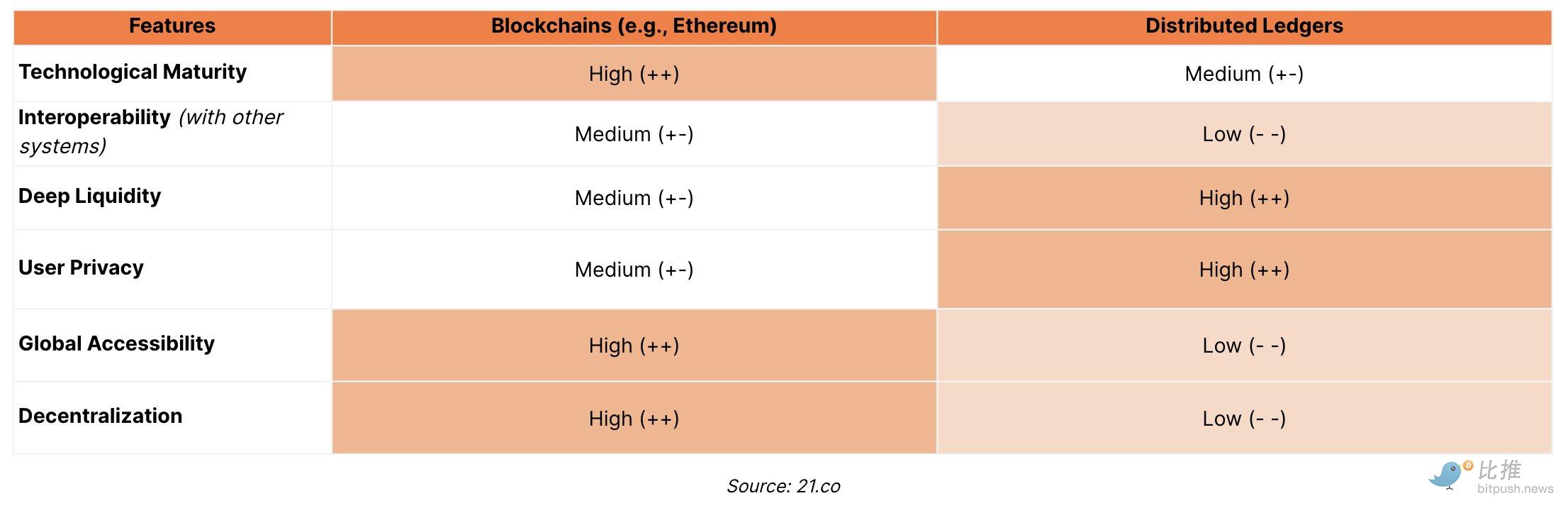
The table below illustrates the evolution of the token landscape. Although the first and most successful examples of token financial innovation were stablecoins backed by fiat currencies, tokenization application scenarios have continued to increase over time, and some companies in the traditional financial field, such as the European Investment Bank, Bonds are also issued via private distributed ledger technology (DLT).
Compared to distributed ledgers, public blockchains such as Ethereum provide a globally accessible platform with superior, battle-tested technology. DLT benefits from strict end-to-end KYC and AML processes, as well as the high concentration of liquidity in the traditional financial ecosystem. Tokenization will help blockchain gain the deep liquidity of traditional finance.
97% of tokenized assets are stablecoins
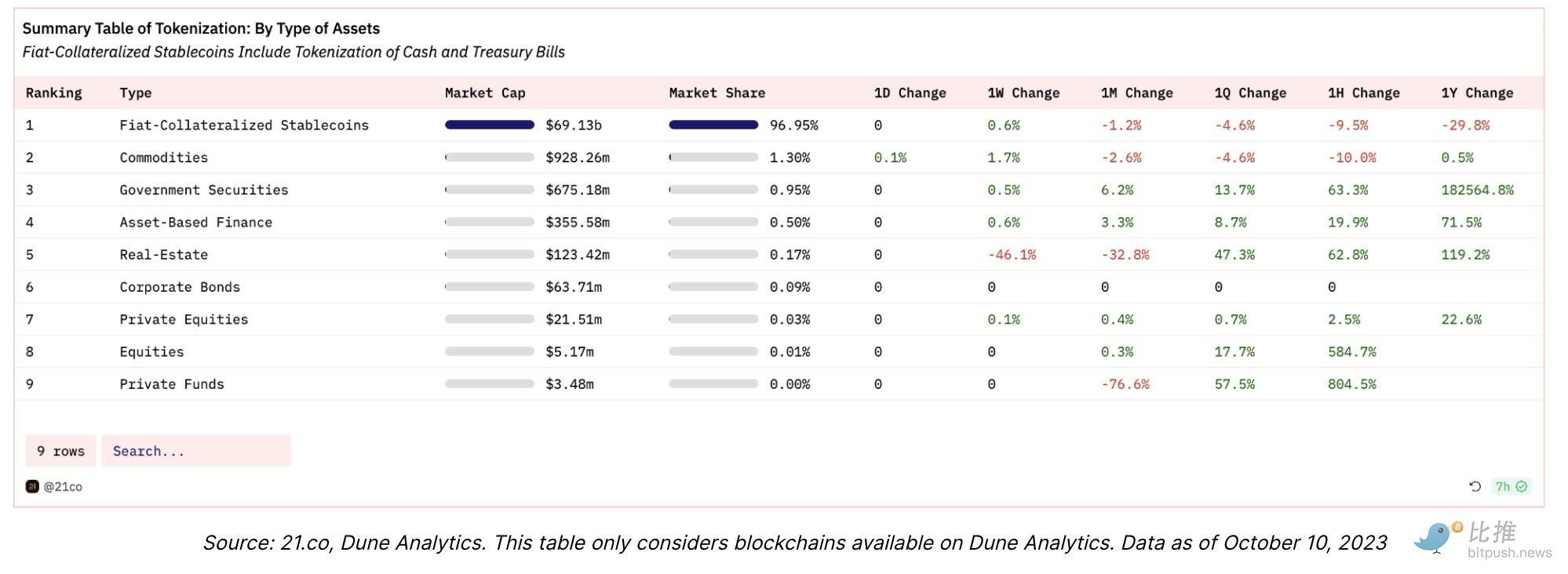
Stablecoins are the original tokenized assets that have certain product-market fit. On Ethereum-compatible networks, stablecoins account for nearly 97% of the tokenization market share ($69.13 billion), followed by tokenized commodities such as gold and tokenized government securities such as U.S. Treasury bonds. It’s worth noting that fiat-collateralized stablecoins are digital representations of fiat currencies, such as the U.S. dollar. Issuers of these products (such as Circle and Tether) maintain off-chain reserves of target assets primarily in the form of short-term U.S. Treasury bills and cash, with a ratio that depends on the issuers asset liability management.
Tokenized government securities have grown more than 450% this year
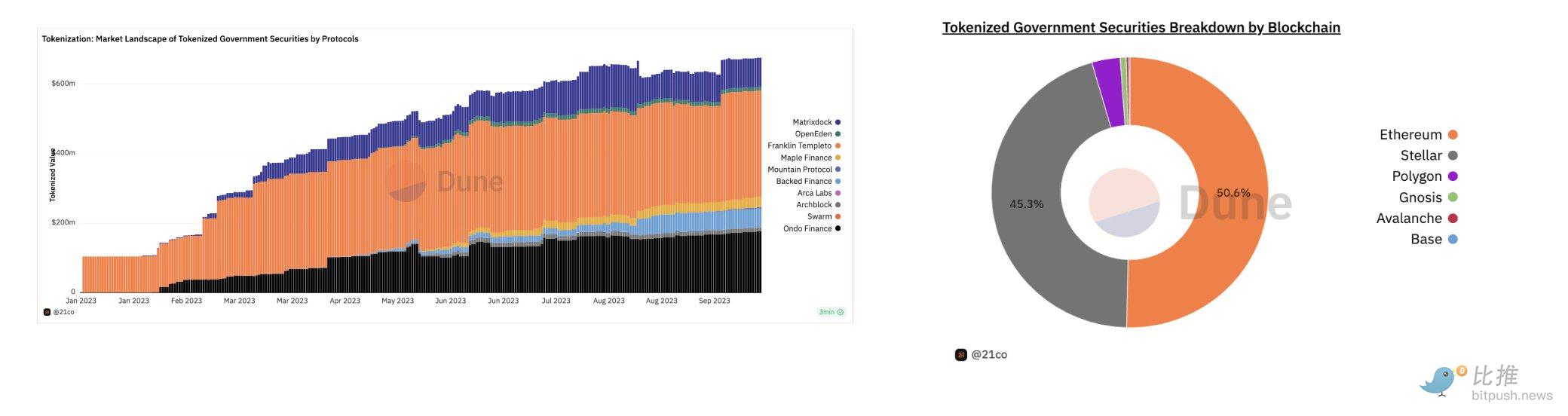
This year, tokenized U.S. Treasury bonds have grown by more than 450%, with total assets reaching $650 million. The rise of on-chain US Treasuries can be attributed to the current high interest rate environment. Issuers include cryptocurrency businesses such as Ondo and Backed Finance, as well as well-known traditional financial companies such as Franklin Templeton.
Tokenized assets continue to be dispersed across various trading venues and channels
Regulatory ambiguity and insufficient shared infrastructure have largely contributed to the lack of a unified trading platform for tokenized assets. As mentioned above, stablecoins are a dominant force in the tokenization market. Stablecoins can be widely used and have very active trading activity on both centralized and decentralized exchanges. As can be seen from the chart below, stablecoin trading pairs account for 70% of the total trading volume on decentralized exchanges. In comparison, at the beginning of 2020, the majority of trading volume (60%) was dominated by altcoin trading pairs (such as BTC/ETH), which dropped to 30% by 2023.
Regulatory ambiguity and insufficient shared infrastructure will also limit access
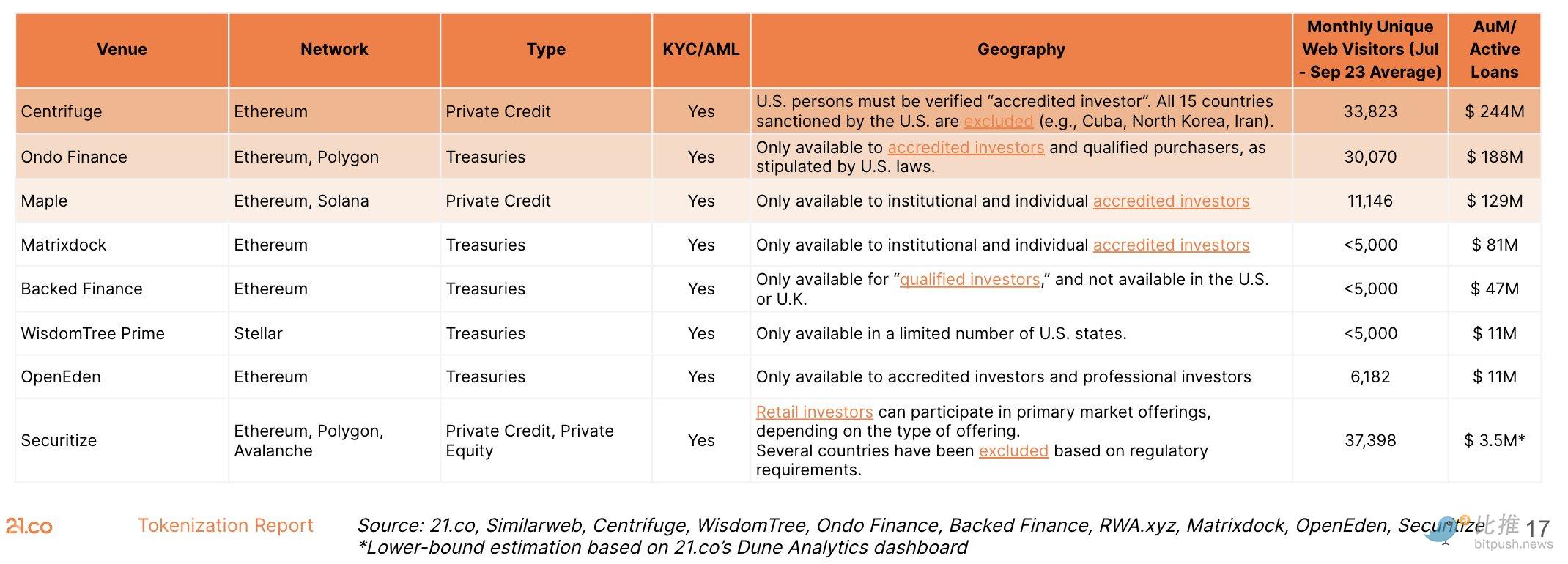
In our research on tokenized assets, we found that while there are avenues for decentralized exchange, most issuers prefer to use independent platforms or applications in order to comply with strict regulatory standards. Although these platforms leverage public blockchain technology, their accessibility is still limited due to the need for KYC/AML (Know Your Customer/Anti-Money Laundering) verification or geographical restrictions. This approach may not be in line with the original intention of openness in the crypto world, but with the advancement of technology and regulation, this problem is expected to be solved. This reflects that the biggest innovation often occurs in back-end infrastructure, such as using public blockchains for settlement.
Tokenization is still in the early stages of development
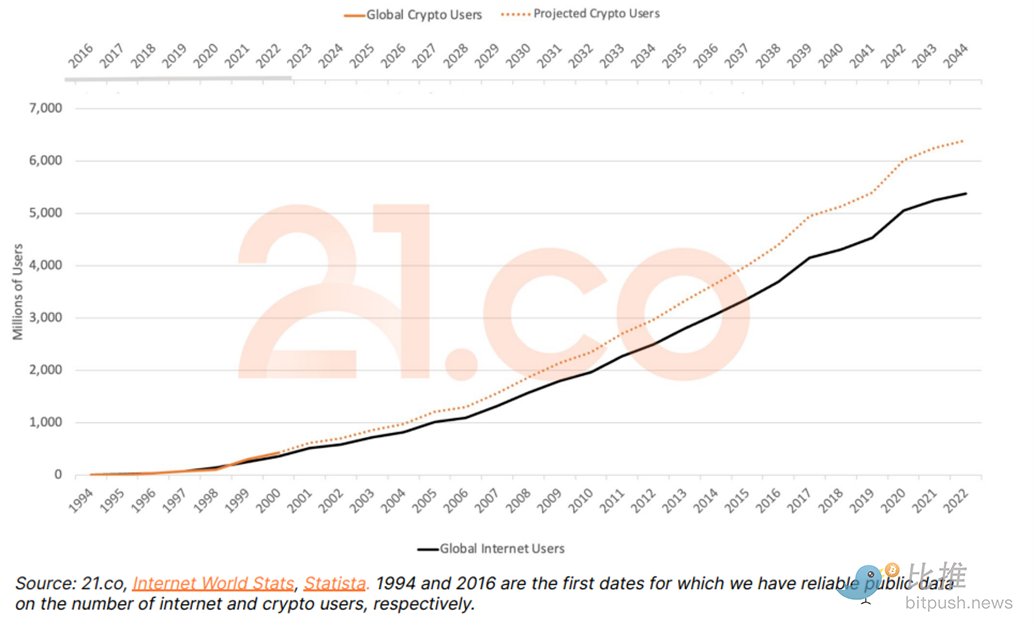
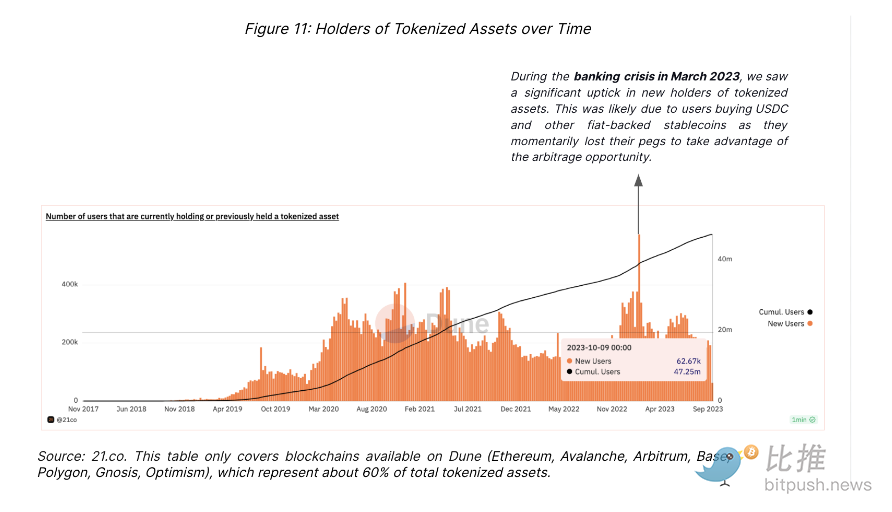
As of early 2023, there were approximately 431 million cryptocurrency users worldwide, accounting for approximately 5.36% of the worlds population. Among them, tokenized users are 47 million, accounting for 10% of the total number of cryptocurrency users.
Cryptocurrency ownership vs. Internet/bank penetration
The level of cryptocurrency penetration today is equivalent to the level of internet penetration in 2000. The number of cryptocurrency holders will grow at a compound annual growth rate (CAGR) of 89% from 2016 to 2022, surpassing the 65% share of internet users between 1994 and 2000. The growth rate over the next 22 years is expected to stabilize at 12.45%, consistent with the growth rate of Internet users from 2000 to 2022.
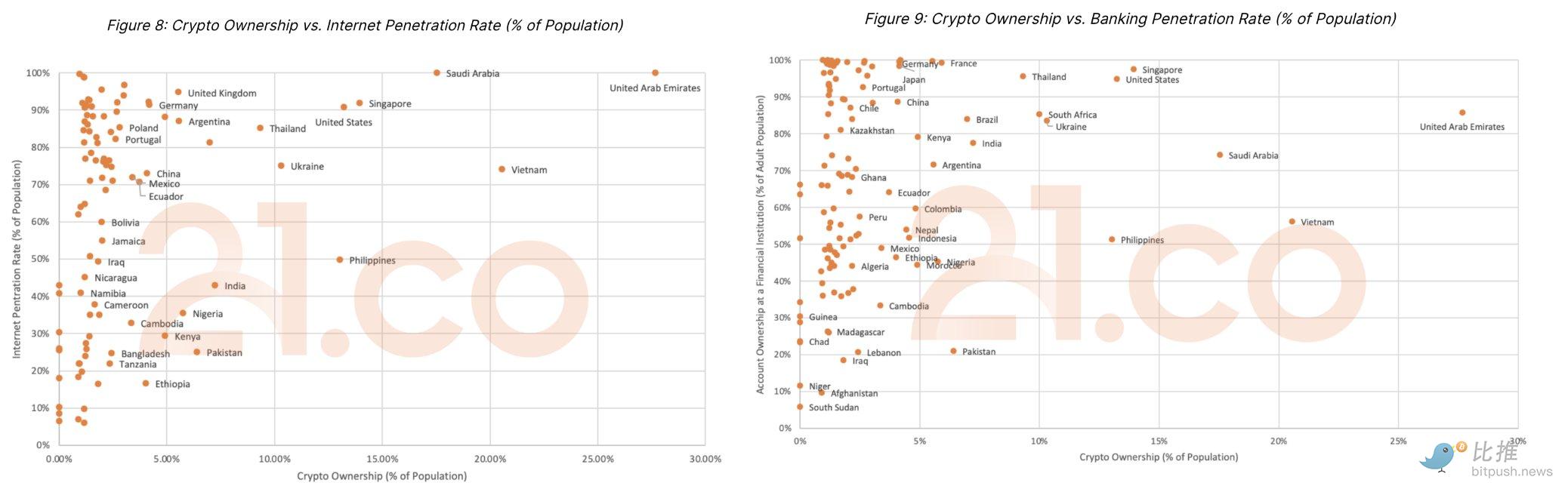
Public blockchains are permissionless, meaning anyone can create a free wallet and transact using tokenized assets. As long as you have access to the Internet, you can use cryptocurrencies. As shown in the chart below left, countries with the highest cryptocurrency holdings tend to have higher internet penetration, with the exception of the Philippines. Low internet penetration in emerging economies, such as South Asia and sub-Saharan Africa, has limited the development of cryptocurrencies.
According to the World Bank, decentralized finance (DeFi) is expected to provide financial services to the approximately 1.4 billion adults who do not have bank accounts. However, the chart on the lower right shows that regions with the highest cryptocurrency adoption tend to have higher bank penetration, with some notable exceptions such as Vietnam and the Philippines.
Developers, leading indicators of value creation
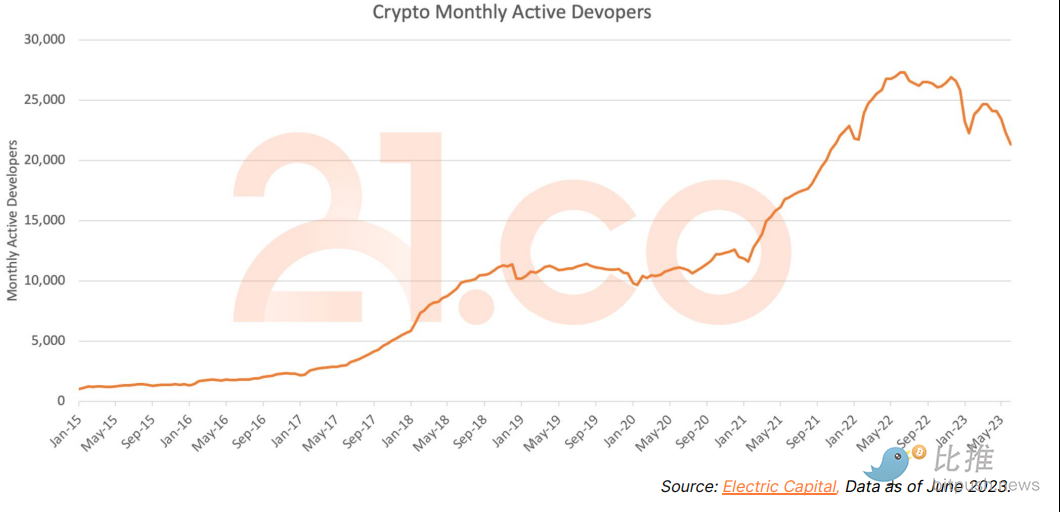
Developers and entrepreneurs are the first users of blockchain technology and are early indicators of potential value creation. They mainly develop end-consumer services and products, or strengthen back-end construction. As of June 2023, the number of monthly active developers reached 21,338, an increase of approximately 2 times compared with January 2020, and an increase of approximately 20 times compared with January 2015. Despite exponential growth, cryptocurrency developers only account for approximately 0.1% of the total global developer population (27.7 million).
Tokenized assets have begun to show a trend
In a 2022 BNY Mellon survey of institutional investors, including asset owners, asset managers and hedge funds (excluding cryptocurrency-specific funds or alternative fund managers), 97% of respondents Said that “tokenization will revolutionize asset management” and “benefit the industry.”
As of October 2023, approximately 47 million people hold tokenized assets. It’s worth noting that 99% of this number comes from stablecoins; other use cases are still experimental at scale. Tokenized assets account for approximately 10% of total cryptocurrency market capitalization, behind only BTC and ETH, indicating that stablecoins already have some product-market fit.
Now is the best time to build
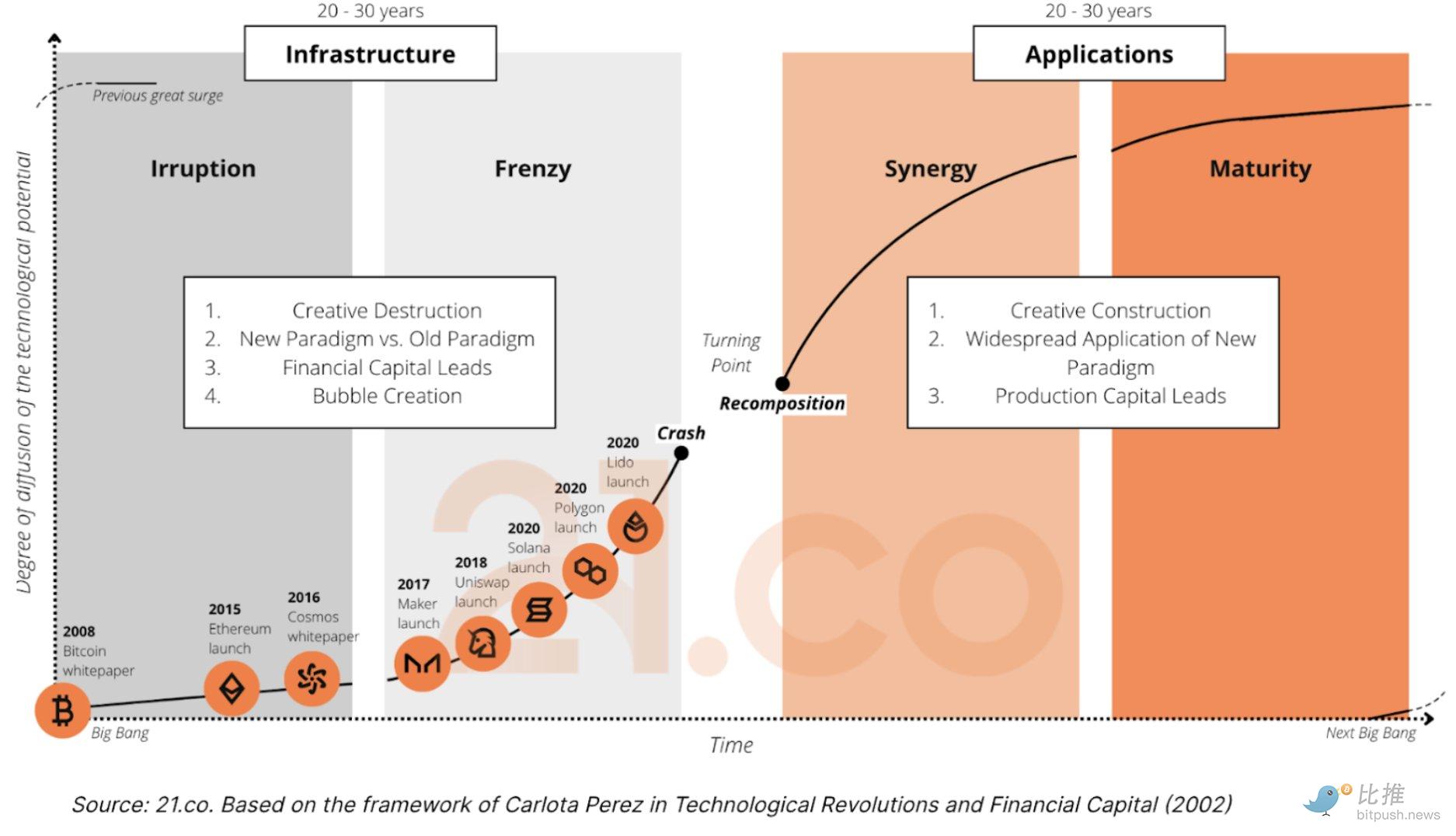
Blockchain, like Internet protocols, will become more invisible on the back end, and innovation will focus more on consumer-facing applications. Based on Carlota Perez’s framework, crypto is transitioning from a frenzy phase to a synergy phase. Through this shift, crypto will be more closely integrated with existing financial software and bring real-world assets (RWAs) on-chain through tokenization.
The future of tokenization
Tokenization is another breakthrough in financial innovation, comparable to the introduction of mutual funds in the 1970s and ETFs in the 1990s. But with the right regulatory framework, the impact of tokenization can be even greater, as it can digitize any asset on the blockchain.
Tokenization can provide: better liquidity, greater accessibility, greater settlement efficiency, greater transparency, greater composability and better interoperability.
Tokenization: a multi-trillion dollar market
According to estimates by the research team, by 2030, the market value of tokenized assets will reach US$3.5 trillion under a bear market scenario and US$10 trillion under a bull market scenario. The base case forecast is based on the assumption that tokenization will account for 10% of global regulated open-end fund net assets ($70 trillion in assets in Q2 2023). The annual growth rate predicted by the bull market is similar to the growth observed historically among cryptocurrency holders. The bear market is half the value predicted by the baseline scenario.
Main challenges to be solved
How tokenization legally transfers ownership
Lack of clear price determination mechanism and mortgage specifications
Differences in regulatory rules across countries
ensure safety
Strengthen cooperation among all parties





