


Comprehensive interpretation of cross-chain DEX WOOFi: trading mechanism, pledge mechanism and token economics


Original author: ASXN
Original compilation: Deep Chao TechFlow
WOOFi is a cross-chain decentralized exchange where users can swap assets, earn income and pledge on 10 different chains. The exchange uses a novel synthetic active market making (sPMM) algorithm to price assets, which operates as a market maker by retrieving order book data from centralized exchanges and a complex hedging mechanism. This enables more accurate pricing, more efficient liquidity, minimized impermanent losses, and protection against auction trading compared to traditional automated market making mechanisms (AMMs).
Over the past year, WOOFi has actively pursued an aggressive cross-chain expansion strategy and has frequently become one of the first non-native decentralized exchanges on newly launched EVM-compatible chains.
Through WOOFi mining, WOOFi provides Supercharger Earn Vaults, a one-way income product that does not cause impermanent losses. Supercharger Earn Vaults is essentially a lending product with a low asset-liability ratio, similar to Maple lending, that can generate real returns.
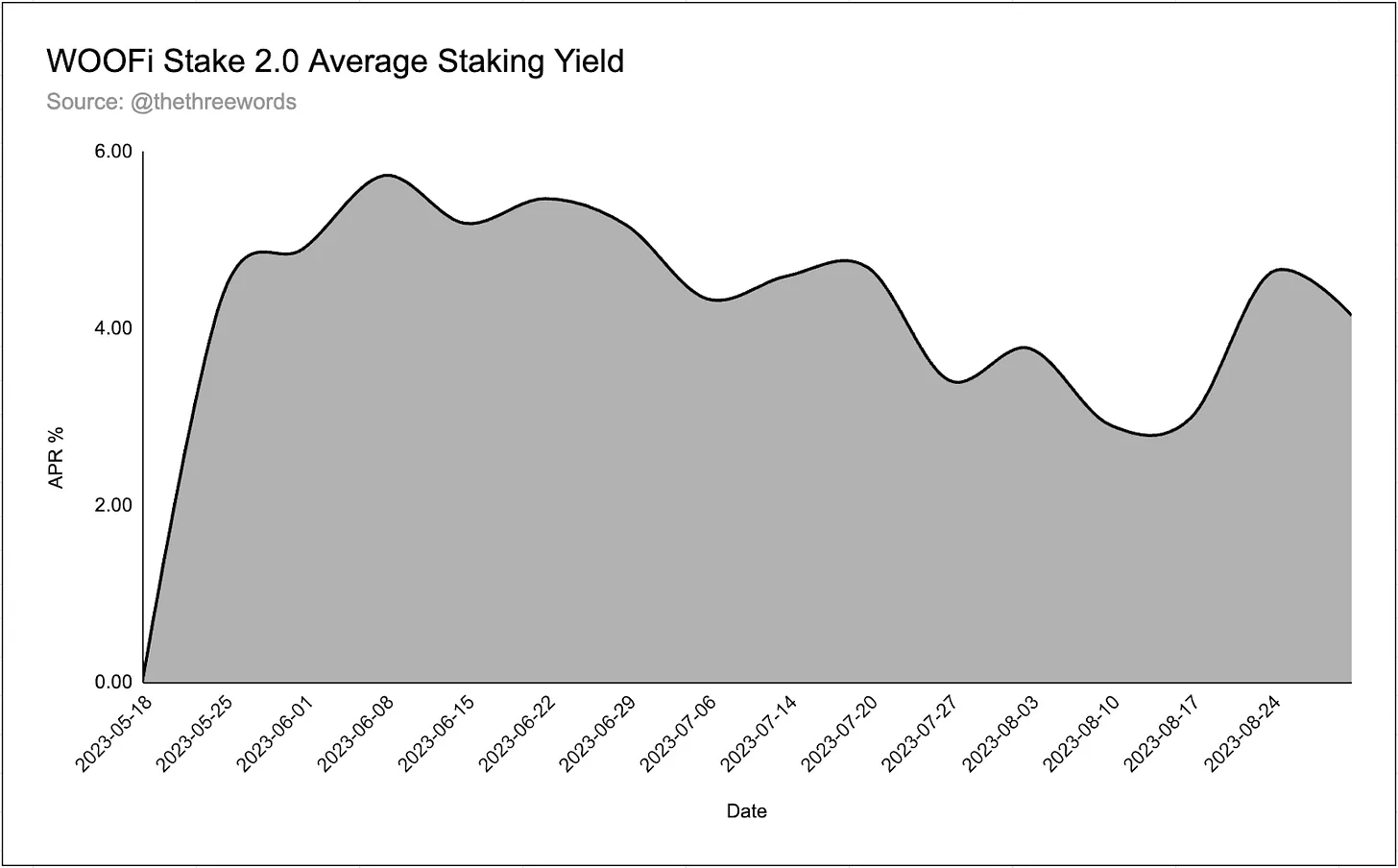
WOO token holders can benefit from these protocol fees through WOOFi staking. WOOFi staking allows users to stake WOO on multiple chains and earn protocol fees. The rate of return for WOO pledgers has always been maintained at around 4%, and rewards are issued in the form of USDC.
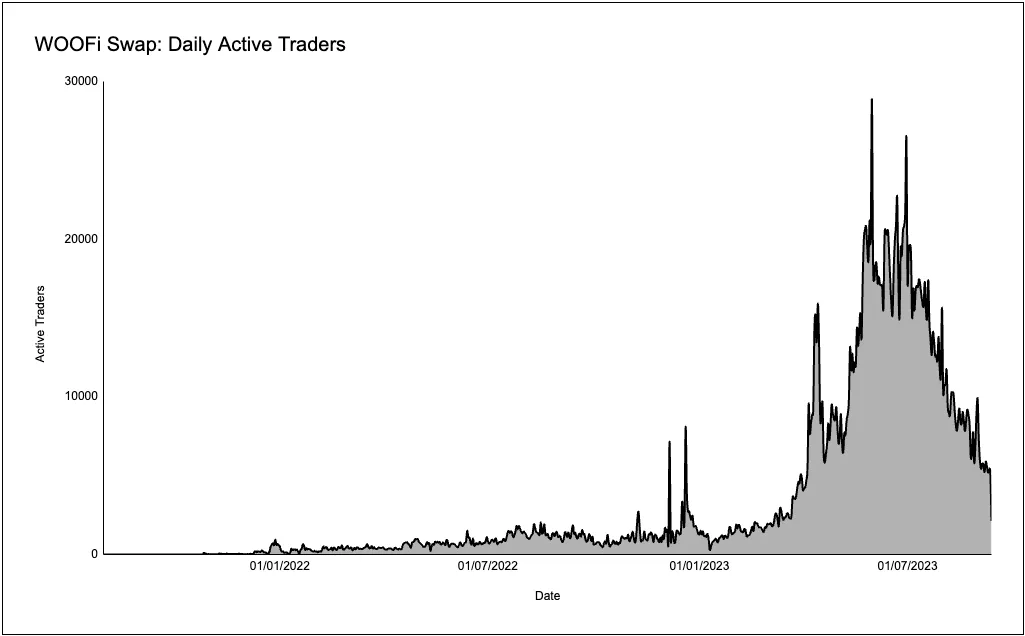
Over the past month, WOOFi’s daily average trading volume reached $13.63 million, making it the 20th largest decentralized exchange in the blockchain space by trading volume. In addition, WOOFi’s average number of daily active traders during this period was approximately 7,000.
trading mechanism
WOOFi Exchange uses the sPMM algorithm, which is designed to simulate the quotes, bid-ask spreads and market depth of centralized exchanges.
In contrast, most decentralized exchanges operate as automated market makers (AMMs) and use a constant product market maker model. These models rely on the xy = k function to calculate the price between two tokens based on each token’s available reserve balance (x and y). This curve is based on the principle that transactions should not change the product (k) of a pair of reserve balances (x and y). According to the constant product formula, the price of token x is calculated as price x = reserve token y / reserve token x.
On the other hand, the sPMM algorithm receives order book data from centralized exchanges and uses the middle price (P 0) (the average of the buying and selling prices), the bid-ask spread (s) (the selling price and the buying price and the middle price). price difference) and slippage to determine the transaction price.
The centralized exchange from which the order book data is sourced is chosen by the market maker and depends on where the market maker chooses to hedge. Use a custom on-chain price oracle to receive data. The oracle actively pushes price updates; this means that as the price on the centralized exchange changes, the new price replaces the old price. When users redeem, they get a price based on the latest valid parameters on the chain. On-chain data is updated based on the price deviation at the discretion of the market maker, which is usually about 0.1% (that is, updated when the price changes by 0.1%).
In addition to mid-price and bid-ask spread data, WOOFi also uses a slippage factor (k) to simulate liquidity on centralized exchanges that pull order book data. It is used to ensure that on-chain slippage matches the slippage on the centralized exchange’s order book, i.e., users executing the same trade on the centralized exchange and the WOOFi exchange will experience similar slippage.
Slippage factors ensure that on-chain offers are competitive enough to attract aggregator traffic, while also managing the risks associated with hedging on-chain traffic to maintain market neutrality and make a profit.
Price of asset x:
AMM:
where: y is the balance of token y in the pool, x is the balance of token x in the pool
WOOFi Swap:
The following is an overview of WOOFi Swap’s work:
For example, the user wants to use USDC to buy ETH:
The user initiates a transaction and uses USDC to buy ETH.
The sPMM algorithm obtains mid-price and bid-ask spread data from the order books of centralized exchanges through a custom on-chain price oracle.
The amount of ETH a user will receive is estimated based on bid-ask spreads and liquidity to match centralized exchanges.
Users receive ETH through the liquidity pool and pay USDC.
sPMM pool managers hedge, taking the same positions as users to maintain market neutrality. (That is, since market makers sold ETH to obtain USDC, they have to buy ETH to pay USDC, or use other tools such as perpetual contracts to increase their ETH position).
Basic information of WOOFi exchange
Minimize impermanent loss
Users who provide liquidity to traditional AMMs face significant impermanent losses. The AMM pool is rebalanced by arbitrage traders buying tokens that are underpriced and selling tokens that are priced too high, until the AMM price matches the broader market. This portion of profits is withdrawn from liquidity providers, who suffer impermanent losses and suffer negative slippage to rebalance the balance in the pool.
In the sPMM model, the assets deposited by users are managed by the sPMM manager. There is no malicious arbitrage traffic, i.e. no arbitrage traders extracting profits from liquidity providers. The sPMM manager hedges its positions to remain market neutral, so even if the swap pool becomes unbalanced, it can cover assets through its position on WOO X.
For example:
User purchases 10 ETH from WOOFi Swap for 20,000 USDC.
In theory, the pool would be unbalanced, with less ETH and more USDC.
The sPMM manager hedges the position by buying 10 ETH off-chain to make up for the imbalance.
Prevent MEV
Since WOOFi Swap does not use the AMM pricing model, that is, the price does not come from the underlying asset pool, it will not be affected by bidding trading robots, users are protected from sandwich attacks, and liquidity providers (and users) are protected from instant liquidity attacks.
First, the way a sandwich attack works causes users to execute poorly on price:
The user submits a transaction to purchase asset X through the AMM.
The bidding trading bot sees pending trades in the trade pool and places one trade before and one after the users trade.
Since the asset price in AMM comes from the balance in the AMM liquidity pool, the bidding trading robot can push up its price by purchasing asset X.
The user ends up buying asset X at an inflated price.
The robot sells asset X at an inflated price.
Instant liquidity attacks are slightly more complex. In most cases, instant liquidity actually provides users with better exchanges. The workflow is as follows:
Users submit large-scale exchange transactions using AMM-priced DEX. Usually an AMM that centralizes liquidity.
Bidding trading bots/searchers see this trade in a trading pool and aim to profit from the exchange transaction fees of the liquidity providers in this pool.
Before an exchange occurs, the bidding trading bot adds liquidity to the specific pool that will process the trade. This liquidity is typically concentrated where exchanges for a single price move (in concentrated liquidity) are most relevant.
Exchanges are then made and fees are earned for providing the liquidity required for trading.
Once the exchange is complete, liquidity and any accumulated fees are immediately withdrawn.
A bidding trading robot may hedge its inventory risk on another trading platform, and the robots final profit will be the difference between the transaction fees associated with the hedging, the transaction fees for adding/removing liquidity, and the LP fees earned.
This usually results in exchangers getting better exchange prices because they exchange into deeper liquidity providers. However, passive liquidity providers suffer because active instant liquidity dilutes their trading fee earnings. They were not compensated commensurate with the risk they took.
It was recently discovered that instant liquidity can actually result in exchangers receiving worse exchange prices if a sandwich attack is implemented simultaneously.
Cross-chain
Over the past year, WOOFi has actively pursued an aggressive cross-chain expansion strategy and has frequently become the first non-native decentralized exchange on newly launched EVM-compatible chains such as Linea and Base. This move is driven by their cross-chain swaps. Through LayerZeros cross-chain messaging protocol and Stargates liquidity, WOOFi transactions can perform cross-chain transactions using a single signature transaction.
However, it’s worth noting that WOOFi Swap relies on Stargate for token bridging, which tends to be more expensive compared to other bridging solutions. To solve this problem, WOOFi has announced subsequent support for LayerZeros OFT (cross-chain fungible token) standard and Chainlinks CCTP.
The number of listings is limited
WOOFi exchange is unable to provide swaps for many currencies because their sPMM model relies on centralized exchanges for pricing. The decision to list a new currency needs to consider the suitability for hedging, so the platform gives priority to tokens with strong liquidity on centralized exchanges - especially tokens with strong liquidity in the perpetual contract market. So far, WOOFi exchange only supports 11 trading pairs natively: USDC, USDT, WOO, ETH, BTC, ARB, AVAX, BNB, MATIC, FTM and OP.
Unfortunately, although the sPMM model has the advantages of mitigating impermanent losses and reducing auction transactions, one of its main disadvantages is that it cannot quickly list new coins because of the need to meet liquidity requirements, especially perpetual liquidity requirements.
Additionally, there are currently a limited number of listings, as adding more assets increases the risk for all assets if one falls to zero. This is because WOOFi uses a single pool design. WOOFi is exploring providing separate pools for long-tail assets to support more listings. WOOFi has integrated 1inch to cope with the limited number of listings: assets that are not tradable on WOOFi will be routed through 1inch.
For example, if the user is trading asset A (not available on WOOFi):
Users exchange asset A on the Ethereum blockchain for ARB on the Arbitrum blockchain.
1inch executes a swap of asset A for USDC.
WOOFi performs cross-chain swaps of USDC and ARB.
capital efficiency
Traditional AMMs require large amounts of liquidity and are relatively capital inefficient because most transactions are concentrated within a narrow price range. The WOOFi exchange requires less total locked value but can achieve similar pricing because it uses order book data for pricing as well as professional market makers rather than underutilized “lazy liquidity.”
WOOFi Mining
WOOFi provides Supercharger Earn Vaults through the WOOFi mining interface, which is a one-way income product without impermanent losses. Supercharger Earn Vaults allow users to lend tokens to the sPMM pool manager at a fixed lending rate by depositing assets into the vault. It is important to note that sPMM pool managers do not provide collateral for their borrowings. In essence, WOOFi has built an unsecured lending and asset-backed securities product similar to Maple Lending.
The sPMM pool manager borrows from depositing users and deposits them into the liquidity pool. Users only interact with liquidity pools, where settlement takes place.
Lending rates are calculated by estimating the interest rate for collateralized non-stablecoin loans and applying a multiplier based on the collateralization rate.
Among them: B_i is the lending rate of a single platform i, X_i is the over-collateralized lending rate of non-stable currency assets on platform i, and the mortgage rate multiplier comes from the lending platform.
The calculation of the final lending rate B uses multiple lending platforms and is calculated using the exponential moving average of Bi.
For example, assume that the borrowing and lending rates for ETH only consider three platforms: Aave, Compound and Radiant:
Aave: Lending interest rate: 3%, mortgage rate: 105%
Compound: Lending rate: 3.2%, mortgage rate: 102%
Radiant: Lending rate: 2.8%, mortgage rate: 110%
Then the final borrowing and lending interest rate of ETH is:
sPMM pool managers can lend up to 90% of the assets in the vault. The operation cycle of the vault is 7 days, and within the last 24 hours, the manager must settle the loan with the user. Users can withdraw their deposits for free during this 24-hour settlement period. In addition, users can choose to withdraw immediately with a withdrawal fee of 0.3%.
Through Supercharger Earn Vaults, users who lend assets to sPMM managers can earn lending fees while bearing counterparty risk. Additionally, Supercharger Earn Vaults minimize impermanent losses.
WOOFi staking mechanism
WOOFi Pledge 1.0
The WOOFi protocol gives WOO token utility through a real income pledge mechanism. The rate of return for WOO pledgers continues to remain at 4%, and the rewards are paid in USDC. Initially, WOOFi implemented staking of WOO tokens in December 2021, utilizing unique staking contracts specific to each chain to allocate 80% of all swap fees on each chain to WOO stakers on that chain. The redemption period for WOO pledgers is 7 days, or they can redeem immediately by paying a 5% fee. In this version, users can stake on Polygon, Arbitrum, BNB Chain, and Avalanche.
In the first version of the staking mechanism, the WOO protocol used 80% of the swap fees generated by WOOFi to buy back WOO tokens and distribute them to WOO stakers. This was very successful, with over 100 million tokens staked across multiple chains and stakers earning a total of 4.6 million WOO tokens.
However, WOOFi is deployed on multiple chains, and each chain has a unique staking contract, which leads to differences in staking APR between different chains. This means that users who stake WOO on chains with higher swap volume and staked WOO can earn higher APR. This design was not ideal, leading to the birth of WOOFi Staking 2.0.
WOOFi Staking 2.0
After improving some shortcomings of WOOFi Staking 1.0, WOOFi launched WOOFi Staking 2.0 or cross-chain staking. Through integration with Layerzeros cross-chain messaging protocol, WOOFi enables users to stake WOO on multiple supported chains and earn the same returns, regardless of where WOO is staked. All WOOFi fees on each chain are charged in the quoted currency of that chain (all USDC except BSC which uses USDT), and then the proceeds are paid in USDC instead of the previous WOO token repurchase and distribution.
The staking page has added an opt-in auto-reinvest feature, where users need to claim their USDC earnings, then redeem and stake WOO tokens. This is where the WOO buyback in Staking 2.0 comes from, with over 1 million WOO bought back since launch.
Cross-chain mechanism:
Users can stake WOO on these chains: Polygon, Arbitrum, BSC, Avalanche, Optimism, and Ethereum.
WOOFi charges 80% of the swap fee for each WOOFi deployment on the chain.
Each Thursday, these swap fees are bridged to Arbitrum via Layerzero’s protocol and then flow to WOO stakers over the next seven days.
This return is calculated taking into account the users entire WOO balance (and multiplier points) staked on all chains.
multiplier
In Staking 1.0, WOO stakers have a redemption period of 7 days or can choose to redeem immediately by paying a 5% fee. WOOFi Staking 2.0 removes these redemption restrictions and instead incentivizes long-term staking of WOO through a GMX-like multiplier point (MP) system. This multiplier point system rewards long-term WOO stakers without increasing inflation.
The multiplier system works as follows:
Users stake their WOO tokens on any supported chain.
All WOO stakers earn MP at a base annualized interest rate of 50% (for example, if you stake 1,000 WOO for one year, you will accumulate 500 MP).
These MPs themselves can also be staked, and each MP has the same earning potential as 1 staked WOO token (1 staked MP earns the same USDC yield as 1 staked WOO token).
If a user decides to redeem part of their WOO tokens, an equivalent amount of MP will be burned, meaning they lose the earning potential of those MP. For example, if a user stakes 1000 WOO and 1000 MP, he will earn USDC income equivalent to 2000 staked WOO. If they then decide to redeem 100 WOO (10% of the total WOO staked), then 10% of the MP (100 MP) will be permanently destroyed.
Challenge (MP APR Boost)
As mentioned before, MPs basic annualized rate of return is 50%. However, by completing challenges or WOOFi protocol-specific tasks, users can increase the rate at which they earn MP to an annualized rate of up to 109.85%.
There are 3 ways to increase MP yield: WOOFi swap volume, super top-up insurance deposits and using the automatic reinvestment function. To complete these challenges, WOO stakers need to stake at least 1,800 WOO, and there is a grading system based on the number of WOO pledged by the user. If a user completes all challenges corresponding to their staking tier, they will receive a 1.3x increase in MP yield in each of the three categories discussed. In order to earn these revenue boosts from their MP, their MP must be staked.
Example: A user who stakes 2000 WOO will be at the lowest valid staking level. In order to obtain a 1.3x increase in MP yield from trading volume, the user needs to accumulate a trading volume of at least US$200 (including cross-chain swaps) within the observed 30-day period. Likewise, they need to deposit at least $100 in the Super Recharge Vault for 30 days. To obtain the final 1.3x boost, WOO stakers must enable the automatic reinvestment function.
WOOFi NFT enhances earnings
In the future, WOOFi will introduce new ways to increase staking returns through NFT. There are two planned NFT types that can be used to increase WOO staking returns:
Consumable NFTs – These NFTs are earned through tasks or challenges and can then be staked for temporary revenue boosts. The degree of revenue increase is based on the rarity of the NFT obtained.
Avatar NFTs – These NFTs will provide a permanent increase in staking returns.
WOOFi Staking 2.0 Indicator
Since WOOFi staking migrated from 1.0, we have seen a total of 132 million WOO staked in WOOFi. These WOO tokens have earned over $300,000 in USDC since May 18, with an average annualized return of 4.15%.
Although users can stake on 7 different chains, staking is concentrated on Arbitrum (36.8%), Avalanche (24.5%), and Ethereum (16.3%).
WOOFi Pro
In addition to the standard sPMM implementation on the EVM chain, WOOFi is also experimenting with the central limit order book model (CLOB). CLOB is built on the Orderly network’s “plug-and-play CLOB” exchange protocol, allowing WOOFi to outsource the risk engine, matching engine and asset pool.
WOOFi Pro is aimed at professional traders, allowing for more complex order types, access to professional trading interfaces and tools, while allowing those traders to self-custody their assets.
The initial implementation of WOOFi Pro is on Near. CLOB trading volume in these spot and perpetual contracts markets is very small, with the total daily trading volume in these markets being in the low 6 figures, which may be partly due to the overall low activity in Near.
The team has shifted focus from Near to becoming cross-chain and will support cross-chain deposits from Arbitrum, Optimism, BSC, Ethereum, Base, Linea and Polygon. In addition, WOOFi Pro’s transaction fees will be shared with WOOFi stakers after the mainnet goes online (expected to launch in the fourth quarter of 2023).
competitive landscape
At present, cross-chain swaps have been relatively little developed in this field. Apart from the WOOFi exchange, only a few protocols, mainly Hashflow and SushiXSwap, have implemented relevant solutions.
SushiSwap
SushiXSwap is a cross-chain AMM built by Sushi using LayerZeros Stargate. Sushiswap was originally launched on Ethereum in 2020 as a fork of Uniswap.
SushiXSwap is currently integrated with Optimism, Arbitrum, BSC, Avalanche, and Polygon. SushiXSwap will aggregate more bridges in the future, with the focus on building SushiXSwap in a modular and composable manner. SushiXSwap leverages Sushis liquidity on each chain in cross-chain transactions.
Hashflow
Hashflow is a decentralized exchange, similar to the WOOFi exchange, providing non-AMM cross-chain swaps. Unlike AMM, Hashflow uses the RFQ model of professional market makers.
An off-chain RFQ engine receives quotes from market makers who manage on-chain liquidity pools. The RFQ model handles settlement and asset swaps on-chain, while market makers price assets off-chain.
Compare
Sushi uses the AMM model. The model uses the xy = k function to determine prices for two tokens based on their respective reserve balances (x and y).
In contrast, WOOFis sPMM algorithm and Hashflow use order book data from centralized exchanges to set trade prices. Since both Hashflow and WOOFis pricing mechanisms rely on the AMM pricing model, they are not susceptible to manipulation by bidding trading bots, protecting users from mezzanine attacks, and protecting liquidity providers and users from instant liquidity attacks.
Additionally, traditional AMMs are known to pose risks to liquidity providers. Those who provide liquidity to these AMMs often suffer huge impermanent losses.
As of September 2023, Sushi spans the most chains, with a total of 18 chains, followed by WOOFi, which spans 10 chains, and Hashflow, which spans 6 chains. In terms of 24-hour transaction volume, Hashflow leads the way with approximately US$16.46 million, followed by WOOFi with US$13.63 million, and Sushi ranks last with US$12.31 million.
However, in terms of fees earned in the past 30 days, Sushi dominates, with a whopping $10.8 million, while WOOFi only generated $751,000 and Hashflow did not earn any fees. In terms of revenue, Sushi once again led the way with $14.75 million, followed by WOOFi with $6.21 million. Examining average monthly active users, Sushi has a significant advantage, reaching 1.278 million users, far exceeding WOOFis 71,000 and Hashflows 47,000.
It is worth noting that even though WOOFis user scale is only a fraction of Sushis, its average daily transaction volume is still higher than Sushis. Furthermore, WOOFi has a relatively higher revenue-to-expense ratio compared to Sushi, indicating that WOOFis revenue capture is more efficient.
History and partnerships
Overview
WOO Trade and WOO Ecosystem were founded in 2019 by Kronos Research. Kronos is actively involved in various trading strategies such as market making, arbitrage, commodity trading advisory services and high-frequency trading. By reaching a daily trading volume of $5-10 billion at that time, they had already made a name for themselves in the digital asset market.
Initially, the WOO token was called KRON, before being renamed WOO in December 2019. In late 2019 and early 2020, WOO products continued to make progress, and its WOO Trade 2.0 version was successfully launched. Their success has attracted the attention of top capital allocators in the field, and they successfully completed a US$10 million seed round of financing on September 28, 2020. Investors include Longfei Capital, Fenbushi Capital, QCP Capital venture capital department, Hashkey and 3AC.
During 2020, the platform continued to hit new trading volume highs while attracting institutional traders and forming strategic partnerships with big players in the space. On October 29, 2020, WOO tokens began trading on Gate.io and were listed on Huobi the next day. However, the WOOFi exchange will not be officially launched until 2021, far later than the time for the Woo team to prove itself in the field of centralized exchanges.
WOOFi development roadmap
On October 27, 2021, Woo Network announced that the alpha beta version of WOOFi Swap 1.0 was launched on BSC. This marks Woos official entry into the world of on-chain liquidity and becoming a participant in DeFi.
In November, Woo completed a Series A round of funding, raising more than $30 million from Binance Labs.
On December 15, 2021, the first version of WOOFi Staking was launched on BSC, allowing users to stake WOO.
On February 9, 2022, Woo launched WOOFi mining.
On March 2, 2022, WOOFi exchange was launched on the Avalanche network.
On March 9, Woo announced that WOOFi had undergone a series of developments: completing code auditing for Verilog auditing, integrating with the Yield Yak aggregator, and launching Debank at the same time as the data navigation platform.
On April 14, 2022, WOOFi Exchange was launched on the Fantom network.
On March 19, 2022, Woo launched WOOFi broker.
On July 16, 2022, Woo announced that cross-chain swaps between Avalanche, Fantom and BSC have been launched. 2 weeks later Polygon was added.
On July 20, 2022, Polygon Adventurer NFT was released, demonstrating the capabilities of WOOFis cross-chain NFT infrastructure.
On November 9, 2022, the WOOFi exchange was launched on the Arbitrum network.
On December 12, 2022, WOOFi exchange was launched on the Optimism network.
On January 10, 2023, Woo Network released a revised token economic model, including burning 24% of the total issuance.
On February 3, 2023, WOO Ventures airdropped venture capital tokens to pledgers on WOO X and WOOFi exchanges.
On March 9, 2023, WOOFi cross-chain swap exited the testing phase, incorporating more chains and better user experience.
On April 27, 2023, the WOOFi exchange was launched on the zkSync Era.
On May 25, 2023, WOOFi Exchange released WOOFi Staking 2.0, enabling cross-chain staking on Arbitrum through the LayerZero partnership.
On July 5, 2023, WOOFi exchange launched on its 10th network, the Polygon zkEVM network.
On August 4, 2023, a strategic partnership was reached with Burrito wallet.
On August 10, 2023, WOOFi exchange went live on the Linea network.
On August 15, WOOFi redemption was launched on the Base network.
WOO Token Economics
Token function
WOO tokens are used throughout the DeFi and CeFi products of the WOO ecosystem. Therefore, various market participants hold WOO tokens for a variety of reasons:
Real Earnings – As discussed, when the WOO token is staked, it earns 80% of WOOFi’s exchange and yield fees, paid in USDC. At present, the annualized return rate of WOO staking is about 5%, and more than 130 million WOO have been pledged.
Trading Offers – WOO tokens also receive utility value from the WOO X centralized exchange. Similar to other exchange token models, WOO can be pledged to unlock zero-fee areas, providing substantial fee reductions for CeFi transactions. Other offers include referral bonuses, free withdrawals, and fee discounts on perpetual contracts and API trading.
Institutional discounts - Trading firms and market makers on WOO X are incentivized to stake WOO to obtain fee reductions and increased API limits.
Token supply
The initial token distribution of WOO is as follows:
However, due to various reasons mentioned in WOOs Q1 token economics revision article, the WOO team decided to destroy approximately 705.2 million WOO tokens (23.51% of the total 3 billion WOO tokens) from the ecosystem and team parts.
First, WOO Ventures was stopped and the WOO network decided to burn the remaining number of tokens (5% of the total supply received by the WOO Ventures team). This resulted in 147.4 million WOO tokens being sent to the burning address.
Secondly, WOO DAO was stopped. This allowed the WOO network to destroy the 259.1 million WOO tokens allocated to WOO DAO and send 5 million WOO tokens to the newly formed WOO Force, which will focus on community engagement.
Finally, the remaining 298.6 million WOO tokens burned came from the insurance fund. In light of the events of 2022 (CeFi collapse, FTX borrowing against their volatile tokens), it is not ideal. Therefore, they decided to allocate $10 million of stablecoins owned by the company to form an insurance fund that serves as a first-loss layer in the event the WOO network suffers a loss or a liquidity source defaults. Therefore, the WOO tokens in the insurance fund were destroyed.
The result of the Q1 tokenomics burn is better token distribution and a reduction in the number of tokens planned to vest. Currently, the circulating supply of WOO tokens is 1.741 billion, while the total supply is now 2.2 billion tokens. Therefore, there are already 79.81% of WOO tokens in circulation.
Token distribution and issuance
The current Q1 token economics upgraded token distribution is as follows:
investor
The WOO token has received support from some of the largest capital allocators and venture capital firms in the space from its early days, across several rounds. WOO Network raises funding in three ways: Seed, Launchpad, and Series A.
Seed round
On September 28, 2020, WOO acquired Dragonfly Capital, Three Arrows Capital, IOSG Ventures, QSN (the venture capital arm of QCP Capital), Defi Capital, Fenbushi Capital, Chain Capital, One Boat Capital, Vector Capital, AKG Ventures, They closed their seed round after a combined $10 million investment from Evernew Capital, Krypital Group, Axia 8 Ventures, The Cabin Capital, Hashkey Capital, SNZ and Fenbushi Capital.
Launch pad
On October 30, 2020, Huobi Global launched WOO trading on its platform. The WOO network provided 9 million WOO (10% of their initial circulating tokens) to Huobi Global.
investor
All investors are fully invested except Series A investors, who own 2.27% of the total supply (71 million WOO). The lock-up period for Series A is 3 years, with a 6-month cliff period. Lockdown begins on November 1, 2021. There are currently about 13 months until Series A investors are fully invested. It is worth noting that in January 2022, a small portion of 2.25 million WOO completed the lock-in period.
Team and consultants
The Team and Advisor portion (8.43%) is locked and has an independent launch plan based on each team member and their joining time. When a WOO employee joins, they receive WOO tokens during a 4-year lock-in period that begins when they join the company.
risk
Smart contract risks
WOOFi, like all decentralized applications, is at risk of exploitation/malfunction due to the nature of smart contracts. This is an unavoidable reality facing DeFi, and we still see well-tested and respected projects like Curve and Balancer being exploited. There is also a hierarchical wisdom here
Energy contract risk because spMM uses third-party agreements to earn revenue when the spMM manager does not use Super Charger vault assets. WOOFi has taken steps to mitigate this risk by conducting multiple contract reviews to check for deficiencies. WOOFi Audit:
In October 2021, WOOFi exchange was audited by Certik and Verilog.
In December 2021, WOOFi Stake was reviewed by Certik.
In February 2022, WOOFi Earn was reviewed by Certik.
In July and August 2022, WOOFi Earn Supercharger Vaults were reviewed by Certik and Peckshield respectively.
In October 2022, WOOFi Swap v2 was reviewed by Certik.
In May 2023, WOOFi Staking v2 was reviewed by Certik.
Centralization risk
Kronos Ventures, the venture capital arm of Kronos, incubated the WOO network, so in its current state, WOOFi relies heavily on an sPMM manager, Kronos Research. If Kronos Research encounters any financial problems or must cease managing spMM, WOOFis liquidity and functionality could become significantly worse. Initially, WOO X relied heavily on Kronos research as a market maker, but as the exchange progressed, more market makers joined and shared Kronos trading volume. This is a healthy state for the exchange, and we will also encourage and welcome more sPMM managers to join WOOFi.
Supercharger Vault Risks
Users lend money to Kronos Research, the sPMM Manager, without collateral, and earn income through Supercharger Vaults. This creates significant counterparty risk and could result in a loss of funds if Kronos Research is unable to repay the loan due to smart contract exploitation, losses during the hedging process, or other issues.
Cross-chain bridge risk
The WOO token is multi-chain, which allows users to stake WOO on many different chains. While this is helpful for the availability and simplicity of staking, the large number of WOO tokens locked in various cross-chain bridge contracts represents a tail risk due to the fragility of these protocols. Cross-chain bridges are extremely easy to exploit, in part due to the complexity of cross-chain bridges and the ease with which these contracts can be exploited.
regulatory risk
WOOFi faces regulatory risks, like most DeFi. The underlying mechanism of aggregation and distribution of earnings may violate U.S. securities laws and classify WOO as an unregistered security. Furthermore, running WOOFi/WOO X may constitute running an unlicensed exchange, similar to what Coinbase and Binance are currently facing in the US judicial system.





