






LD Capital: LINK’s recent funding situation analysis and development trends


Original author: Duoduo, Lisa
Chainlink (LINK) is the leader in the oracle track and is an indispensable middleware in the DeFi field. This article briefly analyzes its financial situation and recent developments.
1. Funding situation
Basic Information
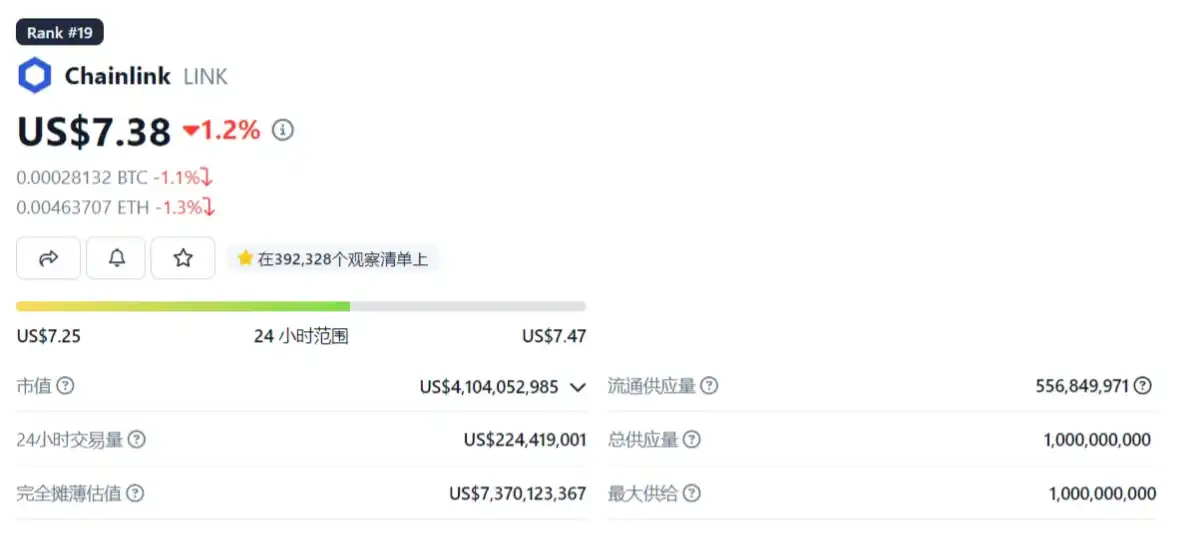
LINK ranks 19th in market value, with a market value of US$4.1 billion, a total supply of 1 billion coins, and a current circulating supply of 560 million coins, with a circulation rate of approximately 56%. The 24-hour spot trading volume was US$220 million.
Price trend
In the 2021 bull run, an all-time high price of $52 was reached. It fell to $7 in May 2022 and has remained volatile since then. The lowest price fell to around $5 in 2023, and the highest price tested $9.5 several times, but failed to break through. The current price is $7.38, down 86% from the all-time high price.

Chip distribution
The total supply of tokens is 1 billion, 35% will be sold through ICO, 30% will be allocated to LINK’s parent company SmartContract for development, and 35% will be used to incentivize node operators.
LINK is mainly used for two purposes - to pay the node operator for obtaining data for the smart contract; and for the mortgage made by the node operator at the request of the contract creator. It can be seen that LINK has no governance rights over the project.
The current LINK circulation rate is approximately 56%. There are no clear unlocking rules for the remaining portion that has not yet been unlocked and will be transferred from the Non-circulating supply marked wallet from time to time.
From the figure below, you can see the release of LINK tokens in history. There will be relatively intensive token releases from July to August 2019, March to November 2021, and July to August 2022, with releases once a week. However, the number of tokens released is relatively small, ranging from hundreds of thousands. to 1.5 million. There will be large-amount releases in August, November 2022, March, June, and September 2023 respectively, basically maintaining a release every three months, with each release amount ranging from 10 million to 20 million. A total of approximately 84 million tokens have been released since August last year. Based on an average price of US$7, the market value is approximately US$590 million.
Judging from the position distribution displayed by Nansen, there are multiple wallets marked with Non-circulating supply, holding a total of about 44% of the tokens. In the past 30 days, a total of 17 million tokens have flowed out of non-circulating supply marked wallets.
The LINK pledge address holds 25.47 million tokens, accounting for 2.55%, and the number of newly pledged tokens in the last 30 days has been 315,000. It can be seen that the scale of token pledge is still small.
In terms of trading platforms, Binance Wallet holds the most LINK, totaling more than 6%. Wallet 0X F 97 has seen an inflow of 15.5 million LINK in the past 30 days, and wallet 0X 5 A 5 has seen an outflow of 8.5 million LINK in the past 30 days.
Upbits tagged wallet holds 1.28% of LINK, with 760,000 tokens flowing out in the past 30 days.
In addition, there is a newly created wallet 0X 95 a within 1 day, which holds approximately 4.21 million LINK, accounting for 0.42%. The address is unmarked and has no clear owner.


The address of market maker Jump Trading holds a total of 4.66 million tokens, accounting for 0.46%, with a market value of approximately US$32 million. In the past 30 days, 0X 7 3A has seen an inflow of $1.55 million worth of tokens, while 0X 2 EF has seen an inflow of nearly $3 million worth of tokens. The net outflow was valued at $1.45 million.
Overall, LINKs circulating token holdings are relatively dispersed. Among the top 40 holding addresses, after deducting the addresses of project parties and trading platforms, the two addresses with the largest unmarked address holdings hold 0.42% and 0.4% of the tokens respectively. There is no correlation between the two addresses. Jump Trading, a market maker, holds a total of 0.46% of the tokens in its disclosed address. In the past 30 days, there has been a net outflow of tokens worth US$1.45 million, which is not a large amount.
Recent token transfers
The table below shows the large token transfers in the past 30 days. Non-circulating supply marked wallets have transferred approximately 17 million tokens to the Binance trading platform. Based on the average price of US$7, approximately US$120 million has flowed into the market within 30 days.
A large investor withdrew 4.21 million tokens from coinbase custody, with a market value of approximately US$29.5 million based on an average price of US$7. The relevant tokens were immediately transferred to the wallet address of 0x 95 a, and the relevant addresses were not marked.
It can be seen that the project address holds a large number of tokens, and due to unclear release rules, there is the possibility of releasing a large number of tokens to the market in the short term. In addition, after this price increase, some large investors withdrew a large number of tokens from the trading platform.

Contract data
According to data from coinglass, the LINK contract position is US$213 million, with a 24-hour trading volume of US$629 million. The contract trading volume is about 3 times that of the spot trading volume. Compared with the overall market value of LINK, the proportion of contract positions is not high, about 5%.
Judging from the contract data, after the decline on August 18, the price fluctuated between US$5.8 and US$6.5. On September 18, open interest increased significantly, rising by more than 50% in a single day, and at the same time, the price broke through the bottom range.
Since then, the holdings have been corrected and the growth rate has slowed down, but the overall growth trend is still there. The token price rose 3 times and pulled back 3 times, but the overall trend line showed an upward trend.
In the process of the price rising from the bottom, the ratio of the number of long-short positions dropped from 2.5 to 0.89, and more people were short. This also means that the average value of long accounts is higher than that of short accounts, and accounts with high values are more willing to go long. More intense.
However, after the price rose to $7, the long-short ratio of large positions also declined, from 1.23 to 1.09. This shows that the willingness of large investors to be bullish on funds holdings has decreased. (Note: The large accounts in the long-short ratio of large holdings refer to the top 20% of accounts on Binance.)
Overall, positions show continued growth. Although there was a correction during the rise, the correction did not fall below the previous high. The number of long-short positions is stronger than that of long-to-short accounts with high value.

2. Fundamentals and recent developments
business data
Currently, in the field of general oracles, Chainlink has shown overwhelming advantages and market position, forming high market barriers.
Simply looking at the market size of oracle machines, Chainlink, Chronicle Labs and WINLink account for more than 90% of the entire oracle market. Chronicle Labs and WINLink also have a large market share. However, the influence of these two projects is difficult to compare with that of chainlink. Comparable.
WINLink is a decentralized oracle project within the TRON ecosystem and is limited to the TRON ecosystem. Chronicle Oracles, an oracle funded by MakerDAO, exclusively serves MakerDAO and is an internal oracle.
According to official website data, there are currently more than 1,700 projects in the chainlink ecosystem, including 704 DEFI projects, 525 NFT projects, 288 Gaming projects, etc., and most of the well-known projects are covered.
product architecture
Decentralized oracle networks (DONs)-decentralized oracle networks
DON is a decentralized oracle network composed of many Chainlink nodes. By introducing multiple independent data providing nodes, the security, reliability and anti-tampering capabilities of the data are ensured, the risk of single point failure is reduced, and it becomes more difficult to manipulate data. Chainlink’s decentralized oracle features have made it the preferred data provider for many DeFi projects and other blockchain applications, which has largely contributed to Chainlink’s leadership position in the oracle market.
Chainlink’s node operators mainly include the following categories:
DevOps nodes: These nodes are organizations that specialize in running blockchain infrastructure, such as PoS verification nodes, PoW mining pools, and full-node RPC providers. These node operators are experienced in running critical Web3 infrastructure, managing encryption private keys, and providing services in exchange for cryptocurrency. DevOps nodes include top staking pool providers such as Fish, P2P Validator and Staked.
Enterprise nodes: These nodes are located around the world and are currently running the backend infrastructure for the traditional Web2 economy. These include international telecommunications companies such as Deutsche Telekom subsidiary T-Systems and Swisscom, as well as global institutions such as LexisNexis.
Community Nodes: These nodes come from the Chainlink community, including Chainlink Oracle Olympics winners, CryptoManufaktur, LinkRiver, and NorthWest Nodes.
Chainlink Data Feeds-data sources
Data Feed (price feed) is one of the most widely used functions of Chainlink. It aims to provide a safe, reliable and decentralized off-chain data source for smart contracts. It is widely used in DeFi for lending, derivatives, and stability. currency, asset management and other scenarios.
Data Feed uses a multi-level data aggregation mechanism.
First, price data aggregators such as CoinGecko and Coinmarketcap perform the first aggregation. These data aggregators will calculate and generate a volume-weighted average price to ensure the quality of transaction data.
Chainlink’s node operators will obtain price data from these data aggregators once and perform a second aggregation.
The last layer of data aggregation occurs at the DON level of the decentralized oracle network. All node operators upload the median data and node signatures they obtain and generate Off-Chain Reporting (OCR) for publication on the chain. OCR aggregates all data once and stores it in the contract. Once the data is stored, it is difficult to tamper with. At least 2/3 of the nodes in DON need to upload results and signatures before OCR will be accepted on the chain. This mechanism greatly ensures that the final data of the Data Feed is difficult to tamper with.
VRF (Verifiable Random Function)-verifiable random function
Chainlink VRF (Verifiable Random Function) is a decentralized random number generation service that provides secure and verifiable randomness to smart contracts. In many application scenarios, such as games, NFT projects, and prediction markets, random number generation is a key component. For example, Axie Infinity uses the Chainlink VRF function to ensure that each of the 4088 original Axies is truly randomly generated based on the probabilities predefined in the smart contract.
CCIP (Cross-Chain Interoperability Protocol)-Cross-Chain Interoperability Protocol
CCIP is an interoperability protocol for building cross-chain applications and services. Developers can build their own cross-chain solutions on top of CCIP. CCIP also provides simplified token transfer, powered by the Chainlink decentralized oracle network. . Although CCIP has similar use cases to products such as LayerZero, CCIP is more than just a bridge with a programmable layer. Hybrid smart contracts will allow interaction between on-chain and off-chain smart contracts as well as cross-chain execution, able to become Web 2 and Web 3 bridges.
Developers, applications, and enterprises can use CCIP to unlock a variety of use cases, such as:
· Cross-chain tokenized assets: Transfer tokens across blockchains from a single interface without having to build your own bridging solution.
· Cross-chain collateral: Launch of a cross-chain lending application that allows users to deposit collateral on one blockchain and borrow assets on another blockchain.
· Cross-chain Liquidity Staking Tokens: Bridge liquid pledged tokens between multiple blockchains to increase their utilization in DeFi applications on other chains.
· Cross-chain NFT: Enables users to mint an NFT on the source blockchain and receive it on the target blockchain.
· Cross-chain account abstraction: Build a smart contract wallet with native CCIP functionality to improve the user experience of cross-chain function calls. For example, enabling users to approve transactions on any chain using a single wallet.
· Cross-chain gaming: Create a blockchain-agnostic gaming experience that enables players to store high-value items on a more secure blockchain while playing games on a more scalable blockchain.
· Cross-chain data storage and calculation: Adopt a data storage solution that enables users to store arbitrary data on the target chain and perform calculations on it using transactions on the source chain.
The main time points of CCIP are as follows:
· In August 2021, Chainlink released the Cross-Chain Interoperability Protocol (CCIP).
· On July 18, 2023, CCIP launched the early access phase on the Avalanche, Ethereum, Optimism and Polygon mainnets, and Synthetix and Aave are using CCIP.
· On July 20, CCIP opened to developers of five testnets: Arbitrum Goerli, Avalanche Fuji, Ethereum Sepolia, Optimism Goerli, and Polygon Mumbai.
· On August 31, Swift launched an experiment with several financial institutions, including Australia and New Zealand Banking Group Limited (ANZ), BNP Paribas, BNY Mellon, Citibank, Clearstream, Euroclear, Lloyds Banking Group, SIX Digital Exchange (SDX) and The Depository Trust Clearing Corporation. Chainlink is used as an enterprise abstraction layer to securely connect the Swift network to the Ethereum Sepolia network, while Chainlinks Cross-Chain Interoperability Protocol (CCIP) enables full interoperability between source and target blockchains sex.
· On September 15, DTCC (The Depository Trust Clearing Corporation) and chainlink explored the functions of CCIP to help realize the tokenization of real assets. DTCC is an important global securities settlement system, processing more than US$200 billion in transactions every year.
· On September 21, CCIP was launched on the Arbitrum mainnet.
· On September 28, CCIP launched the base chain mainnet.
Chainlink Stake v 0.2
Staking is a core measure of Chainlink Economics 2.0, designed to increase the security of the network. Staking enables ecosystem participants, such as node operators and community members, to support the performance of oracle services through staked LINK and receive rewards.
In December 2022, the initial beta version of Chainlink Stake (v 0.1) was released, consisting of a 25 million LINK pledge pool and supporting the ETH/USD data source on Ethereum.
Chainlink Stake v 0.2 is expected to be launched in the fourth quarter of 2023, and the capacity of the initial staking pool will be expanded to 45 million LINK. v 0.2 will gradually expand access to a wider range of participants, starting with a priority migration period for existing v 0.1 stakers, then entering early access, and finally general access.
v 0.2 has been re-architected as a fully modular, scalable and upgradeable Stake platform. v 0.2 takes the lessons learned from v 0.1 and builds on them, focusing on the following goals:
· Provide greater flexibility to community and node operator stakers while retaining the secure non-custodial design of staking LINK.
· Improved security guarantees for oracle services within the scope of Chainlink Stake support.
· The modular architecture iteratively supports future improvements and additions to Chainlink Stake, such as expanding to more services.
· Dynamic reward mechanism that can seamlessly support new reward sources in the future, such as user fees.
3. Summary
Fundamentally, Chainlink is the leader in the oracle track. It currently has significant advantages in terms of the number of service projects and project quality, and has strong product development capabilities, and continues to launch and optimize products.
The recent business focus is to promote the business expansion of CCIP and launch Chainlink Stake v 0.2 in the fourth quarter. CCIP is a service product that is used to consolidate and expand new customers. It has received high evaluation and attention due to its innovative nature. At the same time, it is also an important tool for asset tokenization. Chainlink Stake v 0.2 is a benefit-sharing model of relationships with nodes and token holders, enhancing the security and stability of the project. Strengthen products from both external expansion and internal construction.
In terms of funds, the project party holds 44% of the unreleased tokens, and there are no clear release rules and time, and they can be released as needed. In the past year, it was released once every three months, with 10 million to 20 million coins released each time. The token supply is larger and the uncertainty is higher. However, the latest release was in mid-September. If it is based on a 3-month period, the next release will be in December.
In addition, tokens held by a single address are relatively scattered, and the trading platform is mainly concentrated on Binance, accounting for more than 6%. The market maker Jump Trading’s address holds 0.46% of the currency.
Recently, large investors have opened positions. On September 27, 4.21 million tokens were withdrawn from Coinbase, with a market value of approximately US$29.5 million (calculated at US$7).
According to contract data, positions continued to grow. Although there was a correction during the rise, the correction did not fall below the previous high. The number of long-short positions is stronger than that of long-to-short accounts with high value.
Overall, Chainlink has excellent fundamentals, is a blue-chip project, and has a high market value. In terms of chip structure, the project party holds a large number of tokens, with a large supply and high uncertainty; the remaining currency holdings are relatively scattered. Recently, large investors have opened positions, and the new address holding positions has entered the top 40 holding addresses. In terms of contract data, positions show continuous growth, rising slightly, and pulling back after pulling up, but the pullback is not lower than the previous high, and the overall capital situation is bullish.
Note: The data in this article is as of September 27, 2023.





