


LSM:The Impact of LSM on Cosmos in 5 Aspects


Original author: web3 crypto.eth, founder of IBCL
Odaily Editor's Note: The Cosmos Hub is expected to undergo Gaia V12 upgrade at 20:06 on September 13th, Beijing time. The V12 upgrade will enable the Liquid Staking Module (LSM) module, which aims to replace the existing staking, allocation, and slashing modules to improve network liquidity. IBCL founder web3 crypto.eth outlines the impact of LSM on the Cosmos ecosystem from five aspects, including token price, staking ratio, and liquidity. The following is a summary by Odaily:
Here is a summary of the upcoming Cosmos liquidity staking module (LSM):
First, LSM does not intend to replace third-party liquid staking protocols.
On the contrary, it aims to unlock the already staked ATOMs for third-party protocols. Currently, the main protocols supported by LSM are @stride_zone and @PersistenceOne, which theoretically benefits these two protocols.
Second, what is the most direct value of LSM?
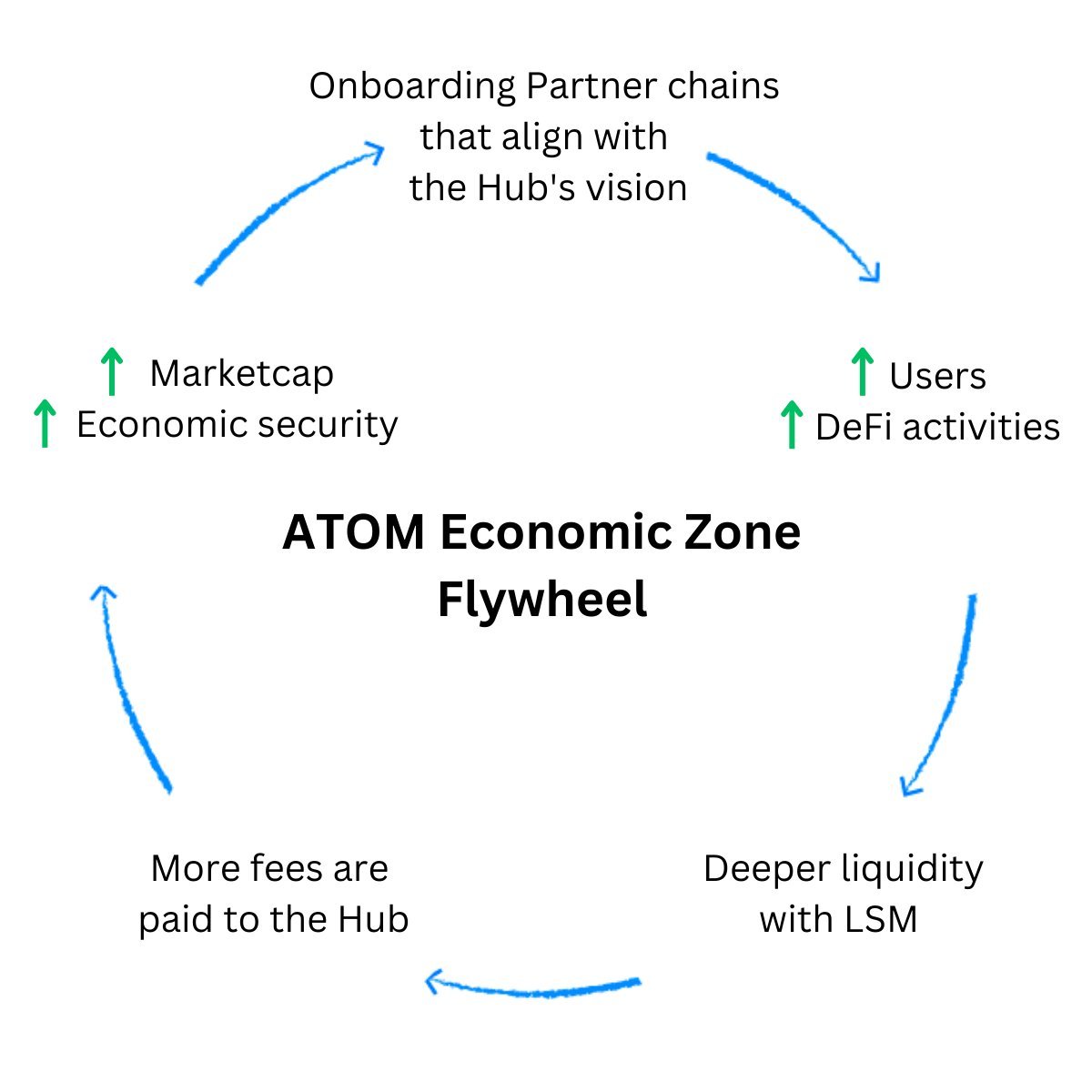
As the name suggests, it definitely brings about liquidity. There are many places in the Cosmos ecosystem that require liquidity for ATOM, especially various DeFi or derivative platforms.
Therefore, the liquidity of various DEX LP and TVL will be enriched, and the development of lending, stablecoins, and other ecosystems will be easier. It can be understood as a small river filled by central banks' liquidity injection.
Of course, this liquidity is ultimately not represented by ATOM but by alternatives like stAtom, which are minted out. For example, many protocols and even ecosystems outside of Cosmos will also have inflows of stAtom, which indirectly provides liquidity benefits.
Finally, there is one additional value, which is to impose certain restrictions on the liquidity of ATOM, that is, unlimited Minting is not allowed, so you can also understand the "M" in LSM as "Management" (currently Module).
Therefore, the direct value brought by LSM is firstly the promotion and prosperity of liquidity within the ecosystem, secondly, the increased opportunity for atom to flow into heterogeneous chains, and at the same time, the standardization and unified management of atom.
Thirdly, some people are concerned that supporting the unlocking of staked atoms in LSM will cause a significant decrease in the staking rate?
In theory, it will not, because stAtoms and atoms are minted in a certain proportion, that is, when one stAtom is minted, your atom is actually staked, just staked with a liquidity service provider, but it is still in the Cosmos Hub network.
Therefore, in theory, the decrease in staking rate is not directly related to LSM, only when users actively unlock their atoms, this is the direct factor.
Fourthly, will the release of large liquidity of atoms lead to a large sell-off and a price drop?
Indeed, there is such sentiment on the market, after all, the previous unlocking required 21 days, which to a large extent also reduced the sell-off, but now unlocking can be done at any time, which means that you can exit at any time.
Therefore, in theory, selling becomes more convenient. The downside is that the price may not be good, but the benefit is that it allows the market to reflect the true price of the underlying asset more quickly.
Fifthly, explanation of the basic operation of Stride
Before integrating LSM, Stride operated in a very simple way, that is, you deposit spot ATOM and then stATOM is Minted for you.
After accessing LSM, if you understand it simply, you can understand it as a redelegate to Stride, so you don't need spot trading anymore. Instead, you directly use your pledged atom, and then mint stAtom for you. Of course, the difference is that you cannot unstaking directly, but you need to return statom before unstaking. (This is an analogy and the technical details have not been confirmed)
Also, after obtaining stAtom, you don't need to claim your earnings. In fact, it works by having a dynamic spot exchange ratio between Atom and stAtom, for example, if you initially use one atom to obtain 1 stAtom, after a period of time, when you exchange it back, it may be exchanged for 1.1 atom.
Lastly, do you think LSM will be launched successfully?
Someone asked what LSM is "managing". Here's some additional information: it basically puts a restriction on the total number of ATOM that can be staked and imposes requirements on participating validators, as follows:
LSM will restrict all providers of liquid staking, with a limit of 25% of the total staked atom, which is approximately 50 million ATOMs.
This value is based on preventing the total proportion of liquid staking providers from exceeding one-third.
Once the limit is reached, LSM will prevent cross-chain accounts from pledging more ATOMs.
An additional security requirement for validators: validators themselves need to pledge a certain amount of ATOMs (called validator staking) in order to strengthen "vested interest".
The maximum number of ATOMs that a validator can receive from a provider is equal to the validator's own staking amount multiplied by 250 (250 is the initial staking factor, which can be governed).
For more detailed information, please refer to the forum signal proposal





