






预言机一家独大?Supra正以Layer级定位杀入市场


Original - Odaily
Author - Loopy Lu
In the narrative of Web3, investors and users are paying more attention to the application layer and the underlying chain. One of them can carry the next billion users and the other is the cornerstone of the operation of the encryption world.
However, the market’s attention to the middleware that drives and lubricates the two seems to be slightly lacking.Especially for developers, excellent middleware is crucial. Oracles, automation, cross-chain protocols, etc. are all indispensable for promoting the development of Web3. At the same time, the market’s attention to the safety and future sustainable development of this track also needs to be strengthened.
As we all know, oracles and cross-chain bridges are relatively common targets of attacks. In July, Poly Network was attacked for the second time due to a cross-chain bridge vulnerability, resulting in losses of up to 10 million U.S. dollars. In August this year, the lending protocol Exactly Protocol also suffered losses of 12 million U.S. dollars due to a cross-chain bridge vulnerability. As for oracles, they are even more targeted by attackers. According to a CertiK report, there were 54 losses caused by flash loan and oracle manipulation vulnerabilities in the second quarter of this year, resulting in losses of approximately US$23 million.
So what is the main reason why they are often attacked? One of the common factors is that these two middlewares have very similar weaknesses.That is, when events circulate through oracles and cross-chain bridges, they lose the security and decentralization of traditional blockchains.The security level of data events has been reduced from the original L1 level to the middleware level, providing hackers with more possibilities to be attacked.
However, Web3 is still early, and the oracle dilemma has not yet been resolved. The market demand is changing with each passing day, and the opportunity to make a comeback and redefine market standards will come at any time. But we believe that under the existing market structure, the technical middle layer will be an absolutely necessary component in the next market stage. Odaily will lead readers to discover Supra, an innovator who has emerged in the ancient track of middleware.
In terms of blockchain security, we have observed that Supra is the entry point from the middleware. From the initial SupraOracles, it is now focusing on the IntraLayer of the middleware service layer. While providing high-quality services to the market, it spares no effort to improve security and serve the chain. Protect external data and cross-chain liquidity. Lets take a look at what Supra, which recently announced that it has raised $24 million in private equity rounds and is invested by many top institutions, is currently doing.
How did Supra get started on the oracle circuit?
What is the “Oracle Dilemma”?
People who know about oracles should have heard of the oracle dilemma to some extent. The situation is that blockchain essentially has the natural advantage of reducing single points of failure, ensuring data security, and preventing data from being tampered with. However, when the blockchain requires external data to execute the contract, it must use the oracle service. If the oracle as the data source has security risks, the security of the blockchain is reduced to the oracle level. The data from that source Problems will directly affect the execution results of smart contracts. Therefore, the ideal situation is that the oracle network can provide accurate data while being no less secure and decentralized than L1.
In other words, in order to improve security and decentralization, we need to establish as many network nodes as possible. However, the more network nodes there are, the longer multiple rounds of consensus take, and the more gas consumed by user transactions. Not only does this result in higher fees and reduced finality and performance, data availability also suffers from delays, creating the possibility of slippage. Therefore, the oracle dilemma appears in the oracle network. Many oracle networks on the market have more or less sacrificed security and decentralization in order to ensure the refresh rate of available data.
However, oracles, as a bridge between the blockchain and the real world, are crucial to the further development and implementation of Web3 and the Metaverse. Perhaps the DeFi projects that sprung up in the early development of Web3 did not have a particularly strong demand for real-world links. As long as the middleware can provide fast and accurate price feeds, security has a certain basic guarantee, and the degree of decentralization only remains at The concept doesnt have a big impact either. However, as Web3 continues to evolve towards its implementation, the market urgently needs accurate and secure data, and it is necessary to ensure data security and improve decentralization while ensuring high performance. In other words, the oracle dilemma must be resolved.
How does Supra resolve the “oracle dilemma”?
So how can we balance these demand points so that the degree of decentralization and security of the oracle is no less than that of L1 and L2 while ensuring the provision of accurate data and high performance?
Supra is building the next generation of oracles for the blockchain industry, truly solving the “oracle dilemma”. Supra designed the Tribe-Clan network node architecture, introduced the L1 consensus mechanism, and created innovative technologies such as original representative value and consistency distance. This unique mechanism design is called DORA (distribution oracle protocol).
By reading the latest white paper released by Supra, the author summarizes several key points of the agreement for everyone:
1) Shuffling parent-child node architecture--Tribe Clan
Supras node network has a Tribe-clan structure. This is a parent set and subset relationship, and a tribe is evenly and randomly divided into multiple clans.

Each tribe contains 5 clans, and each clan contains 25 nodes. The random shuffling mechanism of tribes and clans is executed every x minutes (x execution time can be changed). The random process is blessed by Supras verifiable random number, and the nodes collude. Events such as node attacks are impossible to occur in this network.
For ease of understanding, many oracle node networks on the market are equivalent to a Clan in this structure, so in a sense, DORA may be 100+ times more secure.


2) 33% Byzantine fault tolerance: representative value
In the absence of any Byzantine faults, only a single node is required to obtain information from multiple sources; but in the case of Byzantine faults, we will need multiple nodes. When all nodes can provide a value as input, then when some of them are Byzantine nodes, the remaining honest nodes will reach a consensus and choose a single representative value S-value to challenge it. This representative value must converge between the maximum and minimum values of honest nodes in the protocol. The representative value is calculated and generated by the aggregator family selected in the tribe. It is a single value formed by the aggregator family merging the signed values of the clan nodes.
2) Consistency distance
The protocol requires that there be an honest value even in the worst case, and uses this value as an anchor point, and then fixes other values together so that other values, even if they are dishonest, cannot arbitrarily deviate from the honest value. This binding distance is called the consistency distance D.
4) Alternate protocol
After the protocol starts, a backup countdown will be started. If no representative value is output within the specified time, the backup protocol will be triggered. The protocol will start the entire structural tribe to calculate the representative value, instead of just one tribe under normal circumstances.
5) Multiple rounds of asynchronous calculation of nodes
In a real-life situation, a new round of the protocol can be started every few seconds, since a new round can be started without waiting for the previous round to end. Round values may be published out of order. For example, the value for round 4 may appear before the value for round 3 on the SMR. In reality, round 4 will carry a fresher and more accurate value, so the information from round 3 may not be of any use after the round 4 value is available. Based on this assumption, we can save resources on some unnecessary computation and communication. Delayed data can be eliminated.
The above features also bring a series of advantages to the protocol. The main advantages are summarized as follows:
The shuffling node architecture introduces a high degree of randomness, which can greatly improve the security and decentralization coefficient, and greatly limits the attack capabilities of attackers;
Data can be processed in shards between different tribes, greatly improving processing efficiency;
Multiple rounds of asynchronous calculation ensure data accuracy and refresh rate;
In addition, its moon landing consensus algorithm also provides the protocol with L1-based security and 2-3 seconds of finality, making the overall performance of the protocol operation higher.
What is the IntraLayer built by Supra?
SupraOracles is the starting point of Supra, but with the continuous launch of other middleware products like VRF and cross-chain protocols, the project officially upgraded its brand to Supra in July this year, striving to create an automated cross-chain interaction that provides multiple middleware services. The operation center connects L1 and L2, Web2 and Web3, and provides core infrastructure to promote the development of blockchain.
There are currently hundreds of chains on the market, and many blockchains also provide increasingly diverse services, resulting in extremely fragmented user experience in real usage scenarios. The prominent pain points of this multi-chain reality have also attracted the attention of industry researchers and developers. How to securely and invisibly transfer assets and information from one chain to another to achieve interoperability has become an urgent problem in the industry.
Focusing on this pain point, Supra recently released an innovative bridgeless cross-chain communication model to help cover Supras services to more networks and securely link various blockchains to achieve high-speed and secure interoperability.
Currently on the market, most cross-chain bridges adopt a multi-signature design. Such bridges typically consist of a set of staking bridge nodes, each of which individually signs events that occur on the source chain (such as funds locked in the source chain currency). These signed events are then aggregated and passed through The multi-signature mechanism transmits it to the target chain together with the protocol signature/seal of each node. Such a process prompts a corresponding action (e.g., releasing funds in the target chains native asset or currency). This process is also the stage when the cross-chain bridge is manipulated. Most of the cross-chain bridge manipulation cases we mentioned at the beginning of the article are of this type.
In Supras bridgeless cross-chain protocol HyperNova, relay nodes only share the cryptographic consensus information of the source chain. There is no need to trust any relay bridge nodes to ensure the correctness of the relay information. They only need to ensure the accuracy of the relay information on the source chain. Relevant events are not missing, censored, or delayed in being passed to the target chain. The nodes on the target chain will independently verify the validity of the source chain events. Therefore, the information related to the events on a certain chain between the relay bridge nodes cannot be tampered with during the cross-chain transmission of events. Those who do not lock the corresponding assets on the source chain and pass Attacks that provide false information on a cross-chain bridge to release or mint assets will not be possible on a relay model cross-chain bridge, directly curbing the possibility of manipulation.
In addition, in the HyperNova bridgeless model, relay nodes are only relied on to forward data rather than verifying the correctness of the data. Therefore, bridge nodes do not require a large amount of stake, just an honest node to ensure liveness and censorship resistance. In addition, this can also avoid multiple rounds of consensus, which can improve execution efficiency.
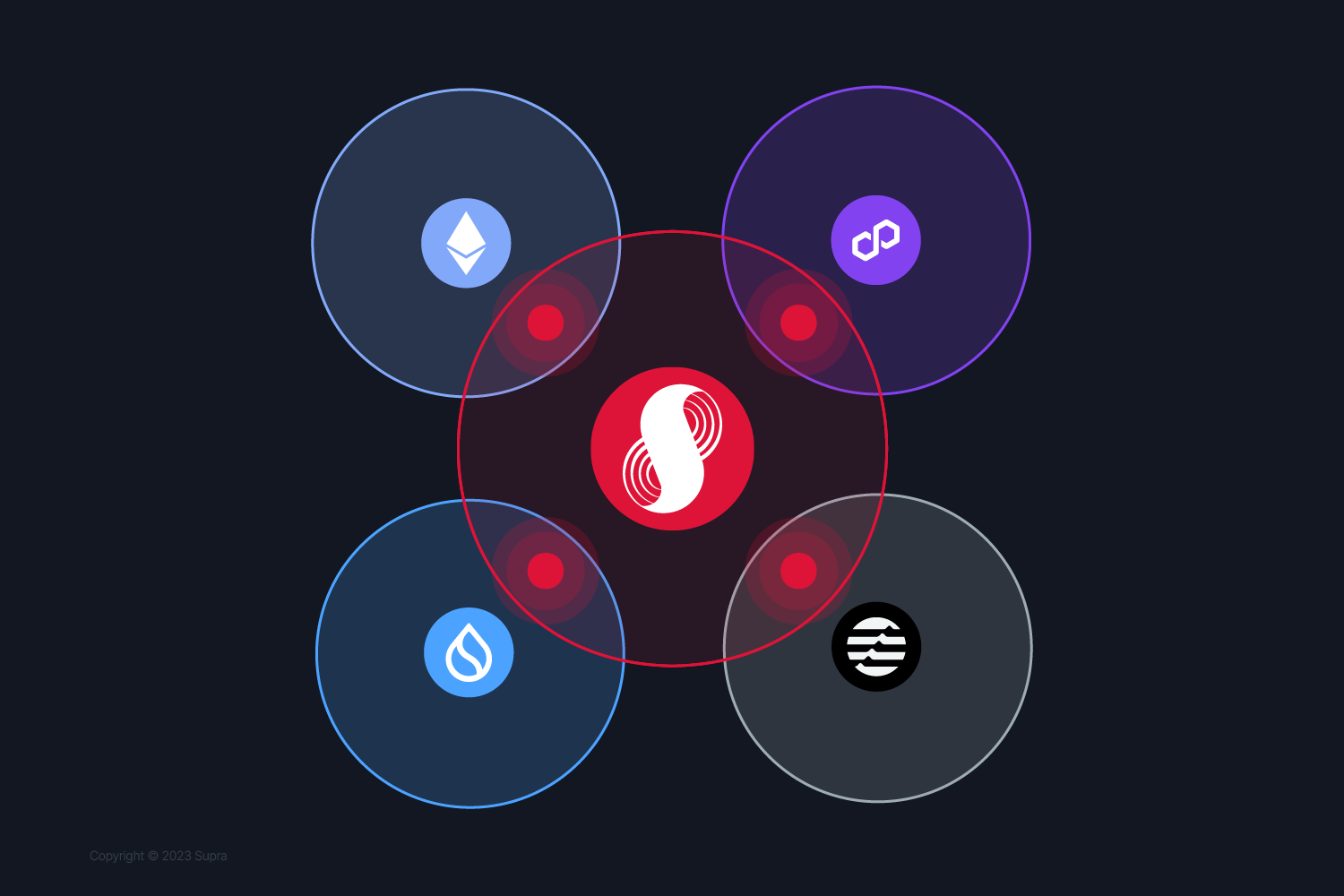
HyperNova allows Supras existing services to cover more networks. It builds a middleware service layer - IntraLayer through vertical integration of native oracles, VRF and other functions. It is also a core infrastructure for interoperability, helping dApps to decentralize. Communicate seamlessly in the blockchain field and integrate all chains into a whole.
The ancient middleware track: value discovery may have begun
Taken together, the concept of IntraLayer very accurately describes Supras unique positioning. IntraLayer is an integrated framework for Supras oracles, cross-chain bridges, and smart contract platforms that enables native cross-chain compatibility and is designed to work together to help dApps communicate seamlessly in the fragmented environment of the blockchain.
Supra focuses on the dilemma and uses L1-level algorithms to ensure the security of middleware. We can see Supras efforts wherever security and trust issues need to be solved. The project currently supports 10+ mainnets and 40+ testnets, and its just-announced “learn to earn” community airdrop activity is also in full swing.
When we look back at the old experience of the DeFi world - looking for demand from the incremental market and new application scenarios from emerging technologies such as L2/ZK, Supras products may be heading towards a more novel and potentially more promising track.
At present, the market has entered an important stage of alternation between bull and bear. In the next market stage that will usher in the future, few people can predict the next heavyweight track from 0 to 100 in the current industry context (technological innovation has not yet produced major changes, and the industry theme narrative has not made breakthroughs). At the same time, we have all experienced in the encryption world that no track is monopolized by only one winner for a long time. Greater development potential and market space are still worth exploring. We believe that these original explorations have laid a broader space for growth for the ancient track.





