






Glassnode Latest Research Report: Leading projects perform exceptionally well, is DeFi making a comeback?


Source: Glassnode
Translation: BitpushNews Tracy
The regulatory environment in 2023 has been a tug-of-war between positive and negative news, with the most affected being altcoins and DeFi tokens. With significant outperformance from MKR and COMP in recent weeks, we explore how to extract information from changes in liquidity on decentralized exchanges (DEX).
Summary:
1. Several positive developments in the digital asset industry and progress in the DeFi space have sparked renewed interest from investors in DeFi tokens.
2. The increase in interest in DeFi tokens has caught the attention of market makers, who have increased liquidity in the corresponding pools, indicating positive prospects for trading and price activity around these tokens.
3. Further analysis of Uniswap's trading volume distribution shows that a considerable portion of trading activity can be attributed to bots, with these bots primarily focused on ETH-stablecoin trading pairs.
Are altcoins back in favor?
In the past few months, the altcoin market has been caught in a tug-of-war between positive and negative news events, driven by several key developments:
In early June, the U.S. Securities and Exchange Commission (SEC) classified 68 cryptocurrencies as unregistered securities, dampening interest in altcoins outside of Bitcoin and Ethereum. Prior to this news, many of these tokens were already underperforming, as mentioned in our report "Navigating the DeFi Downtrend."
The submission of applications for Bitcoin spot exchange-traded funds (ETFs) by financial giants like BlackRock and Fidelity has boosted market sentiment and spilled over into the realm of digital assets beyond Bitcoin.
Furthermore, the court ruling between Ripple Labs and the SEC in mid-July, which determined that the crypto company's sale of its XRP tokens on public exchanges did not violate federal securities laws, sent a positive signal to other U.S. crypto projects and the industry as a whole. The victory for XRP provides some hope for altcoin investors, who believe it has some resilience against further regulatory actions.
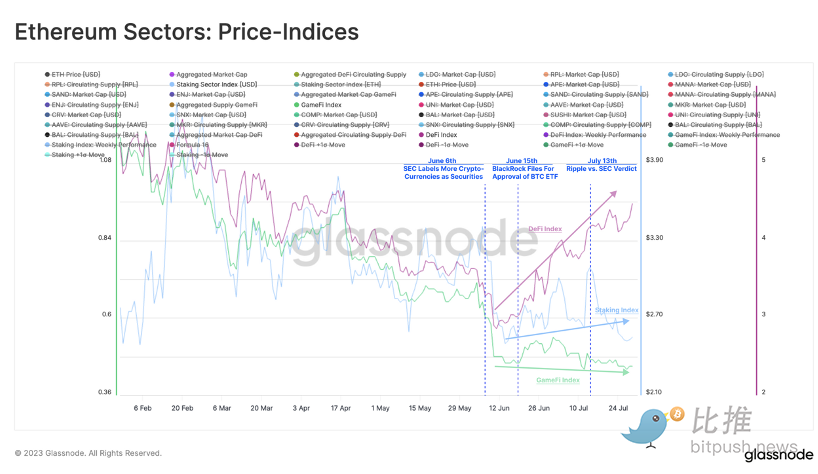
Especially strong performance has been observed in tokens related to the DeFi space, with our DeFi index price rising 56% since the low point on June 11. In comparison, other key market sectors such as GameFi and Staking have performed poorly.
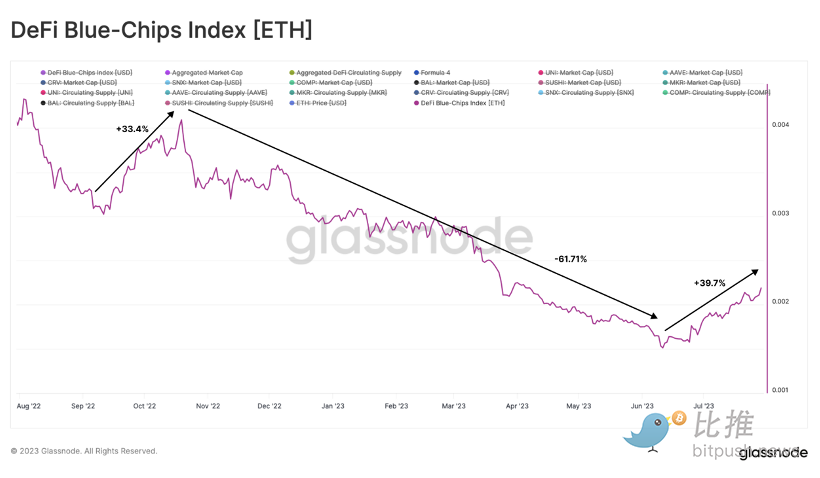
Our DeFi index consists of the top 8 DeFi tokens by market capitalization, and it has been on an upward trend for almost two months relative to ETH. This is the first time it has performed well since September 2022, and the performance so far has been very similar.
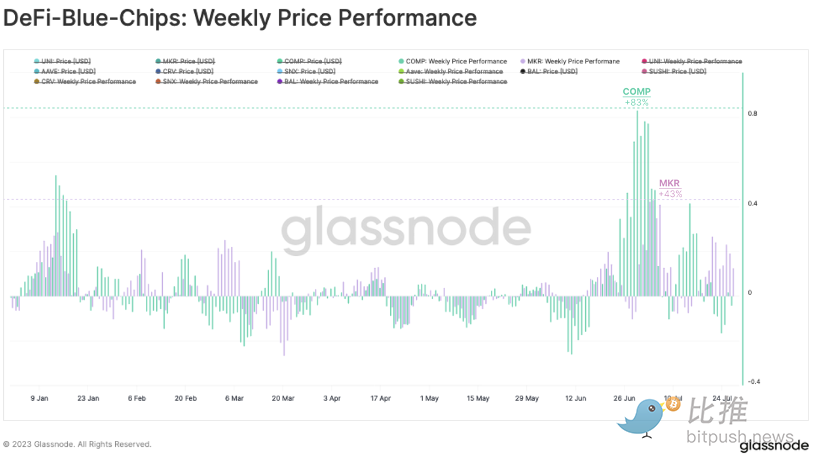
However, if we look at these eight DeFi tokens individually, two tokens stand out in driving this trend: MKR and COMP. Upon closer examination, we can see that this performance is likely closely related to the fundamentals of the new projects rather than broader market developments.
On June 28th, Robert Leshner, the founder and CEO of Compound, announced that he would be leaving the lending protocol and launching a new project focused on bringing regulated finance to blockchain networks. Following this announcement, the COMP token saw a surge of up to 83% within a week.
Around the same time, MakerDAO launched its Smart Burn Engine, a buyback program that uses excess DAI held by the protocol to purchase MKR from the Uniswap pool. The expectation of removing approximately $7 million worth of MKR within a month resulted in a price surge of up to 43% for the token within a week.
By analyzing the trading volume of the top eight DeFi tokens on decentralized exchanges (DEX) and centralized exchanges (CEX), we can see a new round of interest in DEX activity. In early June, the relative trading volume share of DEX trading was 3.75%, which has now increased to 29.2%, approaching the highest level in the second half of 2022.
Mixed type Uniswap transactions
With the growth of DEX activity, we can investigate the impact of these latest developments on DEX activity and the potential implications for stakeholders. Our main focus will be on the leading DEX platform, Uniswap, which has also been the largest consumer of Gas in the past week.
In terms of Uniswap trading volume on Ethereum, the current weekly trading volume is $5.57 billion, still significantly lower than in previous years. In early 2023, there was a surge in trading volume due to interest in liquidity mining tokens and a slight rise in "meme tokens" for a period of time, but it gradually subsided thereafter.
From this perspective, we can see that the recent excitement surrounding Bitcoin ETF applications and the Ripple vs. U.S. Securities and Exchange Commission (SEC) ruling has not resulted in a significant increase in trading activity on Uniswap.
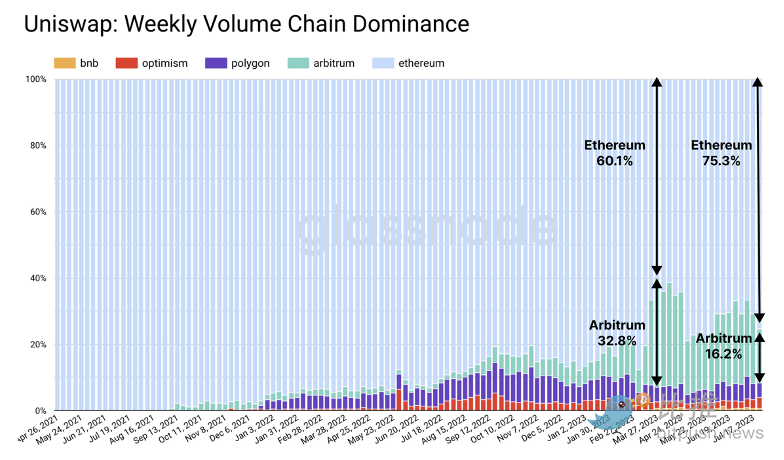
By studying the distribution of Uniswap trading volume on different Layer 2 networks, we can get a clearer picture. It is evident that a significant portion of the trading volume has shifted from the Ethereum mainnet to Arbitrum, attracting up to 32% of the volume in March. This trend has continued in June and July, which partially explains the lower trading volume on Ethereum that we observed above.
Robots vs. Humans
Looking at the background of Uniswap trading activity from another perspective is to observe the types of traders executing the trades. Since 2019, we have seen the emergence of various MEV (Maximize Ethereum Value) robots, which are automated programs that monitor the blockchain to detect profitable trades and exploit them. In this analysis, we will focus only on two types: arbitrage robots and sandwich bots.
Arbitrage robots aim to profit from price differences of the same tokens across different decentralized exchanges (DEXs) and centralized exchanges (CEXs).
Sandwich bots insert their trades in front of target traders (assumed to be buyers), resulting in executing the trades at a larger price difference. Afterwards, the sandwich bots will sell the assets again to close the gap, maximizing value for both parties.
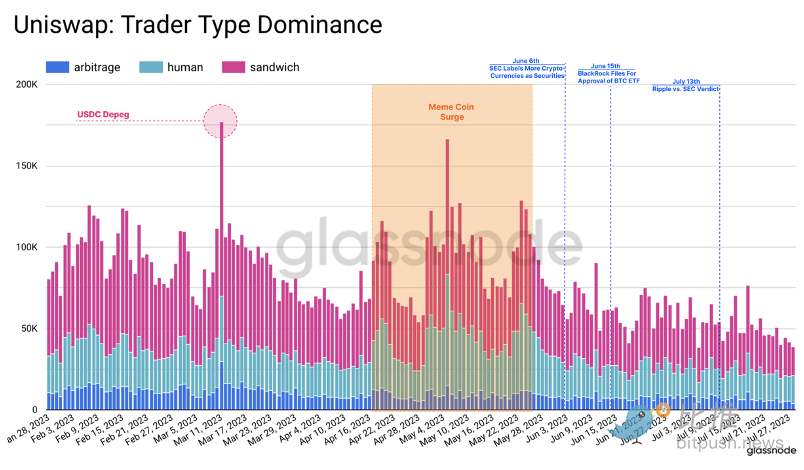
The chart below shows the proportion of trading volume from robot trading and human trading in Uniswap trades on Ethereum.
We observe that sandwich bots typically account for over 60% of the daily trading volume. The trading volume share of arbitrage robots has decreased from about 20% at the beginning of the year to 10%. Meanwhile, since early July, the trading volume share created by human traders has increased to 30%, aligning with a period of increased interest in DeFi tokens.
Please note that this categorization is the result of the first iteration of Glassnode's newly developed heuristic algorithm, which is still actively being developed. For this iteration, we have applied quite conservative criteria in labeling bots, especially for arbitrage bots.
Furthermore, please note that different types of bots create a different number of trades and trading volume. For example, sandwich bots execute at least two trades, generating twice the trading volume of human traders in a single trading action.
As different types of bot attacks may amplify trading volume in different ways, the daily number of trades by trader type provides another comparative perspective.
We can see that human traders are highly active during major events such as USDC unlocks or meme token frenzies. As price volatility intensifies and "target traders" rush in, both arbitrage bots and sandwich bots follow suit, increasing their activity levels two to three times during peaks of increased human trading activity.
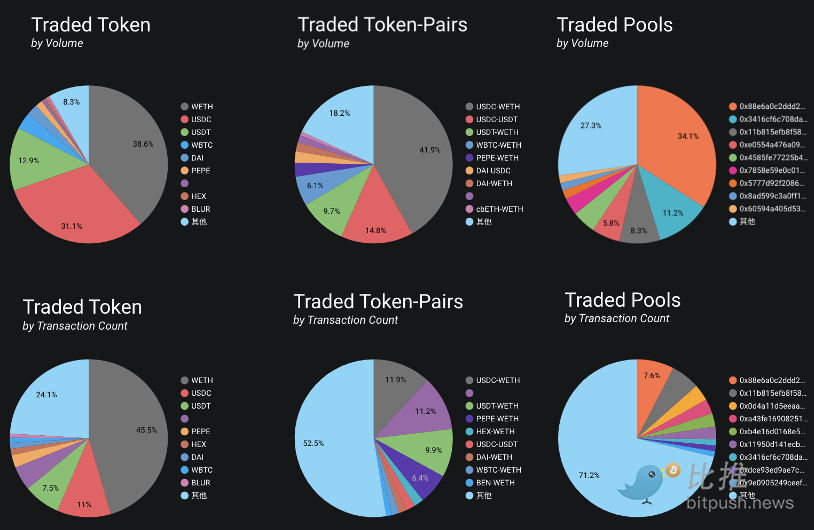
The interactive charts below show the tokens and liquidity pools preferred by each type of trader, with all three trader types showing a clear preference for the largest and most liquid trading pairs, ETH-USDC and ETH-USDT.
Liquidity Pools as Information Markets
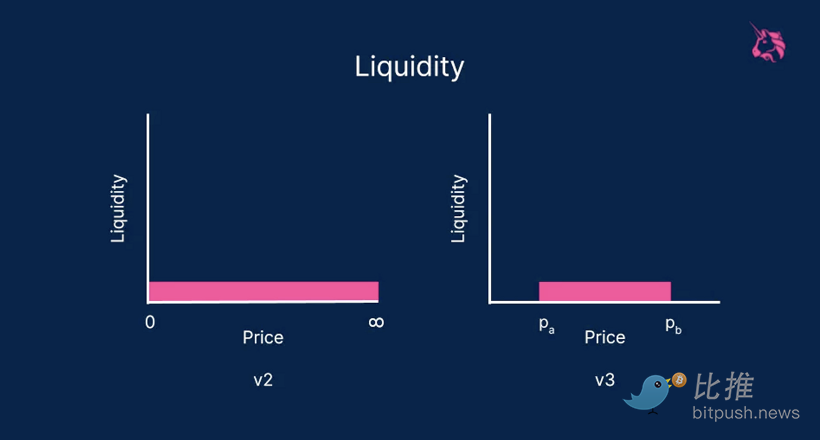
Since the launch of Uniswap V3, liquidity providers have been able to allocate liquidity within specific price ranges in the pool. Unlike dispersing liquidity across an infinite range of prices, liquidity can be more effectively concentrated around price ranges where investors expect the highest trading volume (to capture fees).
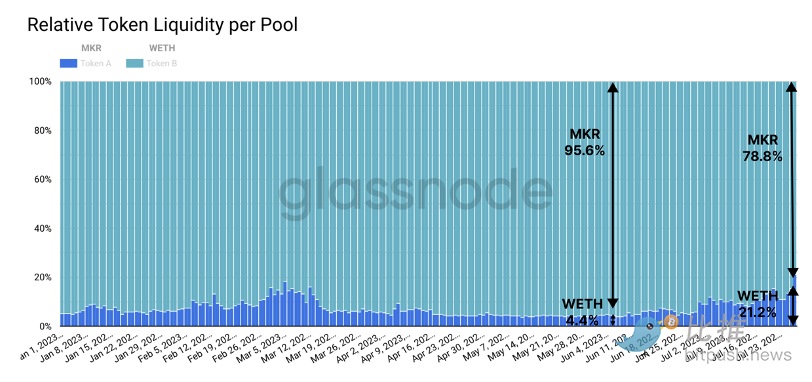
Since the announcement of the Maker buyback program, the most successful Maker liquidity pool on Uniswap V3 has been the MKR/WETH pool, with significant increases in liquidity.
Although the pool traditionally holds primarily MKR funds, the liquidity depth of WETH has grown by over 700%. This indicates that liquidity providers are anticipating higher trading volumes for the MKR-WETH trading pair.
When examining the composition of the pool, we can clearly see an increase in the share of WETH, now accounting for 21.2% of the total. This is the result of traders increasingly purchasing MKR with WETH, indicating a significant increase in demand for MKR since early June.
Finally, we present the idea of how the Uniswap liquidity pool serves as an information market reflecting the expected price development of tokens. If we carefully observe the out-of-range portion of the MKR-WETH liquidity pool, we can clearly see liquidity rising at price points well above the MKR/ETH exchange rate.
When liquidity providers move funds to higher price ranges, they essentially express a call option on income at higher price points. Assuming liquidity providers are rational participants seeking profit, their liquidity movements may provide insight similar to an options market for predicting the expected volatility and range of tokens of interest.
Summary and Conclusion:
In 2023, the regulatory environment for digital assets has been continuously changing, with positive and negative news intertwined. In recent weeks, especially DeFi tokens have experienced extraordinary performance, with MKR and COMP leading the way. However, by examining the trading activity on Uniswap, we find that these price increases have not been reflected in the trading activity on decentralized exchanges.
This can be explained by the growth in trading volume on second-layer solutions like Arbitrum, while the participation of human traders is relatively low. With fewer human trades, arbitrage and sandwich bot activity are correspondingly reduced.
As for MKR, in the Uniswap liquidity pool, the increase in liquidity provided by market makers is significant, indicating their expectation for an increase in trading volume. Based on this, we propose a concept that the distribution of liquidity may provide information about the expected trading range for the discussed token.





