


Concerns about the largest BTC-listed company MSTR



On August 1, Nasdaq-listed company MicroStrategy (MSTR) released its Q2 2023 report, announcing a significant increase in its holdings of 12,800 BTC. Market participants have expressed concerns about the company's leveraged Bitcoin purchases. MicroStrategy has spent a total of 4.53 billion dollars on Bitcoin purchases, with over 4 billion dollars funded through bond issuances or stock financing. While high leverage is generally seen as risky, for MSTR, it has become a low-cost and low-risk strategy. However, due to limited growth in its software business, the company does not have excess cash flow. Currently, it seems challenging for the company to raise funds through bond financing, so it can only continue its debt repayment through equity financing, essentially tying its fate to the price of BTC. If BTC does not experience a significant increase in value before the debt maturity in 2025, MSTR's game may not continue.
Bitcoin Holdings
As the largest publicly-traded holder of Bitcoin, MicroStrategy's initial acquisition of Bitcoin was as a defensive strategy to protect its balance sheet. However, it has now become their second core strategy. MicroStrategy has two company strategies: acquiring and holding Bitcoin, and developing its enterprise analytics software business. They believe these two strategies differentiate their business and provide long-term value.
The company initially announced that more than $50 million of its excess capital will be invested in Bitcoin, but in subsequent statements, they mentioned that they will continue to monitor the market conditions to determine whether additional financing will be conducted to purchase more Bitcoin.
MicroStrategy started investing in Bitcoin in August 2020, shortly after the outbreak of the COVID-19 pandemic. As of July 31, 2023, the company holds 152,800 Bitcoins with a total cost of $4.53 billion, which is approximately $29,672 per Bitcoin, almost matching the current market price (August 1, $29,218). Among them, 90% of the Bitcoins are unencumbered, meaning that these Bitcoins are not used as collateral for any loans or debts.
Source: MSTR, TrendResearch
It can be seen that MSTR purchased at a fast pace before the first quarter of 2022, and then almost stood still as the market plummeted in the next three quarters. Then, in 2023, with the market rebounding, the purchasing pace accelerated.
Financing Structure
Their methods of expanding the balance sheet include equity, debt, and convertible bond issuance.
Bond Issuance
Despite MSTR increasing its holdings of Bitcoin every quarter, the price of Bitcoin has dropped significantly since the end of 2021. However, the company's debt structure is relatively stable, with a total debt of approximately $2.2 billion and an average annual fixed interest rate of 1.6%. The annual fixed interest expense is approximately $36 million, mainly due to the use of convertible bonds.
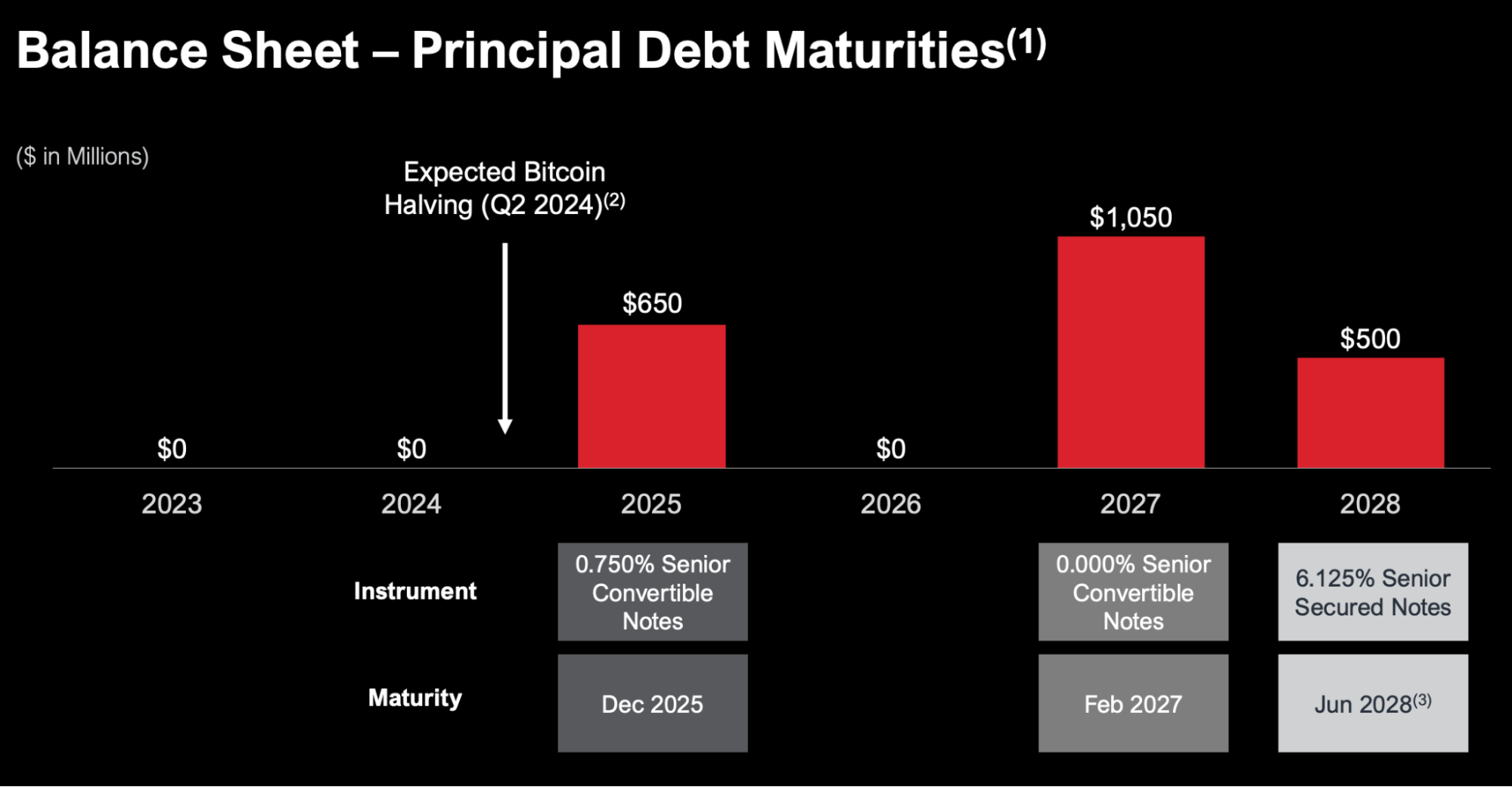
As of the latest financial report for the second quarter of 2023, the company's main debt includes:
6.125% Senior Secured Bonds due in 2028 (secured by 15,731 bitcoins), with a total issuance amount of $500 million and annual interest expense of approximately $30.6 million. (Issued in June 2021)
0.75% Convertible Senior Bonds due in December 2025, with a total issuance amount of $650 million and annual interest expense of approximately $4.9 million. (Issued in December 2020)
0% Convertible Senior Bonds due in February 2027, with a total issuance amount of $1.05 billion and no annual interest expense. (Issued in February 2021)
MicroStrategy has no debt maturing from 2023 to 2024. Its debt maturity begins in 2025, with the latest maturity date being 2028. This means that MicroStrategy can smoothly navigate through the Bitcoin halving in 2024.
Source: MSTR, TrendResearch
Among them, convertible bonds are hybrid financial instruments that have both bond characteristics and stock characteristics. Taking the $1.05 billion convertible bond issued in 2021 as an example:
Issuance amount: The issuance amount is $900 million, including the initial purchasers' right to purchase an additional $150 million of notes within 13 days.
Nature of the notes: Unsecured senior debt, no regular interest, and the principal amount will not appreciate. They will mature on February 15, 2027.
Redemption: MicroStrategy may redeem the convertible bonds on or after February 20, 2024, based on specific conditions, with the option to...Cash redemption notes are redeemed at a price equal to 100% of the principal of the notes plus any accrued but unpaid special interest.
Conversion: Notes can be converted into cash, MicroStrategy's Class A common stock, or a combination of both. The initial conversion rate is approximately 0.6981 shares per $1,000 principal amount of the notes, equivalent to an initial conversion price of approximately $1,432.46 per share. This represents a premium of approximately 50% over the reported closing price of $955.00 per share of MicroStrategy Class A common stock on the NASDAQ on February 16, 2021. Noteholders may also convert their notes prior to the maturity date, subject to a 130% stock trading price requirement of $1,400 per share.
By issuing convertible bonds, MicroStrategy raises funds without incurring significant interest expenses and also maintains control over immediate dilution of equity.
Why do investors choose zero-coupon convertible bonds? The main reasons include two points:
Potential for stock price increase: Convertible bonds can be converted into common stock of the company under specific conditions. If the stock price of the company exceeds the target price, investors can choose to convert the bonds into stock, thus benefiting from the increase in stock prices. This is one of the main motivations for investors to choose zero-coupon convertible bonds.
Capital Protection: Convertible bonds provide better capital protection compared to direct stock purchases. Even if the company's stock price declines, investors can still redeem the face value of the bonds, and the bonds have a priority claim over stocks. This provides investors with a way to reduce investment risk while enjoying the potential for stock price increases.
So convertible bonds can be seen as holding both bonds and call options on MicroStrategy stock, but considering that the current MSTR stock price is only $434, the stock price needs to increase more than 3.3 times by February 2027 for investors to profit. Therefore, if the price of MSTR stock, or more precisely the price of Bitcoin, does not increase by more than 3 times from now on, MSTR will have essentially used this money for free for 6 years.
Stock Issuance
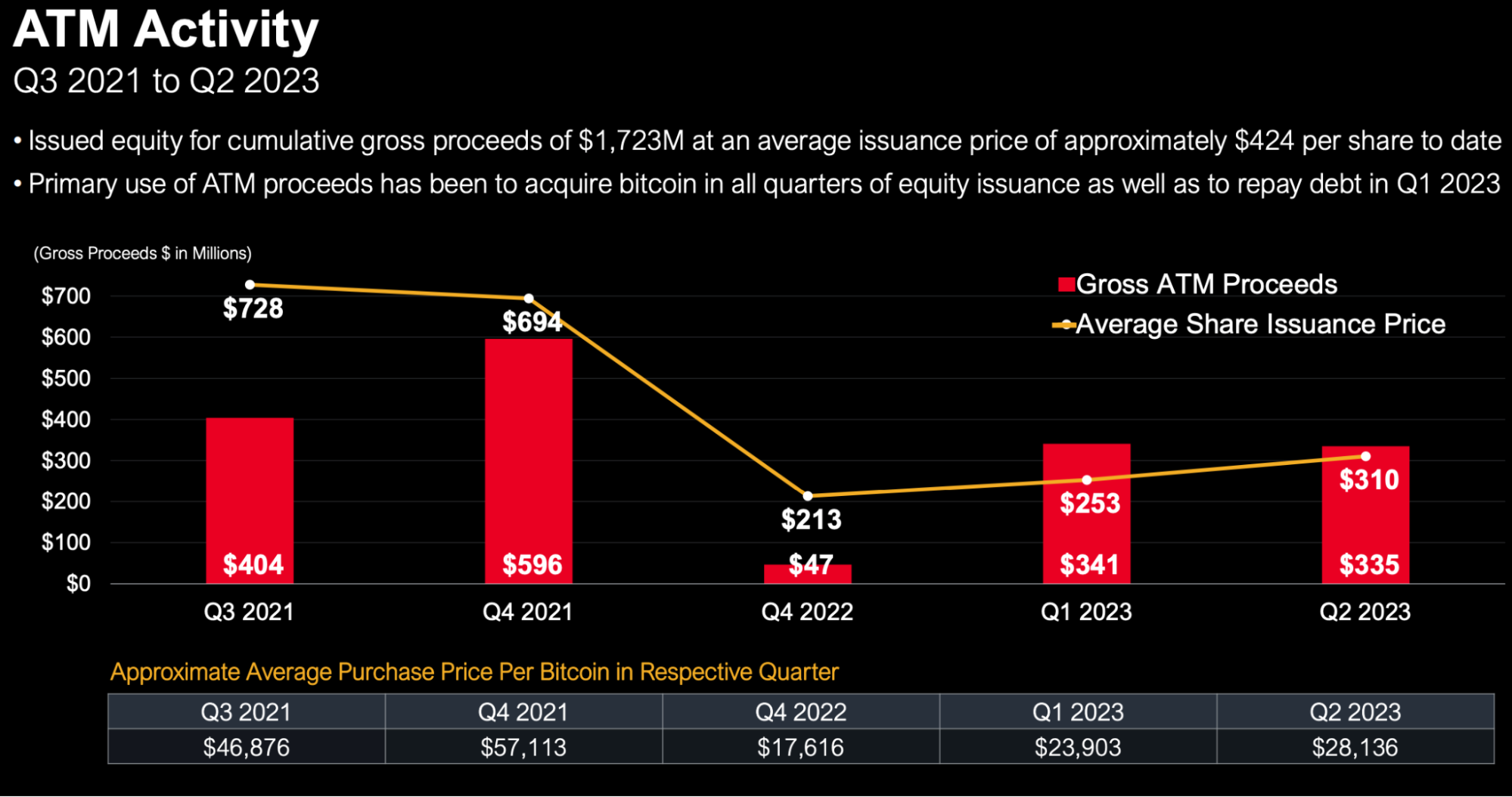
MicroStrategy issued a total of $1.723 billion of Class A common stock in 2021, 2022, and 2023, with an average selling price of $424 per share. The main use of these stock issuances is to purchase Bitcoin during all stock issuance quarters and repay debt in the first quarter of 2023.
The issuance dates of these stocks are:
Financed $404 million through a rights issue plan in the third quarter of 2021, with an average issuance price of $728 per share.
Raised $596 million in the third quarter of 2021, with an average issuance price of $694 per share.
Raised $47 million in the fourth quarter of 2022, with an average issuance price of $213 per share.
Raised $341 million in the first quarter of 2023, with an average issuance price of $253 per share.
Raised $335 million in the second quarter of 2023, with an average issuance price of $310 per share.
Figure: MSTR stock issuance prices and scales in 2021 so far
Source: MSTR, TrendResearch
On August 1, 2023, with the release of the second quarter report, MSTR announced the launch of a new $750 million stock offering plan, which is the largest stock offering financing in history. The purpose is still to continue supporting the company's strategy of large-scale purchase and holding of Bitcoin.
Financial Health Analysis
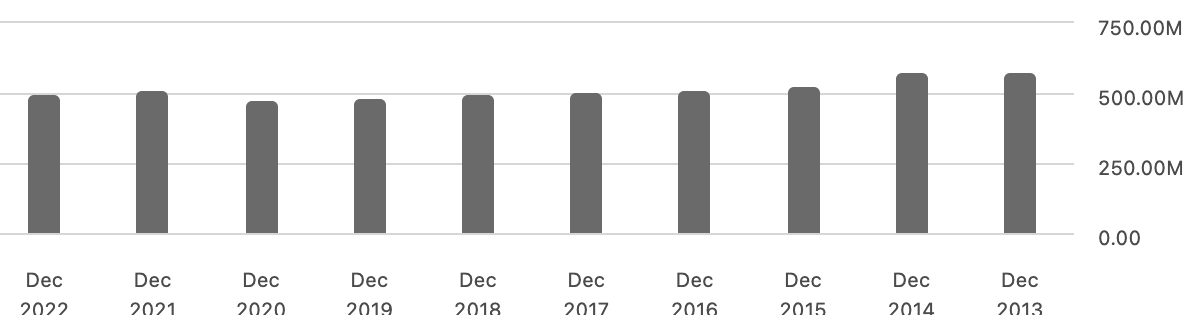
MicroStrategy's annual revenue has been relatively stable in recent years, reaching $499 million in 2022. However, since 2013, it has basically remained around $500 million, which is quite worrying for a software company that is unable to expand its software sales revenue during the prosperous period of technology companies.
Chart: MSTR Annual Total Revenue (Annual)
Source: TrendResearch, SeekingAlpha
And the revenue has remained almost unchanged in the first two quarters of this year, maintaining at $120 million.
Figure: MSTR Annual Revenue (Quarterly)
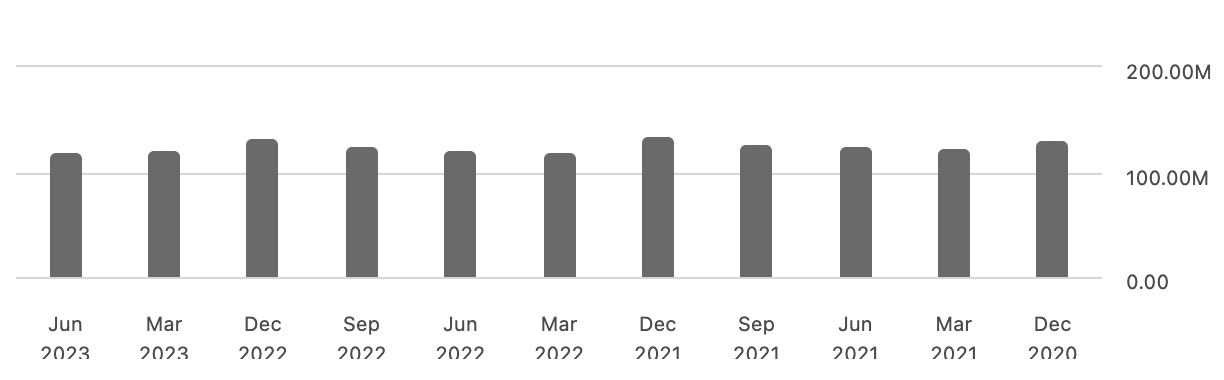
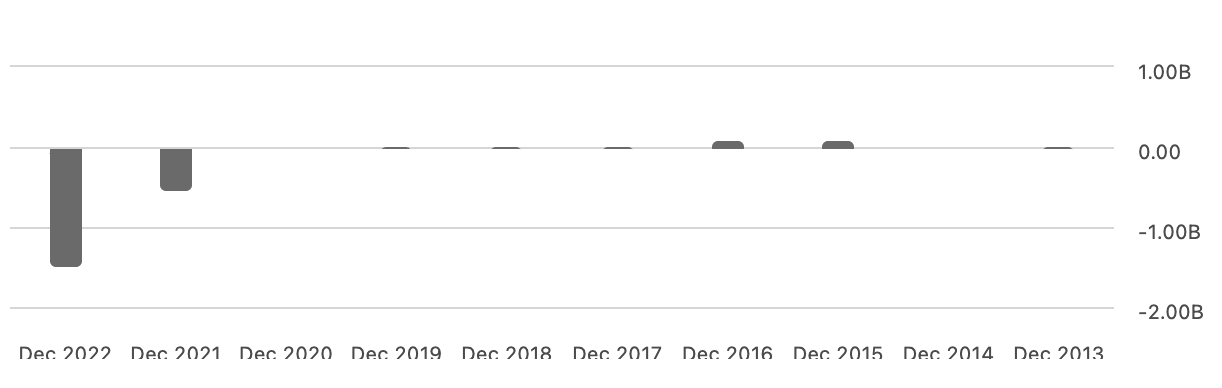
Figure: MSTR Net Profit (Annual)
Source: TrendResearch, SeekingAlpha
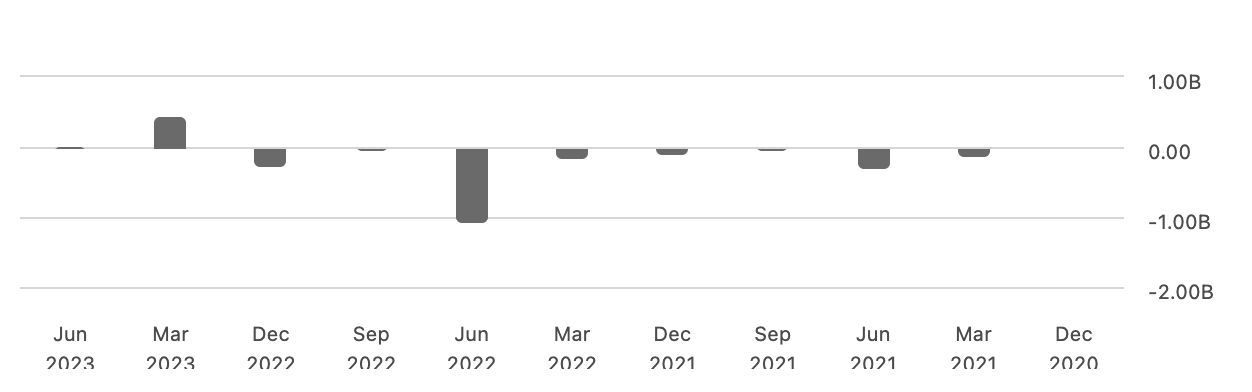
Although MicroStrategy recorded a net profit of $483 million in the first half of this year, its software business operations still did not make a profit, with an operating loss of $30 million in the first half of the year. The net profit is mainly due to the recognition of $513.5 million in income tax benefits.
These benefits do not represent the actual cash received by the company, but rather various tax incentives and exemptions that can be deducted from total revenue when calculating pre-tax profits, mainly due to the previous devaluation of Bitcoin. In terms of accounting treatment, a company's asset impairment, business losses, etc., may generate income tax benefits, as it can offset future taxes with these losses.
Figure: MSTR Net Profit (Quarterly)
Source: TrendResearch, SeekingAlpha
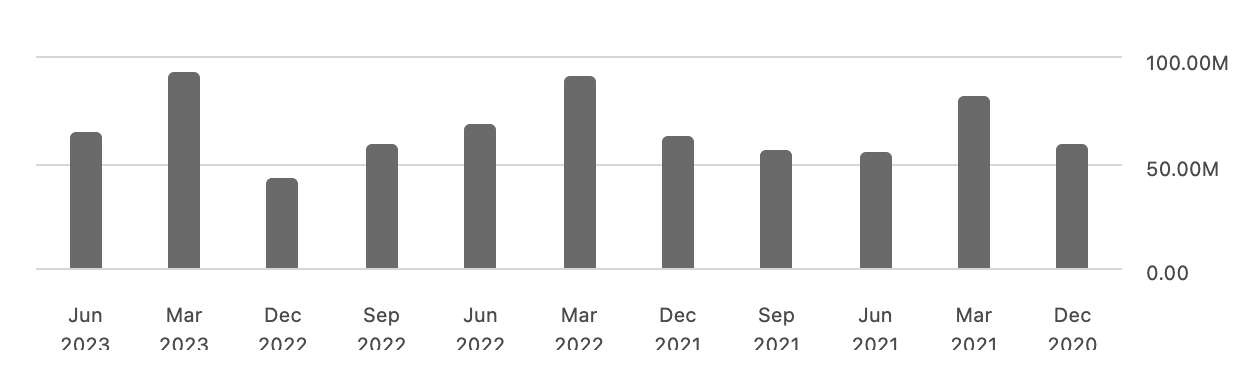
In addition, although the company has a revenue level of $500 million, it doesn't actually have any surplus cash flow. Even though the average cost of debt is only 1.6%, the debt generates an annual interest expense of over $36 million, which accounts for more than half of the company's cash reserves. This forces the company to continue issuing new bonds or issuing new stocks to raise interest. If the cash reserves hit bottom, it could jeopardize the investment in the software business and further affect operating income.
Chart: MSTR Cash and Cash Equivalents Reserves (Quarterly)
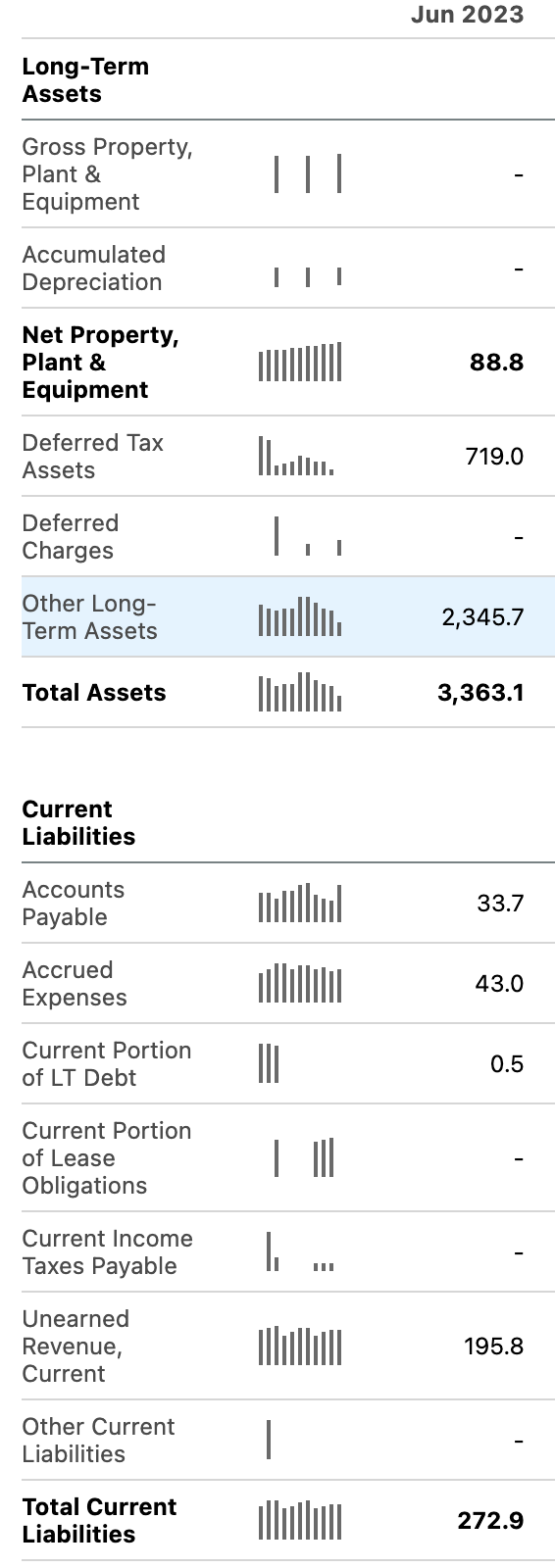
The current balance sheet of MSTR shows that the total assets of 3.363 billion US dollars (2.346 billion US dollars in BTC) are actually underestimated. This is mainly due to the calculation of the value of BTC only based on the cost depreciation. Even if the price rebounds later, it will not be included in the statistics. Therefore, there is a non-permanent impairment loss of 2.2 billion US dollars. In fact, at the current price of BTC close to $30,000, the total assets of MSTR should be 5.56 billion US dollars, corresponding to a debt of 2.73 billion US dollars.
Figure: MSTR balance sheet (2nd quarter of 2023)
Source: TrendResearch, SeekingAlpha
Although MSTR has tried to reduce its debt pressure through its business model, the overall performance of the traditional business has been poor. Therefore, the company's prospects and the price of Bitcoin are deeply intertwined. If the price of Bitcoin cannot sustain a continuous rise at the current level, MSTR may face difficulties in continuous fundraising. For example, this quarter, MSTR announced the launch of the largest $750 million stock issuance plan in history. Currently, it is unclear how the plan will be executed, but the stock price of the company fell 6.4% on the second day of the announcement.
Looking at MicroStrategy's specific situation, issuing new shares directly has lower costs compared to conventional bonds, while issuing convertible bonds is slightly more challenging and requires carefully designed terms to attract investors, which is clearly difficult in the current bear market of digital currencies.
It can be seen that the major bonds issued by MSTR were all issued during the peak of the previous BTC bull market (December 2020 to June 2021), while post Q3 2021, stock issuance has become the main financing method, which also reflects MSTR's cautious approach to bond issuance.; Financing in the bond market may be difficult or difficult to bear high interest rates. After all, the benchmark yield for junk bonds in the United States is 8% +. It is unsustainable to roll over existing debt with this cost, so we can only bet on BTC to rise significantly before the 2025 maturity date.





