Why is NYM worth attention?


1. Transparency and the Transparent Side of Blockchain
In 2008, Satoshi Nakamoto created Bitcoin, a decentralized peer-to-peer payment system that is very different from traditional settlement models. In the absence of a central clearinghouse, Nakamoto chose a "broadcast every transaction to the entire network" model to ensure the accuracy of each transaction.
This model makes the on-chain records more publicly transparent. To this day, users can easily check the account balances and transaction information of any address on the entire network through blockchain explorers. The balance and transaction records of Vitalik.eth.
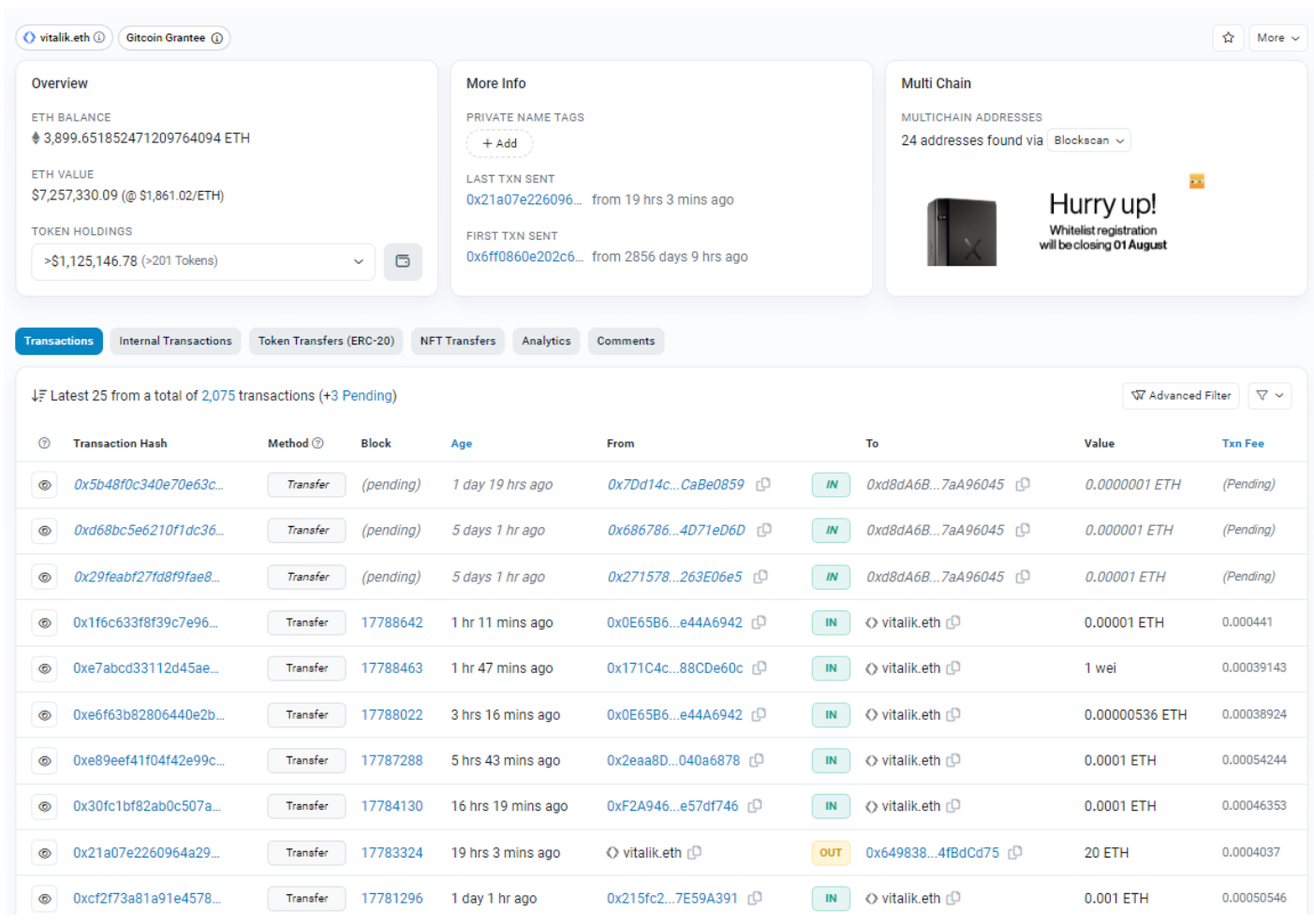
Balance and transaction records of Vitalik.eth
However, from the perspective of privacy protection, this transparency is not user-friendly. It's just that in the early stages of development of Web3, where on-chain applications are scarce, users are rare, and there is a disconnect between on-chain and off-chain identities, few people care about personal privacy.
2. The Privacy Track on the Eve of Explosion
In recent years, the Web3 field has developed rapidly.
In the consumer goods sector, in 2021, Coca-Cola partnered with Decentraland (MANA) to release a large number of Coca-Cola-themed NFTs. In 2022, Starbucks announced the issuance of brand NFTs for marketing on the Polygon chain...
In the internet sector, in 2022, Reddit, a forum with 450 million users, launched NFTs on the public chain. Currently, the cumulative number of NFT users has exceeded 6 million. In November 2022, Musk acquired Twitter and announced several crypto-related transformations (including cryptocurrency payments) for the platform.
In terms of finance, the large traditional stock trading software Robinhood has launched wallets that support ETH and Polygon; the Singapore government has issued Singapore bonds on Polygon; payment giants such as Visa/Mastercard have expressed their intention to utilize smart contracts on public chains for payment services; the concept of representing traditional assets on the blockchain, RWA, has also gained popularity recently...
Although the above projects and concepts still need time to be fully implemented, what changes will occur when these projects become widely adopted in our lives, from daily consumption to financial investment to browsing the web, all done through Web3 wallets?
Every day, our meals, shopping, internet browsing, and investment records will be publicly available on the internet. Therefore, before Web3 is deeply integrated into real life, a privacy protection application will be essential.
III. Overview of the Privacy Track
In fact, Web3 builders have always been paying attention to the privacy track and have made many projects, but currently, there are still very few potential mainstream privacy projects.
(1) Early Privacy Transfer Projects
In 2014, Monero was launched, and this token was the first to achieve the hiding of account balances and transaction records. Subsequently, projects such as Zcash and TornadoCash were launched, becoming the pioneers of early privacy transfers.
However, these privacy projects at that time had obvious limitations. Because the majority of transactions in the real world are "buy-sell" actions that require "smart contracts," while "transfers" are only "one-way" actions that are rarely applied in reality. Therefore, these projects did not meet the future Web3 needs of the real world.
(2) Privacy Public Chain Projects
These projects are also quite diverse and have solid technical backgrounds. For example, Oasis and Secret implement privacy smart contracts based on "Trusted Execution Environments (TEE)" with chip hardware; MINA and ALEO implement privacy smart contracts based on zero-knowledge proofs with algorithms; PlatonR is based on "Multi-Party Computation (MPC)" and so on.
However, these privacy-focused Layer 1 projects hope to independently build their own public chain ecosystems, which naturally meet many privacy needs;
However, more Web3 applications are still built on mainstream public chains like ETH and Polygon. The need for such solutions still needs to be addressed.
In addition, current privacy protection projects mostly focus on protecting the data itself, rather than addressing the protection of "metadata".
For example, after browsing several videos, microblogs, and websites on Sunday morning, you bought a cosmetic product on an e-commerce website. At present, most projects only focus on hiding the transaction record of "spending xx yuan on a cosmetic product on a certain website". The user's various browsing records are still publicly accessible on the internet.
(III) Privacy Middleware Project NYM
NYM has two major advantages. First, the project is positioned as a "middleware," which means that the entire Web3 world, including ETH and other mainstream chains, can use NYM. This versatile project will make it easy to cooperate and conduct business with various Web3 projects in the future.
Second, NYM implements "metadata" level protection. Moreover, for users who value "privacy with convenience," using NYM will hardly sacrifice any convenience while protecting privacy. This will greatly expand the potential of NYM in the future.
In addition, NYM is an investment by a16z and incubated by Binance, providing NYM with sufficient capital and business resources for expanding the aforementioned business.
In summary, the development of the Web3 privacy track is gaining momentum. Users are encouraged to pay more attention to the development trends of leading projects in specific areas to seize the opportunities in advance.