


Understanding NFT lending protocol terms and liquidation mechanisms in one article


Introduction
This article aims to explore the development path and trends of NFT lending by organizing the lending terms and liquidation mechanisms of various NFT lending protocols, as well as important proposals that have been passed. The research objects include BendDAO, ParaSpace, JPEG'd, Blend, NFTfi, Arcade, Pine Protocol, and Sodium.
All parameters and proposals mentioned in this article come from protocol whitepapers and governance platforms, with data sourced from Blur, OpenSea, LooksRare, X2Y2. The data is based on the floor price of the platforms, as of July 30, 2023, and aggregated statistics from Dune.
Overview of Liquidation Mechanisms
This article categorizes lending protocols into two types:
Pool-to-Pool: Borrowing from a collective fund pool;
Peer-to-Peer: Borrower and lender are matched through a matching mechanism.
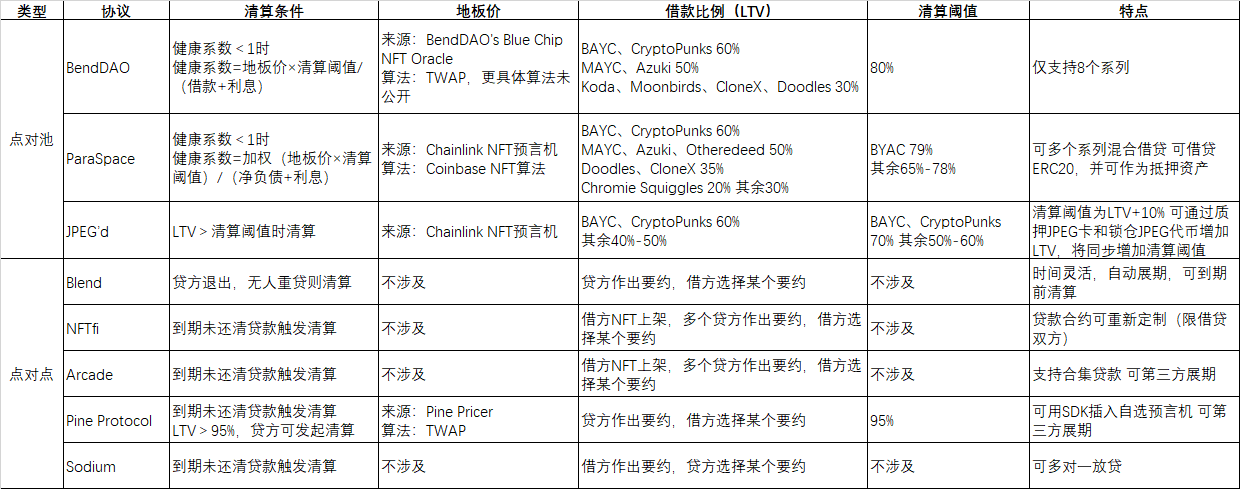
Common features of pool-to-pool lending protocols include:
Decentralized oracle price feed, with the basic algorithm being Time-Weighted Average Price (TWAP) to avoid sudden fluctuations. The specific algorithm is not publicly disclosed to prevent floor price attacks;
BAYC, CryptoPunks, MAYC, and Azuki have significantly higher borrowing ratios compared to other NFTs, and their liquidation thresholds are usually more favorable.
In the Point-to-Pool protocol, because the borrower can borrow immediately, and since there has been no apparent upward trend in the overall market after the NFT bull market in April 2022, in order to control risks, lending agreements only offer lending functions for select blue-chip NFTs and have set strict control parameters.
For example, in BendDAO, if funds are borrowed with an LTV of 30% and a liquidation threshold of 65%, a 62.5% decrease is required to trigger liquidation. In ParaSpace, with an LTV of 30% and a liquidation threshold of 65%, the liquidation percentage for a decrease is 53.8%.
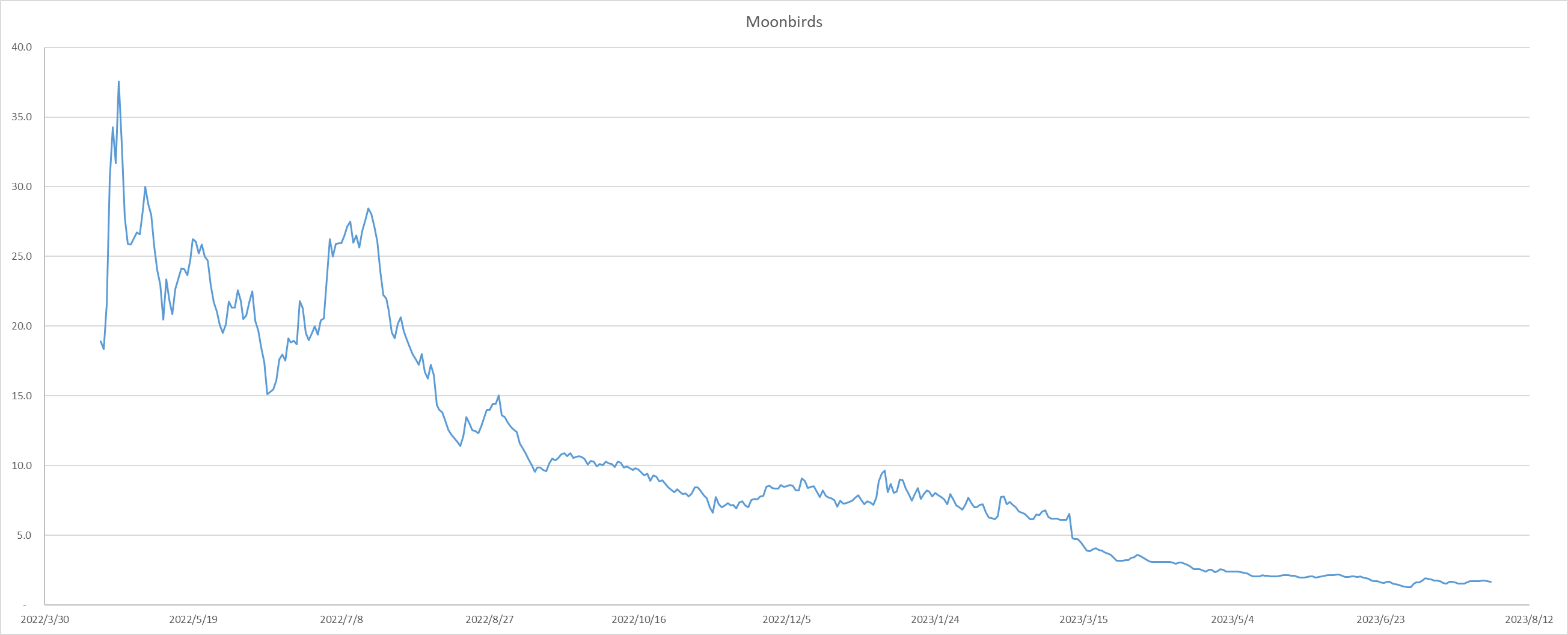
Although subsequent market results have shown that multiple blue-chip series have experienced drops of more than 50%, below is the price curve chart of Moonbirds starting on April 18, 2022. The floor price on that day was 18.9 ETH, and the highest point was 37.6 ETH on April 24, 2022. However, by July 30, 2023, the floor price had dropped to 1.7 ETH, representing a maximum decrease of 95.5%.
The Point-to-Pool protocol improves the matching efficiency of blue-chip NFTs, eliminating the need for both borrower and lender to reach a consensus on market conditions and increasing the turnover ability of blue-chips. However, to ensure the safety of the overall liquidity pool, the economic efficiency is usually lower. Additionally, the Point-to-Pool protocol alone cannot solve the issue of rapidly deteriorating market conditions. For example, the rapid drop and liquidation caused by the release of Azuki Elementals required temporary measures by the project team outside the protocol mechanism. Relying solely on auction liquidation mechanisms may result in bad debts.
Reference article: "ParaSpace: Due to the volatile price of Azuki, the Azuki mining pool is temporarily suspended, including functions such as depositing, withdrawing, and forced liquidation"
In peer-to-peer lending agreements, common characteristics include:
Usually not involving a floor price, with the ability to repay the loan on time being the triggering condition for liquidation;
Usually, the lending party issues an offer (i.e., parameter settings for loan conditions), representing the dominance of the lending party in the market;
Usually, rollovers and liquidations can be arranged.
The peer-to-peer protocol solves the lending problem of long-tail assets through matching. Because the non-blue chip NFT market is more niche, the lender usually makes the offer. Only in Sodium, where multi-to-one and multi-tiered lending is possible, the borrower makes the offer. Liquidation is based on repaying the loan at maturity, avoiding the liquidation issue that the pool protocol may face with rapid declines. However, it also brings the risk that borrowers may choose not to repay if the price continues to decline without recovery. Pine Protocol has set up the function of liquidation initiation by the lender, but an additional 5% liquidation fee is charged.
In addition, peer-to-peer protocols usually support rollovers, but only Blend and NFTfi support loan retracement conditions. This mechanism avoids drastic differences between market situations and the initial loan conditions. Pine Protocol has set a specific limit for loan duration at either 7 days or 14 days, reducing the possibility of large fluctuations. In comparison to the traditional bond market, changes in the market interest rate are balanced through inverse changes in bond prices. However, NFT lending protocols do not currently have sufficient depth in secondary markets to support this method of balancing. But as the market size grows, it is also a potential development direction. Pine Protocol V3 has already made initial attempts to tokenize lending positions for transfer between accounts. Therefore, for protocols that support borrowing for a quarter or more, the functionality of loan retracement conditions is indispensable.
Lending Terms and Liquidation Mechanism Proposal
In the initial versions of major lending protocols, the lending terms were relatively strict and lacked flexibility. In the process of development, restrictions were gradually eased in order to deal with liquidation crises caused by downturns or to improve economic efficiency and promote protocol development. This section lists the important changes proposed for lending terms and liquidation mechanisms mentioned in the previous section.
The proposals mainly focus on two directions: improving economic efficiency and enhancing liquidation processes.
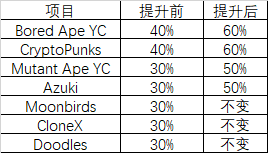
The methods for improving economic efficiency include: increasing the loan ratio of top blue-chip NFTs or increasing the loan ratio of rare editions in a blue-chip series. For example, in BendDAO, BAYC initially had an LTV (loan-to-value) ratio only 10% higher than other NFTs, but in BIP#15, the gap widened to 30%. In ParaSpace V 1.4, the golden skin BAYC and Koda have increased their LTV by 6 times.

The ways to improve liquidation include: reducing liquidation, such as JPEG'd PIP-61 allowing partial repayment and extending the liquidation time. Another approach is to ensure successful liquidation and prevent auctions from being unsold. BendDAO's BIP#9 removed the bidding floor price restriction, greatly increasing the profit margin of liquidation. And major protocols are shortening the auction time. According to JPEG'd statistics, most auctions occur in the last few hours or minutes, so it is only necessary to ensure that users have enough reaction time to participate in the auction.
To study the relationship with market conditions, the time mentioned below is based on the start of the proposal voting.
BendDAO
Improving Liquidation: BIP#9 (2022/8/22)
Removing the requirement that the liquidation bid price must be higher than 95% of the floor price;
Adjusting the liquidation threshold to 70%, completed in three stages;
Adjust the auction period to 4 hours: "The 48-hour window design is to protect NFT holders from liquidation and avoid waking up to lose their PFP. But now we have an on-chain Oracle with TWAP protection, which means floor price attacks will be very difficult. So we want to reduce the time from 48 hours to 4 hours to improve the liquidity of the auction."
Improve economic efficiency and liquidation: BIP#10 (2022/8/23)
Adjust the liquidation threshold to 80%;
Adjust the auction period to 24 hours.
Improve economic efficiency: BIP#15 and BIP#15-1 (2022/11/11)
ParaSpace
Improve economic efficiency: ParaSpace v 1.4 (2023/1/28)
Improve the value of rare NFT collateral, such as Koda collateralizing as six times the regular Otherdeed;
Otherdeed LTV increased from 30% to 35% -40%。
JPEG’d
Improved liquidation:PIP-51 (2023/4/29)
Repayment time after liquidation reduced from 72 hours to 48 hours.
Enhanced economic efficiency:PIP-58 (2023/6/11)
Increased the LTV of each collateral, with a minimum of 5% and a maximum of 25% (BAYC);
Added the ability to increase LTV by pledging tokens.
Improved liquidation:PIP-61 (2023/6/15)
Allows partial repayment to avoid liquidation.
Improved liquidation:PIP-71 (2023/7/17)
The auction time has been reduced from 24 hours to 12 hours.
NFTfi
Improving Liquidation:Loan Renegotiations (2022/8/30)
NFTfi borrowers and lenders can renegotiate loan terms at any time before the loan is redeemed (i.e., liquidated) by NFTfi.
Pine Protocol
Improving Liquidation:PIP-8 (2023/4/28)
Liquidation fees are levied and paid by the borrower when liquidation is initiated, amounting to 5% of the loan amount.
Improving Economic Efficiency:PIP-12 (2023/7/12)
The loan term is limited to only 7 days and 14 days to enhance market predictability and reduce decision-making complexity.
Improving Economic Efficiency: Pine V 3 (2023/1/13)
In Pine Protocol's V1 and V2, the addresses of lenders and borrowers are directly written into the loan smart contract. This cannot be changed as long as the loan position exists. In order to make it more decentralized and flexible, in the design of the Pine V3 smart contract, the loan position is marked as an NFT. Any blockchain address holding these NFTs will become the creditor and debtor of the corresponding loan position.
NFT Blue Chip Index and Significant Change Timeline
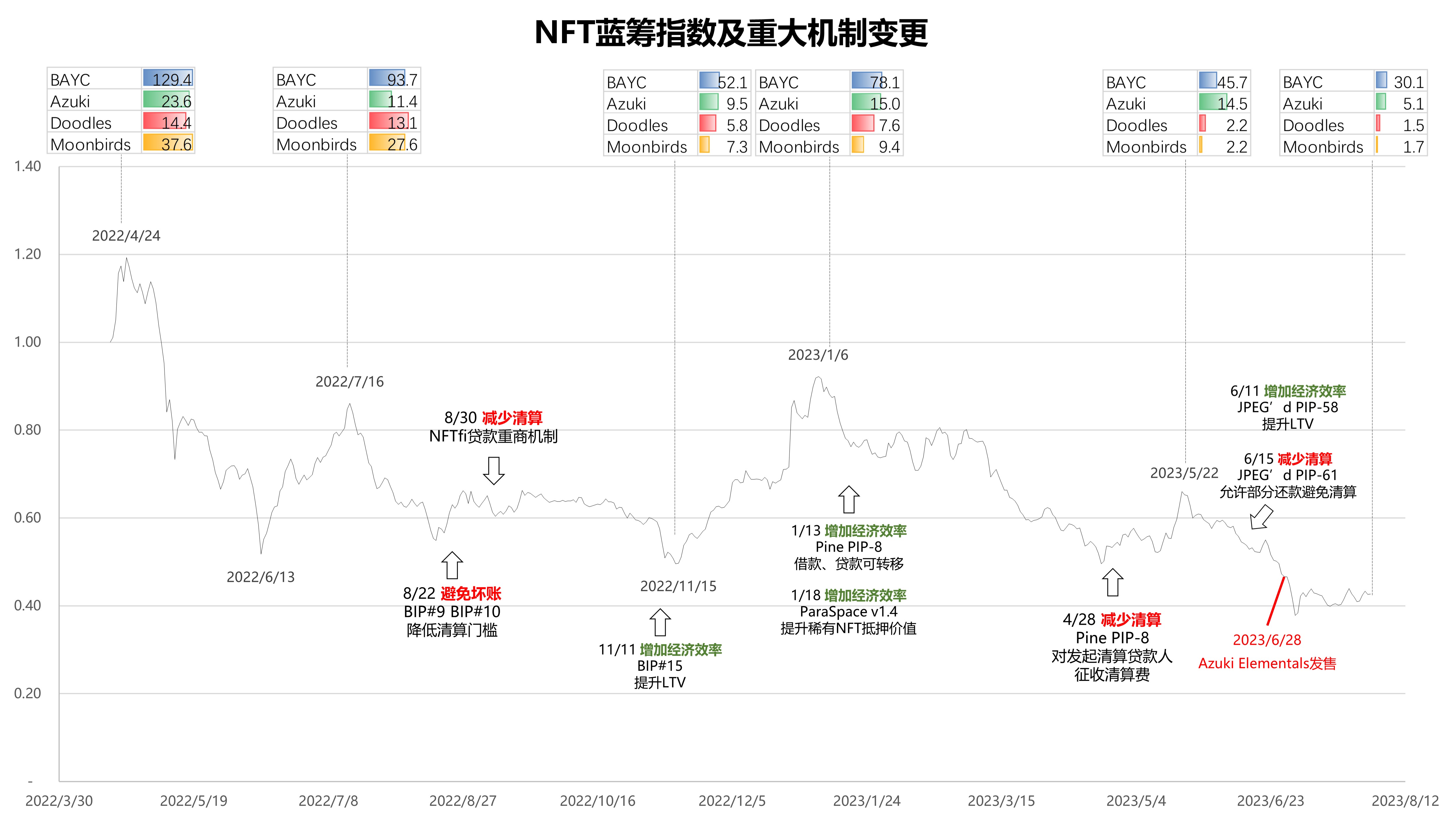
The NFT Blue Chip Index is derived by averaging the daily percentage changes in price relative to the base prices of 7 blue chip NFTs including BAYC, MAYC, Azuki, Pudgy Penguins, CloneX, Doodles, and Moonbirds as of April 18, 2022. CryptoPunks is not included because there have been no trades in that series for multiple days, which could distort the index.
The following conclusions can be drawn from the relationship between the time of each proposal initiation and the index:
Improvement proposals on liquidation are usually made during price lows. For example, in 22 BendDAO, there were four instances of loan interest rates exceeding 100%. When this happened for the second time in August, BendDAO made significant changes to the liquidation mechanism by removing the minimum bid requirement.
Measures to improve economic efficiency do not show an obvious relationship with NFT prices. BendDAO BIP#15 and JPEG'd PIP-58, which propose increasing LTV, were introduced during price lows or were related to the protocol's own development needs. Another potential factor is the health of NFTs being borrowed on the platform. Since the occurrence of the fourth instance of loan interest rates exceeding 100% in September 22, the remaining three months' loan interest rates have been at their lows for the year, indicating a higher lending health factor and a window for improving LTV.
With the crisis brought by Azuki Elementals resolved, there is an opportunity to improve the agreement mechanism and parameters of various lending agreements. Whether lending agreements can become a booster for NFT recovery or another liquidity crisis will occur again remains to be observed.





