






DeFi Stablecoins Enter a New Golden Age? In-depth Analysis of Recent Innovations in the Stablecoin Space


Original author: Ignas
Original translation: Luffy, Foresight News
Do you hold stablecoins? If so, which ones do you hold? What do you use them for? Do you stake them in DeFi yield activities, or just hold them and wait for a buying opportunity at a low price?
Perhaps you have converted stablecoins to fiat currencies to avoid associated risks. This is undeniable, especially when one of the main stablecoins, USDC, has temporarily suffered severe deviations. Or maybe you have chosen fiat currencies because they currently offer higher yields than blue-chip DeFi protocols.
In the bear market of the crypto market, the total market value of stablecoins dropped from a historical high of $200 billion to the current $126 billion, which is not surprising.
But don't be afraid. The stablecoin market is becoming more and more fascinating, and the founder of Synthetix said, "We are entering the golden age of decentralized stablecoins."
Are you curious about what he means by this statement? Let's break it down in detail.
Which stablecoin is the safest?
This is the most important question because you don't want to wake up one day and find that your stablecoins have dropped by 50%.
Fortunately, the non-profit organization Bluechip has released an economic security rating for top stablecoins this week. The safety rating considers the overall performance of stablecoins and provides multidimensional information: stability (S), management (M), implementation (I), decentralization (D), governance (G), and externalities (E).
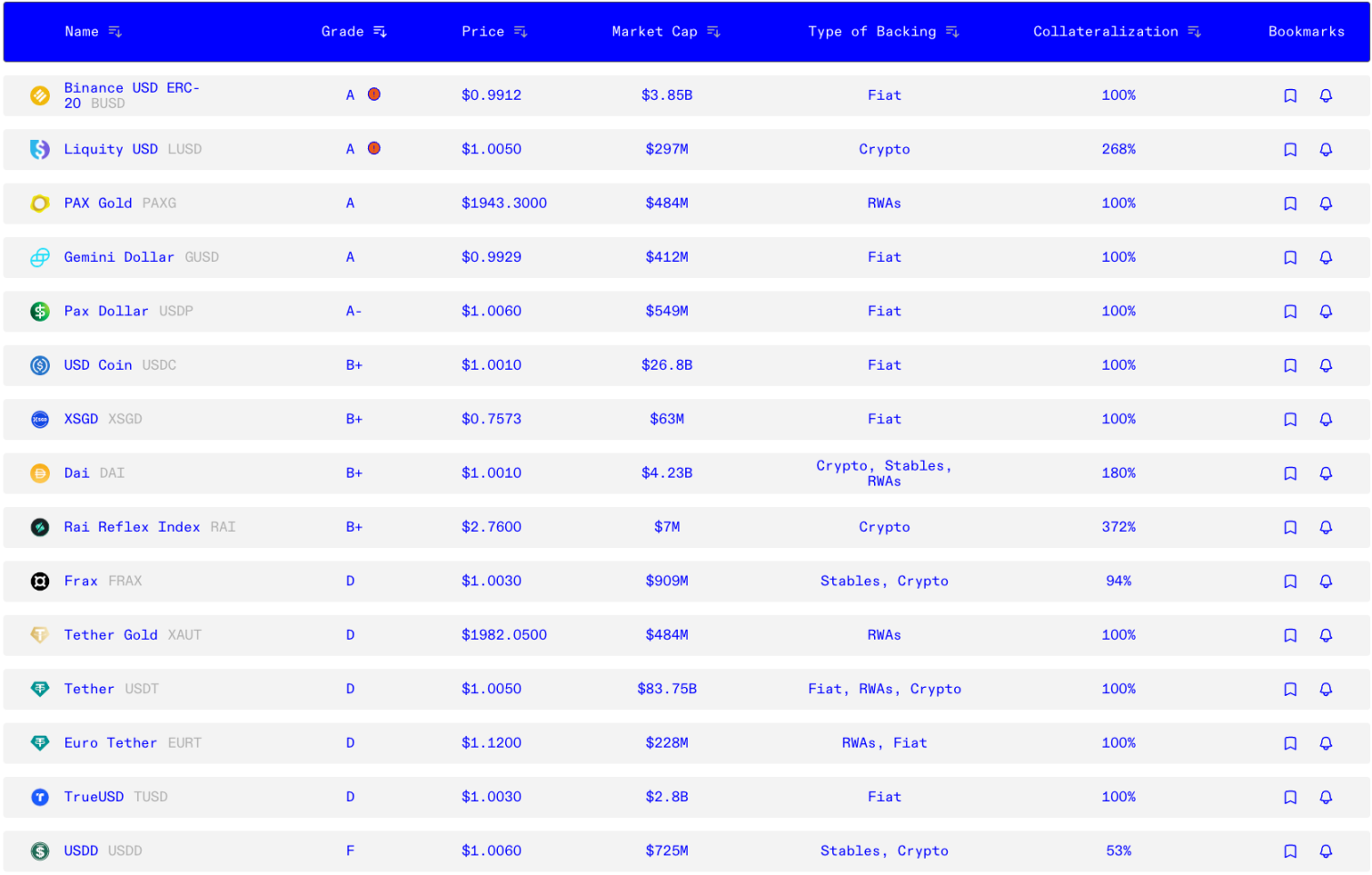
In the Bluechip evaluation model, the safest stablecoins are BUSD, PAXG, GUSD, and LUSD from Liquity. This means that LUSD is the economically safest decentralized stablecoin, even safer than USDC.
This is not surprising. During the USDC severe deviation incident in March, LUSD acted as a safe haven.
Interestingly, other DeFi stablecoins are also included in the evaluation range, with DAI and RAI receiving a B+ rating, while USDD is rated as F.
Tron's USDD score is F because its reserves are composed of TRX (69% ), BTC (29% ), and TUSD (2% ). However, Bluechip does not consider the collateral ratio of TRX. The collapse of Terra/Luna illustrates the huge risks hidden in native collateral.
If you are curious about the survey results, here is a brief summary of the selected stablecoin reports:
Binance USD ERC-20 (Rating: A): This stablecoin is issued by Paxos and is considered safe for public use. Despite the NYDFS stopping issuance in 2023, the support for BUSD remains unaffected.
Liquity USD (Rating: A): LUSD is part of the Liquity Protocol and is a highly decentralized stablecoin. It is controlled by code rather than a central authority, which is a reflection of its security. However, please note that there are also risks with smart contracts and oracles, so exercise caution when purchasing LUSD worth more than $1.
USD Coin (Rating: B+): USDC is one of the safest stablecoins, and its reserves include short-term US government bonds and cash deposits. It has wide usability and can improve its rating by proving bankruptcy isolation reserves and incorporating redemption schedules into its terms of service.
DAI (Rating: B+): DAI is the oldest on-chain stablecoin primarily backed by centralized assets. Nonetheless, it is considered secure and ideal for users seeking permissionless protocols.
Rai Reflex Index (Rating: B+): RAI is a decentralized stablecoin with a floating price not pegged to any fiat currency. Despite being an experimental stablecoin, it has proven to be a reliable low-volatility alternative to traditional stablecoins. It is backed by ETH collateral and is suitable for users who want decentralized and censorship-resistant stablecoins.
Tether (Rating: D): Despite being the oldest and largest stablecoin, USDT has transparency issues. It is suitable for institutional users, high-net-worth individuals, and advanced traders who can directly avail of the redemption mechanism.
Frax (Rating: D): FRAX has a tight peg and performs well under market pressure, but concerns arise from its partial collateralization mechanism and reliance on centralized assets. It is suitable for yield-seeking miners and liquidity providers who can handle protocol complexity.
USDD (Rating: F): USDD is managed by the Tron DAO Reserve and is similar to the failed UST stablecoin. Due to concerns about its collateral, as only 50% of its supply is supported by non-TRX collateral (primarily Bitcoin), it is advisable not to use it.
You may wonder how this security ranking relates to the golden age of decentralized stablecoins?
It is indeed related, as the subsequent content will include experimental DeFi stablecoins, which will either become the next big thing or completely collapse.
For example, just a year ago, I wrote an article about algorithmic stablecoins like USDD, USDN, and CUSD. A few months later, USDN unpegged and rebranded into another VOLATILE token.
Remember that fund security is crucial, so let's see what makes DeFi stablecoins so exciting now.
Lybra: The Challenger of LUSD
Below are the top 10 stablecoins ranked by market cap. Which one impressed you the most?
First, USDT occupies a staggering 66% of the market share, even though it was rated "D" by Bluechip due to its lack of security. Second, this month, only USDT and LUSD have seen an increase in market cap. All other stablecoins have experienced a decrease, with some showing significant drops.
eUSD comes after the top 10, which is a stablecoin launched by Lybra Finance.
Interestingly, Lybra is a fork of Liquity that accepts stETH as collateral, while Liquity only accepts ETH as collateral. Thanks to stETH, eUSD holders can earn a 7.2% annual interest rate.
eUSD has a higher yield than stETH because eUSD can be generated with a 159% overcollateralization ratio using stETH.
But this also brings a potential issue: the decoupling of stETH, as Lybra uses Liquity's ETH:USD price feed.
The eUSD's another issue is that the yield is distributed through rebase, which means you can earn more eUSD tokens based on the APY rate. To address these problems, Lybra is now introducing v2 and another new stablecoin: peUSD.
The main upgrades in v2 include:
Full-chain functionality: peUSD is the full-chain version of eUSD (via LayerZero), allowing holders to use their stablecoin across different chains.
Minting with various collaterals: peUSD can be minted directly using non-Rebase LSTs, such as Rocket Pool's rETH, Binance's WBETH, or Swell's swETH. Earnings accumulate through the underlying LST, so even if peUSD is spent, its value will increase.
Continuous earnings: When eUSD is converted to peUSD, users can continue earning interest from their eUSD collateral even if they spend peUSD.
Usage in DeFi activities: peUSD is not a rebase token, so it can be used more widely in the crypto ecosystem.
You can experience v2 on the Arbitrum testnet here.
Overall, eUSD poses the biggest threat to LUSD, but there are also other potential competitors like Raft and Gravita.
However, Liquity is not sitting idly by; it is organizing a counterattack.
Liquity v2: A Standalone New Product
The beauty of Liquity lies in its simplicity. You can mint LUSD using ETH as collateral with 0% interest, just paying a one-time borrowing fee of 0.5%.
Liquity was originally created as an alternative to DAI with heavy governance. LUSD has the lowest level of governance, and its smart contracts are immutable (cannot be upgraded) - which is useful for economic security but not for growth.
To keep up with competitors, Liquity has also introduced v2 with support for LST. However, "condename v2" will be a completely new and different product, not an upgrade of the original one.
Liquity v2 aims to solve the "Stablecoin Trilemma" of decentralization, stability, and scalability through a Delta-neutral hedging model with reserve support.
It's complex, but the working principle can be simplified as follows:
Assume Alice has 1 ETH worth $2000. She can deposit it into Liquity v2 and receive 2000 v2 LUSD in return. Now, Liquity holds her ETH and Alice possesses 2000 v2 LUSD. If the price of ETH falls below $2000, Alice's v2 LUSD will no longer be fully backed, exposing her to the risk of a downward spiral in price.
To address this issue, Liquity v2 introduces:
Principal-protected leverage: Users can hold leveraged positions (betting on future prices) and only bear the risk of the premium paid, not the principal.
Secondary market: Users can sell these principal-protected positions to others. If a position isn't purchased, Liquity will subsidize it, ensuring all positions are bought and subsidies remain in the system.
If you're still confused, please check out this Thread or Blog Post for a more detailed explanation.
The impact of Liquity v2 is manifold, but the goal is to provide DeFi users with everything: principal-protected leverage, mining opportunities, and secondary market trading opportunities. v2 is expected to launch in 2024.
Synthetix sUSD: Towards v3
As mentioned earlier, Synthetix founder Kain is bullish on decentralized stablecoins. Want to know why?
That's because Synthetix v3 is being gradually rolled out. This is a great timing because despite the growing trading volume on Kwenta, the market cap of sUSD has been declining and is currently at $98 million.
And v3 could bring a turning point.
Synthetix is one of the most complex DeFi protocols to date. However, the core of the Synthetix ecosystem is the sUSD stablecoin, which is backed by SNX.
You can read Thor Hartvigsen's article on how Synthetix v3 will impact DeFi. v3 is addressing two crucial pain points for sUSD minters:
Multicollateral: v3 no longer limits collateral and allows any collateral to support synthetic assets (v2 only allows SNX). This will increase the liquidity of sUSD and the markets supported by Synthetix.
Synthetix Loans: Users can now provide collateral to generate sUSD without facing debt pool risk or incurring any interest or issuance fees.
If you have tried minting sUSD, you will know how significant these changes are! sUSD now has the potential to compete with other mature stablecoins like FRAX, LUSD, or DAI.
MakerDAO: The Revenue-Generating Machine
Maker is now in its final stages (please check my Thread for more details). One key point to remember is that if the regulatory environment changes, Dai may even abandon its peg to the US dollar.
Currently, Maker seems to be entering a frenzy:
MKR has increased by 66% in the past 30 days, and the Maker founder continues to buy MKR.
Due to the reactivation of the DAI savings rate, DAI has brought a return of 3.49% to its holders.
The Spark protocol is a fork of Aave that focuses on DAI, with a current total value locked (TVL) of $75 million.
Maker has reduced its dependence on USDC from 65% in March to the current 17%.
Maker currently ranks third in terms of revenue generation, surpassing Lido, Synthetix, and Metamask.
Not everything is rosy. A consumer electronics company owes MakerDAO $2 million in debt. However, with a Bluechip rating of B+, a 3.49% DSR, and growing revenue, Maker's DAI is experiencing a recovery months after the disastrous event of USDC's decoupling.
Frax v3: Abandoning USDC?
Frax received a D (unsafe) rating in the Bluechip assessment. The report states that FRAX carries risk due to its partially collateralized unstable FXS token and heavy reliance on centralized assets (USDC), with the core team having control over voting rights and monetary policies.
It is suitable for yield farmers and liquidity providers who are comfortable with the protocol's complexities.
Like DAI, FRAX also lost its peg to the USD during the USDC decoupling and seems to have learned from the experience.
Frax Founder Sam Kazemian shared in a Telegram chat that v3 is expected to launch within 30 days.
Details about v3 are scarce, but DeFi Cheetah reports that it will be "a completely different system that does not rely on fiat currencies including USDC."
If true, v3 will mark a 180-degree turn from v2.
Sam previously stated that their long-term goal is to obtain a Federal Reserve Master Account that holds USD and directly transact with the Fed, making FRAX the closest thing to risk-free USD stablecoin. This would allow FRAX to move away from USDC collateral and expand its market cap to trillions of dollars.
I recommend following DeFi Cheetah for the latest updates on Frax.
GHO: The Promising New Player
Despite the hype leading up to GHO's launch, its growth has been steady. While Aave boasts a total value locked (TVL) of up to $58 billion, GHO's market cap is only $8 million.
This could be due to three reasons. Firstly, GHO is only 11 days old, so it's still early. Secondly, integrating GHO into multiple DeFi protocols will take some time, but growth is expected to accelerate soon. Thirdly, we are currently in a bear market.
Now, let's take a look at how GHO works:
Using over-collateralization to maintain the value of stablecoins.
Minting/burning can only be done by approved coordinators (such as the Aave protocol itself, but potentially more), with each coordinator having a limit.
Generates interest when supplied to liquidity protocols, with the interest rate set by Aave governance (currently 1.51%).
Cannot be supplied to the Aave Ethereum market, which is important for security.
Destroyed after repayment or liquidation, with the interest going to the Aave DAO treasury.
Interest rates are determined by Aave governance rather than dynamically adjusted by supply and demand.
Offers lending discount to stkAave holders (interest discount of 30%).
Keeps the price stable at $1, set by the Aave protocol (without oracles), with arbitrageurs restoring the peg when the price deviates from $1.
The GHO brings new revenue to the Aave DAO. The current borrowing rate is set at 1.5%, and if it reaches the equivalent market value of LUSD, GHO may bring $4.4 million in revenue to the Aave DAO.
You can delve deeper into how it works in this post from Moonshot 21. However, what truly sparked my interest in GHO is its potential for growth.
Aave DAO can choose to mint GHO using real-world assets, government bonds, or even adopt a partial algorithmic approach similar to the current FRAX model.
The potential of GHO is enormous, but its actual execution remains to be seen.
crvUSD: The Stablecoin for True DeFi Professionals
I believe crvUSD is the most difficult stablecoin to understand.
crvUSD's unique features include LLAMA, soft liquidations, and "de-liquidations." Here's a brief summary for you:
The uniqueness of crvUSD lies in its use of a special AMM algorithm called the Loan Liquidation AMM Algorithm (LLAMA) to implement a soft liquidation mechanism.
In typical DeFi lending protocols, if the value of the borrower's collateral falls below a certain threshold, it is forcibly liquidated, which could result in significant loss for the borrower.
On the other hand, LLAMA gradually converts devalued collateral into crvUSD, enabling a soft liquidation process that helps maintain the peg of crvUSD and protect borrowers from losing all their collateral during severe market downturns.
However, if the price of the collateral continues to plummet and the losses can't be covered through soft liquidation, forced liquidation occurs.
If the price of the collateral rebounds, LLAMA reverses this process by converting crvUSD back into the original collateral, a process known as "unliquidation".
To maintain the peg of crvUSD, Curve leverages the PegKeeper contract, which can mint and burn crvUSD tokens as needed to ensure the price stays around $1.
The above mechanism provides a more flexible approach to handling collateral liquidation events and offers a new interesting way for a potential top-selling feature of crvUSD in DeFi.
The operation of this game is as follows:
Borrow crvUSD with ETH or LST.
ETH Price Increase: If the value of ETH rises, your collateral will increase, allowing for more potential crvUSD borrowing.
ETH Price Decrease: If the price of ETH drops, LLAMA gradually converts your ETH collateral to crvUSD, maintaining a safe collateral ratio.
Forced Liquidation: If the price of ETH significantly drops, forced liquidation occurs.
Lower Liquidation Fees: Compared to other protocols, the soft liquidation mechanism of crvUSD potentially offers lower liquidation fees.
Due to the lower and gradual liquidation fees, this is a more efficient way to achieve a top-selling feature compared to borrowing through other lending protocols. Hopefully, the peg of crvUSD can be maintained.
Final Thoughts: The Golden Age of Decentralized Stablecoins?
Innovation goes beyond the aforementioned stablecoins, some lower market cap projects offer many innovative approaches:
Beanstalk: A unique stablecoin that maintains a $1 peg using credit instead of collateral, adjusting its Bean supply, Soil supply (loan limit), and maximum interest rate through its proprietary Sun, Silo, and Field mechanisms. Learn more here.
Reserve Protocol: Enables permissionless creation of asset-backed stablecoins with revenue generation and over-collateralization. Anyone can create stablecoins backed by a basket of ERC20 tokens, including eUSD backed by stablecoins deposited in Aave and Compound v2.
Reflexer's RAI: Receives a B+ rating from Bluechip. RAI value is determined by supply and demand and constantly adjusted based on its issuance protocol. Unlike traditional stablecoins, RAI's target exchange rate fluctuates based on market conditions, establishing balance between RAI generators and holders.
Will these recent changes usher in a new golden age for DeFi stablecoins?
The reputation of DeFi stablecoins was first hit when UST collapsed, followed by the uncoupling of USDC, exposing the reliance of DAI, FRAX, and all DeFi on USDC.
However, Maker's recent shift away from USDC to more censorship-resistant stablecoins, and the possibility of Frax v3 transitioning to more decentralized collateral, can be seen as steps in the right direction.
In addition, Liquity's v2 offers a solution for scaling stablecoins by addressing the blockchain trilemma, as the current design of LUSD has made compromises in scalability.
The upgrade of Synthetix sUSD v3 will also enhance the usability of sUSD outside the Synthetix ecosystem, as it will be minted using various collateral types and sUSD minters will no longer be exposed to the debt pool.
Lastly, the introduction of crvUSD and GHO presents a new strategy to maximize DeFi yields and surpass traditional financial yields, potentially helping DeFi enthusiasts sell at the top during the next bull market.
Individually, these changes may seem small, but when considered in the broader context of DeFi, they do inspire hopes for a true golden age of decentralized stablecoins.


