


2023 Q2 Investment and Financing Report: Total investment amount decreases compared to previous quarter, with the United States taking the lead.


Source: "Crypto & Blockchain Venture Capital - Q 2 2023 "
Author: Alex Thorn, Head of Firmwide Research & Gabe Parker, Research Analyst
Translation: Kate, Marsbit
This report uses data from Pitchbook. Reports on venture capital transaction data are often lagging, so Galaxy Research may revise the data for the second quarter of 2023 in future reports.
Highlights
Venture capital in the crypto space has not yet hit bottom. While the number of transactions in the second quarter has slightly increased, the total investment amount by venture capitalists in cryptocurrency and blockchain startups continues to decline.
Valuations continue to decline. The median pre-money valuation for crypto venture capital transactions in the second quarter of 2023 is $17.93 million, the lowest level since the first quarter of 2021, while the median deal size has increased slightly.
Companies in the broad Web 3 categories dominate in terms of transaction quantity, while companies in the transaction category raise the most capital. The second quarter performance continues the trend from the previous quarter.
The United States continues to dominate in the crypto startup space. US-based crypto startups account for over 43% of all completed transactions and raise over 45% of the invested capital by venture capital firms.
The venture financing environment remains highly challenging. In the second quarter of 2023, only 10 new crypto venture capital funds raised a total of $720 million, the lowest level since the start of the COVID-19 pandemic in the third quarter of 2020.
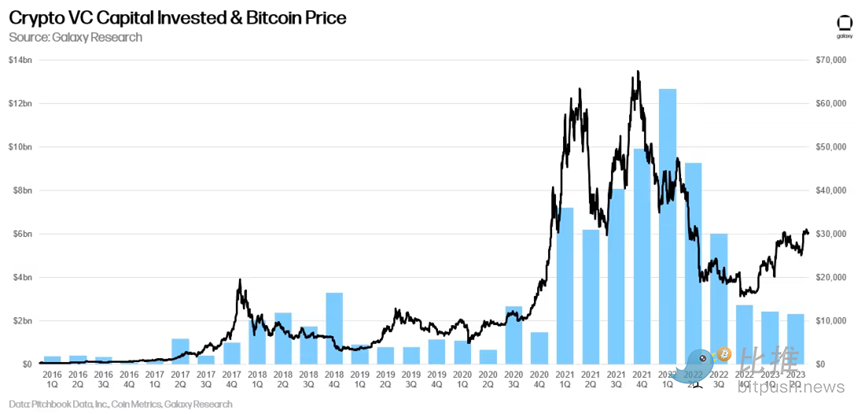
Cryptocurrency Risk Investments and Capital Investments
The investment in the cryptocurrency and blockchain industry in Q2 of 2023 was $2.32 billion, hitting a new cyclical low and the lowest level since Q4 of 2020, continuing the downward trend after the peak of $13 billion in Q1 of 2022. The total funds raised by cryptocurrency and blockchain startups in the past three quarters were lower than Q2 of last year.
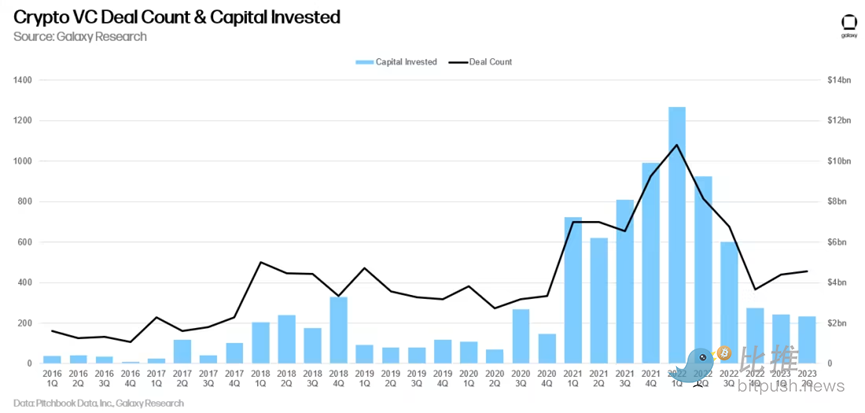
Although capital investments have not bottomed out, the transaction activity slightly increased in the second quarter, with 456 completed transactions, compared to 439 transactions in Q1 of 2023. This slight growth was due to an increase in Series A transactions from 154 in Q1 to 174.
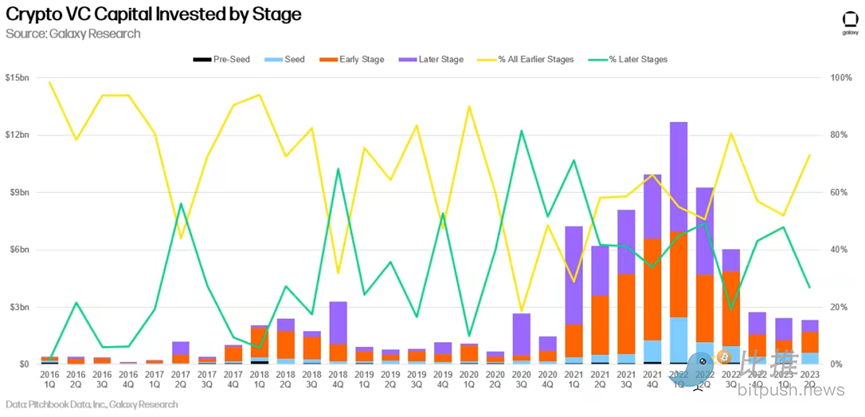
In terms of capital investments, early-stage transactions (Pre-Seed, Seed, and Series A) account for the majority of investments (73%), while later-stage transactions (27%).
Investment by Company Year
The companies established in 2021 and 2022 completed the most investment transactions in the second quarter of 2023.
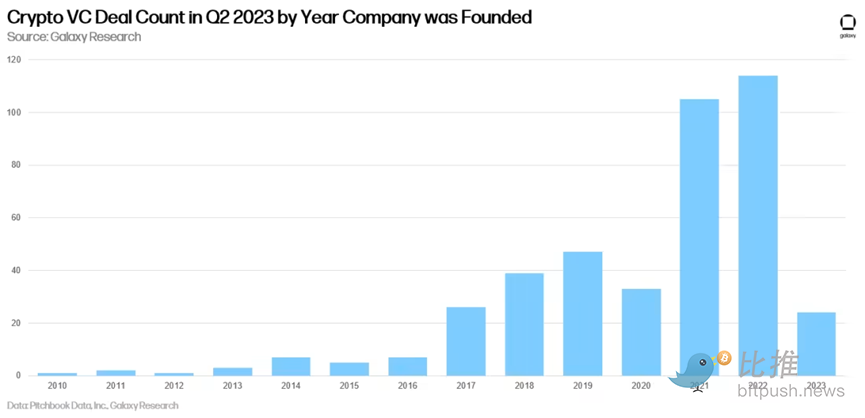
Unlike the first quarter of this year, companies in 2022 raised the most funding among companies of the same year, followed closely by companies in 2021.
Crypto Investment Company Headquarters
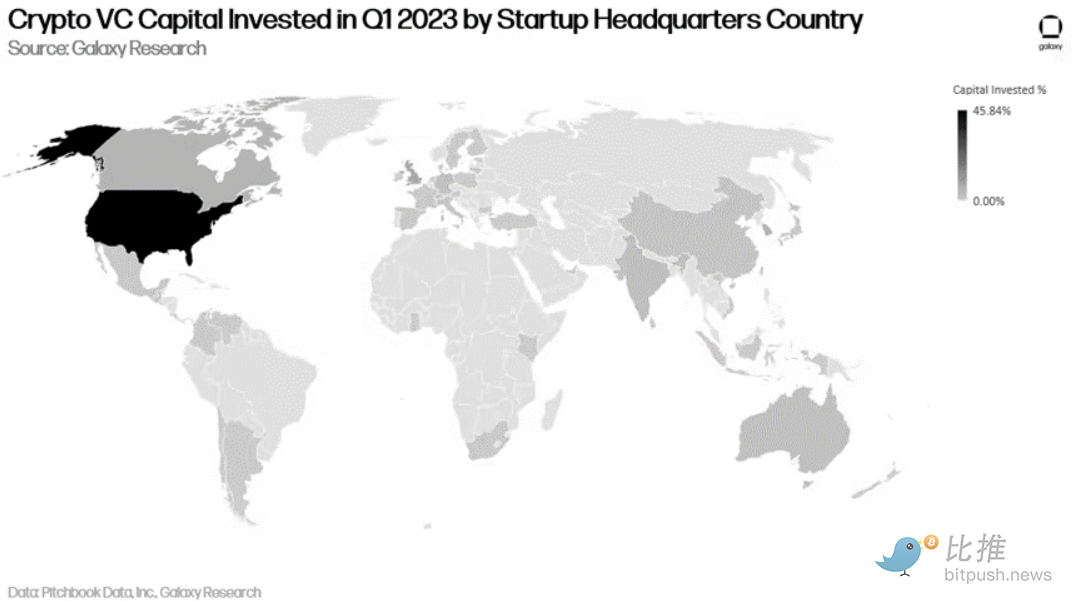
Companies headquartered in the United States dominate both the completed transactions and raised funding. In the second quarter of 2023, US companies raised 45% of the funding for crypto investment, followed by the United Kingdom (7.7%), Singapore (5.7%), and South Korea (5.4%).
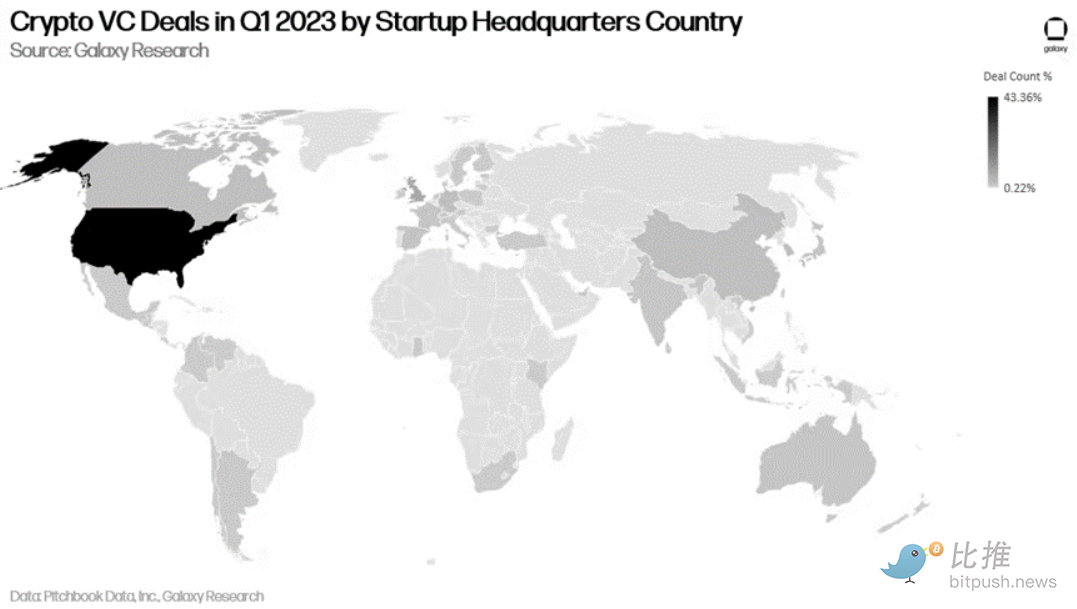
From completed transactions, the situation is similar. In Q2 2023, American companies accounted for 43% of all cryptocurrency venture capital deals, followed by Singapore (7.5%), the United Kingdom (7.5%), and South Korea (3.1%).
Size and Valuation of Cryptocurrency Venture Capital Deals
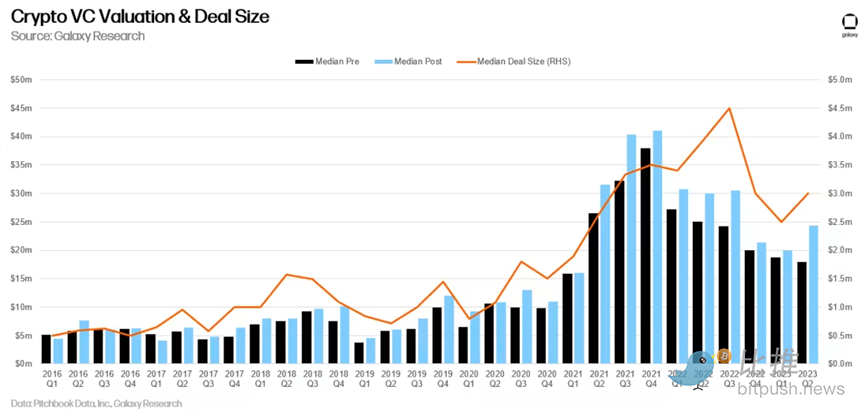
In Q2 2023, the valuation of the entire venture capital sector continued to decline, and cryptocurrencies were no exception. The median pre-money valuation for cryptocurrency or blockchain venture capital deals dropped to $17.93 million, the lowest level since Q1 2022. The median size of cryptocurrency venture capital deals in Q2 2023 was $3 million, with a pre-money valuation of $17.93 million.
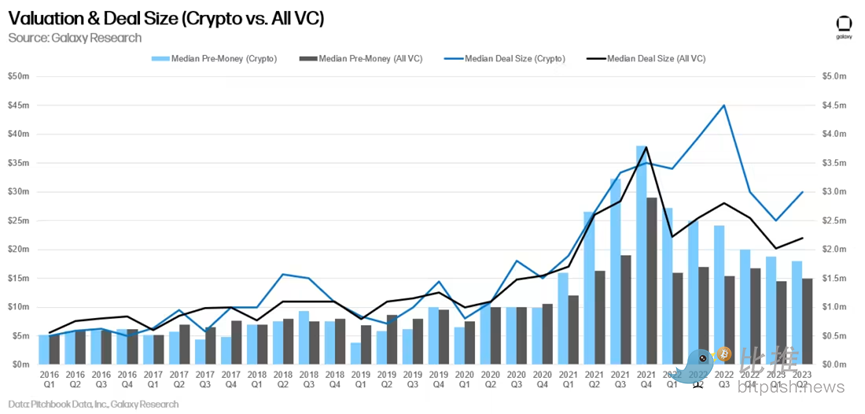
The decline in the size and valuation of cryptocurrency venture capital deals follows the trend in the entire venture capital industry.
Encrypting Venture Capital by Category
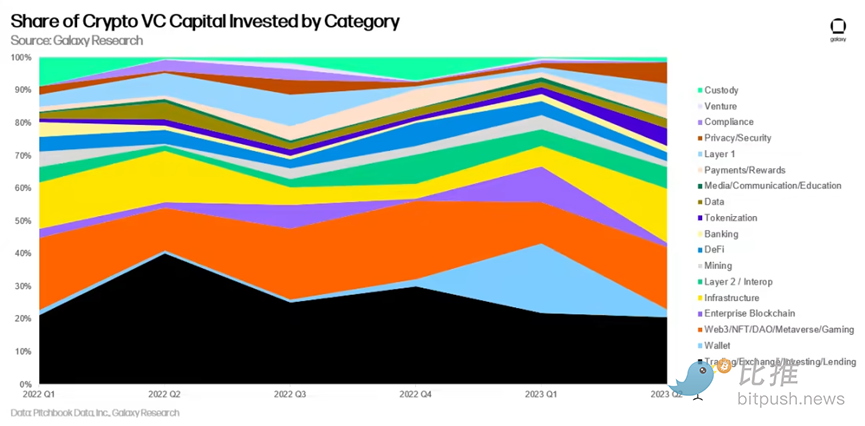
In the second quarter of 2023, trading, transactions, investments, and lending startups raised the most venture capital ($473 million, accounting for 20% of deployed capital). Web 3, NFT, gaming, DAO, and Metaverse startups raised the second highest amount of capital, reaching $442 million, accounting for 19% of all venture capital deployed in the second quarter of 2023. The Layer 2/Interop sector witnessed the largest transaction of the quarter - LayerZero, which raised $120 million in Series B funding. Magic Eden had the largest Web 3/NFT transaction, amounting to $52 million, Auradine had the largest infrastructure transaction, amounting to $81 million, and River Financial had the largest trading/exchange transaction, amounting to $35 million.
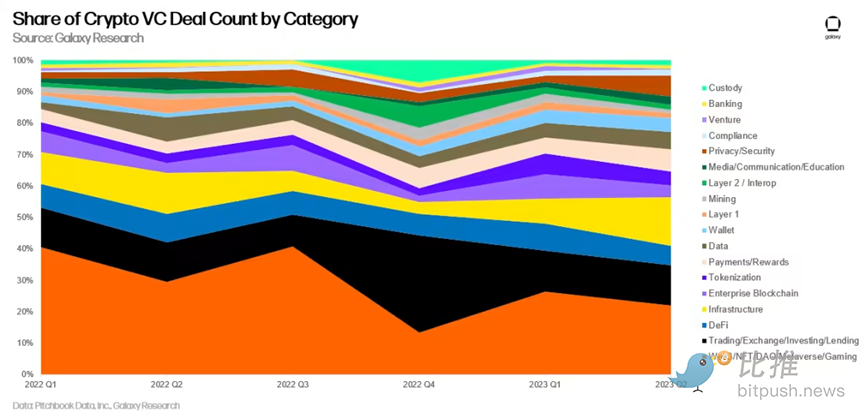
From the perspective of transaction volume, companies developing products in the areas of Web 3.0 games, NFTs, DAOs, and the Metaverse maintain the first position, followed by companies in the fields of trading, exchanges, investments, and lending. These trends have remained unchanged compared to the first quarter of 2023. It is worth noting that companies building privacy and security products have seen the highest increase in transaction volume compared to the previous period (275%), followed by infrastructure (114%).
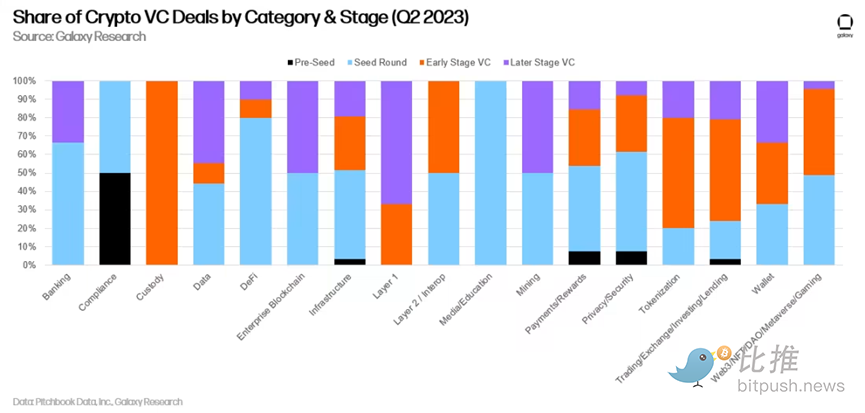
In the later stages of completed transactions, the largest share is in the mining and enterprise blockchain categories, while the compliance category (including chain analysis and regulatory tools) has the largest share in transactions completed in the seed stage.
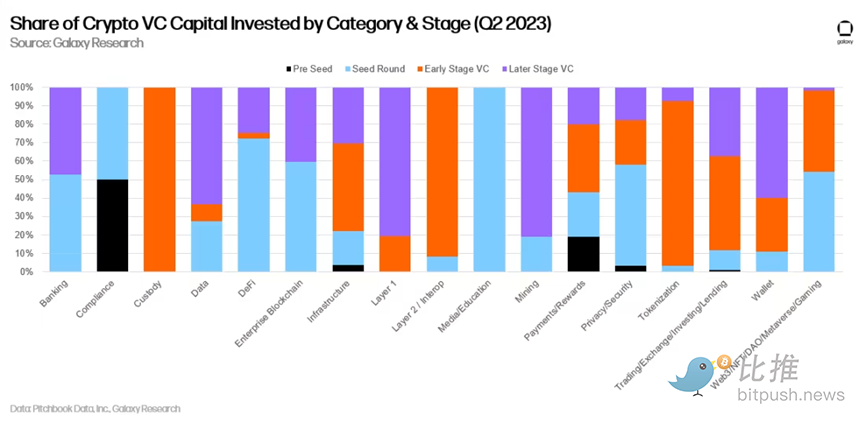
In terms of financing, most mining and Layer 1 transactions occur in the later stages, while custody, media/education, compliance, and DeFi have a significant portion raised in the early stages.
Cryptocurrency Venture Financing
We have worked with Galaxy Asset Management to compile the second quarter risk capital financing information for 2023 - that is, the funds raised by venture capital firms for new funds or fund years. Since the third quarter of 2020, the second quarter of 2023 has had the fewest new fund issuances (10) and the lowest allocation of funds ($720 million).
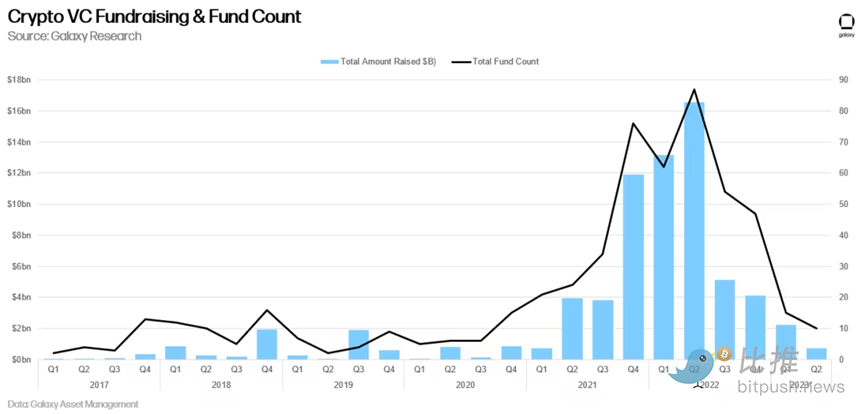
Combining the data for the first half of 2023, the average size of new funds is currently $236 million, with a median of $50 million, both significantly lower than last year.
Analysis and Conclusion
The bear market for crypto venture capital continues. Although trading volumes remain strong, the total capital allocated to crypto startups is still declining. However, the decline in crypto venture capital activity is not unique to the crypto industry, as the broader venture capital industry is facing resistance in the face of rising interest rates. Other important findings from the second quarter of 2023 crypto venture capital data include:
Relative to the previous bear market, crypto venture capital activity remains strong. Trading volumes and investment capital are still about twice as high as during the bear market period from 2017 to 2020, indicating that the startup ecosystem will continue to experience net growth over a longer period of time.
Venture capitalists continue to face a challenging financing environment. Rising interest rates have reduced investors' willingness to bet on long-tail risk assets such as venture funds compared to the previous decade of near-zero interest rate policies. Combined with the bear market in crypto assets and the fact that many allocators have been reeling from the dramatic falls of several venture-backed companies in 2022, venture capitalists will continue to find it difficult to raise new capital in 2023. In fact, the second quarter was the lowest in terms of new fund launches and capital allocation since the third quarter of 2020, which was one of the worst quarters for venture capital investment as global investors struggled with the COVID-19 asset collapse.
Lack of significant new venture capital will continue to put pressure on founders. Venture-backed startups have faced more difficulties in financing this year and will continue to face a challenging funding environment in the foreseeable future. Many more speculative and ambitious blockchain use cases that were funded during the bull market are now struggling to find investments as user enthusiasm and hype have subsided. Founders must focus on revenue and sustainable business models and be prepared for smaller-scale fundraising, potentially giving up more equity.
Pre-seed trading activity remains fairly active. While slightly down from the first quarter, the number of pre-seed deals has remained largely unchanged. If seed rounds and Series A deals are combined, these early-stage transactions account for nearly 75% of all deals, indicating that despite the overall sluggishness, entrepreneurs remain active and investors continue to pay attention. Savvy investors may find gems among those stubborn individuals founding companies in challenging environments, just as they did during previous bear markets.
The United States continues to dominate the crypto startup ecosystem. Despite mostly unfriendly regulatory environments, crypto startups headquartered in the US continue to attract the majority of venture capital activity. US companies hold a dominant position in the crypto ecosystem, with US policymakers seeking to retain top talent, promote technological and financial modernization and leadership, and extend the US's leadership position into the future economy. Formulating policies that promote growth and innovation is wise.
Web 3 continues to lead in transaction volume, while transactions still account for the highest amount of investment. This has been a multi-quarter trend, with traditional moneymakers—companies building exchanges, trading tools, etc.—raising the most funds, but the largest number of individual transactions flowing into emerging companies in the Web 3, DAO, metaverse, and gaming sectors.





