






GameFi's Crossroads: Continue P2E or Seek Breakthrough?


Original author: @Gannicus
Original editor: @HeiYuXiaoDou
Original source: BuilderDAO
In the current boom of P2E, our discussion on breaking away from this path dependency does not mean that P2E cannot succeed, nor does it oppose path dependency. Our goal is to examine the design ideas behind these models, understand their strengths and weaknesses, and make improvements.
01/ The Birth of GameFi
In 2020, Andre, the founder of YFI, proposed an idea on his Twitter: the current DeFi is still at the TradeFi stage, which is about trading finance, and as smart contracts and economic models become more diverse, there will be many gamified finances, called "GameFi." This definition is well created and accurately predicts the future. GameFi lives up to expectations and has developed into an independent track, with many temporarily popular GameFi projects.
In fact, before this term appeared, GameFi already existed. The earliest blockchain GameFi was Fomo 3D. The Fomo 3D team made no secret of their reputation - they called themselves "Exit-Scam." They believed that the essence of blockchain projects is essentially playing a game of pass-the-parcel, and the gameplay is very opaque to users. They designed a completely transparent pass-the-parcel game for users - this game can be seen as a lottery on the chain.

The game rules are simple:
Users enter the Fomo 3D game by purchasing Keys, which are equivalent to shares. In each round of the game, which lasts for 24 hours, users can receive continuous dividends from buying Keys. The more Keys they have, the more dividends they will receive;
Whenever a player purchases a Key, the remaining game time increases by 30 seconds, up to a maximum of 24 hours (the first two mechanisms basically determine that this game is difficult to truly stop);
The price of Keys will continue to rise as the entry funds increase (the price increase mechanism is written in the smart contract);
The ETH used to purchase Keys will be allocated to the prize pool, Key holders (dividends), the official team, and the airdrop pool, etc., according to the proportion based on the team chosen when buying Keys;
There is also a rolling airdrop prize pool, and each purchase can participate in the lottery draw with a certain chance (about 1%) to win rewards of 2-5 ETH.
The teams are divided into Snake, Bull, Bear, and Fish. After purchasing the Key, ETH distribution rules.

At the end of each round, the last player to buy in becomes the winner, receiving the majority of the ETH in the jackpot. The remaining ETH in the jackpot is distributed according to the distribution rules of the team the last player to buy in belongs to, as follows:

There is also a rolling airdrop jackpot, where each purchase can participate in a lottery with a certain chance (around 1%) to win rewards of 2-5 ETH.
In summary, the rules needed to end the game are:
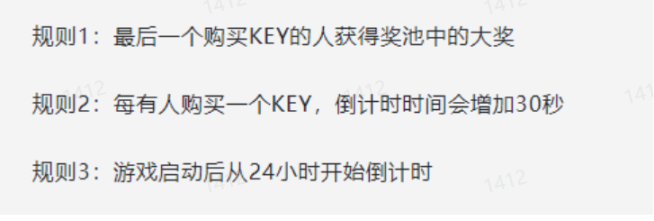
The ultimate winner doesn't like to choose the Fish team, and there are also more people choosing the Fish team - so there are more people to distribute the jackpot. How to get the ultimate jackpot? You need to keep waiting for the game to cool down. Because if it doesn't cool down, the countdown can't even be less than 3 minutes.
In theory, if there is no genius idea to take away the jackpot, the game seems to be endless - there will always be someone (or a smart contract script) waiting to buy the Key when the countdown gets shorter, and then praying that no one does the same thing.
Not long after, a genius appeared: he took down 10,469 ETH with a cost of approximately 2.7 ETH. From the browser, it seems that he just used a smart contract script to buy a Key every time the countdown had 3 minutes left. But he did something amazing - he managed to congest the Ethereum network, preventing miners from packaging transactions for others to buy Keys after his purchase. During the 3 minutes he won, in 12 blocks, Ethereum was filled with many high-Gas transactions initiated by 5 brothers (the nickname given to the hackers by the replayers) — no miner had time to package transactions for the next person to buy the Key. He succeeded.

Fomo 3D is an ancient model, but even now it still has a strong sense of design. Recently, there is a Meme project called BDOW in the BRC 20 ecosystem. Its official website design is based on Fomo 3D.

The birth of Fomo 3D was short-lived, but it also had a profound impact: it made us realize that blockchain games can be so different from traditional ones - blockchain can create more new paradigms and shape new business models. Subconsciously, we assumed that online lotteries on the blockchain would be the same as offline ones, just like there is not much difference between online lotteries and offline ones. But when we actually saw it, we realized the huge difference. After DeFi Summer, there have been countless new paradigms for financial behavior on the blockchain.
02/ The Maturity of GameFi
AXIE: Defines Gamification Finance as Play to Earn
Axie and SPTEN both inherit the breeding attribute from CryptoKitties - they use breeding as a point to attract user participation. Essentially, the breedable GameFi is a tulip bubble model. Everyone rushes to buy the rarest tulips to showcase and breed even rarer ones. Breeding itself is meaningful because it brings new complexity and raises the system's complexity ladder - the more complex the system, the further away from fragility it is. Breeding behavior brings new communities of interest and identity, which are the breeders. The game between players becomes more complicated, and breeders will not simply buy/sell NFTs based on price fluctuations; they will have their own plans.
Axie Infinity, as one of the most groundbreaking blockchain games, has initiated the industry paradigm of Play to Earn. Its dual token economic model has also become the mainstream model adopted by subsequent blockchain games.
Axie presents game characters (pets called Axies used for battles) in the form of NFTs. These NFTs serve as game tickets with different attributes. Each player needs to bring three Axies for battles, and winning battles will result in rewards of SLP or AXS tokens. The game has two modes: Adventure mode (PvE) battles, in which winning players can receive SLP rewards, and Arena (PvP) battles, in which winning players can receive AXS rewards. Players at higher rankings can receive additional AXS rewards.
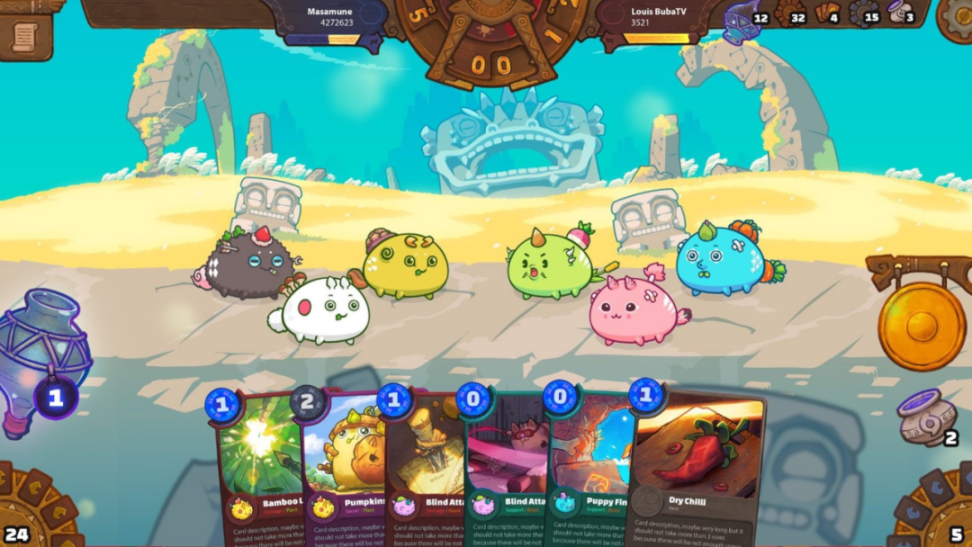
Axie inherits the breeding mechanism from CryptoKitties: Axies can breed with each other to produce new Axie NFTs. The new Axies are the same type of NFT assets with the same functions, and their attributes are randomly combined from the parent Axies' attributes. Breeding new NFTs requires the consumption of both AXS and SLP, and a player can breed up to 7 new Axies, with the number of SLP consumed increasing each time. The consumption of AXS remains constant.
In summary, Axies can be obtained through official presales, secondary market purchases, and breeding using existing NFTs.

Essentially, Axie follows a model of dual FT tokens + NFTs:

From the perspective of an ordinary player, the path to playing Axie is as follows:
Entry: Players spend U to purchase game NFTs for entry.
Gameplay: Earn SLP through PvE battles; earn SLP and AXS through PvP battles, with higher-ranking players winning AXS.
Consumption / Reinvestment: Players can use the initially purchased NFTs to breed new NFTs, consuming a certain amount of SLP and AXS. Players can also stake AXS to receive AXS rewards supported by the treasury's income.
Exit: Sell game NFT, SLP, and AXS tokens on the secondary market.
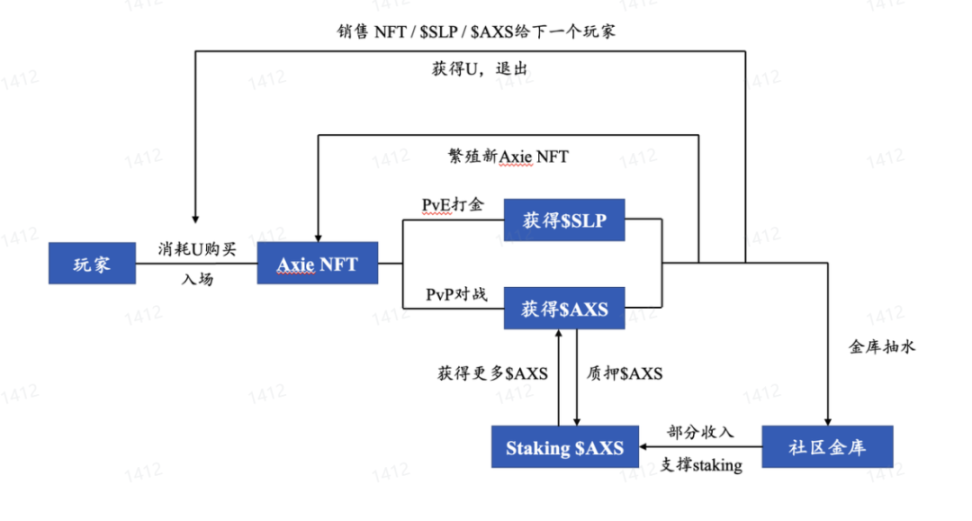
The entire Axie ecosystem functions as a system, with capital input from players' funds and new players taking over game assets sold by exiting players and injecting new funds; capital output occurs when players exit and sell assets for funds, some of which are used to finance external payments from the community treasury.
In order to maximize personal earnings, players' best strategic choices are: selling acquired tokens directly when the prices are high, and then selling NFT after accumulating a certain amount of tokens; or taking the breeding path, using tokens to breed NFTs and generating more tokens to sell NFTs after accumulating a certain amount of tokens. When NFT prices are high, players consume tokens for NFT breeding and directly sell the NFTs.
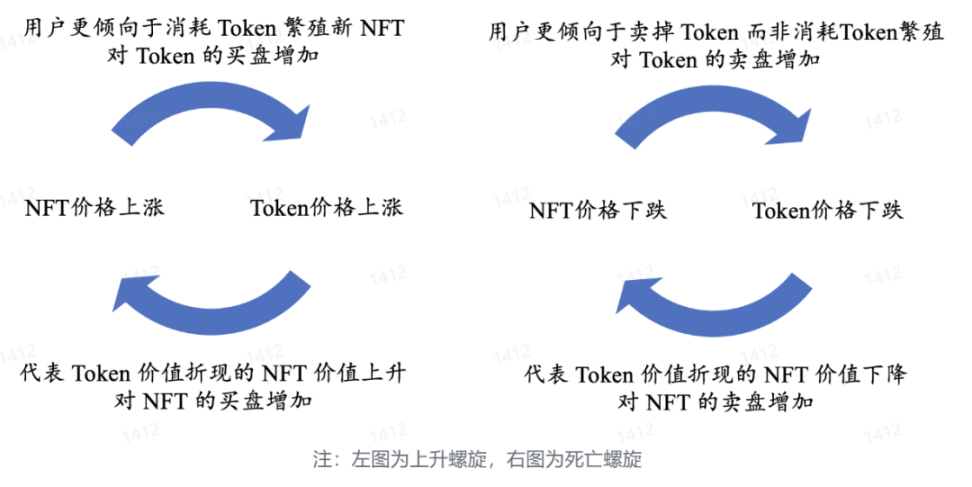
The Ponzi structure of Axie is evident, particularly in the pronounced spiral effect -- the price trends of the two assets reinforce each other, leading to rapid escalation and spiral downturn of game asset prices.
When the growth of game players accelerates, the demand for game assets continues to rise, and both exiting and entering players drive up the transaction prices of game assets, resulting in an increase in game valuation and higher gold farming income, forming a positive feedback loop;
When the growth of game players slows down, the demand for game assets decreases, exiting players need to sell assets at a discount, which lowers the game valuation to the transaction price, reduces gold farming income, and triggers a market spiral downward, essentially signaling the end of the game's lifecycle.
STEPN: Move to Earn, promoting Gamification Finance
STEPN is an attempt to extend the gamified decentralized model to other fields. It was initially created on the Solana blockchain and ranked fourth in the Solana Hackathon Chain Game category, gaining early attention. The biggest selling point of STEPN is the combination of GameFi and offline sports, which they call the Move To Earn model. After users download the app and successfully register, they create a new in-app wallet and transfer the cryptocurrency SOL or BNB into the wallet. They can then purchase a pair of NFT virtual sneakers and start earning money by running outdoors.

The amount of money earned depends on the user's exercise situation and the factors of the sneakers. The sneakers have different attributes, types, qualities, and levels. Users run within the effective energy time range corresponding to different sneakers and can earn the game token GST, which has unlimited issuance, to upgrade their sneakers and gems, unlock slots, forge new sneakers, or directly exchange them for stablecoins.
The sneakers include four types: Walker, Jogger, Runner, and Trainer, each corresponding to different pace ranges and basic rewards. The quality of the sneakers includes: Common, Rare, Epic, and Legendary. Players use different colors to represent them: gray represents Common, green represents Rare, blue represents Epic... After the sneakers reach a certain level, players can unlock corresponding gems and slots to improve the sneakers' attributes, including efficiency, luck, comfort, and elasticity. In addition, the quantity of sneakers also affects the income of GST. Players generally adopt a combination of "quantity + quality" configuration of sneakers to maximize token earnings, such as "one green and eight gray".
STEPN also has a breeding mechanism. If you have multiple pairs of sneakers, every two pairs can be used to mint a new shoebox, just like blind boxes, and open up new sneakers. The minting process consumes a certain amount of GST. The newly opened sneakers can be traded for profit. After a user's sneaker level reaches level 30, they are eligible to receive governance token GMT. In addition to upgrading sneakers and permanently increasing the success rate of gem synthesis, GMT can also be used for staking to participate in project voting and unlock more gameplay. Corresponding to the unlimited issuance of GST, GMT has limited issuance and the quantity issued decreases each time. In summary, for ordinary users who want to play STEPN Chain Game, the entry ticket is an NFT virtual sneaker, the real application scenario is outdoor running, and the earnings are GST or GMT. As for how much income, it depends on the player's strategic ability.
In terms of gameplay and mechanics, STEPN has two main innovations: first, it offers more flexibility through adjustable parameters that create a Ponzi structure. Whether it's matching different types of shoes, quality differences, durability and repair mechanisms, or choices of efficiency, luck, comfort, and elasticity, STEPN provides more macro controls. Second, it raises the threshold for mining - you can only mine the appreciation currency GMT at level 30, before that, you can only mine GST. In the same model of dual FT tokens + NFT, this design allows STEPN to surpass Axie. The threshold setting blurs the calculation of players' return on investment and increases their investment, correcting the idea of players wanting to maximize "free rides".

The inspiration brought by STEPN is not limited to this - it should make us see how a GameFi model can bring new changes to a specific industry. The walking (health) industry has always had no shortage of attempts. In a broad sense, we can also refer to them as "coinless" GameFi. The earliest player in this field was the WeChat Mini Program "Step Counter". It was a genius design: users earn points by walking, and these points can be exchanged for goods in the mall. The clever part is that the goods have zero cost - because the flow of this mini program is large, merchants are willing to provide hundreds of small commodities for millions of people to see their products. What if a user is interested and wants to search for it on Taobao? When Xiaomi released its balance scooter, it was immediately put on the platform. Is there any other way to use the money from a balance scooter to let tens of millions of people know about Xiaomi's new product? At one point, the number of daily active users of the Step Counter reached 30 million, only second to several large internet companies' mini programs, making it very popular. However, the failed listing made the Step Counter give up on bigger dreams and focus on monetizing flow, and now the Step Counter page is full of small advertisements. After that, Qubu tried to create a point-based Step Counter independently as an app. However, their crude and faulty economic model couldn't support their ambitions, and a year later Qubu had its license revoked.
03/ A Ponzi Structure is a Double-edged Sword
Although the new waves push the old waves forward, the beach is littered with the corpses of this new wave called GameFi. After being tested by time, many DeFi economic models have achieved long-term stable operations, successfully achieving incentive compatibility and even having locally optimal solutions - such as the VE architecture. However, in comparison, the economic models of GameFi are still in the exploratory stage. We haven't seen very good models that combine gaming. At first glance, it is densely written with P2E.
Let's first look at DeFi, the "predecessor". In Buidler DAO's introductory article on Tokenomics, "Tokenomics, the Economic Order of the Crypto World", we divided the incentive layer of DeFi, which is the structural layer that balances the circulation of tokens between project parties and users, into three categories: governance mode where tokens only have governance functionality for the protocol (e.g. UNI); pledge/cash flow mode where tokens generate continuous cash flow (e.g. SUSHI); and the voting custody mode where pledged tokens gain custody tokens called veToken, and veToken is used to facilitate LP yield voting (e.g. CRV). From the timeline perspective, the three types of governance tokens have a clear iterative relationship: later ones are iterations and upgrades of the previous ones, gradually becoming more appealing in terms of value capture and incentive effects. In terms of results, capital has a more acute response to mechanisms compared to miners, users, and other participants. Curve's voting custody mode has gradually become the most popular model, with a large number of DAO projects, including Buidler DAO itself, adopting the veToken architecture. In "An In-depth Analysis of the Mechanism and Innovation of the veToken Economic Model", we provide a detailed explanation of the development history and design formulas of the veToken architecture.
Now let's turn our attention to GameFi, the "new wave". Can GameFi come up with an optimal solution like DeFi? It's much more difficult. DeFi can be clearly divided into the business layer and the incentive layer because DeFi is essentially a usable on-chain tool. The usable properties of DeFi are the business layer, such as the lending protocol itself, the AMM market-making protocol itself, and so on. The clever mechanism of encouraging users to stake instead of selling their tokens and allowing the system to enter Nash equilibrium is the incentive layer.
As long as DeFi is a necessity, it does not need to heavily rely on future Tokenomics (or debt) to obtain initial traffic. DeFi can easily stay away from a Ponzi-like structure.
The embarrassment is that games cannot become a necessity. The prerequisite for being addicted to a game is that you have to play the game first. It's a dead end. How to break the deadlock? Buy traffic. Traditional games roughly require twice the development cost for marketing and promotion. P2E (Play to Earn) GameFi takes a different approach. They don't spend money on marketing, instead they directly find early players and promise them "Earn" tokens to encourage them to play more and earn more.
The tokens promised must have value and a buying market, they cannot be empty promises. The project team and the market serve as the buying market. Who is stronger, the buying market or the selling market? At first, the buying market is stronger, but gradually, because the distributed tokens will become the opposing market, once the number of new users decreases or the earnings decrease, players will rush to sell game assets, and the trading volume will exponentially decline. This is called a Ponzi structure. This is the reason why P2E has a short lifespan and the cause of the "death spiral" phenomenon encountered by GameFi in practice.
In the game theory definition of a coordination game like the Ponzi structure, there are two Nash Equilibria (NE): one is that everyone chooses to trust and invest, and the other is that everyone chooses to mistrust and withdraw at the appropriate time. The former is the upward spiral process of the Ponzi structure, and the latter is the inevitable "death spiral" of the Ponzi structure- the process of withdrawal (this is common, even commercial banks face withdrawals at the end of credit cycles). I will explain the Ponzi structure in detail in my later article "Ponzi Structure - The First Principles of Economic Models".
Most GameFi users are speculators, and they are well aware that they are playing a Ponzi game. A very small percentage of them may choose to hold game assets in the long term because they genuinely like the game, but they are more likely to hold NFTs because they are breeders or gold farmers. When they encounter the right opportunity or capture dangerous signals, they will not hesitate to sell. Let's illustrate the game of users when they encounter a selling opportunity:
α represents the strategy of stop-loss / withdrawal, β represents the hodl/long-term holding strategy. For users, since they are here for speculation, they naturally assume that their opponents are also here for speculation. Regardless of the opponent's strategy, the user's best strategy is to cut losses early.
However, flaws cannot hide the beauty. The Ponzi structure brings not only a downward spiral but also an upward spiral to GameFi. GameFi certainly has its shortcomings, but it has more advantages, so much so that it is worth it for practitioners to go all in. In my opinion, there are two major advantages:
Building consensus around token value
This is also the greatest function of tokens - to gather consensus on things in a cost-effective way.
As we mentioned earlier, the biggest feature of GameFi compared to traditional Web2 games is not that users own the assets, but that it provides a vehicle for imagination of the game's market value.
As a traditional game, no matter how much players like it or how much they earn, they cannot grow together with the game's market value.
Buy volume (cash after) postposition
P2E (Play to Earn, the same below) GameFi took a different approach, using "Earn" tokens to directly pay players to play. After issuing tokens, you can't just leave them be, you have to constantly support and promote the market, which is equivalent to paying off the debt before payment. This is a kind of "postposition" buy volume.
And the cryptocurrency ecosystem provides the "only real potential solution" to solve the problem of cold start — even if the content and products on the platform are incomplete, users know that they will own the platform through tokens, and as long as they use and contribute in the early stages, they can gain huge potential economic returns. The cost of this model is the influx of speculators and the delay in Product-Market-Fit verification, but for breaking the network effects of monopolies, these sacrifices seem acceptable. —— Paradigm
Just as the technical aspects of blockchain may not represent a paradigm shift, the gameplay of cryptocurrencies provides a possibility to challenge trillion-dollar companies like Google and Facebook. Network effects are the strongest moats for these internet platform companies, and due to the "chicken or egg" problem of two-sided platforms, there are hardly any emerging platforms that can shake them.
04/ How does GameFi achieve a good Nash equilibrium?
However, in many Web2.0 games, what we see is not such a Nash equilibrium.
What we see is that even if skins cannot be traded, League of Legends generates annual revenue of up to $12.4 billion, and the monthly profitability of Honor of Kings reaches $200 million, surpassing the majority of A-share listed companies; what we see is that NetEase's "Fantasy Westward Journey" still has thousands of players addicted to it, with some spending hundreds of thousands, and the most expensive equipment can be sold for 10 million; what we see is that Dota 2, with tradable equipment, has dominated the esports prize money rankings for years, with the prize pool of Ti 10 (The International) reaching $40 million, all accumulated through global players purchasing "handbooks" containing skins within Ti.
Why does rational game theory fail when it comes to the top games of Web2.0? Because games have always been a "black hole" for the "rational actor hypothesis". Classical game theory does not consider people as rational actors when they are influenced by emotions, so it is not the focus of game theory research; while recent advancements in game theory consider people's emotional expressions — as long as they appear stable in the long term — as a Nash equilibrium of the game.
As long as we change the "rational" standard of various strategies from "trading account" to "social account", irrationality disappears. It seems irrational for older people to buy health products at twice the market price, just because young salespeople flatter and inquire about their well-being: not buying health products means not spending money, buying affordable health products means spending -500 yuan, buying Xiao Wang's health products means spending -1000 yuan, yet the elderly choose the worst strategy. But what if the elderly themselves are not sensitive to trading accounts but sensitive to social accounts? What if the elderly believe that as they grow older, money is something external to them, and it's normal to spend a little money on health products to extend their lives? Let's illustrate the corresponding gains and losses using percentages. Suppose an elderly person has 100,000 in savings:

The loss in the trading account for the elderly is only a small part, and this small part is likely what they have mentally allocated to spend; but they gain a lot in social terms. Xiao Wang interacts with them, has conversations with them, and this companionship increases their quality of life by 50%. They are happy, and it's worth it.
Isn't this the same principle for luxury goods and live streaming platforms? Nowadays, many people spend their days in the live broadcast room of DaSimawang, an anchor for the game "League of Legends," constantly changing their Douyu ID and giving large donations to DaSimawang, just to hear him pronounce their cleverly designed homophonic IDs. They spend 100 yuan for an airplane, just to hear him pronounce it once. Under the capitalist system, the accumulation of wealth is achieved through the exploitation of surplus value. The accumulation of surplus value is nonlinear and follows the Matthew effect. When there is an accumulation of surplus value, people's need for showing off increases because their trading accounts have little impact on them anymore - I spend 100 yuan to give a donation to the anchor, which is less than 0.001% of my total assets; but I achieve the satisfaction of showing off and socializing, which boosts my social account by 70%. Live streaming platforms and luxury goods may seem unrelated, but they both exploit this psychological need for showing off.
This is how games should be. When we emphasize the metaverse and Web3.0, we forget that excellent games of Web2.0 have already established strong moats, immersing players in them. Single-player games on Steam have successfully created immersive worlds, extending people's lives like movies. Online games focus on social interactions: "League of Legends" and "Honor of Kings" players cannot resist dressing their favorite heroes in the best-looking skins, even though these skins cannot be traded. You may ask: since skins cannot be traded, does it mean that even after spending so much money, I can't recoup my investment by selling my account when I stop playing? Although this is true, many years later, even if they no longer play the game, you rarely see them trading their accounts. They prefer to leave them as witnesses of memories. This is the identity recognition that the metaverse truly needs.
Game items are a form of social currency and a conventional identity recognition. Players either hope that game items themselves can directly help them dominate, like the items in the game "Fantasy Westward Journey," or they hope that when they dominate in a fair game, other players will not only admire their skills but also compliment their good looks. Players see game characters as a reflection of themselves, an avatar.
Our game design should immerse players and help them find a sense of identity. Instead of deducting money from their "trading accounts," we should deduct it from their "social accounts" when they purchase game assets. If we can't achieve this, our game will just be a financial tool, and the relationship between players and the game will become a rational game between individuals. Since the structure of the game is clearly a Ponzi scheme, the players' strategies are obvious.
If a game has strong gameplay, players are playing a Game; if a game has weak gameplay, players are playing Game Theory.
It has been 3 years since the concept of GameFi was introduced. Although it may not be enough time to develop AAA-level games, there should still be sufficient time to develop decent games. So why hasn't Web3.0's GameFi been able to achieve this?
In my opinion, there are many projects that take game development seriously, but very few projects that seriously study economic models. Too many games blindly follow market trends and blindly copy popular economic models. When designing an economic model for GameFi, the first step is to clearly define what type of GameFi you want to create.





