






Old-school DeFi protocols lead the market recovery, a flash in the pan or a promising future?


Original Author: Ignas
Original Translation: Luffy, Foresight News
DeFi 1.0 is making a comeback. Although it never really disappeared, the protocols have been running as planned, but this hasn't always been reflected in token prices.
Now, the prices of established DeFi protocol tokens are leading the cryptocurrency market.
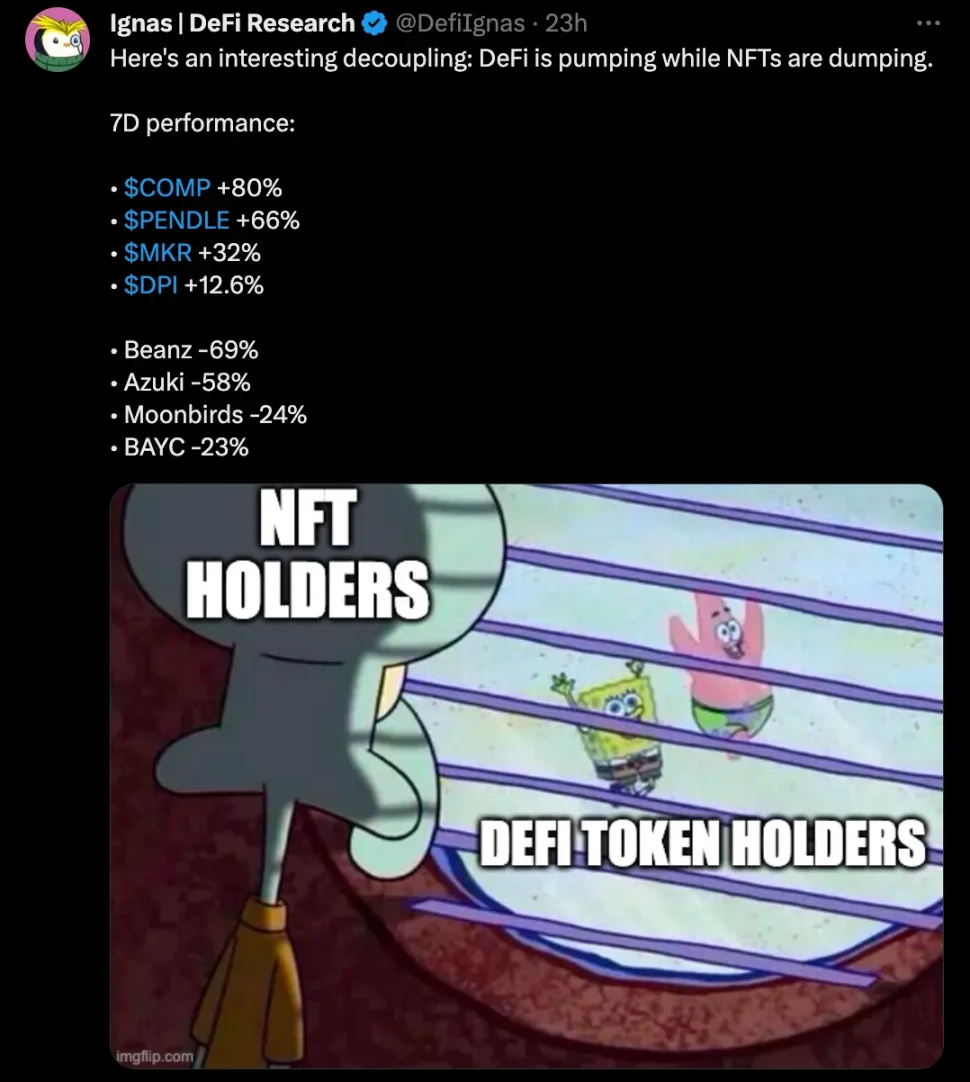
So, why are DeFi tokens so hot right now?
The Pump 1.0
DeFi 1.0 has had an impressive performance in the past two weeks:
COMP+ 117%
AAVE + 48.5%
ZRX + 35.1%
MKR + 33.6
UNI + 23.8%
DPI + 20.1%
However, this snapshot doesn't capture the full story of the DeFi 1.0 revival, as not all DeFi 1.0 tokens have performed well.
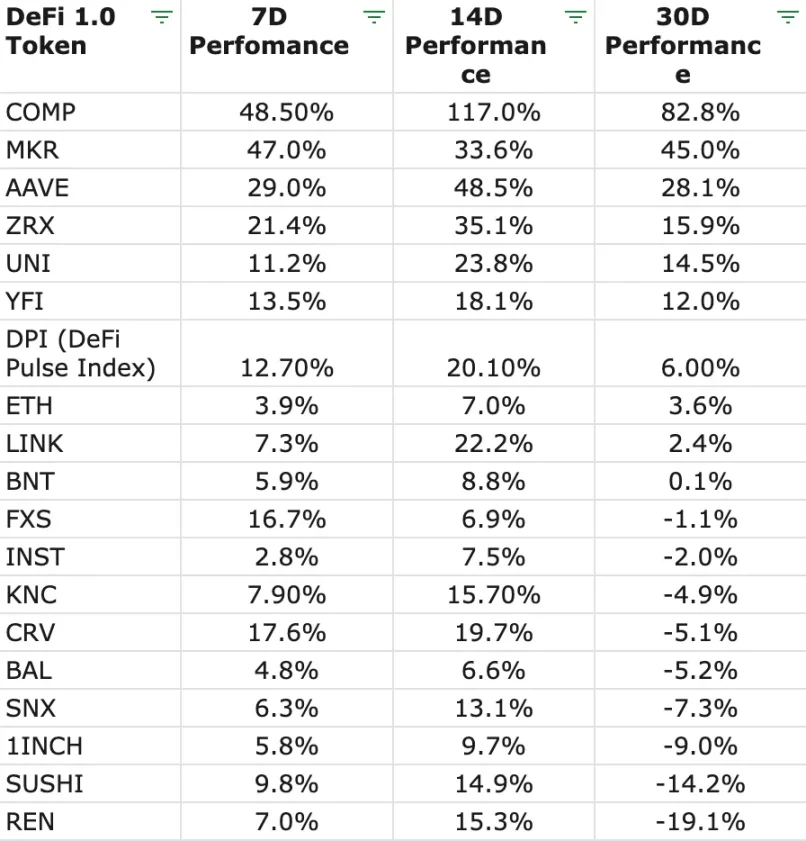
In fact, all DeFi 1.0 tokens have been fairly stable in the past two weeks, with FXS and BAL being the exceptions that failed to surpass ETH.
However, looking at the 30-day data analysis, only a few of them (COMP, MKR, AAVE, ZRX, and UNI) have performed exceptionally well. More than half of the DeFi 1.0 tokens have failed to outperform ETH.
Nevertheless, I believe the rebound of DeFi 1.0 will continue, for the following reasons.
Starting from a low point
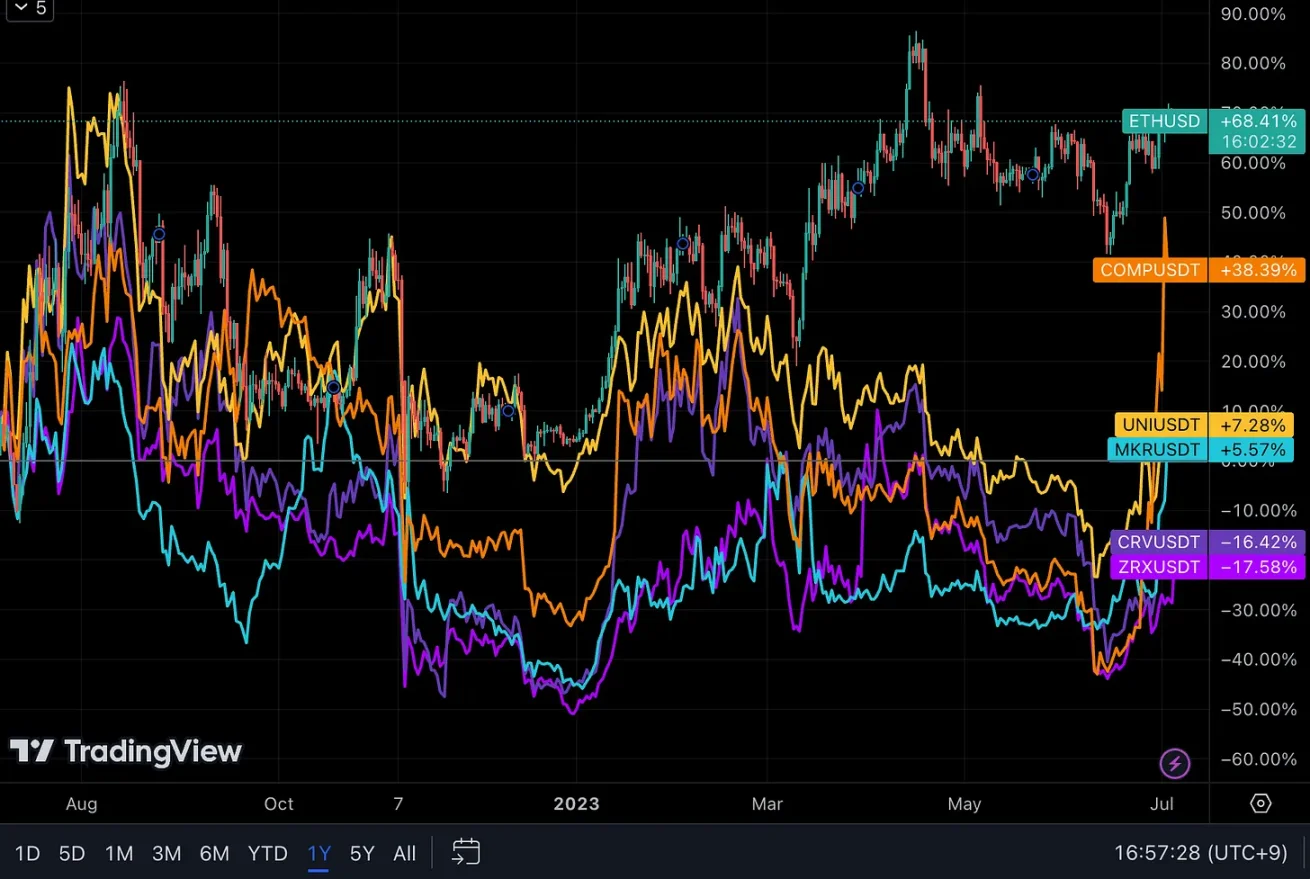
Despite the top DeFi 1.0 tokens performing well in the past month, their overall performance over the year still lags behind ETH.
ETH has risen by 68% , and DeFi 1.0 tokens need to catch up quickly.
So, is the bear market over?
Maybe it's just a simple cycle rotation. Memecoins have already had a wave of breakout, and now as the market is relatively calm, traders and long-term investors are looking for undervalued assets, and I am one of them.
In my opinion, DeFi 1.0 tokens offer unique value propositions.
Stand the test of time
DeFi 1.0 protocols may have excellent teams, investors, and products, not to mention audits from top companies.
I know that the yields offered by Aave, Compound, Maker, or Instadapp (disclaimer: I am an ambassador) may be lower than some flashy new projects, but I am willing to accept lower returns because they allow me to sleep more soundly at night.
DeFi 1.0 protocols have been around since 2020 or even earlier.
Compound Finance, Instadapp, and Aave all debuted in 2018 (Aave was renamed from ETHLend in 2020). MakerDAO even launched the DAI stablecoin at the end of 2017, although DAI had been in development since 2014.
Despite some issues, all of these platforms survived the 2020 Corona crash and the recent 2022 CeFi collapse.
This resilience becomes apparent over time. In my interview with Sanket from Polygon regarding Polygon's development, he shared the following:
The only real audit is the one that stands the test of time. - Sanket, Growth Lead at Polygon
Even today, among the top ten protocols with the most locked assets, eight were launched before 2021. And four of these ten protocols were launched before 2019.
But that's just one reason for the continued existence of DeFi 1.0.
Strong financial position
According to a survey of nearly 500 founders, two-thirds of startup failures are due to financial difficulties.
CB Insight research shows that 47% of startup failures in 2022 are due to lack of funding, nearly double that of 2021. Additionally, 44% of failures are often due to poor financial planning or insufficient funds resulting in cash shortages.
The study was conducted on non-cryptocurrency companies, but it also applies to DeFi startups. For example, Friktion Labs on Solana closed earlier this year due to "insufficient revenue."
This is why it is crucial to invest in projects with good financial conditions.
Recently, the best-performing companies in DeFi 1.0 have a substantial amount of assets. Uniswap has $2.3 billion, while Compound, Maker, and Aave have $135 million to $152 million (including their own tokens) to fund their development.
In terms of daily revenue, DeFi 1.0 is also performing strongly, although Compound's daily revenue is only $5,500, much lower than Aave ($72,000) or Curve ($25,000).
Maker DAO, in particular, has shown strong performance. According to Makerburn.com, Maker is expected to earn a profit of 69 million DAI.
Maker's revenue has been growing, mainly attributed to Real World Assets (RWA), reaching $100 million per year.
Thanks to the "burn mechanism," this value ultimately flows back to MKR.
The burn mechanism aims to increase the value of the MKR token. By using the remaining Dai to purchase MKR tokens and reintroducing them into the market as Uni v2 LP tokens, this process increases the on-chain liquidity of MKR, potentially adding value to MKR token holders.
Continued Development and Iteration
Since its inception, the DeFi 1.0 protocol has seen significant development.
Although there have been multiple upgrades and changes, the market seems to have just begun to recognize the extent of these improvements.
Take Aave and Compound as examples. Both have successfully launched their third iterations and have planned unique development paths for the new versions.
While Aave v3 emphasizes capital efficiency, Compound III has abandoned the fund pool risk model and adopted a model that only allows one "base asset" and supports other cryptocurrency assets as collateral.
More importantly, Aave and Curve are developing their stablecoins GHO and crvUSD, respectively. These stablecoins will further improve capital efficiency, reduce reliance on native token issuance to attract liquidity, and increase the governance value of native tokens.
Let's not forget the significant progress of Synthetix V3, which introduces multi-collateral liquidity, permissionless pools, and cross-chain liquidity.
0x (ZRX) has also performed exceptionally well in the past two weeks. Part of the reason is that the newly upgraded Matcha DEX aggregator uses the 0x API.
Instadapp has a TVL of 2.1 billion dollars and recently launched Avocado, a top-notch multi-chain wallet that can also be used as a blockchain aggregator. The team is also preparing to launch the next generation of multi-chain multi-signature wallets, which will have features such as single gas transaction, same address wallet, and account abstraction.
Of course, Uniswap V4 is also under development. But when it comes to upcoming changes, I am most optimistic about Maker.
Maker is in its final stages with the goal of making Dai a fair global currency. The DAO architecture has been modified to include smaller subDAO units for more efficient governance. Each subDAO will also have its own token, which will be launched through fair launch via MKR/DAI liquidity mining.
Maker even introduced a Dai-based fork of Aave called the Spark protocol. Thanks to the DSR, Dai holders can earn a yield of 3.49%.
Finally, if you want to know why Compound's COMP has been rising, please check out my post on Twitter.
Old and Boring vs New and Exciting
I am bullish on the mentioned DeFi 1.0 protocols, which have the first-mover advantage but are still evolving.
Every month, there will be a large number of new protocols launched, hoping to surpass the "old and boring" DeFi 1.0 protocols and become the leading liquidity layer in DeFi.
However, it is a challenge to surpass those protocols that have stood the test of time and lock billions of dollars in smart contracts in a fraudulent industry.
Nevertheless, I am optimistic about new and exciting protocols, such as the top 5 new DEX I discussed last week.
What I see in these emerging protocols is a unique niche market that either builds on top of existing DeFi 1.0 protocols or complements them.
Protocols like Liquity, Morpho, Maverick, GNS, PENDLE, and GMX are newer and exciting protocols that I am closely monitoring.
I also track venture capital firms to discover innovative protocols because I believe those protocols that successfully raise funds during bear markets will thrive in bull markets.





