The Internet bubble is over, and the future belongs to the era of encrypted on-chain technology.


Author: YANCEY STRICKLER
Translated by: Block unicorn

Cryptocurrency is dead, and only a few people will mourn it. Now, the bubble has burst and real revolutionary work can begin.
In 2022, people witnessed the collapse of the cryptocurrency world.
Apart from those who unfortunately lost large sums of money during the pandemic or had their Twitter avatars targeted by laser eyes, few mourned the decline of cryptocurrency. Its excesses have become an expensive, absurd living example, symbolizing scams and hollow money (assets without substantial backing) in modern human history.
This period of frenzy cannot last forever, and indeed it is not. The cryptocurrency era is now coming to an end. Not because of SBF (although he has indeed made contributions), but due to the accumulation of many familiar things: the volatile price of cryptocurrency, making it almost unusable as a practical currency; offshore tax planning to evade regulation and financial control; everything being securitized, and so on.
The end of the cryptocurrency era marks another major event: the merger of the new proof-of-stake version of Ethereum. This evolution creates cheaper infrastructure with less energy demand and opens a new chapter in blockchain history: the era of on-chain.
The Cryptocurrency Era
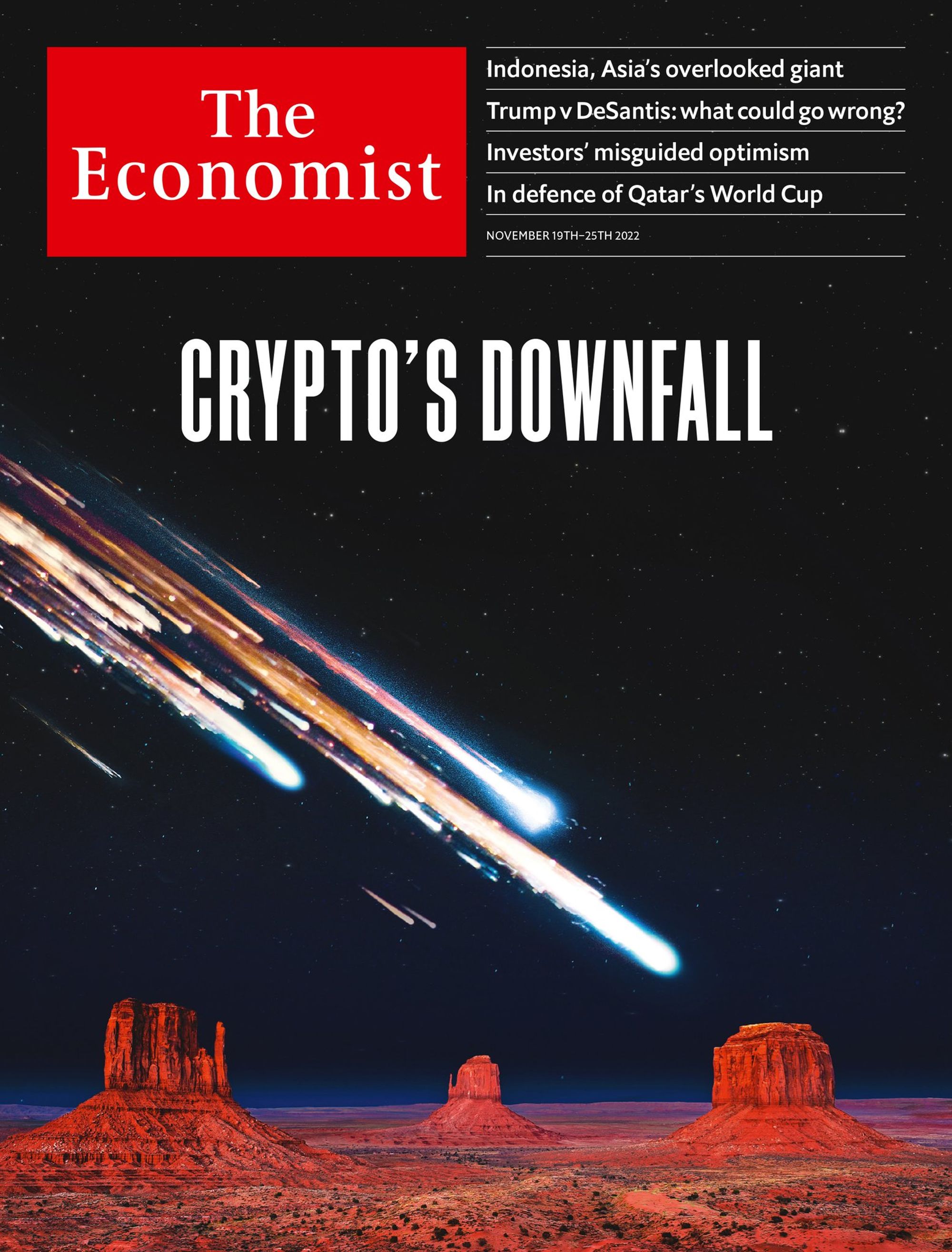
The cryptocurrency era began with the release of the Bitcoin white paper in 2008 and ended with Ethereum's transition to the proof-of-stake validation model in September 2022.
The defining features of the cryptocurrency era are the creation of blockchain technology visions and their initial applications: cryptocurrencies, especially Bitcoin and Ethereum.
The benefits of the cryptocurrency era include the invention of blockchain and the widespread dissemination of ideas supporting it, the establishment of new forms of digital value, and the power to reshape institutions and financial regulations.
The defining products of the cryptocurrency era are cryptocurrencies themselves - cryptocurrency, cryptographic infrastructure, cryptocurrency investments, cryptocurrency organizations, and finally, infrastructure derivatives such as non-fungible tokens (NFTs).
The downside of the cryptocurrency era is that human greed is magnified through cryptocurrency - Ponzi schemes, scammers, charlatans, and endless speculation, resulting in the mass production and inflation of assets, sometimes even using illegal means.
The ultimate collapse of cryptocurrency will be mourned by few except those directly affected, and celebrated by almost everyone else. Cryptocurrency era: 2008 - 2022 (Rest in peace).
Era of the Blockchain

In September 2022, Ethereum successfully transitioned to a proof-of-stake model, significantly reducing its energy and financial costs, bringing Ethereum closer to a practically usable (rather than theoretical) world computer for the first time. With this merge, the era of the blockchain began.
The era of the blockchain will be defined as a period in which the majority of the world's innovation and cultural output, as well as shared history and information infrastructure, are built, stored, and accessed on the blockchain.
The benefits of the blockchain era lie in empowering individual users and user communities to maintain digital sovereignty, allowing them to freely move between various markets and spaces without being confined to a single platform, and enabling them to control their own works, data, and background. This allows various creators, consumers, and institutions to securely connect and access critical information in a simpler and more powerful manner than isolated systems of the past and present.
The defining products of the blockchain era will make digital history and identities more secure, useful, and decentralized, thus putting an end to the true killer application of Web2: platform lock-in. A work or content minted on the blockchain will establish a verifiable origin of that information or work; distribute it through shared ledgers on a public blockchain; store and maintain it on decentralized computers and code networks; and allow it to be useful across the network and in our everyday lives.
The downside of the blockchain era will be the limitations of the blockchain itself. How big can blockchains scale? How fast can they become? How cheap can they be? Can they handle larger volumes of information? How complex can decentralized applications become? What about zk proofs? And, as always, there are onboarding issues.
For consumers, the convenience and sovereignty of blockchain systems will be the killer application, not some person speculating on a currency, promising it may someday have value if all goes well. In the era of the blockchain, the goal will be more practical and useful: to make information more durable and permanently accessible.
The cryptocurrency era relies on sometimes deceptive promises of future utility to sustain itself, while the era of the blockchain will create practicality in the present and future.
Technological Revolution and Financial Capital
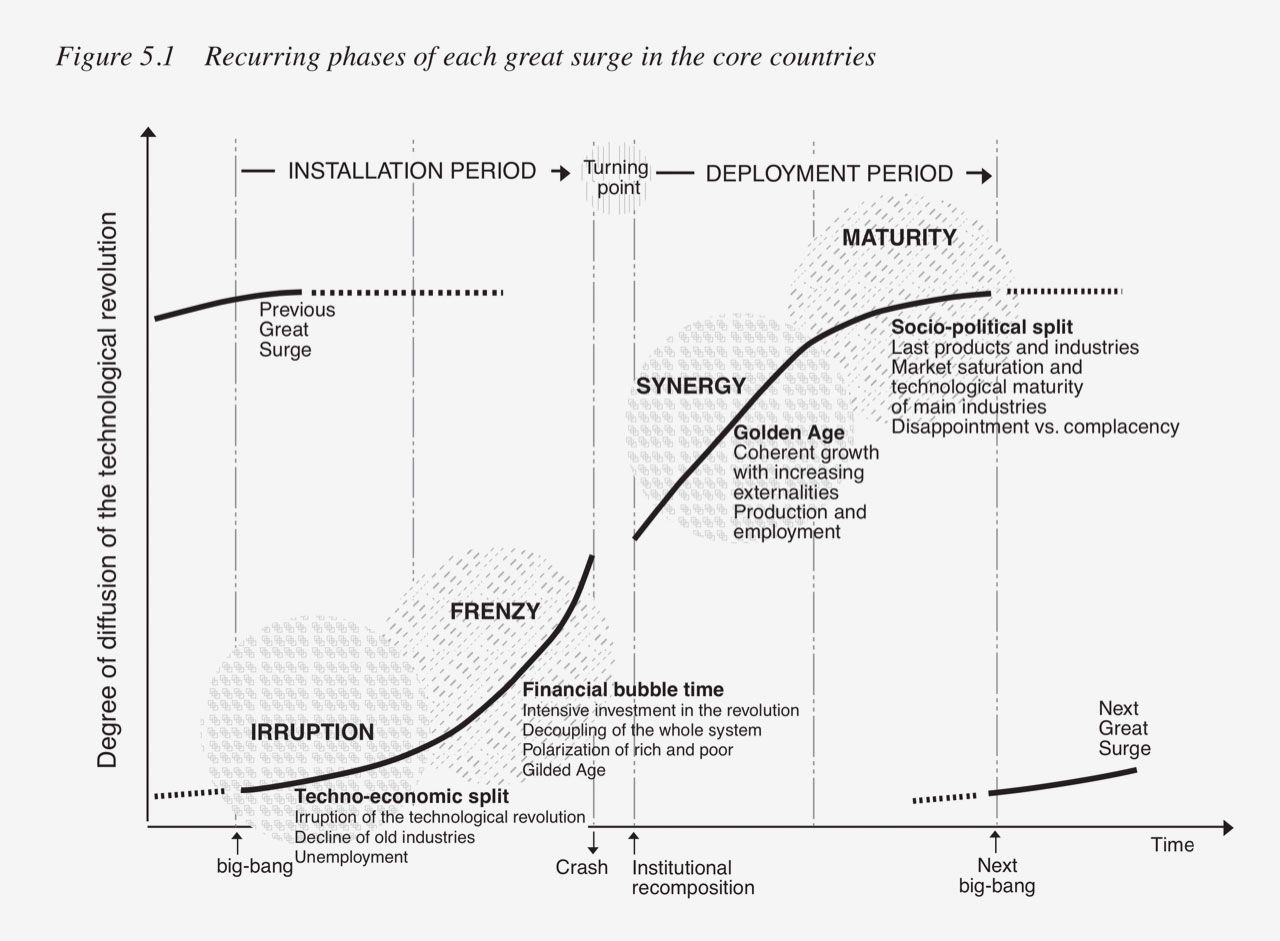
Image Source: Carlota Perez, "Technological Revolutions and Financial Capital" (UK: Edward Elgar, 2002)
Blockchain infrastructure may be going through different stages of thought and is not just a narrative device. Similar patterns have also been observed in past technological revolutions. In her book "Technological Revolutions and Financial Capital," British-Venezuelan economist Carlota Perez observes an important evolution of technological shifts: they occur in phases and bubbles often create practical applications in later stages.
In the 19th-century railway era, local communities raised funds to invest in the construction of regional railway lines based on their technological potential, accompanied by promises of great wealth. Most of these projects failed, leaving the landscape cluttered with useless railway tracks and causing significant loss of wealth for the true believers in the local population.
These entities eventually learned that simply building a railway line was not enough. There needed to be activity, commerce, and industry to support it. Without these, it was too early (and I say as much).
Perez observed that later generations of entrepreneurs and projects leveraged the infrastructure built during the bubble period and started using it. The core railway infrastructure became cheap enough and railways became numerous enough that they started to have practical value. Perez found that bubbles often create markets, just not in the timeline envisioned by the initial promoters and certainly not within their false promises.
It is worth noting that Perez's book was published in 2002 before the dot-com bubble burst and the subsequent revival, and the stages of development of the internet itself remarkably mirror her model's predictions.
Railways and Blockchain
So what does this mean for the future of cryptocurrencies? How is blockchain like railways? These are questions posed by Joe Wiesenthal of Odd Lots in a recent tweet thread and an excellent podcast episode. His own answers listed a number of things - all financial, all indicative of the crypto age - but they lacked strong persuasiveness.
Does blockchain have the practicality similar to railways? Which infrastructure of the cryptocurrency age actually proves useful for the new era of innovation?
It's not complicated: it's blockchain itself. Blockchain is the invaluable and increasingly useful infrastructure for storing and transferring information, assets, and ideas.
With on-chain storage, information has gained an origin that can be proven, determining its source, collaborators, and supporters, as well as an environment where it is permanently and openly accessible without the need for any institutional approval or maintenance. This system of independent verification and knowledge dissemination – whether it's ideas, artwork, or personal information – is truly revolutionary. Children see the internet as a magical, unique thing that contains everything, and the experience they envision is not far off from the era of the blockchain.
Making information provable, infinite, and establishing it within a shared public database sounds somewhat intriguing, but most of the time it is quite mundane – hardly worth engaging in a cultural battle over. As the era of cryptocurrency fades from memory and its excesses and fraudulent behavior continue to be revealed, the behind-the-scenes running of the blockchain era will grow.
In Web 2, publishing information and ideas generate content. In the blockchain era, publishing information and ideas will create history.
Today, a project I co-founded called Metalabel released a new product that shares our perspective on creative work in the blockchain era: a new format called "record". A record is a digital container for creators to distribute and sell versions of their work, and it can include any creative medium (art, writing, music, performance, video, design, games, ideas, etc.) and any form of creation (physical, digital, conceptual, transient, live, exclusive, mainstream, niche). Once purchased, records exist permanently on the blockchain, so even if the platform disappears or changes ownership, the creators will not lose their work (or the collections of supporters). This is what a blockchain product looks like to us.
Zora is not the only project bringing culture onto the blockchain. The growth of Sound.xyz, with many creators already archiving their work on the blockchain, and countless other projects, are examples of the transition to the blockchain era.
In the future, projects like these won't discuss cryptocurrency. They will discuss information, media, and other digital elements being secure and portable because they are on the blockchain. As a result, we will have greater control over our digital lives. Our identities will follow us in the way we want, rather than the way Facebook and Google want. We will pay for these services not just with cryptocurrency, but also with credit cards and digital options. It may not be perfect, but compared to the maze of usernames, passwords, and accounts that everyone is dealing with now, it will be more convenient.
Finally, this new era will thank cryptocurrency for bringing us here. The past decade has led to a massive bubble that has now burst, and it has paved the way for an extraordinary future.