






Filecoin Virtual Machine (FVM) Review of 100 Days Growth and Roadmap for the Second Half of the Year


Source: Filecoin Network

It has been 100 days since the official release of FVM. Read on to learn about everything that has happened since the release, and how FVM will develop for the rest of 2023.
100 days ago, on March 14th, 2023, the Filecoin network launched the first programmable EVM runtime on the Filecoin Virtual Machine. This release solidified Filecoin's unique position as an L1 blockchain and provided momentum for the open data economy. Since then, the open ecosystem consisting of developers, storage providers, storage users, and other participants in the Filecoin network has continued to grow. Let's take a look at the significant progress FVM has made since its launch on the Filecoin mainnet.
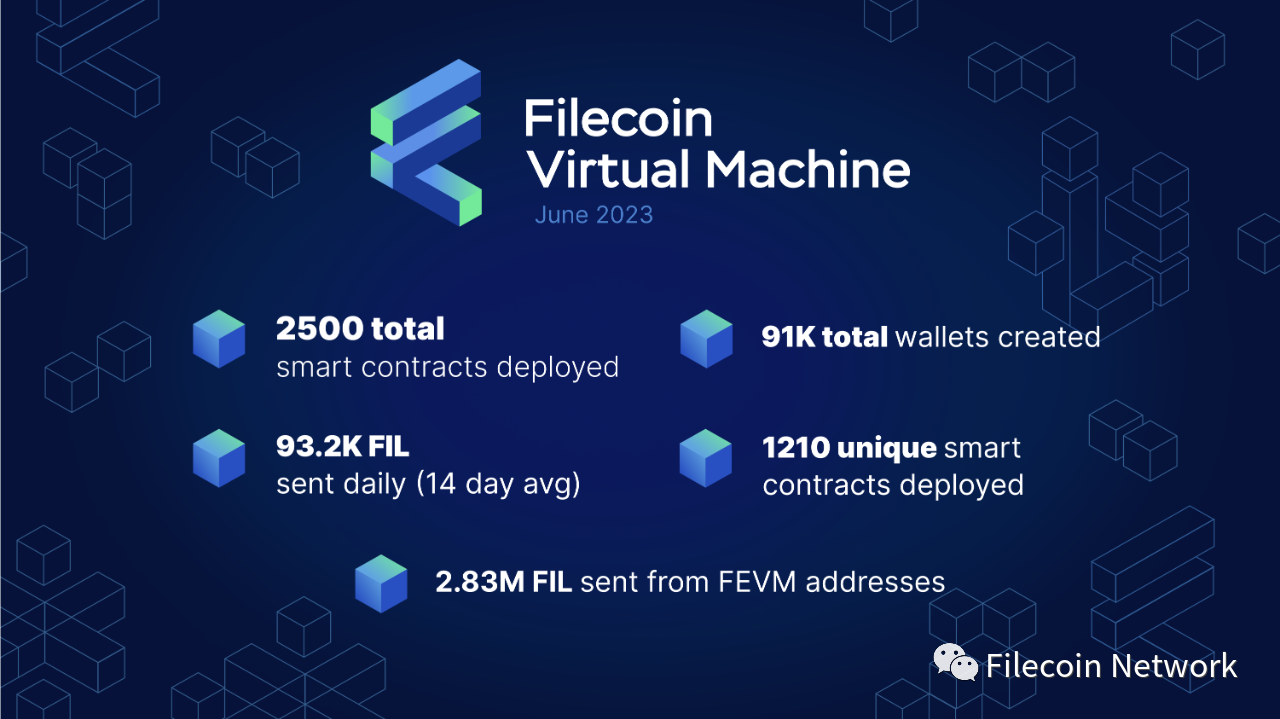
Filecoin Virtual Machine: Empowering the Filecoin Economy
When FVM was launched, the prospect of moving most of the Filecoin economy's activities on-chain was highly encouraging for the community. We hope that FVM can accelerate the achievement of key goals in Filecoin's overall plans. Some of the priority items include:
In the world's largest distributed cloud storage network (which can provide over 12 million TB of capacity at a competitive price), data set storage and management are conducted. Today, after 100 days since its launch, smart contracts are able to autonomously facilitate and aggregate storage transactions, helping storage users automatically find the best storage providers that suit their specific needs.
In addition, FVM enables the Filecoin community to establish discovery and reputation services on the Filecoin blockchain, enhancing network transparency. Many Filecoin block browsers have started using data directly extracted from the Filecoin blockchain to enrich their dashboards and help guide decisions, bringing greater trust and transparency to the Filecoin network (e.g., through verifying smart contracts).
FVM also commits to facilitating FIL staking and lending. FIL is the native token of Filecoin, used by storage providers to pledge, develop, and protect the network. Initially, many well-known cryptocurrency exchanges quickly implemented support for FVM wallet address compatibility (f 4), allowing Filecoin network participants to not only interact with new FVM dApps but also interact with familiar tools like Metamask. Specifically, to date, since the launch of FVM, over 82,000 unique wallets have interacted with it. Additionally, measured by the growth of Total Value Locked (TVL), DeFi services on the Filecoin network are currently the fastest-growing (+140%) among the top 100 in all blockchains, reaching almost 4.5 million FIL with several providers.
When launching, community members hope that FVM can leverage the capabilities of Filecoin and FVM (such as data storage) to enhance the functionality of products and services appearing in other web3 communities. Approximately three months after the launch of FVM, multiple integrations with bridges such as Axelar and Celer, as well as over 35 other key partners, have brought Filecoin closer to the rest of the web3 ecosystem, enabling rich messaging and transaction exchange between Filecoin and other web3 ecosystems.
Many unique smart contracts and dApps (totaling over 1200) have already been launched on FVM, but many of these applications still have a relatively novice user base. In the coming weeks and months, the Filecoin community's goal is to continue accelerating the development of FVM.
Unlocking Utility for End Users with dApps
The new possibilities unleashed by FVM have sparked a frenzy of activity among developers and entrepreneurs in both existing and new communities. At the time of writing, over 1100 unique smart contracts have been deployed to dApps on the Filecoin network, and over 80,000 wallets have been created and started interacting with these FVM-powered dApps. The total balance of our FVM accounts and contracts has exceeded 2.8 million FIL.
FVM and the Ethereum Virtual Machine (EVM) running on the Ethereum blockchain are fully compatible, which helps new Filecoin developers deploy solutions on the Filecoin blockchain. As a result, the community's interest in hackathons continues to soar. Specifically, we have held two hackathons with a focus on FVM: Space Warp (before FVM release) and HackFS, attracting over 1700 developers. Additionally, all available slots for two dedicated FVM accelerator projects have been fully utilized, with these teams building products and services at the forefront of this new technology.
There are also many notable distributed applications already launched on FVM, spanning across multiple categories. While the Filecoin Ecosystem Directory is currently undergoing a redesign, it will soon become the best place for community members to add or browse the growing list of products and services on Filecoin. However, currently there are only a few outstanding web3 projects being developed or already integrated with FVM.
Infrastructure Tools
Storage and Cloud Services
Education, Science, and Public Goods
Media and Entertainment
Filecoin Staking
The Road Ahead: Filecoin will Shape the Open Data Economy
Over the past quarter, we have focused on ensuring key partnerships and removing obstacles. As we enter the second half of 2023, we want to prioritize the user experience of FVM dApps and developers using FVM.
We plan to focus on small storage transactions to drive the democratization of storage with Filecoin and FVM. This will allow the creation of dApps and DAOs around the data uploaded by individual users. They can create unique incentive mechanisms to replicate, update, and repair storage transactions based on this democratized standard. We are collaborating with aggregators on Filecoin and making them native to FVM so that builders can upload small data segments through their dApps and smart contracts.
We are also building a distributed aggregation standard that allows anyone to create a "data delivery box" for FVM. We hope this can achieve true trustless aggregation on Filecoin, all managed on-chain through FVM. dApps and DAOs can be built on top of this standard to upload new data and can update, replicate, and repair storage transactions through the distributed aggregation standard.
What do we expect to unlock in the future with FVM? There are many cool platforms on FVM: distributed computing, data markets, and DAOs built with LLM and generative AI. We hope the team can create a market for any computation work, especially model training and inference based on the data stored on Filecoin. We predict a strong market for IPNI dispute resolution, data preparers, and REC tokenization. We anticipate that LLM will play a crucial role in open-source generative AI models, and all of this is built on FVM for data DAOs (learn more here). With data, AI, and computation, the future looks bright for FVM!
Lastly, we are working hard to ensure that FVM is user-friendly. We want the process of uploading funds, data, and smart contracts to FVM to be effortless. We are partnering closely with wallets, exchanges, and browsers, and we hope these integrations will be meaningful for builders. If you are interested in building in this space as well, please reach out to us!
Please check out the latest overview of the Filecoin and IPFS ecosystems to get a comprehensive understanding of ecosystem development and to see more insights and comments.
Stay in sync with FVM
As mentioned above, it's never too late to build with FVM! If you want to participate in the upcoming hackathon, please visit the Filecoin Ecosystem Hackathon page. If your project has reached the accelerator stage, please check out Softnoise by Protocol Labs, which will help you find the most suitable accelerator. For more FVM resources, please visit the FVM linktree.





