How does the "ShitCoin Recycling Station" Poop in the DeFi world achieve an upward spiral in the circular economy?


"Poop is building a circular economy to allow holders of the illiquid 'Shitcoin' to realize their residual value. This circular economy also creates an upward spiral system that benefits all participants."
The product of the iterative development of the crypto industry, the illiquid 'Shitcoin'
Web3 marketing is mainly based on blockchain technology to achieve direct interaction and value exchange between brands and users. The most common Web3 marketing method is for brands to issue tokens to directly incentivize user participation in marketing activities. Users can then use these tokens to obtain the brand's products or services, achieving seamless collaboration between brands and users, and more.
Cryptocurrency-based marketing had a good effect in the early stages, such as Uniswap, ENS, Aptos, Optimism, Arbitrum One, and other leading ecosystems that distributed valuable token airdrops to a large number of eligible community users (usually those who were early adopters and made contributions to the ecosystem's development). These airdrops had quite positive effects (users would usually become active members of the community), and under the incentive of token rewards, most users in the crypto industry aspire to become early users of these early ecosystems. In fact, very few people would refuse such an opportunity to potentially get a 'free lunch'.
Of course, the reason why this 'blunt' airdrop method can continue to be effective is usually based on strong community consensus, which can offset the negative effects of the airdrops.
However, for crypto projects that lack community cohesion (which most of them do), after providing airdrops to users, they often struggle to counterbalance the negative effects due to weak underlying value, resulting in a short-term price crash and lack of liquidity for the tokens once they hit the market.
In fact, since 2020, there have been thousands of crypto projects using token airdrops for marketing, but only a few have significant value and good liquidity. This means that the frenzy of airdrop marketing has produced a large number of almost zero-liquidity 'Shitcoins'.
In addition to airdrops, the alternation of bull and bear markets, as well as the shift of industry hotspots, have led to the death of many crypto projects and Rug Pull events, leaving behind a significant number of illiquid altcoins. As the crypto industry continues to iterate, it seems that no one remembers the once glorious projects represented by these tokens.
Almost every "crypto native" has dozens of such 'Shitcoin' assets in their crypto accounts, which not only represent their past achievements but also demonstrate the speed of iteration and the brutal competition in the crypto industry.
Are these "Shitcoins" salvageable?
In the real world, the value of most items decreases over time after a certain period of use. In recent years, with the development of various recycling technologies and the strengthening of environmental awareness in various countries, recycling systems for various types of items have been improving. Based on this, we can further monetize the remaining value of these items through recycling and contribute to a circular economy.
In the Web3 world, behind every "Shitcoin," there may represent the holder's past efforts or a failed investment. After these assets become completely illiquid "Shitcoins," the holders may express regret or powerlessness.
Now, these former "Shitcoins" also have the opportunity to extract residual value like in the real world through a "recycling bin." A project called Poop is becoming the "recycling bin" of the DeFi field. It is establishing a series of recycling mechanisms and facilities for these "Shitcoins" to regain liquidity and has become a blessing for many "Web3 natives."
Poop: The "Recycling bin" of the DeFi world
Poop is becoming an on-chain platform for the recovery of illiquid assets. The protocol has established a recycling mechanism with value creation momentum. This protocol allows all "Shitcoins" to achieve "recycling" through its recycling system and receive returns in $POOP tokens to monetize the remaining value of these assets.
The Poop recycling system consists of several parts: Shitcoin Recycle, POOP Station, Referral Program
Shitcoin Recycle
Shitcoin Recycle is the core function of the Poop platform, and this section is the main execution place for the "Shitcoin" recycling. In Shitcoin Recycle, we can exchange 0 liquidity assets generated through failed investments, airdrops, rug pulls, and other means for $POOP tokens, just like DEX trading. After the exchange is completed, "Shitcoin" holders can sell their $POOP tokens to earn income, while the "Shitcoin" itself is directly burned and destroyed.
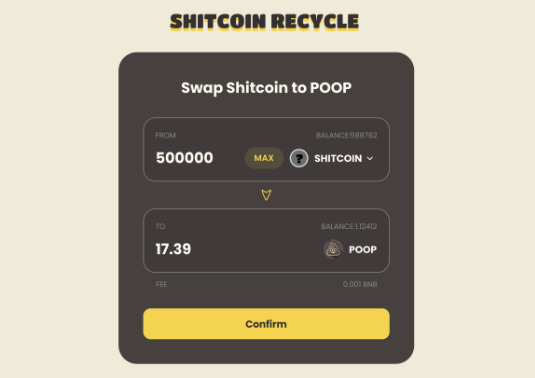
On the implementation path, Shitcoin Recycle handles different paths for different levels of liquidity of "Shitcoin".
When the liquidity of a "Shitcoin" is greater than or equal to the required minimum liquidity, the Shitcoin Recycle protocol will convert the "Shitcoin" into Layer 1 tokens (such as ETH, BNB, etc.) through the smart router, and then use Layer 1 tokens to purchase $POOP tokens.
When the liquidity of a "Shitcoin" is less than the required minimum liquidity, users need to pay the fee in Layer 1 tokens, which is equal to the required minimum liquidity. Then, Shitcoin Recycle will perform the recycling process, and users will receive $POOP as a reward.
POOP Station
In addition to the Shitcoin Recycle protocol, POOP Station is the place for minting and burning $POOP tokens in the Poop protocol. In the POOP Station, users can buy or sell $POOP tokens using Layer 1 tokens through this trading hub. Throughout this process, $POOP tokens will continue to experience deflation and empowerment, helping to build a stronger foundation of value for $POOP tokens.
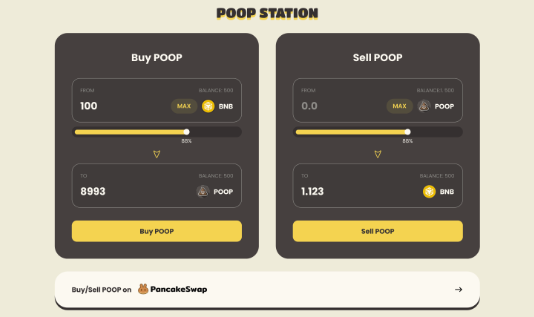
In addition, the Poop protocol also allows $POOP holders to further profit through Staking and LP, and continues to receive dividends from the deflationary mechanism.
Referral Program
The Poop protocol has also established a referral system aimed at rewarding users who help expand the Poop community and share the product. When one user refers another user to use the Poop protocol, 10% of the invitee's earnings will go to the inviter as an incentive. These rewards will be immediately distributed to the inviter's account in the form of Layer 1 tokens upon completion of the transaction. Through this direct incentive model, Poop is helping to build a strong community and user base, while bringing significant income to contributors.
The Poop protocol has established a "recycling" system based on the $POOP token. Of course, in order to ensure the continuous value capture ability of the $POOP token and offset the potential selling pressure, a highly deflationary empowering mechanism has been designed. This guarantees that $POOP will always maintain an upward spiral in its circular economy system and encourages more $POOP holders to become holders.
Upward Spiral in the Poop Circular Economy
The Poop protocol has established an upward system based on an elastic supply mechanism anchored by collateral, and this asset has no private placement or early whale investors. It is launched in a fair manner to ensure that $POOP can achieve an upward spiral.
Buy to boost the value of $POOP
When users purchase $POOP tokens using Layer 1 tokens through POOP Station, new tokens will be minted through the Poop Finance contract. During the purchase process, buyers need to pay a certain amount of taxes (10% ), and this tax will be distributed to the Backing Vault (60% of the tax revenue, which is the liquidity reserve pool for $POOP tokens), LP stakers, and contributors.
Although the total supply of $POOP tokens increases, the tax mechanism ensures that buyers receive fewer $POOP tokens through Layer 1 tokens.
For example, when the BNB/POOP exchange rate is 1000, the amount of $POOP obtained through purchasing with 1 BNB on POOP Station will be less than 1000 tokens, further promoting the continuous rise of $POOP token price (counteracting the impact of inflation). The buying behavior also boosts the value reserve of Layer 1 tokens in the POOP Station treasury.
Sell $POOP for accelerated destruction
When users sell $POOP to exchange for Layer 1 tokens, although the Layer 1 token reserves in POOP Station decrease, the sold $POOP tokens will be destroyed by the Poop Finance contract. At the same time, selling $POOP also requires paying taxes (10%), which will be distributed to the Backing Vault, LP stakers, and contributors, accelerating contraction. The destruction of $POOP will also accelerate the rise in $POOP token price.
It can be seen that both buying and selling $POOP will bring new gains to the value of $POOP. This means that more and more users will realize the recovery of "Shitcoin" through Poop, and the Poop ecosystem and $POOP will continue to accumulate new value, making every participant a beneficiary. Of course, the upward spiral of $POOP is promoting more holders to hold for the long term in order to continually profit from the upward spiral system.
The Poop protocol will go live on BNBChain on June 28th at 20:00 (UTC+8), and will subsequently be deployed to ecosystems such as Ethereum, Arbitrum, Optimism, zySync, Polygon, etc.
Conclusion
From the perspective of the industry, the majority of crypto players are holders of "Shitcoin", and they will also be potential user groups of the Poop protocol, especially under the incentive of the Referral Program, which will accelerate the influx of these users into the Poop ecosystem. As more and more users participate in "recovery" transactions, the Poop ecosystem spiral flywheel will also accelerate, and the base value of this ecosystem will continue to be amplified.