From Synthetic Asset Protocol to DeFi Infrastructure, Synthetix's Path to Transformation


Original author: Grapefruit, ChainCatcher
Original author: Grapefruit, ChainCatcher
On May 25, the total transaction volume of Synthetix Perps (perpetual contracts) officially exceeded 10 billion US dollars, entering a new milestone. According to DUNE data, from the release of the Perps V2 version in December 2022 to June 7, the total transaction volume of Synthetix's perpetual contracts was 11.278 billion US dollars, and the captured transaction fees were nearly 8.897 million US dollars.
In addition, the average daily trading volume of Synthetix Perps has surpassed GMX in the past month, ranking second in the decentralized derivatives track (the first is dYdX).
Synthetix has released Perps V2 for half a year, and its revenue has reached nearly 9 million US dollars. Such excellent performance brought Synthetix, a veteran DeFi application, back into the sight of users again. Synthetix is no longer the original synthetic asset platform, and its main business has shifted from the front stage to the backstage.
Among them, Synthetix perpetual contract products are not aimed at C-end users, but are presented in the form of back-end products, supporting developers or DeFi derivatives to integrate this function, and users can interact with Synthetix Perps contracts by using integrated DeFi products , rather than using or interacting directly.
From a front-end product to a liquidity infrastructure for DeFi products, supporting the integration of any derivatives and trading products, Synthetix has completed its own strategic transformation. So, how did Synthetix approach the goal of becoming an infrastructure for DeFi liquidity step by step? What have you been through?
first level title
The trading volume of flagship product Kwenta has surpassed that of GMX
As the first front-end product based on Synthetix Perps, Kwenta supports users to trade cryptocurrency spot and futures, and contributes more than 98% of the transaction volume to Synthetix Perps. Since the beginning of May, the Kwenta contract trading volume has performed well. Among them, the highest single-day trading volume on May 24 reached 450 million US dollars.
According to DUNE data, in the past month, the total transaction volume of the Kwenta platform was 4.46 billion US dollars, while the total transaction volume of the GMX platform during the same period was only 3.67 billion US dollars. Among them, on May 23, the intraday trading volume of Kwenta was as high as US$450 million, while the trading volume of GMX on that day was only US$110 million.
image description
Kwenta transaction data changes
In fact, judging from the official background data, Kwenta’s trading data has shown an upward trend since February this year, and hit a record high of US$480 million on March 17. What drives the growth of Kwenta transaction data? This is mainly because on February 11, Kwenta announced that it has launched the Synthetix Perps V2 version, allowing users to open new positions in the V2 version.
From this point of view, the growth of Kwenta transaction data is inseparable from the help of Synthetix Perps V2. What is Synthetix Perps V2? What's new for Kwenta?
Synthetix Perps V2 is an upgraded version of the contract launched by Synthetix. Through the new off-chain oracle system and the adjusted funding rate mechanism, transaction costs are reduced and capital utilization is improved.
To put it simply, Perp V2 uses a dynamic funding rate to ensure the balance of the positions of both parties. For example, when the number of short parties is greater than that of long parties, the short party needs to pay funding fees to the long parties regularly to keep the positions of both parties in balance. Similar to CEX exchange. But Perp V2 will dynamically adjust over time and will vary every hour.
In addition, Perps V2 introduces the off-chain oracle system provided by Pyth Network, which reduces transaction delays, reduces the risk of front-running transactions and arbitrage, and reduces transaction fees to 0.05% ~ 0.1%.
The current Kwenta transaction fee is only 0.02% to 0.06% (GMX transaction fee is about 0.1%). In addition, when Kwenta launched the V2 version in February, it added 22 new crypto asset trading pairs, and its trading volume has increased significantly since then.
At the same time, Synthetix is also cooperating with Kwenta. The Kwenta platform will also provide an additional 600,000 OP tokens to reward its platform traders, and all traders will be rewarded according to the transaction fees paid.
image description
Synthetix and Kwenta Rewards
With the support of Synthetix's resources, the Kwenta platform has gained a firm foothold in the derivatives track, and its current popularity has fed back to the Synthetix platform.
first level title
Synthetix Provides Liquidity for DeFi Apps by Modularizing Debt Pools
Judging from the current product positioning, Synthetix is trying to integrate liquidity into the backend of a wider range of DeFi applications, and build a set of products for users to interact with their synthetic assets.
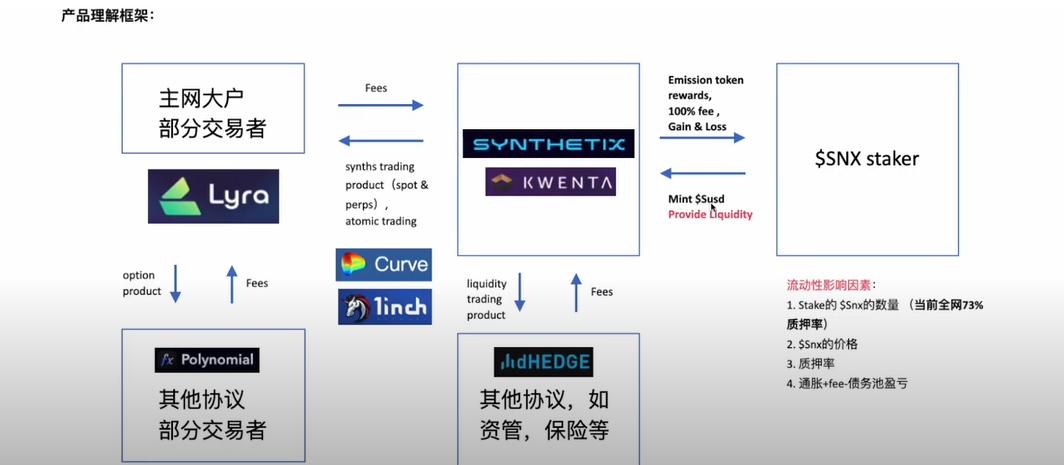
image description
Image from Youtube
At present, products built on Synthetix include not only Kwenta, but also options platform Lyra, options liquidity aggregation protocol Polynomial, contract platform Decentrex, etc. The commonality of these platforms is the use of Synthetix's sUSD asset, which provides liquidity.
In fact, Synthetix not only supports the integration of liquidity for DeFi derivatives, but also supports the integration of spot trading products. Atomic Swaps launched by Synthetix last year is a spot transaction, and platforms such as Curve and 1inch have been integrated.
The so-called atomic transaction supports multiple transactions of users in different Dapps to be executed in a single transaction in a packaged manner. The biggest feature of using Synthetix to complete spot transactions is that it allows users to mint and trade various synthetic assets without slippage. There is no specific counterparty for transactions between synthetic assets, but a token is destroyed through a smart contract, and Mint another token. Swapping USDC for DAI and continuing to swap that DAI for ETH may have better results.
For example, if Xiaoming wants to buy ETH with 100,000 USDT, the usual way is to use the DEX platform to directly buy ETH with 100,000 USDT. The transaction process is probably USDT-DAI, DAI-ETH. There will be transaction slippage in this process, and through the integrated Synthetix On the DEX platform, the transaction process may become that USDT is first converted to sUSD, sUSD is converted to sBTC, and then sBTC is converted to BTC. Since sUSD/sBTC is a synthetic asset exchange without slippage loss, and USDT/sUSD and sBTC/BTC are both There is no slippage for the exchange of similar assets.
The liquidity of integrated Synthetix products is ultimately provided by its platform's unique debt pool.
Dynamic Debt Pools are an innovation of the Synthetix platform and the mechanism by which synthetic asset Synths are issued. Users stake SNX to mint sUSD, a stablecoin pegged 1:1 to the U.S. dollar. The value of sUSD is considered a liability of the system, and when sUSD is traded into sToken, the debt will increase or decrease as the price of sToken rises or falls to keep the price of sUSD and other sTokens stable, as well as during the transaction of no slippage.
For example, if the original debt pool has 100 sUSD, and Xiao Ming buys sBTC with this 100 sUSD, when Bitcoin rises by 20%, the entire debt pool debt will rise to 120 sUSD; when sBTC is exchanged for sUSD, he can receive 120 sUSD ; If Bitcoin falls by 20%, the debt of the entire debt pool will drop to 80 sUSD, and when sBTC is exchanged for sUSD, only 80 sUSD can be received.
In other words, Synthetix actually modularizes the debt pool of synthetic assets and becomes a separate liquidity layer infrastructure that supports DeFi application integration. With Synthetix, some newly launched DeFi applications can complete asset transactions even if there is no fund pool on the platform, without worrying about liquidity issues.
first level title
Synthetix V3 has achieved the evolution from synthetic assets to liquidity infrastructure
The predecessor of Synthetix is the stable currency protocol Havven, which issues the stable currency nUSD by mortgaging the native token HAV on the chain. It changed its name to Synthetix in 2018, and later appeared as a synthetic asset. Users can stake SNX to mint synthetic assets (sUSD) Synths. It not only supports synthetic stablecoins, but also supports tracking prices of foreign exchange, stocks, and commodities with synthetic assets.
In 2021, the Synthetix Perp contract function will be launched, supporting DeFi derivatives developers to integrate the application, and deploying Kwenta, Lyra and other products.
In 2022, the Atomic Swaps function will be launched to support spot DEX integrated liquidity.
However, during this process, the team did not publicly state that Synthetix’s positioning was adjusted from a synthetic asset platform for C-end users to an infrastructure that provides liquidity for B-end users such as DeFi applications and developers. It was not until March of this year that the Synthetix V3 version was deployed on Ethereum and Optimism that users really realized that Synthetix had completed its transformation.
The V3 version mainly focuses on four areas: the liquidity layer of DeFi derivatives, supporting new protocols to be built on Synthetix; increasing the types of mortgage assets; compatible with EVM, supporting cross-chain deployment; providing more friendly tool components for developers, etc.
The liquidity layer of DeFi derivatives, Synthetix's clear goal is to become an agreement focused on Liquidity as a Service (Liquidity as a Service), in order to build the agreement into a permissionless derivatives liquidity platform, providing the next generation of DeFi products Provide source power.
Increase the types of mortgage assets, increase the market size of Synths, and increase the depth of liquidity. At present, since Synths can only be minted by SNX pledgers, this means that the upper limit of the overall scale of Synths depends on the value of SNX. The circulation of SNX is about 300 million. According to the price of 2.3 US dollars, the market value of SNX is about 700 million US dollars. According to 400% The market size of Synths is limited to $170 million based on the mortgage ratio. Therefore, V3 creates a universal vault that has nothing to do with the type of collateral. Each vault supports a single collateral asset. These vaults will be combined and connected to one or more market liquidity pools. Different vaults have different Incentive structure to guide liquidity.
Compatible with EVM and supporting cross-chain deployment, Synthetix V3 will be able to be deployed on any EVM-compatible chain to support synthetic assets on any chain.
Developer tools, Synthetix will provide more components to support developers to make it easier to build applications based on Synthetix.
Synthetix V3 has fundamentally improved the operating efficiency of the Synthetix system, making its future positioning clearer, mainly for B-side developer users. The V3 version will be released in stages over the next few months, and features will gradually become available.
In fact, the positioning of Synthetix as a DeFi liquidity infrastructure can be found in founder Kain's views on the future development direction of DeFi in 2021-"DeFi is not really user-oriented. We once mistakenly thought it was because We’ve only been interacting with crypto enthusiasts since 2018. But ordinary users are more likely to interact with mobile wallets in the future, rather than directly interacting with DeFi infrastructure.”
It is through this step-by-step product iteration and function optimization, identifying its own advantages and characteristics, and deepening them, Synthetix products have been upgraded from B2C products to B2B products, trying to find themselves in the homogeneous DeFi track. features and differentiation.