






Comprehensive analysis of what use cases will Web3 have in the future?


Compilation of the original text: angelilu
Compilation of the original text: angelilu
In today's article, the next in a series of "Web3 Use Cases: Today and Tomorrow", we focus on the future and discuss whether Web3 is worth the hype.
in the series of articlesaboveIn , we introduced the Web3 use cases that exist today, in a nutshell:
NFT: There was a transaction volume of 31.3 billion US dollars in OpenSea alone;
Decentralized exchanges: Uniswap, a leading DEX, has processed over $1 trillion in trading volume;
DeFi protocols: Compound, Maker, Aave, and other DeFi lending protocols performed well during the sell-off, while centralized lenders struggled;
Lending in the real world: Goldfinch and Jia help close credit gap in developing countries;
User-Owned Marketplace: Braintrust has doubled its total service volume to $74 million in the past five months, while maintaining its acquisition rate at an industry-low 10%. ;
Connected Device Networks: Helium and DIMO facilitate user-built networks and application ecosystems built on user-owned data.
Stablecoins: USDC, DAI, and other fully/over-collateralized stablecoins facilitate payments, especially international payments. There are $155 billion in stablecoins in circulation.
Evan Conrad's Use Cases: In a blog post, Evan Conrad highlights non-government funding, cheap loans, Filecoin, Lab DAO, Radicle, Helium, Toucan, and Golden.
More and more people are starting to actually consume in Web3 applications, even if some of these products look "stupid". But I think these Web3 use cases that are already on the ground will justify all the venture capital, investment and talent that has gone into the space.
This article will be carried out in two time spans, and I will discuss in depth the potential points that Web3 will excite me from the dimensions of the next few years and decades.
If there is another bull cycle in the next few years, I think it will happen when people use real products at scale, not speculation. When these products emerge, speculation will follow, but it will look more like a traditional tech bull market than pure speculation. These products are already on the way—apps are coming soon, and the infrastructure continues to improve.
Over the next few decades, I believe Web3 infrastructure will be the fabric of much of our work online and in our financial lives. I also believe that the Web3 protocol's experiments in economic design, incentive alignment, and governance will reach beyond the Internet to impact "real world" institutions.
Today, I'm going to dive into some future use cases and potential benefits that I'm excited about.
decades to come
So, let's start with the future. So what if all of this worked out?
Personally, I'm happy to see faster iterations, more upside for ownership and users, new governance and economic models, more liquidity, efficient and global capital markets, and a more interesting world.
While it's hard to see a path through all the short-term technical, financial, and social challenges in a bear market, it's actually equally hard to imagine a world decades from now where Web3 doesn't play a big role.
When I think about where this is all going, I have a diagram like this in my head.
When people say that Web3 is accelerating the progress of financial markets, what they really mean is that we are making a lot of mistakes that have been made before, faster than before.
In the early stages of the process, it can seem downright silly. "That's a Ponzi scheme!" "Of course direct democracy doesn't work for DAOs, the US is a representative democracy for a reason. And at this point, are you really decentralized?" "Aren't these people from Has nothing been learned in 200,000 years of human history?"
But I think that there is a logical bifurcation point where you have to believe that one of them is correct:
The existing economic and governance model is as good as it gets.
This is not the case, and any method that allows the fastest iteration on new models will eventually produce superior models.
If I had one point to describe why I'm excited about Web3, it's this: Web3 allows for the fastest iteration of new economic and governance models for any system humans have built.
Every new application, game, and protocol is simultaneously one of economic designsmall experiment. Every DAO, and even some NFT projects, such as Nouns, is also a small experiment in governance. In the early days, this means that Web3 entrepreneurs face more complex problems than traditional entrepreneurs - they need to build great products, a thriving economy, and a governance system that is resistant to attacks and productive. Some skeptics argue that all three represent too much complexity to build something users understand and love. Centralized products can develop themselves more quickly. But I think Web3 startups will act as a hive of experimentation, learning and rapid growth, with each successive startup building on the software and idea legos of previous startupsBuilding Blockson until they accelerate beyond the pace of current institutions.
Some of these experiments will be micro: For example, a Web3 version of Twitter with an open protocol on which anyone can build a client will drive more innovation in Web3 Twitter client design. Other experiments are macro: For example, how large groups of token holders can fairly manage and control multi-billion dollar lending protocols. In both cases, there will be more failures than breakthroughs.
But breakthroughs can be very important. They could affect how we design traditional economies and institutions, or even the economies and governance models we build from the ground up on Mars, on asteroids, and elsewhere.
Central to the rapid iteration of Web3 is the concept of superstructures. Jacob Horne Aboutsuperstructure(Hyperstructures) article, I am atpart oneimage description
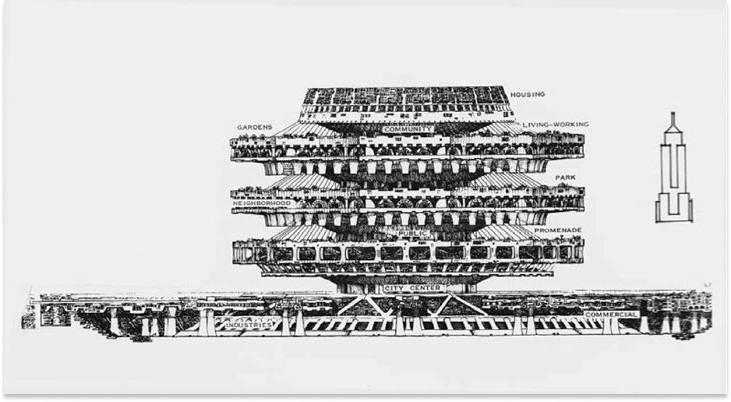
"Hyperstructure" in ground view of Paolo Soleri's Hyperstructures
Hyperstructure, like open protocols such as http, IP, DNS, SMTP, etc., is the foundation of the Internet we know and love, with additional capabilities as Horn articulates:
Unstoppable: The protocol cannot be blocked by anyone. It runs as long as the underlying blockchain exists.
Free: There is a 0% agreement-wide fee and runs entirely on gas costs.
Valuable: Accumulates value and can be captured and used by the owner.
Extensibility: There are inherent incentives for participants in the protocol.
Permissionless: universally accessible, censorship resistant. Builders and users cannot be deprived of information.
Positive sum: It creates a win-win environment for participants to utilize the same infrastructure.
Trusted Neutrality: The protocol is user-agnostic.
This concept is similar to Chris Burniske's "Protocol as Minimal Fetch Coordinator" have a common idea, which is a classic that I have quoted a lot.
The important takeaway from these two articles is that Web3 introduces the opportunity to create software infrastructure that is free to use forever and that anyone can build on top of, but rewards "builders and contributors Create and contribute these valuable systems to serve society as a whole for many years to come".
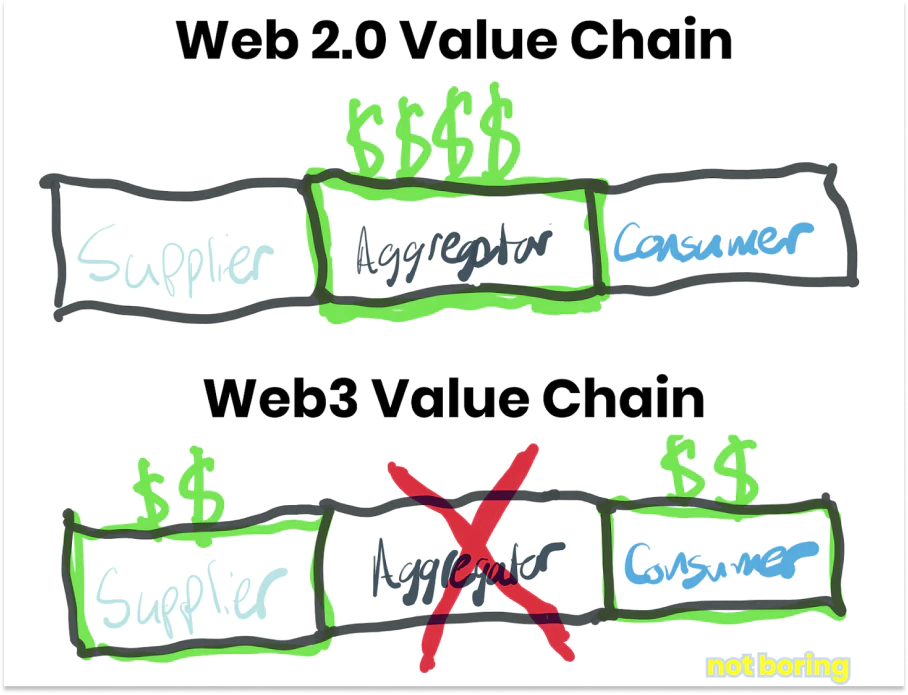
The most successful example so far is Uniswap, which I highlighted last week. Despite charging no fees to its users, Uniswap has a market cap of $4.1 billion (fully diluted: $5.6 billion). Horn believes that there should be a single superstructure for every financial and non-financial instrument: exchange (Uniswap), marketplace, lending pool, options, domain name, registration, identity, curation, hashtag, reputation, emoji, read receipts and more.
Each will be a piece of free infrastructure that can be combined with other free infrastructure. Entrepreneurs of every generation can use it to build, allowing them to focus on the things that make them unique, increasing the rate of innovation and abundant creativity. Hyperstructure excites me for the same reasons APIs excite me, with the added bonus of being free, perpetual, extensible, and license-free.
Hyperstructure will underpin a global, fluid marketplace for digital and physical items.
As Zach Weinberg highlighted in our debate on DeFi and housing, there is still a lot to figure out when it comes to bringing real world assets (RWA) online. First, what happens in case of default? While defaults are relatively rare, occurring on less than 2% of loans, they still need to be resolved on paper in court. There needs to be a hybrid solution that mirrors some of the simulation workflows. But it's a feature, not a bug, to handle legacy processes for a small subset of cases to make the majority faster, cheaper, more efficient, and more composable.
I personally think it's inevitable, and I'll quote our friend Jeff Bezos to explain why:
In our retail business, we know customers want low prices, and I know it will be the same in 10 years. They want fast delivery; they want a huge selection. Impossible to imagine that 10 years from now, customers will come up and say, "Jeff, I like Amazon, I just wish the prices were higher, or I like Amazon, I just wish you delivered slower." Impossible. .
What the customer needs isLow prices, fast shipping and a huge selection.as
asSam LessinSays, “Most things that people own, real estate, small businesses, etc., don’t have access to liquidity, leverage, etc.” The reward for solving this pain point is huge — the tokenization of everything — and will attract a wave of Another wave of talent, capital and creative approaches. Clearly, this will need to go hand in hand with smart regulation. When cryptocurrencies hit RWA - when small business owners can get cheaper capital, when homeowners can get more competitive home equity loans, when users can seamlessly own a piece of the product they use, Regulators will be incentivized to find solutions that protect people without restricting access.
With hyperstructure, tokenization of everything, and rapid iteration of economic and governance models, Web3 will be an important piece of the puzzle to solve some of humanity's most complex challenges.
physically
The first article I wrote this year is called "Laboratory of Complex Problems". It's about Web3's chance to be a simulator for solving complex problems that require large-scale human coordination, like climate change.
The theory is simple. All tokens, votes, and even NFTs are in a golden zone: containing enough content that the stakes aren't big for most people, but the economic consequences are bigger than the $20 students play for academic economics studies. Furthermore, the Web3 ecosystem is dynamic and interconnected, more like simulations run by complexity scientists than formulas and theories, with real people rather than "Economic Homo". Read the article for the full argument; now, I'll quickly introduce two complex problem areas that Web3 begins to address through regenerative finance and decentralized science.
Regenerative Finance
One of the challenges with our current financial system is that it is too prone to negative externalities, leaving public property to pay for it. Regenerative Finance (ReFi) is a bold attempt to rethink this system. As I wrote in Celo: Building a Regenerative Economy:
ReFi is a beautiful idea - a reimagining of the financial system, using the tools humans have now at their disposal, to better consider the needs of all stakeholders, both now and in the future. It puts a price on externalities, charging those who create negative externalities and rewarding those who create positive ones.
Specific ideas from ReFi include UBI, lending, data ownership, community commerce, and the many Web3 x climate projects backed by Not Boring Capital, incl.
Toucan: The Web3 carbon stack, including tokenized carbon credits, has bridged over 21.9 million tons of CO2 so far.
Loam: Creating an agricultural data marketplace, a fast, simple, and transparent platform that incentivizes farmers to engage in regenerative practices.
Do you need blockchain for these use cases? Maybe, maybe not. Carbon credits already exist. Maybe create a web2 marketplace for agricultural data and exchange credits based on carbon credits that carbon farmers put back into the ground. Web3 just makes both of them more efficient, more transparent, and more composable—imagine having a pool of Loam Credits on Toucan with access to global capital markets. in the latest issue BanklessIn, Mark Cuban talks about how much easier it is to buy and burn BCTs (Basic Carbon Tons) on the Toucan to offset his carbon footprint than to buy carbon offsets from a broker.
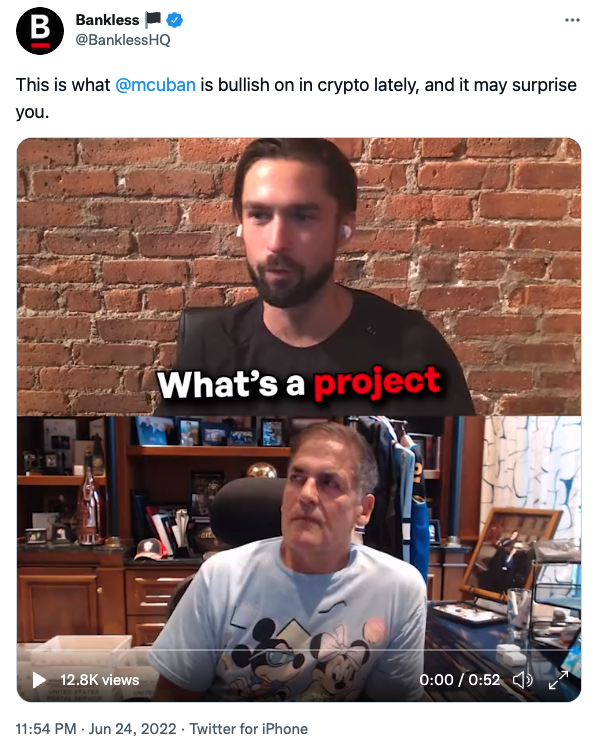
(To be fair, he says he hasn't seen a killer app like streaming, which I agree with).
By simply making carbon credits more accessible, and providing a liquid global market, ReFi has the potential to increase demand for offsets (Toucan, Flow Carbon), which should stimulate the supply of more carbon offset projects (Loam, Open Forest Protocol).
Decentralized Science (DeSci)
Decentralized Science (DeSci)
Another Web3 category with physical world implications is Decentralized Science (DeSci). As Phas3 founder Sarah Hamburgwritten:
Still in its infancy, DeSci is at the intersection of two broader trends. 1) efforts in the scientific community to change the way research is funded and knowledge shared, and 2) efforts within the cryptocurrency-focused movement to shift ownership and value away from industry intermediaries.
Hamburg highlights DeSci's potential applications -- specific areas such as funding, peer review, access incentives, pace, biotechnology -- and some open questions, including whether DeSci is really the best name. Decentralization doesn't feel like a core value prop; instead, she highlights several areas where blockchain can be useful.
Smart contracts mediate between authors and peer reviewers without going through the academic publishing industry.
An incentivized community may use tokens and NFTs to encourage the scientific community to share, review and curate different resources.
Fight censorship by storing data and information forever to avoid political interference.
Blockchain-based funding models might use public goods, DeFi, NFTs, or DAO LEGOs to obtain project funding, return value to funders, and create self-sustaining scientific communities.
A verifiable reputation that allows anyone to contribute science, peer review or funding based on what they know, not which institution they are affiliated with.
Ownership, allowing the scientific community to own their work and the products of their work.
I suspect that one of the most successful early applications of DeSci will be grants.
image description
Vibe creature
By bringing together communities of patients, scientists, and other partners, they plan to fund treatments that aren't worth Big Pharma's bother, smooth the approval process by bringing together trial participants, and potentially provide patients financially if a drug succeeds. (other than medical) benefits. Vibe is launched with two partner communities - NF2 Biosolutions and Chelsea's Hope - to find treatments for NF2 and Lafora diseases.
Why DAOs? Why not Kickstarter or a series of LLCs? The answer is simple: DAOs are able to leverage the global funding markets of cryptocurrencies. Additionally, when a project produces a successful outcome, the money goes back to the DAO and the community can vote on which other projects to fund with the proceeds.
Molecule also uses Web3 tools to fund life science research, starting with three DAOs:
VitaDAO focuses on longevity research
PsyDAO focuses on psychedelic research
LabDAO is an open, community-managed network of wet and dry laboratory services.
At the heart of Molecule's approach is the IP-NFT, through which they attach projects to NFTs that have been pre-screened by their community of scientists and practitioners. People can fund projects by purchasing NFTs, and if IP-NFTs are sold, funders can get benefits. This is a novel way to provide early-stage research and development funding for research projects that may not be funded through traditional channels.
DeSci is in a very early stage, and you should read Hamburg's DeSci Guide to understand the current state of the market, including some very real challenges and open questions. But if DeSci succeeds in making it easier to fund scientific research and for scientists to share knowledge, this small slice of Web3 might be enough to justify the hype.
Digitizing
More clearly, Web3 will impact the Internet economy. In the case of rising, Web3 will serve as the value layer of the Internet, connecting the global digital economy. Let's jump into the metaverse.
Metaverse. The best way to stop someone from taking you seriously is to say it straight up"Metaverse", but here we are.
The Metaverse is already here. People are spending more and more time online than they did a decade ago. As I wrote about in Great Online Games, cryptocurrencies are in-game currencies for our online activities. If the Metaverse is going to become a bigger part of our lives, then our digital goods will need the same property rights as our physical goods. Simply put, cryptocurrencies give physical properties to digital items, making them ownable, tradable, combinable, portable, and usable across platforms.
image description
Cyber X RTFKT Pod
The first article I wrote about Web3 "The value chain of the open metaversedescribes why I think Web3 will be a necessary part of the digital economy.
The idea that Web3 might help the Metaverse isn't controversial. exist"cartoon avatar, Jon Wu and Zach agree that, at this point, the problem is believing that the future will turn out to be something, and waiting and seeing if that turns out to be a reality. I won't spend more ink here.
For all of the above reasons, I believe Web3 is well worth the hype and money if we get it right. But are we doing it right? What's going on now? Can Web3 get over the hurdle to the point where the average person can use it and benefit from it?
With a utopian vision of the future, and an acknowledgment that we're going to have to wait and see, let's talk about some of the things I'm excited about in the near future.
The next few years
Getting to the utopian future I described above will require a lot of hard work, experimentation, and mainstream use over the next few years. There are use cases beyond guesswork to drive adoption and add value to people's numbers and even real life then we're going to enter the next bull cycle. People are unlikely to be attracted by the "risk-free 20% yield or unfounded bitcoin to $250,000" prophecy
It's no surprise that there aren't many Web3 applications yet that have broad appeal beyond speculation and entertainment. Great products take time to build. Great networks take longer to build. Smart contracts are already 7 years old.
Web3 social
Web3 social
I was skeptical about Web3 social - thanks in no small part to Bitclout, which is just Twitter + tokens - because I didn't think increasing funding would be enough to overcome the deep network effects of existing social media platforms. And as it stands, building a fully decentralized social network on Web3 rails would be too slow, too clunky, and too technical for all but the most ardent cryptocurrency enthusiasts.
When I read Varun Srinivasan'sFull decentralization of social networks, my perspective changed. Varun believes that decentralized social networks can challenge centralized social networks by making two promises. "They can guarantee that users have a direct relationship with their audience, and developers can always build applications on the network."
Believing that Web3 social will take off doesn't require you to believe that any one social product will benefit from building a token. Instead, it asks you to believe that a well-designed social protocol — and possibly the superstructure itself — will give every more focused, performant, and novel application built on top of it a better chance, through Leverage a shared social graph to build and sustain network effects.
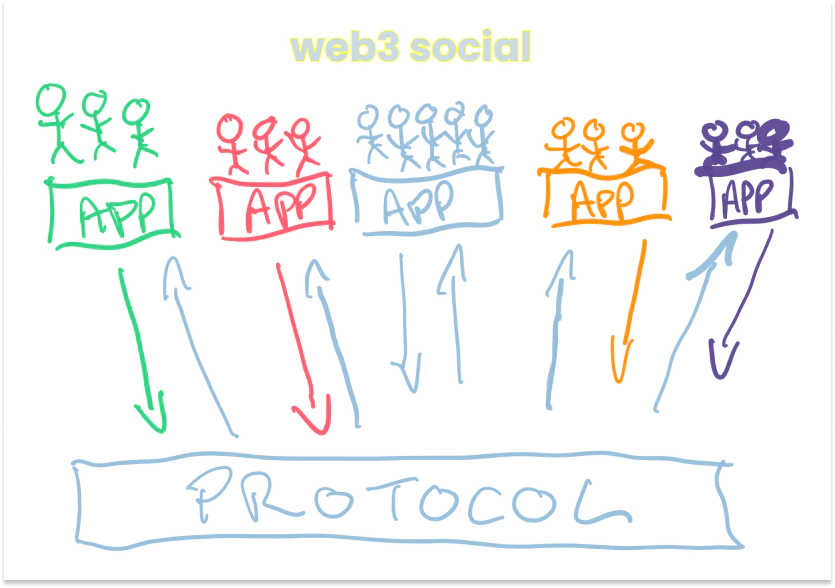
One of the most challenging aspects of building a web2 social product today is bootstrapping the web and attracting enough people that others want to stick around.
When users come for a specific application, possibly including those built by the same team that built the protocol, they can create usernames, information, and connections in an application and be written into the protocol, and they can be in the ecosystem used in any other application in . Importantly, the applications themselves can be built in a centralized manner, maximizing the quality of the user experience. Some apps will become very popular, others will be super hot early on like many social apps created in the past decade, and then die, but all will help increase the strength of the protocol network and quality, making it easier for the next app to enter and reach more users. This should mean that app developers can focus more of their time on building great, purposeful user experiences, rather than trying to figure out how to reinvent the web wheel.
Also, by connecting these apps, users will be able to build followers in one app, which can be accumulated in all other apps used in the ecosystem. For example, imagine if all your Twitter followers followed you on Clubhouse, or if every follower you gained on Clubhouse automatically (or via opt-in) followed you on Twitter. I bet things would have played out differently - Twitter might not have built Spaces, and more creators would have found more value in creating content on Clubhouse - if both were built on the Web3 protocol.
Of course, there will be challenges. For example, a lot of people I follow on Twitter don't use a Web3 product, and if it were a Web3 product, the experience would be worse than normal Twitter. The killer app for Web3 social software will likely have to feel like normal social software and focus on simplicity rather than Web3 bells and whistles. Even so, the killer app might start out by gathering a legion of cryptocurrency enthusiasts, or appealing to a younger demographic more likely to try out a new social app.
In this space, I'm excited about what Farcaster and Lens Protocol are building. As I mentioned in my conclusion, for Web3 social software to reach its potential, a winning protocol may have to emerge.
Web3 Gaming Is Growing, Too
articlearticleimage description
Axie World
It peaked at $364 million in the second month, most of it from the cost of breeding new Axies. Volume has since dropped sharply, to less than $1 million last month. Mostly due to lessons learned from Axies, earn-to-play games have fallen out of favor and better games have emerged - Axie Infinity creator Sky Mavis himself recently postedAxie Infinity: Origin, which provides users with free starter NFTs instead of asking players to buy NFTs to play the game.
If good web and mobile products take a long time to build, AAA games take even longer. A AAA game can take anywhere from 2 to 5 years to develop with a team of 100+ people. In the past year or so, game developers at AAA studios have started building for Web3, and it will be a year or two before they release their creations. These games will leverage Web3 patterns and infrastructure where useful, and use centralized technology where necessary. Great game first, ownership is a bonus.
I'm excited that one of the games Not Boring Capital invested in isGOALS, a "gameplay-first football game". GOALS will be free to play, but will also allow users to own and trade assets. Essentially, it's a fun, fast-paced, free-to-play football video game if you just want to play. If you want to go into franchise mode, there will be a thriving economy around players, practices, equipment, stadiums, teams, tournaments, etc., allowing players to earn money for their talents. However, the focus is still on the gaming experience. Earlier in June, the team released thistrailer, showing the quality of what they are building.
tweetstweetsas said in.
There are challenges here too, on the one hand, a lot of gamers hate Web3, when Discord CEO Jason Citron on myreplyWhen I shared a screenshot of the Discord/Ethereum integration in , I had to mute the notifications because there was a lot of abuse right away from most of his company's game userbase. It will take a lot of work to convince gamers that Web3 is not a hoax, not primarily in language but in the way game developers design their economies.
image description
Visual Capitalist
Compared with other forms of entertainment such as music, they have an interesting characteristic: new platforms tend to supplement overall revenues rather than cannibalize previous ones. Games with a rich interconnected economy can become a rich new layer on top of this revenue stack, and ultimately give console, PC, and mobile games new ways to monetize.
Decentralized Content Creation
Web3 social and gaming could end up looking like a different version of what we're used to. Not all use cases will be so straightforward. Probably because I write for a living, one example I'm particularly excited about is decentralized content creation. While different projects in this space have taken different approaches, the general idea is that communities and fans of specific stories and characters can participate in creating the universe of their favorite stories.
Not Boring Capital has invested in two companies in this category. Tally Labs, the team behind Jenkins the Valet, and StoryDAO. By the Founding Chairman of Marvel Studios and my friend Clint KiskerLeading Mythos, and Adim, founded by It's Always Sunny in Philadelphia creator Rob McElhenney, are also worth watching.
Decentralized writing is trying to solve two problems at the same time:
How content and intellectual property are funded and developed. Under the current model, studios and streaming services such as Netflix buy the rights to IP and place a cap on the upside for creators. Since building great IP can cost hundreds of millions of dollars under the traditional model, creators often have no choice but to sell.
The community engages in world building and storytelling. Fan fiction — where fans write their own stories based on Odaily Wars or Harry Potter or other popular IP — is insanely popular, but these creators don’t influence the core IP. Decentralized storytelling will allow fans to help create universes and tell stories, all based on the skeleton of a central IP with their favorite characters.
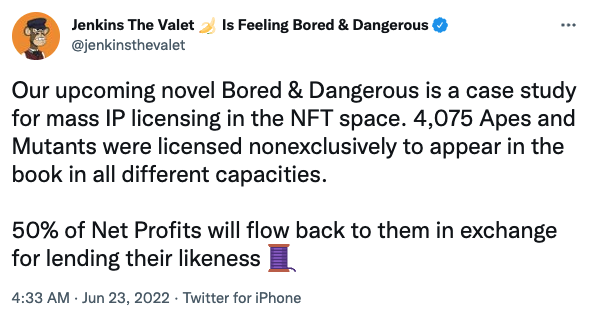
As an example, Jenkins the Valet is releasing a book written by Neil Strauss with input from a "writer's room" ticket holder. This book is from the holder of Bored Ape and Mutant Apegetauthorized characters and share the profits from book sales (done as NFTs) with them.
Tokenized Commerce
When Alex Danco visited Not Boring to write about tokenized commerce and how his team at Shopify made Shopify wallet-aware, I got a lot of feedback that this was the most convincing and understandable Web3 use case people had come across .
According to Danco, Danco said that token commerce “started with an observation: There is a new type of Internet user in the world called people with wallets.” In these wallets, people may have fungible tokens or non-fungible tokens. tokens, but the fact that they can show up in online stores with the contents of these wallets turns them into irreplaceable buyers. Merchants can treat these individuals as irreplaceable without having met them before.
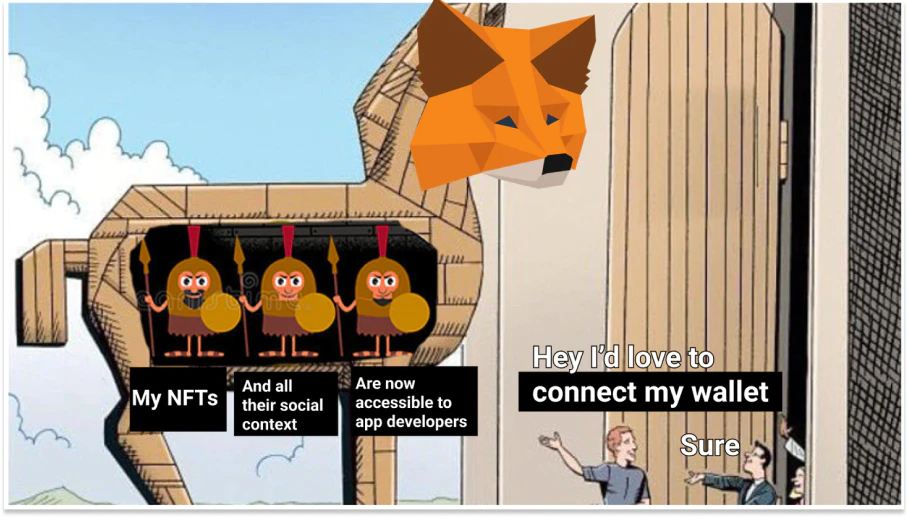
For example, if you own a Doodle NFT, the Doodle Shop might let you buy a hoodie reserved only for the Doodle holder. What's even more amazing is that any merchant, Doodle-affiliated or not, can give the Doodle holder something that an alternate buyer might not get. The Yankees may have Doodle nights and offer discounted tickets to Doodle holders. Supreme may reserve a certain number of its upcoming offerings for Doodle holders.
herehereRead the full article to learn more about how it works, why it matters, and why blockchains and tokens are necessary ingredients.
This is already happening, and Shopify has four amazing tokenization apps: PERC Engage, Manifold, Shopthru, and Lit Protocol for merchants to plug into their stores.
People are willing to do crazy things to get exclusive products. Popular merchants will be the driving force for new Web3 users and will show a more mainstream audience that NFTs can be more than jpegs.
Data ownership and wallet-aware websites
Tokenized commerce is a subset of a broader concept that I'm excited about: wallet-aware websites. When Nikhil Basu Trivedi asked me to contribute to his annual Next Big Thing article in December, I wrote:
Tokenized commerce is an example of this idea, but I think developers will start building broad wild wallet-aware products. Here are some potential applications:
Personalized recommendations: Spotify has a huge data advantage — it knows what you listen to, how often, and can build tailored playlists that keep you coming back. If I could have my listening history in a wallet on the internet, plus all sorts of information about myself from different sources, and have third-party apps access it, it would certainly be possible to recommend different playlists, but also How about movies, books, product recommendations, and even food recommendations?
Koodos: Koodos is a company invested by Not Boring Capital, allowing people to turn their favorite things on the Internet into NFTs, not for financial gain, but to show what they care about, like a digital scrapbook or a wall full of poster. Developers may build experiences on top of Koodos that are even better than the personalization they can get from the fire throat of data. Or creators can surprise their biggest collectors with a special experience.
Why the discount: After the Supreme Court decision to overturn the Roe V. Wade case, many businesses came forward saying they would pay for out-of-state travel for abortions. In part, it's a way of supporting their employees; in part, it's their way of showing that they support women's rights. What if the companies also offered discounts to those who could prove they donated in support of women's rights? Some friends of mine started ChoiceDAO, which is raising $1 million and donating it in tranches to various organizations based on input from the community. What if the donor received an NFT that Dick or Disney could read?
Over the next few years, we'll start to see more wallet-conscious experiences pop up on the internet. They may be created by Web3 companies, or they may be subtle options offered by established companies such as Shopify merchants.
Vana, one of the Not Boring Capital-funded companies I'm most interested in, is working to make it easy for people to own and access their data, which will help usher in this new world of digital experiences.
other
other
zero-knowledge proof
zero-knowledge proofIt is possible to remove one of the major trade-offs inherent in living, working, and transacting online: the convenience, speed, reach, and scale of the Internet in exchange for our privacy. One of the big challenges with Web3 today is that unless you use a bunch of wallets and try to mask their connections, you end up exposing a lot of information that you have. In order for real world assets to flow online, for people to use their Web3 wallets like bank accounts, or even send DMs on Web3 social networks, there needs to be a way to transact and interact privately while proving something about themselves . Zero-knowledge proofs are a key piece of the puzzle. I'm excited about the companies working on this problem, including Aztec Network (where Jon Wu works), Espresso Systems (of which Jill Gunter is a co-founder), Aleo, Starkware, and zkSync. Read more here.
soul bound tokensA powerful building block of experiences such as token commerce and governance, but it is non-transferable. A party might buy up a lot of the DAO's or protocol's governance tokens to influence a decision, or someone might lend me their doodle so I can buy a product for doodle holders (not a big deal, but Depending on the content of the token, it might be). In January, ethereum co-founder Vitalik Buterin proposed a solution to these problems: soul-bound tokens. The tokens will be non-transferable and tied to a specific person or wallet, meaning they can only be used by intended users. Additionally, the inability to trade will help de-financialize aspects of Web3, which will be more stable and free from speculation.
DAO:Most of the superstructures, protocols, and projects we discuss in this post will be governed by DAOs after a period of gradual decentralization. In the years to come, DAOs will be hotbeds of innovation in governance as they iterate on the best ways to govern online.
There will also be more interesting, purposeful, culturally relevant DAOs that capture the public's imagination: they are the fastest way to build an internet organization that catches the tide of the times. There will be more likeConstitutionDAO moment.Krause HouseWait DAO may realize their dream of buying NBA teams. Companies invested by Not Boring CapitalArkiveA decentralized museum of objects is being built to reach more people.
herehereLearn the basics of DAOs.
Personally, there are a lot of things that get me excited about Web3 in the far future. To reach such a future state, Web3 projects need to demonstrate usefulness in the short term, and the examples I've shared are some where I think it's possible to make it happen. That said, the people actually building will have a better idea of what's coming, and have stuff in their heads, IDEs, and Figmas that I can't imagine.
challenges and opportunities
challenges and opportunities
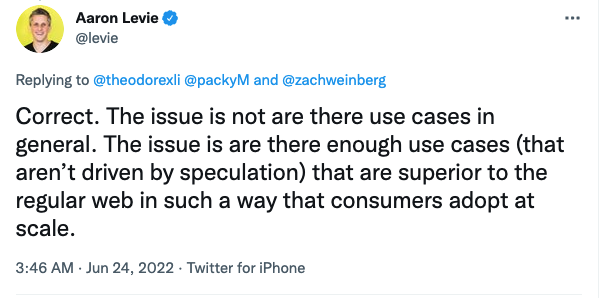
The best part of the debate is that it reveals some very legitimate concerns and challenges. For example, in the series of articlesaboveAfter the release, Box CEO Aaron Levie sent me a well thought out set of technical and game theory problems that he thought would be difficult or impossible to overcome. He's very smart, and his logic for many of these issues is sound.
blog postblog post。
This challenge is compounded in Web3 because people have an interest in the game - in the form of tokens - which may make them choose to build or use an inferior protocol. Ultimately, though, we agree that if the ecosystem coalesces around one protocol per use case — Uniswap for liquidity, Farcaster for social, XMTP for messaging, etc — these issues are less challenging . In other words, like Horne, we've come to the conclusion that there should be a single superstructure for everything.
That's the value of productive debate. I hadn't thought about it this way before, and it changed the way I thought about competitive dynamics. There is a definite problem to be solved, not inevitable or impossible, that will be familiar to anyone trying to build a platform in a competitive environment: how to attract a sufficient number of developers to a protocol.
This is not a challenge unique to Web3. Even Meta, with its Hall of Fame network effects, is fighting hard to turn Oculus into a VR platform. As I said in "Everybody Hates Facebook"As written in.
To become a platform, Zuck predicts that the company needs to sell 10 million Oculus headsets to attract enough developers to build an ecosystem. That's why the company dropped its price to $299.
Protocols should fight the same way: how do we become the protocol for developers to build applications for this specific use case? How do we attract developers, attract users, attract developers, attract users, and so on, until we build a client? These are questions any platform needs to answer, and Web3 presents unique challenges and unique tools to answer them.
From there, there are more challenges. What if the best social products are built on Ethereum, but the best lending products are built on Solana? What does this mean for composability and user experience?
What I'm trying to say here is that the market will figure this out. For example, LayerZero is an "universal chain interoperability protocol" that "can implement cross-chain applications with a low-level communication primitive." (Listen to my conversation with LayerZero co-founder and CEO Bryan Pellegrino.) It makes it easier for developers to build products that work across chains, and for users to trade assets across chains. At the user level, I have invested in a company that is building a wallet that will abstract away the need to trade tokens or cross-chain assets to interact with Web3 applications. Put in USD, connect your wallet, and transact in whatever currency is desired for a particular application. These are just two examples of the efforts of many companies to make the user experience of Web3 less confusing.
However, for many cases, the question remains: why does this need to be on the blockchain?
Nathan Schneider in "Web3 is our all-time opportunity"A good answer to this question. I largely agree with his argument: to some extent, the hype around Web3's impact as a democratizing force for the economy and governance is justified, "only in part due to the availability of the technology itself. Perhaps more What matters is the amnesia it induces, as an innovative paradigm whose novelty predisposes people to ignore once-stable norms.”
Technical aspects aside, what excites me most about Web3 is that it prompts people to rethink many of the patterns and systems we take for granted and provides a laboratory for experimentation. In many cases blockchain is really needed - token commerce is possible because any merchant can read what's in your wallet - but in many other cases the magic comes from Willingness to experiment and try new things in the lab.
It’s okay to look at pictures of monkeys, unsustainable yields and volatility, “enjoy poverty” tweets and billion-dollar hacks and think “Yeah! This is how we’re going to solve all the world’s problems!” understand. It's even harder to imagine that the same system that produces so much fraud, scams, and rug pulls would have a net benefit to society, especially when there are so many other pressing problems that need to be addressed.
To put it bluntly, is there something that people can do that has a more direct and significant impact on humanity than building Web3 products? Of course, yes, if you're a scientist and think you might have a cure for cancer, stop reading this now, turn off your Metamask, and get to work.
However, I don't think this is a zero-sum problem. First, as highlighted above, DaSci may provide new funding and knowledge-sharing mechanisms to accelerate the development of cancer treatments. Plus, Web3 isn't stealing scientists and aerospace engineers -- it's attracting software entrepreneurs who might be working on less open products, and traditional finance folks who are applying their skills to more liquid global markets, And academics who would rather spend their time experimenting with new models in a living laboratory than refining old ones in formulas, such as economists, mathematicians, and policy experts.
Ultimately, this will not be resolved through debate. It will be addressed by usage and usefulness, by what I've written here, and a whole bunch of other things I can't imagine, whether it will come to fruition, or if scams, margin calls, fraud overwhelm the positive potential. Through this debate, I realized why it's important to point out bad actors and unsustainable patterns even though I'd rather focus on the positive: by proving skeptics right and by overbearing Regulation, bad things can prevent good things from appearing.
Original link


