质押通胀改革,困住以太坊与Solana


- Key Takeaway: Ethereum and Solana are caught in a "Morton's Fork" amid disputes over slashing validator staking rewards. Regardless of how issuance policies are adjusted, both could see a decline in validator numbers, exacerbating centralization risks. In the long run, their economic models will ultimately be constrained by real-world financial dynamics.
- Key Elements:
- Ethereum's EIP-8363 proposal suggests burning a growing portion of rewards as staking volume rises. With current staked supply at 41.4 million ETH (34% of total supply), validator yields could drop from 2.862% to 1.476% if implemented, sparking strong community backlash.
- Ethereum issues approximately 1.1 million ETH annually (~$2.1 billion) for staking rewards, with fees accounting for only 15% of staking income. Solana issues roughly 19-22 million SOL annually (~$1.5 billion), with an even lower fee share (13%) and an annual inflation rate of 3.7% (vs. Ethereum's 0.85%), resulting in higher dilution for non-stakers.
- Staking yields currently underpin a $35 billion lending and leverage loop strategy built on LSTs. Cutting rewards could force repricing in fixed-rate markets like Pendle, prompting lending platforms to reassess collateral and destabilizing DeFi's benchmark rate system.
- Solana's SIMD-0550 proposal aims to hit a 1.5% inflation target ahead of schedule by 2029, while SIMD-0553 seeks to raise daily burns to 7,500-9,000 SOL (still far below the ~60,000 SOL in daily rewards). Active validator numbers have already fallen from a peak of 2,500 to 683.
- Ethereum's security moat—staked ETH valued at ~$79.6 billion—is nearly four times the size of traditional financial clearing giant DTCC's guarantee fund ($19.7 billion). However, attackers face penalty mechanisms that destroy staked assets for malicious behavior, meaning economic security depends on the stability of the staking ecosystem.
Original Author: Thejaswini M A
Original Translation: Chopper, Foresight News
In 1487, Henry VII was in dire need of funds. Two years earlier, he had seized the English throne at the Battle of Bosworth Field, and the cost of maintaining his rule was immense. The task of raising taxes fell to Lord Chancellor John Morton.
Legend has it that Morton had his own methods. He would visit noble estates and observe their lifestyle: if a noble lived lavishly, Morton would judge that the man was wealthy and thus obligated to offer tribute to the King; if a noble lived frugally, Morton believed this indicated a talent for saving, meaning he was equally capable of paying.
There was no third option. Regardless of what Morton saw, the outcome was always the same: the noble had to pay.
This anecdote is a second-hand account, recorded by Francis Bacon in 1622, when the story was still widely circulated among the populace. The term "Morton's Fork" didn't come into widespread use until the 19th century, but this logic has endured because it holds significant real-world relevance. The "dilemma" referred to here describes two choices that ultimately lead to the same outcome, starkly contrasting with a win-win situation.
Currently, Ethereum and Solana are caught in such a predicament.
Both public chains incentivize validators by issuing new tokens, and both are attempting to reduce these issuance subsidies. Ethereum's proposed adjustments face strong opposition; Solana's proposal is currently being voted on, with voting concluding on August 18th.
On one hand, maintaining current validator staking rewards would make the staking sector more favorable for large institutional service providers with substantial capital; on the other hand, cutting rewards would put the most pressure on smaller node operators, whose operational costs are fixed and profit margins are already razor-thin.
Whichever path is chosen, the eventual outcome is a decline in the number of validators. This article will dissect the debates over issuance policies on the two public chains: they are forced to make a choice, merely deciding which form of centralization to drift towards.
Ethereum: EIP-8363 Progressive Issuance Burn Proposal
On August 4th, Ethereum researchers including Justin Drake and Jérôme de Tychey published a draft titled "Progressive Issuance Burn," known as EIP-8363. The core mechanism involves proportionally increasing the protocol's burn rate of validator rewards as the total amount of staked ETH rises.
Once the total staked amount reaches 60.25 million ETH (approximately half of the total supply), the reward burn ratio hits 100%, reducing the staking issuance yield to zero.
Currently, around 41.4 million ETH is staked, representing 34% of the total supply, corresponding to roughly 890,000 validators with an average staking yield of 2.67%. Aave founder Stani Kulechov calculated that if implemented at the current scale, the validator yield would drop from 2.862% to 1.476%, a near-halving.
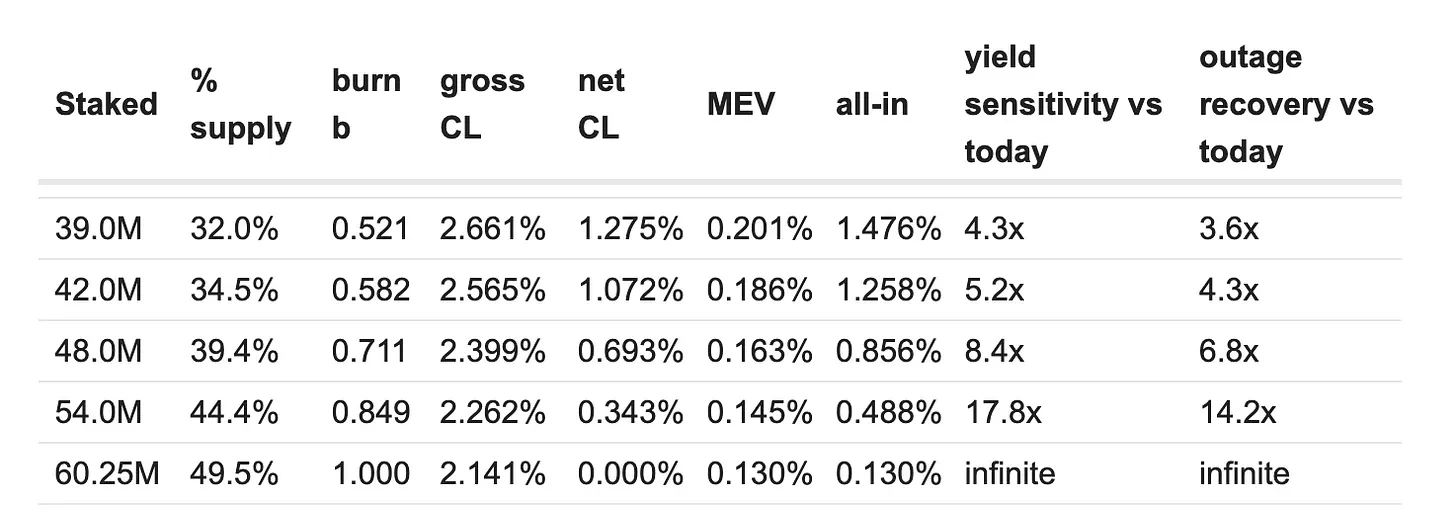
Within three days of the proposal's release, Stani Kulechov, SharpLink CEO Joseph Chalom, and ether.fi's Mike Silagadze publicly announced their opposition.
EIP-8363 is still in its early draft stage, undergoing initial review on GitHub. It's far from finalization and implementation and missed the window for Ethereum's upcoming Hegotá upgrade; however, the proposal could still be submitted for consideration in future network upgrades.
To understand why the staking community fiercely resists reward cuts, one must look at the size of this revenue pool. Ethereum relies on issuing new tokens to incentivize participants and secure the network. The protocol mints roughly 1.1 million new ETH annually for validators. At a price of $1,921, this represents an annual compensation pool of approximately $2.1 billion.
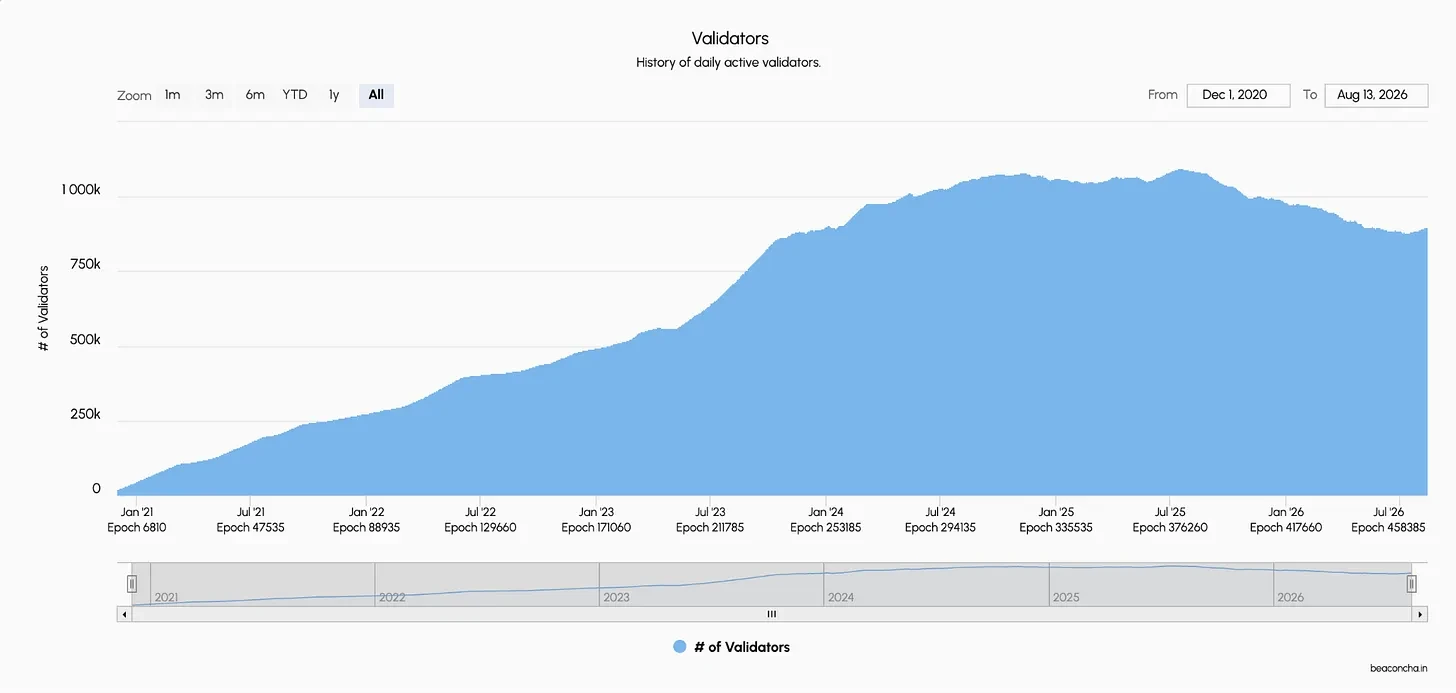
Ethereum's active validator count
Solana operates similarly, but its issuance is larger relative to its economic size. Solana issues approximately 19 million to 22 million SOL annually, worth around $1.5 billion at current prices. User transaction fees plus Jito tips total 6,400–9,600 SOL per day, or about $225 million annually. In other words, user fees only cover 13% of total validator revenue, with the remainder relying entirely on token issuance. Ethereum's situation is similar; Chalom estimates that fees and tips constitute about 15% of staking rewards, with the remaining 85% derived from issuance.
Solana's annual inflation rate is 3.7%, while Ethereum's is only 0.85%. Non-staking SOL holders see their assets diluted more than four times faster than ETH holders under equivalent conditions.
In traditional finance, the National Securities Clearing Corporation (NSCC) participates in nearly all U.S. stock and bond trades. Its parent company, DTCC, processed $470 trillion in securities transactions in 2025, with assets under custody totaling $115 trillion. The NSCC maintains a member default fund of $19.7 billion, funded by member contributions, with NSCC itself contributing only $130 million.
To attack the Ethereum network, an attacker would need to control 41.4 million staked ETH, representing a capital barrier of $79.6 billion—four times the size of the NSCC guarantee fund. This is just the minimum requirement; if someone were to aggressively acquire ETH, the massive buy pressure would quickly drive up the price. Additionally, the attacker would need to build a large-scale, globally distributed server cluster to wield these stakes. Ethereum has built-in defense mechanisms; malicious behavior triggers the network to directly burn all of the attacker's staked assets. A failed attack means all investments are permanently zeroed out.
However, there remain significant differences in how the two systems operate.
NSCC members contribute $19.7 billion in guarantee funds, which merely serves as a threshold for market entry. This capital generates no returns, and members desire the required contribution to be as low as possible. In contrast, Ethereum offers a 2.67% annualized yield on comparable staked capital, while Solana's staking yield ranges from 5%–8%.
Years of stable staking returns have spawned a complete commercial ecosystem dependent on them. Currently, around $35 billion in liquid staking tokens like stETH are deposited as collateral across various crypto lending platforms. Traders use these tokens to build looping leverage strategies: depositing LSTs into Aave or Morpho, borrowing WETH, and staking again in a cycle. This strategy's viability rests on staking yields exceeding borrowing rates. Pendle has created a fixed-rate market based on staking yields, Curve has established trading pools for investors to exit, and SharpLink holds $3 billion in ETH reserves, mostly staked via Coinbase, Anchorage, Figment, and Galaxy.
The staking yield has become the benchmark interest rate for the entire DeFi market. If consensus layer rewards were to be cut in half, leverage looping strategies would turn from profitable to loss-making, forcing Pendle's fixed rates to reprice, and lending platforms would have to comprehensively reassess the collateral value of all liquid staking tokens.
Key difference pre- and post-Merge: Miners and stakers are not the same
Before the Merge, the Ethereum protocol issued approximately 13,000 ETH daily to miners; after the Merge, it issues only about 1,700 ETH daily—a one-time 88% reduction in issuance. Miners, who had invested billions of dollars in hardware over years, fiercely resisted the change, eventually leading to a fork that created ETHW, a token now worth less than 1% of ETH.
But the miner community and the DeFi financial system were independent. Miners provided hashing power for rewards, and no one built complex financial products around mining income. Their earnings weren't used as collateral for lending across the chain, so even if their income were wiped out overnight, the lending market would remain unaffected. When miners exited, the rest of the system could function normally without adjustment.
Stakers play a dual role. On one hand, they maintain network security; on the other, their staked tokens serve as underlying collateral for half of DeFi's lending operations. Thus, cutting staking rewards impacts the entire financial ecosystem built upon them.
In 1965, Mancur Olson proposed a theory: smaller groups with potentially enormous gains tend to be more effective than larger groups where individual interests are thinly spread. Small groups have stronger incentives to voice their concerns and engage in strategic maneuvering.
Regardless of whether a node is profitable, there are fixed costs to running a validator: servers, electricity, network, and so on. Currently, staking 32 ETH yields approximately 0.92 ETH annually, equivalent to $1,760. If the new progressive proposal is implemented, annual income would drop to 0.47 ETH (about $900). With operational costs unchanged, expenses that previously accounted for 20% of income would suddenly approach half of it. In the event of a slashing penalty for a proving error, the same dollar loss would represent double the proportion of income.
According to Olson's theory, ordinary token holders constitute a large group: Ethereum mints new tokens annually for stakers, continuously diluting the assets of regular holders. However, the dilution spread across individuals is negligible—only a few ten-thousandths annually. Most people don't perceive the impact strongly and lack the motivation to protest.
Large staking service providers, however, constitute a small group: the bulk of newly issued tokens flows to them, representing billions in revenue, and their businesses depend entirely on this income. If the network cuts rewards, these companies would suffer enormous losses.
Those supporting issuance reduction argue that current staking yields are too high, continuously attracting ETH inflows, with rewards heavily concentrated among top exchanges and staking services. In the first half of 2026, institutional capital drove the total staked ETH up by roughly 15%. The proposal's rationale is to raise the marginal cost of staking, making new stakes unprofitable, thereby curbing centralization.
Opponents contend that directly cutting rewards would first bankrupt ordinary individual operators running home-based nodes. In fact, both sides share the same goal—preventing a few capital giants from controlling Ethereum. The disagreement lies in whether cutting rewards or maintaining them would more quickly harm the network's decentralization.
Solana faces the same dilemma
Solana validators must pay approximately 389 SOL in annual voting fees, whether the node is profitable, regardless of market conditions, and whether they receive delegated stake. The current staking yield is around 6.5%, and the break-even point for a node requires roughly 200,000 SOL in delegated stake. Solana's active validator count has fallen from a peak of 2,500 to 683; yet the total staked SOL has climbed to 430 million, representing nearly 68% of the stakeable supply.
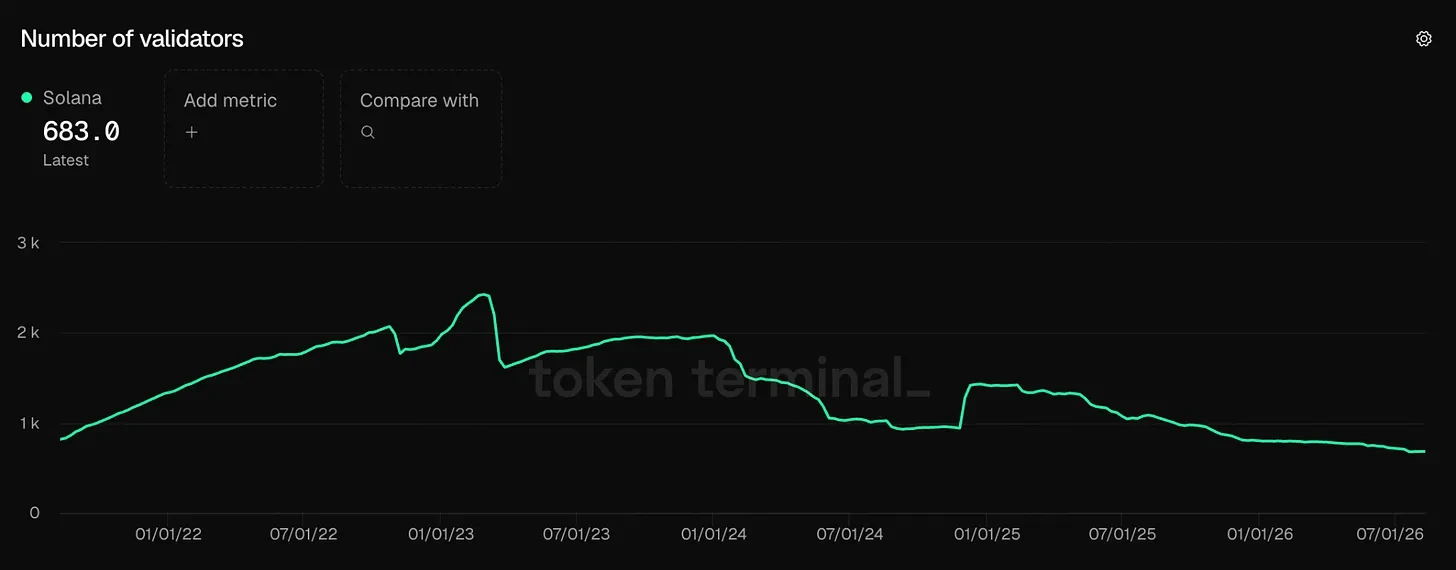
Changes in Solana's validator node count
Solana is currently voting on reward reforms. Proposal SIMD-0550 increases the annual disinflation rate from 15% to 30%, advancing the timeline for reaching the long-term inflation target of 1.5% from 2032 to 2029, reducing an estimated 18.9 million SOL in future issuance. Proposal SIMD-0553 redesigns the fee mechanism based on resource usage, increasing daily burns from 648 SOL to 7,500–9,000 SOL. Even at the upper bound, the burn scale remains far below the roughly 60,000 SOL distributed in daily rewards.
Voting concludes on August 18th, and the proposal requires an absolute majority of over 66.67% of staked supply to pass.
We are accustomed to viewing blockchain governance as a practice of autonomous decision-making, where code and community votes determine the future of a digital economy. But Ethereum and Solana reveal the same trend: protocol rules are ultimately constrained by real-world financial dynamics. When early founders designed their economic models, they hoped the market would spontaneously maintain decentralization. Yet once a public chain's assets grow into a global liquidity cornerstone and an institutional asset allocation target, the underlying economic forces of yields, leverage, and corporate operating costs will eventually supersede the original design vision.
If a public chain relies on offering returns to attract users to lock in assets for expansion, it will inevitably hit this wall. Regardless of how Solana's vote concludes next Monday, or how Ethereum ultimately handles its proposals, they are only choosing: how soon we reach the destination and hit the barrier.