The Internet returns to the crossroads of history: How does Web3 solve the dilemma of openness and commercialization?



In 2007, Jobs released the first touch-screen mobile phone, the iPhone, which subverted the rules of the Internet industry.
In 2008, inspired by the global financial crisis, Satoshi Nakamoto released the Bitcoin white paper, creating a new electronic currency - Bitcoin.
At that time, Jobs probably did not expect that the change of the iPhone to the Internet industry directly triggered the golden decade of closed development of the Web2 mobile Internet.
At that time, Satoshi Nakamoto probably did not expect that more than ten years later, when the possibilities of Web2 were exhausted, Bitcoin and the blockchain, which were originally designed to resist global fiat currency inflation, would become the key to open the door to Web3.
Now, after more than ten years of development of the mobile Internet, it seems to be the end of the road. Talking about the monopoly and closure of large companies has become a kind of political correctness. Under the brutal conquest of Internet giants, the walls of big factories are getting higher and higher, and the data ownership and privacy rights of ordinary users are at risk. When the traffic dividend disappeared and the growth slowed down, I thought that the Internet industry was only left with the stock game, but Web3 gave the industry new hope, and people began to yearn for a new Internet future.
In this new future, users will own the platform, not the platform owns the users. Users' time, attention, and data are no longer commodities sold by the platform, and the ownership of content and data returns to users. The interests of shareholders are not the first priority. Web3 applications are jointly created and owned by the community. The most important thing is that the Internet will no longer be closed, and open source and openness will become the consensus of Web3, which will lead to more innovative possibilities.
People who are familiar with the history of Internet development may say here: Wait a minute, isn’t open source and openness a feature of the early days of the Internet? The river of history twists and turns, does it go back to the past?
It is said that "people cannot step into the same river", but the Internet seems to be tracing its origin, returning to the fork in the past of Web2, and starting again standing in the river of history.
secondary title
Once Open Web2
In the Chinese Internet industry where "traffic is king" and spending money is the main way of growth, Xindong Technology CEO Huang Yimeng has successfully cultivated such excellent game distribution and content as TapTap in the cracks of game giants such as Tencent, NetEase, and Bilibili. Platform, this is of course because he understands games very well, and it is inseparable from his in-depth understanding of open communities.
Before Xindong, Huang Yimeng founded VeryCD in 2003, which is the Chinese version of eMule, a P2P media resource sharing website based on open source. At that time, the concept of VeryCD was "Sharing the Internet". It wanted to build the world's largest, most convenient, and most user-friendly resource sharing network through open technology, and it really became one of the most visited resource sharing websites in mainland China.
In the Chinese Internet at that time, Huang Yimeng was not the only entrepreneur who believed in the concept of openness. Recently, Huang Yimeng was nostalgic on Twitter, reminiscing about discussing with Ah Bei (Douban founder Yang Bo) and Mtime founder Ma Ruila for more than ten years, how to get through the movie data open agreement of Douban, VeryCD and Mtime.
image description
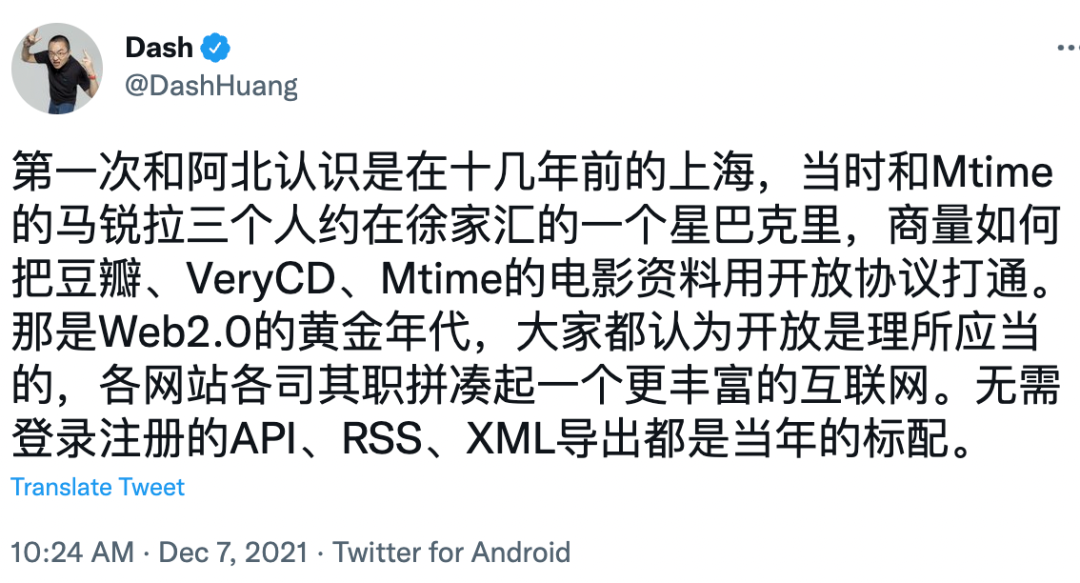
Huang Yimeng Twitter
Indeed, Web2 was once an open playground. The most typical representative is the once-popular RSS protocol.
RSS is a web aggregator protocol that allows users to access updates from websites in a standardized, computer-readable format. Subscribing to RSS allows users to keep track of updates from many different websites in one news aggregator without opening and checking each one. Translated into adult words, users who use RSS can customize their own content information flow.
At that time, the Internet industry was still in its early days, and the common large-scale applications such as Facebook, Twitter, and Weibo had not yet been born. People used RSS to track the updates of different websites and customize their favorite information streams. As Huang Yimeng said, ten years ago, API, RSS, and XML export without login registration were standard configurations of many websites.
However, with the development of the mobile Internet, various App applications have emerged. Users only need to register an account, and the App will provide us with corresponding information. We no longer need to customize our own information flow, the APP will "continuously push" according to our browsing preferences. At present, our commonly used content applications such as WeChat official account and Toutiao are actually closed services based on RSS. Correspondingly, excellent RSS providers such as Google Reader and feedsky have been shut down one after another, and the number of websites supporting RSS is also decreasing day by day. This agreement seems to be becoming dust of history.
Even mobile apps have had an open era. In the early days, Weibo started to build an open platform and provided API interfaces for third-party developers to build personalized client products, thus giving birth to a batch of third-party Weibo clients with strong personalization and fewer advertisements. Welcomed by users. However, Weibo, who is unwilling to see the development of third-party clients, has successively closed basic permissions for reasons such as security issues. Until 2017, some developers revealed that Weibo had completely closed the open interface, which meant that the third-party clients were almost wiped out, and Weibo was closed again.
Another popular open product is the application IFTTT born in 2011, which is If This Then That in English. As the name suggests, you can set a condition on IFTTT to have the system perform a specific action for you.
As an open collection of a bunch of websites, IFTTT allows users to only need to select one of the third-party services it provides, and specify that when it appears in a certain state, it will trigger an action in another service. Everything can be done with a snap of your fingers. For example, you can set IFTTT to send you a tweet when the weather changes to rain; you can set IFTTT to send the mention of you to Evernote when it finds out that someone mentions you on Twitter; Set IFTTT to send the updated content to Read It Later when an RSS feed is updated.
In the early days of Web2 development, this kind of open thinking allowed the innovation of different products to be combined and superimposed like Lego. On the basis of information aggregation and mutual inspiration, more incredible compound interest effects appeared.
However, between openness and closure, history has finally made its own choice.
Now we look back, with the birth of Apple's application system and the development of the mobile Internet, a large number of Web2 protocols that once moved towards open source and openness have been eliminated in the competition. Instead, Internet applications that focus on moats, intellectual property rights, and monopoly are killing more and more brave. Under such a path, Web2 naturally began to turn, from open to closed, and then developed into the monopoly giant we are familiar with today.
secondary title
The Dilemma of Openness and Commercialization
Openness and open source are obviously conducive to innovation, why are they abandoned by history. This is inseparable from a classic problem in the development of Web2, how to make money?
The biggest profit logic of Web2 is "traffic realization".
Ever since Yahoo, the originator of Internet companies, launched the free service "Haotou", "burning money to earn traffic" and "monetizing traffic" have become problems facing all Internet companies. How to obtain traffic (strategic choice) and the monetization efficiency of traffic (business model) can greatly affect the profitability and market value performance of Internet companies.
This point can be fully reflected in the development history of Tencent’s early business model. Tencent's earliest product was to provide users with free instant messaging tools. Although the number of users has grown rapidly, users do not have the habit of paying, and Tencent did not have a good way to realize it at the time.
In order to achieve profitability, Tencent first charged through three modes of telecom value-added services, virtual commodity sales (QQ skin, etc.) and "Freemium" (Free + Premium), and then continued to expand other free products and content, such as WeChat, QQ Music, QQ Portals, QQ games, etc., and then through value-added services, advertising, entertainment and e-commerce, etc., continue to expand the attempt of "traffic realization".
In the face of such business logic, the number of users and the duration of use are the biggest reservoirs of every Internet company, and applications need to be monetized around users. This also forces Internet applications to think of various ways to keep users in their own closed ecosystem, even at the expense of shielding and monopolizing each other, and there are giants such as Ali, Tencent, and Byte that we are familiar with. wars of all kinds.
Under the Web2 mechanism, openness and open source are exactly the opposite of profitability.
When the RSS service is popular, it means that the traffic of a large number of websites is actually stolen. Users can directly track website updates through RSS subscriptions, which is equivalent to cutting off the traffic of these websites and applications. The content producers of the websites cannot obtain clicks and traffic. Therefore, it cannot be monetized through advertising and other forms.
When Weibo opens the API to third-party developers, it means that the traffic of its main website is also shared, and the traffic and click-through rate of Weibo's own products will naturally decrease. In the Web2 era where "traffic is king", what is shared is not just traffic, but business value and monetization opportunities. This model will certainly not last long for Weibo, a listed company.
For another example, in the traditional Internet, open protocols such as TCP/IP, HTTP, and SMTP, which establish the cornerstone of the Internet, are obviously of extremely high value, but their inventors have no way to realize them, and cannot match the value that matches their contribution , often can only "generate electricity with love".
All historical choices are inseparable from the nature of human beings to pursue interests. This has no moral color, but an unchangeable fact.
In order to make money, Google continues to cut off unmonetized applications, no matter how popular it is with users, including Google Reader that uses RSS.
In order to make a profit, Tencent kills the applications built on its own ecology. A few lines of code can cut off the lifeline of a small program application. No matter how successful it is, it only poses a threat to its own business.
In order to make a profit, the Internet giants regard the entrance of user traffic as a golden door, blocking each other, no matter how much inconvenience this causes to users.
Until the end, when there is a conflict between user interests and commercial interests, Internet applications will still choose interests, after all, they only need to be responsible to shareholders and themselves.
secondary title
Web3: Incentives Change
To change the predicament of the Web2 model, it is necessary to change the business incentive mechanism.
Thanks to Satoshi Nakamoto, the concept of Bitcoin proposed more than ten years ago has finally subverted the enterprise business model and social collaboration model after layers of evolution.
As the "fat protocol" theory says, the previous generation of shared protocols (TCP/IP, HTTP, SMTP, etc.) produced immeasurable value, but most of these values are re-acquired in the form of data at the application layer (think Think Google, Facebook, etc).
The key elements that Web3 will subvert this ecology are the shared data layer and the introduction of encrypted tokens.
By storing user data through an open source and decentralized network, rather than independent application access to control different information islands, Web3 lowers the barriers to entry for new participants, allowing innovative ideas to be built layer by layer like Lego, and create an ecosystem System: The above products and services will be more dynamic and competitive. On the same and open source protocol, the marketplace can build several competing, non-cooperative, but interoperable services. This also prevents a “winner takes all” market monopoly.
On the other hand, after the token is introduced, when the token appreciates, it will attract early speculators, developers and entrepreneurs. They become stakeholders in the protocol and financially support its success. Then, some holders who have obtained early benefits will create applications and services around the protocol in order to further enhance the value of the token, and continue to grow the protocol ecology. Some applications will become very successful and introduce more new users, which will further increase the value of toekn, attract more entrepreneurs' attention, and bring more applications, thus forming a positive cycle growth mechanism.
Under the dual functions of openness and token, it not only ensures the security, privacy and control of user data, but is owned by the user himself. The interests of protocols, applications, developers, and users are also closely related to each other. Everyone becomes an important participant in the entire interest cycle system. Everyone can be an architect, participate in the construction of the Web3 platform, and obtain and work through smart contracts. Proportional incentives. Everyone owns a platform.
In the Web2 era, the predicament that opening up and monetization cannot be achieved at the same time will be completely broken. Although Web3 is currently still more discussed than implemented, it provides a better solution and a way forward in the predicament. After the development of the Internet hit the south wall, with the help of technological innovation, it returned to the once forked intersection, and continued to move forward along the path of openness and innovation of the predecessors.
From openness to closure of Web2 to the openness of Web3, there is quite an evolutionary conception of "seeing mountains as mountains and seeing water as water".
The historical course of this river seems to have taken a detour, but it is also the only way to go. At every moment, each market participant has made a choice to maximize his own interests, and the course of history is carved by interests. The birth of Bitcoin and the decentralized blockchain has released power from the hands of a few people and distributed it to a wider group of people. The final choice of history must also be in the interests of power owners, that is, each of us.