Editor's Note: This article comes fromDeep tide TechFlow (ID: Tech-Flow), reprinted by Odaily with authorization.
Editor's Note: This article comes from
Deep tide TechFlow (ID: Tech-Flow)Deep tide TechFlow (ID: Tech-Flow), reprinted by Odaily with authorization.At the beginning of 2021, Bitcoin has broken through a new high, reaching $32,000, and a number of cryptocurrencies have also launched an impact to the high point.In this year, from the 312 sharp drop to the halving of mining output, from the DeFi wave to the new high of Bitcoin, from Bitmain’s infighting to reconciliation and separation... The mining industry is undergoing a quiet upheaval.These changes are geographical. The center of Bitcoin mining is gradually shifting from China to Northern Europe, North America, and Central Asia. They are also psychological. The cost of new miners entering the market is getting higher and higher. The old miners "wait for the rabbit" to deal with the hidden reefs and vortexes of the currency market at any time.
These changes are concrete, the Antminer S9 mining machine has changed from a 100-yuan "retired" scrap iron to being sought after again; it is also abstract, the status of miners has changed from no one cares about it to everyone's envy.What has 2020 left for the crypto mining circle? Deep Tide TechFlow tries to summarize 5 major changes.01 Bitcoin halving: Insufficient supply of miners or reason for Bitcoin growth
On May 12, the Bitcoin block reward dropped from 12.5 BTC to 6.25 BTC. After the halving, Bitcoin’s annual inflation rate fell to 1.8% from the previous 3.7%.
This lack of supply fuels Bitcoin's rise. Bitcoin miners regularly sell mined bitcoins to the market in order to pay electricity bills or buy new machines. After the halving, output and selling pressure were cut in half, and the annual inflation rate of Bitcoin fell from 3.7% to 1.8%, lower than most central bank fiat currencies in the world.At the end of October, after PayPal launched its Bitcoin service, its purchases of Bitcoin have exceeded 100% of the new supply.On December 11, according to the Wall Street Journal, MassMutual, one of the five largest life insurance companies in the United States, has purchased $100 million worth of Bitcoin for its general insurance accounts through New York Digital Investment Group (NYDIG). .Another crazy public company is MicroStrategy. Beginning in July this year, MicroStrategy began to buy bitcoins on a large scale. Through several continuous purchases, it exchanged 475 million US dollars for 40,824 bitcoins.
According to the statistics of Bitcoin Treasuries, there are currently more than 16 listed companies holding Bitcoin in the market. In addition, the trust company Grayscale Investment bought 350,000 bitcoins in the second half of the year.In 2020, Bitcoin has tripled, and the "halving market" predicted by encryption analysts at the beginning of the year has been fulfilled.02 Large companies in China and the United States enter Bitcoin miningWith Bitcoin leading the take-off of major cryptocurrencies, encryption mining has become a business coveted by big companies.On January 4, Ninth City, a Nasdaq-listed company, announced that it would enter into cryptocurrency mining. "The expected goal is to contribute 8-10% of Bitcoin's global computing power, 10% of Ethereum's computing power and 10% of Grin's computing power."The Ninth City is an online game operator, and from 2004 to 2009 it was the sole agent for the operation of "World of Warcraft" in China.Before the Ninth City, Wall Street capital had already entered the bitcoin mining industry aggressively.In 2020, American mining companies are the largest customers of mining machine manufacturers such as Bitmain. According to incomplete statistics, in 2020, Bitmain and an American company reached a cooperation of 200,000 S19 mining machines.According to Bitmain's official website, on December 18, Bitmain announced that it had signed an order agreement with North American blockchain custodian Core Scientific. Until September 2021, Bitmain will successively deliver more than 58,000 S19 series antminers.In the past 12 months, Core Scientific has purchased a total of 76,024 S19 series ant mining machines, worth more than 129 million US dollars.Core Scientific has won cheap electricity in 5 cities in the United States, and the project covers a total area of more than 600 acres.Riot Blockchain, Inc., a listed company in the United States, has ordered more than 30,000 S19 series mining machines from Bitmain in batches this year.Marathon, also a listed company, purchased 10,500 S19 Pro Miners in August this year. In October, it announced the joint venture with Beowulf Energy to establish a 105-megawatt Bitcoin mining data center. In the same month, it signed a new contract with Bitmain to purchase another 10,000 An S19 Pro mining machine.Why Are These Big Companies Stepping Into Bitcoin Mining? In addition to bringing bitcoin mining benefits, its exciting incentives for stock prices may be an important reason for large companies to deploy mining.Shares of Bit Digital (NASDAQ: BTBT ) have risen more than 70 times in the past 12 months.According to the financial report for the first three quarters of 2020 disclosed by Bit Digital, as of September 30, 2020, the company operated 22,869 mining machines, of which 16,964 were added in the third quarter, and a total of 814.23 bitcoins were produced. Added 739.51 new ones.On the other hand, after Bitcoin hit a new high of $24,273 on December 20, listed Bitcoin mining companies all rose to varying degrees on US stocks: Marathon rose 24%, Riot rose 10%, Bit Digital rose 12%, and CleanSpark rose 18%. %.In addition to raising the stock price, behind the above-mentioned companies entering mining is also the battle for the mining center by the American consortium."The United States is rapidly developing into the world's major bitcoin mining center, and the country's bitcoin mining power energy accounts for 14% of the world's total." In July this year, Fidelity Investment commissioned BitOoda's mining report, which stated that China's mining is only Accounting for about 50% of the world.A month before the report was released, Fidelity was revealed to have participated in the $6.1 million public offering of Canadian mining company Hut.Earlier this year, Layer 1, a mining company invested by PayPal co-founder Peter Thiel and DCG (Digital Currency Group, the parent company of Grayscale Investments), started operations in Texas, covering tens of acres of land.The purpose of Layer 1 is to "change the situation that the US mining industry lags far behind China", and plans to control 30% of Bitcoin's computing power by the end of next year and become the world's largest mining farm.Although part of the early dividends of mining has been missed, the determination of American companies to enter mining cannot be underestimated. Americans want to take back the initiative of Bitcoin from Chinese miners.It is not difficult to find that there is DCG behind both Core Scientific and Foundry, which is the parent company of Grayscale Trust.
In addition to controlling Grayscale Trust, DCG is also the parent company of Genesis, one of the largest cryptocurrency over-the-counter trading and lending platforms, the well-known blockchain media Coindesk, and the exchange Luno, and has directly invested in Bitpay, Circle, CoinList, Coinbase, etc. mechanism.DCG has made a big move in the encryption ecology. As a supply source for Bitcoin mining, DCG has obviously also considered it well.In 2020, an easily overlooked phenomenon is that the Bitcoin mining center is quietly shifting from China to abroad.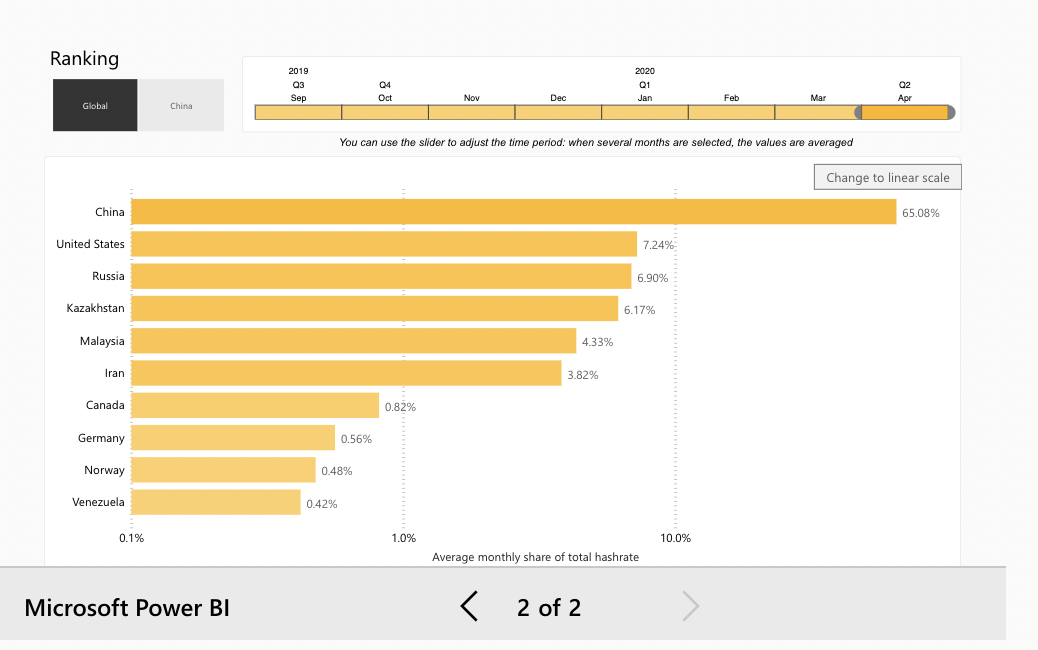
source:https://cbeci.org/mining_map
According to the Bitcoin Mining Map designed by the Cambridge Center for Alternative Finance, mining in Kazakhstan accounted for approximately 6.17% of Bitcoin’s average monthly hash rate in Q2 2020, only slightly behind Russia (6.9%) and the United States ( 7.24%), while China remains the undisputed number one (about 65%).In September 2019, China's mining accounted for 75.62%.In half a year, China's mining share fell by 10 percentage points. This part of the share lost by China is divided up by North America mentioned above, as well as Northern Europe, Central Asia, Southeast Asia, Iran, Russia and other places.For Bitcoin mining, the cost of electricity is the key to the rate of return. Lower electricity bills mean greater returns.Recently, Philip Salter, director of operations at Genesis Mining, revealed to Bloomberg that miners are moving from China to the Nordic countries, namely Sweden and Norway, because "these countries are considered safer and more stable."He explained that the profitability of the company’s data center in Boden, Sweden has more than tripled due to the wet weather and the continued rise in bitcoin."If you don't consider fees and taxes, the electricity price here is the lowest in the world, and it is almost carbon-free, mainly composed of hydropower, nuclear power and wind power." Bloomberg said in the article.In addition, in November this year, the Dutch blockchain company Bitfury Holding BV announced an investment of US$35 million to expand the Norwegian mine.In addition to Northern Europe, Kazakhstan has also become a new center for Bitcoin mining.In June, Bagdat Mussin, Minister of Digital Development of Kazakhstan, announced that the ministry plans to attract $738 million in investments by 2023 for activities related to cryptocurrency mining.According to Zhumagaliyev, there are currently 14 cryptocurrency mining farms that have brought in a cumulative investment of about $201.7 million.Kazakhstan, which is dominated by thermal power, has a power surplus of 4000MW (megawatts). The cost of electricity per kilowatt-hour is around $0.03.“Now there are a lot of local mining people in Kazakhstan. The president’s brother is mining, and there are people from Greece, Germany, Japan, South Korea, and Iceland.” A Kazakh miner said.The main mining companies in Kazakhstan come from China, South Korea and other countries, including the above-mentioned Genesis Mining and Bitfury, which have deployed mining in Central Asia.On the other hand, the location is pulled to Siberia. At the beginning of this year, the Russian nuclear power leader Rosatom was exposed by Coindesk to open its energy supply to Bitcoin. On December 30, a subsidiary of the Russian natural gas giant Gazprom announced the opening of a Bitcoin mine.In July of this year, Abdolnaser Hemmati, governor of the Central Bank of Iran, issued a statement: "The economic committee of the government approved a mechanism for digital currency mining, which will be discussed at a cabinet meeting later."And three months later, the Iranian Republic News Agency (IRNA) reported that Iran had amended the country’s cryptocurrency regulations to require licensed bitcoiners to sell their bitcoins directly to the Central Bank of Iran to fund imports.Iran has issued 1,000 licenses to crypto miners, including licenses from Turkish mining giant Iminer. Power plants in Iran are allowed to mine cryptocurrencies, while bitcoin miners are granted exclusive access to the electricity produced by three of them.In December, Venezuela’s Crypto Assets Supervision Agency (Sunacrip) and Venezuela’s National Electricity Company (Corpoelec) signed an agreement to improve the development of Bitcoin and other cryptocurrency mining activities across the country by developing guidelines.Low electricity bills, policy incentives, clean energy, and the entry of giants... These conditions are enough to give birth to batches of mines and new mining centers.
Will China Lose Its Dominance In Bitcoin Mining? Due to China's unique advantages in the hardware industry, cryptocurrency mining has risen rapidly. Mining machine manufacturers, mining farms, miners...China covers the entire cryptocurrency mining industry chain, and Bitcoin was once called "Chinese currency" by Americans.On the one hand, it is the encouragement of foreign policies and the rise of local miners, and on the other hand, the transfer of domestic miners to foreign countries. In the future, can China maintain its leading edge?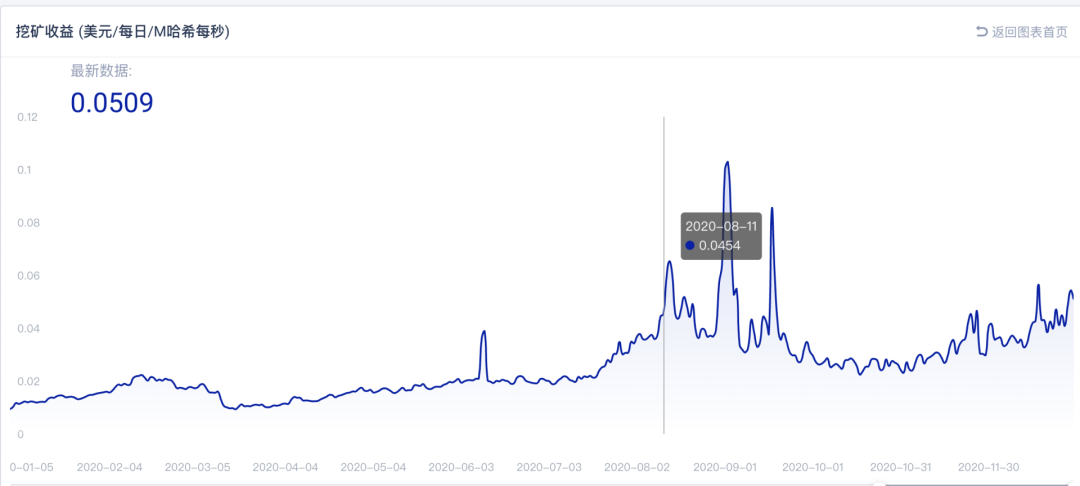
According to Tokenview data, Bitcoin mining revenue reached a new high of $0.209/day/T hash per second on December 29.
But this is far from the highest of $0.498/day/T hash per second last year and $3.839/day/T hash per second in 2018.
For Ethereum miners, 2020 is even more thrilling. With the popularity of DeFi, Ethereum miners earned $295.1 million in August, a month-on-month increase of 98.2%, a two-year high.
In September this year, Ethereum mining revenue reached $0.103/day/M hashes per second. "The cost can be paid back in one month, and the rest is the residual value income of the machine." Xiaoming, a miner, said.
image description
Source: Coinin Pool
On January 4th, as the price of Ethereum ETH broke through 1100 US dollars, the income of major mining machines also soared. OKLink shows that the fee income of Ethereum miners is 2 ETH of the block reward. 3x (6 ETH).
In the past three months, the computing power of Bitcoin’s entire network has fluctuated in the range of 120-160 EH/s. In the past three weeks, the fluctuation range has shown signs of narrowing.
According to past statistics, the price increase of Bitcoin will lead the computing power for about half a year. This wave of bitcoin prices rose in mid-October this year, and has increased by more than 150% so far.
Therefore, some organizations predict that the next six months will be the golden period of mining.
Is the golden age of mining really coming?
But it is not the case. Bitcoin miner Xiaoming revealed that mining will be more difficult in 2021, because a large part of the mining machines and mines are still in a dormant state, and they will start up when the income rises, and then the income will fall.
“A lot of mines with S9 level and higher electricity cost and poor environment are not running, and if the income is suitable, they will start to suppress the income.” Xiaoming said.
"Recently, a Russian miner directly placed an order for 10,000 S9s." Xiaoming revealed.
Jiang Zhuoer of the Litecoin mining pool also said recently that he still has "a vast number of BTC mining machines, and there are nearly 100,000 S9s alone, and they need to find a place to start them."
But this is still a money-making business, just not as profitable as imagined. There is no more sudden wealth, and Bitcoin mining is a sea of red.
Xiaoming's current attitude is: new miners are welcome, but not recommended. "Whether a novice buys a machine or builds a mine, it is good for the old miners. Otherwise, how can there be cheap mining machines when the market is bad, and who will sell the high-priced mining machines when the market is good?"
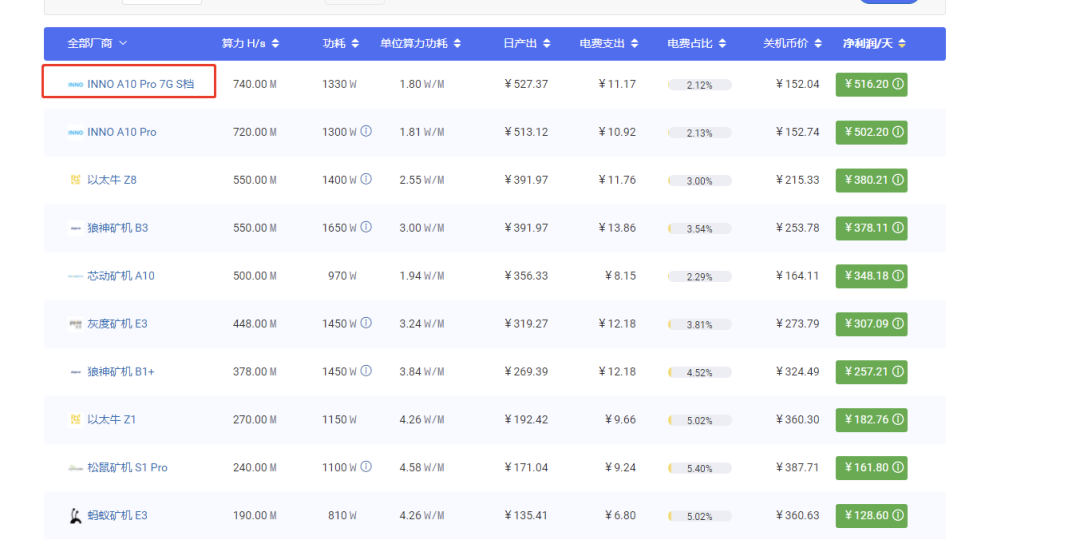
05 Looking forward to 2021Taking the Antminer S19 95T as an example, the futures price on the official website shows 19,200 yuan, but the lowest off-site transaction price has reached 25,000 yuan.According to media reports, mining machine manufacturers such as Bitmain have scheduled their mining machines for July next year.Is now a good time to start mining?For the purchase of new mining machines, the investment of 20,000 to 30,000 yuan per machine is also adding up costs and risks."The power consumption ratio of the S19 is so good that I'm betting that other people won't follow up with machines of this level." Xiaoming explained that once a machine with a large computing power is invested, the computing power will skyrocket. However, according to the current computing power growth and currency prices, he expects to be able to pay back in one year, "the remaining machines are considered profits."On the other hand, the influence of the technical improvement of the mining machine on the industry is decreasing, and the iterative energy consumption of the mining machine before S9 has more than doubled.For Ethereum miners, the average payback period for purchasing a graphics card machine at this moment is about one year. According to Wu, there are still more than 10 mining machine manufacturers manufacturing new Ethereum mining machines, many of which are ASIC machines with large computing power.