DApp "AARRR" user operation strategy (Part 1)


Source | PANews.io Data Support | PeckShield, DAppTotal
The main problem facing the current DApp development process is not unmanned development, but how to operate to make DApp "live" for a long time and "live" better.
The main problem facing the current DApp development process is not unmanned development, but how to operate to make DApp "live" for a long time and "live" better.
As a new thing that originated from Internet products, DApp must reflect the thinking of Internet product operation in the formation of its operation model. The "AARRR" model, that is, the operation model of "recruitment-activation-retention-transformation-referral" has gradually matured in the development of Internet products. The last part will focus on observing the performance of DApp in the three links of new acquisition, activation and retention.
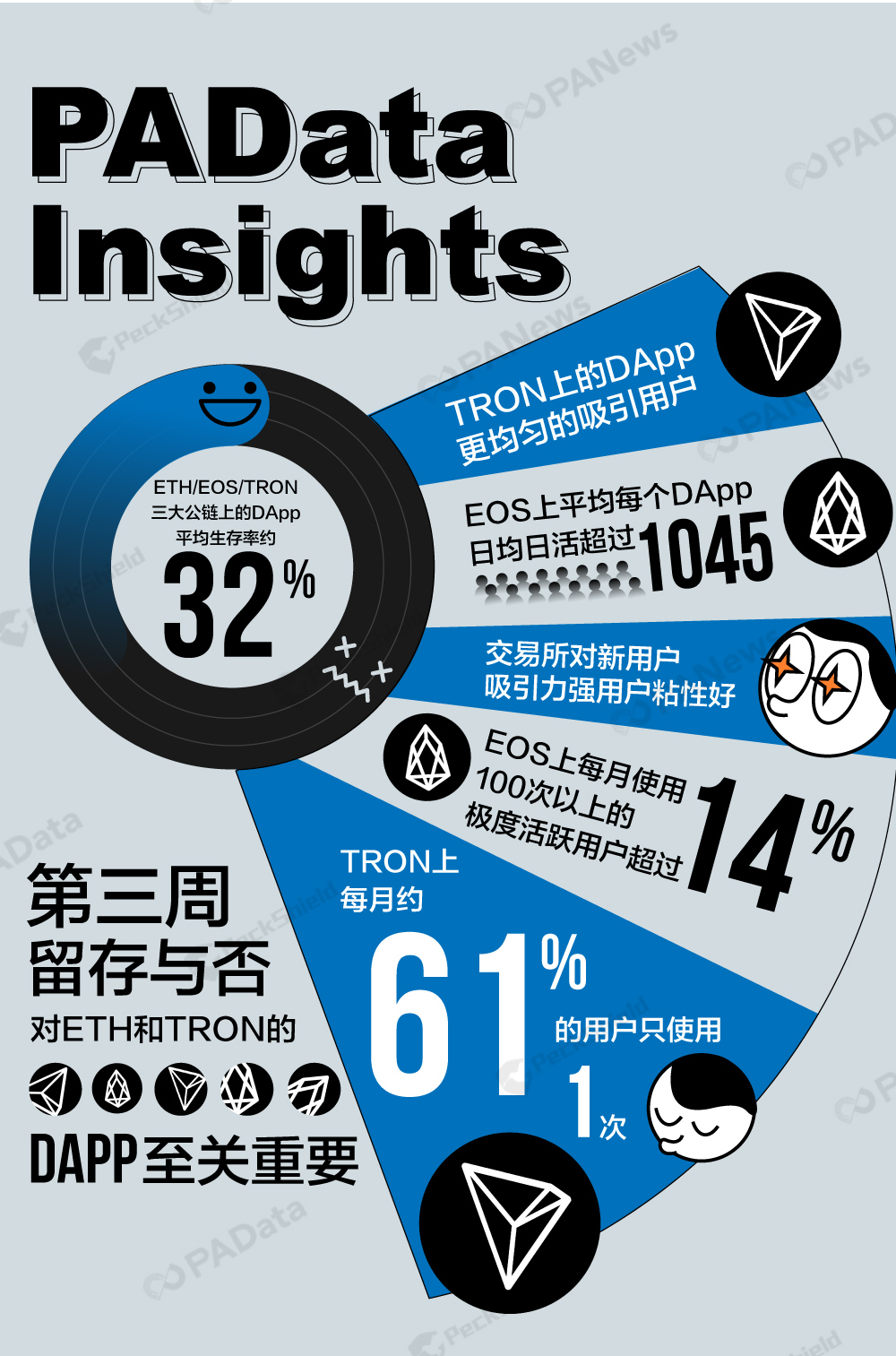
PAData Inghts: 1. The average survival rate of DApps on the three major public chains of ETH/EOS/TRON is about 32%. An average of 16% of DApps on EOS/TRON are falsely prosperous. 2. Among the three public chains, TRON is the one with the smaller two-level differentiation in the ability to attract new DApps. Users are attracted more evenly. On average, each DApp attracts 45 new users every day. Exchanges are most attractive to new users. 3. EOS has the highest overall daily activity, with an average daily activity of more than 1045 people per DApp. Exchange and game users are more active. 4. More than 60% of users on ETH use DApp less than 10 times a month. About 70% of users on EOS use it more than 10 times a month, and more than 14% of the extremely active users use it more than 100 times. About 80% of TRON users use it less than 10 times a month, but most of them only use it once. 5. DApps on EOS have the highest four-week average retention rate, reaching an average of 28.57% in the first week and 12.12% in the fourth week.
DApp’s ability to attract new products is differentiated and dominant DApps are lower than the overall level
Judging from the overall performance of new DApps on different public chains, the average newness performance of DApps on EOS is closer to that of ETH, and the two-level differentiation of DApp newness capabilities is more serious, which means to a certain extent that users are more likely to be attracted by individual projects. attract. This presents a possibility from the negative side. Among the three public chains, influential DApps are more likely to appear on EOS and ETH.
If the type of DApp is added as the dimension of investigation, it can be seen that different types of DApps on the three public chains have obvious differences in their ability to attract new users.

On average, financial DApps in ETH are the DApps with the largest number of daily new additions, and are higher than the overall level of ETH. The largest number of game DApps, 50% of the DApps have an average daily number of new users of only 9.5, which is not only lower than that of financial and financial DApps, but also lower than DApps of exchanges, gaming, other types, and platforms. sixth place. However, game DApps are severely polarized, either attracting many users or attracting very few users.
In the DApp ecology of EOS, the daily average number of newly added DApps of games and exchanges is relatively concentrated, and the average (median) daily number of new DApps is much higher than the overall level. As the dominant type in the EOS ecosystem, the daily average number of newcomers of gaming DApps is lower than the overall level of the DApp ecosystem on EOS. Like ETH, the EOS ecosystem has also experienced serious differentiation in the internal ability of leading DApps.
In TRON, the daily average number of new users of exchanges and game DApps is higher than the overall level of the DApp ecosystem on TRON, while the dominant high-risk DApps are lower than the overall level. Game DApps are the type of DApps with the worst ability to attract new users among all types, which means that most of the games on TRON are "on the verge of death" except for a few.
Three types of user active structures appear when individual DApps drive up the overall DAU
Judging from the daily average daily activity data of the 50 most popular DApps of the three public chains in April, EOS has the highest overall average daily activity, followed by TRON. On the other hand, more than 50% of the DApps on ETH have an average daily activity of only 87 people, which is the public chain with the least active users among the three DApp ecosystems. The polarized activity of DApps on the three public chains means that the current prosperity of the DApp ecology is not a common prosperity, and the prosperity of individual DApps has not formed a radiation effect.
The type of DApp has an impact on its user activity, and the impact is more obvious. Among the three DApp ecosystems, the respective leading DApps are not the most active types. What subverts the stereotype is that on ETH, gaming and exchange DApps outperform mainstream gaming DApps; on EOS, other gaming DApps outperform mainstream gaming DApps; On TRON, exchanges performed better than mainstream high-risk DApps. However, as the leading DApps, the overall performance of ETH games and EOS gambling DApps is healthier than other categories, which is mainly reflected in the fact that there is no intermediate fault in the distribution of the average number of daily new users and the average number of daily active users of the two types of DApps serious magnitude differentiation phenomenon.
According to the user's active times, the user active structure diagram of each public chain DApp can be generated. According to the number of times a user uses DApp per month, users can be divided into extremely inactive users who "use only once", inactive users who "use 1 to 10 times", active users who "use 10 to 100 times", and "use 100+" hyperactive users. The percentage of these four types of users to the total users (stacked from bottom to top in the figure below) constitutes the active user structure.
Judging from the user active structure chart from January to April this year, ETH’s DApp user ecology presents a stable slender cone structure at the bottom, which means that although users are relatively stable and mature, ETH’s DApps lack the ability to integrate these The attractiveness of converting users into deep users. The active user structure of EOS presents a pattern of "big in the middle and small at both ends", which means that EOS DApps need to pay more attention to attracting new users. The user structure of TRON presents a "pyramid" style, indicating that DApps on TRON lack effective means to activate new users.
The retention rate has nothing to do with the number of new people, whether the retention in the third week is crucial to ETH and TRON
Retention refers to the behavior that a user has used a certain DApp within a certain period of time, and then uses this DApp again after a period of time. The retention rate refers to the percentage of retained users to the total number of users.
Taking the three public chains of ETH, EOS and TRON as the main classification dimensions to observe the four-week retention rate of the 50 most popular DApps in April (with the highest daily average DAU in April), it can be seen that the DApps on EOS are the four-week average The one with the highest retention rate is the ecology with the best user stickiness at present.
On the whole, the retention rate of DApp users on the three public chains has decreased over time. However, the retention rate changes of each public chain in each time period are different, which in turn presents different user behavior stickiness performance. If we abstractly summarize the retention behavior of DApp users on the three public chains, EOS may be close to a slash, ETH may be close to two sides of an obtuse angle, and TRON may be close to a "ladder".
For EOS, the retention rate drops most significantly in the second week, and DApp developers need to pay attention at this point in time. For ETH and TRON, the retention rate in the third week is a turning point. ETH’s increase in the retention rate in the third week is equivalent to directly increasing the overall retention rate. TRON’s increase in the retention rate in the third week may be important to slow down the loss in the fourth week. effect.
DApp types have an impact on user behavior stickiness, and interestingly, the analysis of user behavior stickiness of public chain DApps once again supports the point of view in the analysis of user activity, that is, mainstream DApp types do not represent the preferred direction of user behavior. For example, gaming DApps, which are the mainstream type in the EOS ecosystem, are not the best in terms of user activity and user stickiness. On the contrary, games and others are DApp types with better user stickiness. The user stickiness of financial and financial DApps in ETH is better. The mainstream types of high-risk DApps on TRON are not the most sticky ones.
It is also worth noting that the number of new users and the retention rate do not form a statistical correlation, that is, the more new users are recruited, the more will be retained. This means that under the current situation of limited existing users, killing the incremental market is only a way to achieve growth, and may not be the optimal way. It may be a more efficient way to grow by retaining the stock market for further cultivation.