






每周编辑精选 Weekly Editor's Picks(0902-0908)


"Editor's Picks of the Week" is a "functional" column of Odaily. Based on covering a large amount of real-time information every week, it also publishes many high-quality in-depth analysis content, which may be hidden in the information flow and hot news, passing by you.
Therefore, our editorial department will select some quality articles worth spending time reading and collecting from the content published in the past 7 days every Saturday, bringing you new inspirations from the perspectives of data analysis, industry judgment, and opinion output in the encrypted world.
Now, let's read together:

Investment and Entrepreneurship
Quick rebound = giving money to traders? An analysis of 4 best-performing volatile tokens
The combination of token status and intrinsic value makes ARB a good volatile asset; OP has improved reputation and considerable trading volume on Binance; Solana (SOL) has its loyal user and developer community (and the support of Jump); ETH price will not remain low in the long term.
If the market crashes, these tokens will also fall, but less than other tokens. However, what makes them stand out is their strong rebound, which usually allows traders to make a daily return of 10%+.
Are platform tokens worth hodling? An exploration of the valuation logic of exchange platform tokens
For exchange platform tokens, do not blindly trust PE; at least a two-stage model should be used, because besides current revenue, future growth rate also plays a decisive role. Of course, the cryptocurrency market has typical bull and bear cycles, so the actual model will be more complex. However, overall, the growth rate will have a decisive impact on valuation and value regression.
Growth rate plays a decisive role in asset valuation. Binance has taken a leading position in the competition at the asset layer. Specifically, there are two pillars: Binance Labs and BSC. The advantages of layout at the asset layer have been transformed into the issuance rights of assets in the bull market. The highest quality and most wealth-effective assets are launched on Binance or Binance becomes the main trading platform, and the growth flywheel is realized.
In the bear market, growth has slowed down, and regulatory pressure is immense. Binance has already taken as many stock markets as possible and attracting external traffic is the only way to sustain high growth. OKX is a typical representative of "defensive strategy": listing fewer coins, using a large amount of costs for asset management, and keeping users in the OKX ecosystem in the trend of on-chain transformation. The defensive strategy has been very successful during the 2022-2023 bear market.
BNB, OKB, and BGB are currently overvalued, and the valuation method is ineffective. The industry's big eruption is still far away from us. The window to get on board will not close immediately. After BTC stabilizes at ATH, platform coins will present a good buying opportunity.
Forecasting the Future Direction of the "Trading Bot" Track with Five Charts
The differentiated development directions of trading bots include: Linking the chains to provide the most comprehensive end-to-end services; professional upgrades; integration with AI.
The potential development paths of major projects can be divided into two categories: becoming a "penguin" in the bot field - by copying the most outstanding features of competing products, becoming a one-stop tool; becoming a "One Punch Man" - since the meme market has limited single-coin scale and no one wants to be a bearer, achieving extreme excellence in a certain function can force users in that link to use it.
DeFi
The functions of stablecoins include transaction medium, value storage/anchoring stability, capital efficiency, currency exchange channels, and resistance to censorship.
The stablecoins supported by crypto assets do not meet product market demands (mainly reflected in transaction medium and capital efficiency).
Bankless: Tokenized Government Bonds and the RWA Revolution
TradFi yields are at levels unseen in decades, while cryptocurrency yields are far below the peak of the bull market. Now is a good time for protocols to utilize RWA. Maker is just one of the protocols trying to gain a competitive advantage by using U.S. government bonds as collateral.
CeFi
"Don't be an adversary to market makers": Delving into the market maker logic behind the CYBER chaos
DWF is a global cryptocurrency high-frequency trading company that has been trading spot and derivatives on more than 40 top trading platforms since 2018, ranking among the top 5 in global cryptocurrency trading volume. DWF Labs' official website previously stated that "regardless of market conditions, DWF Labs invests in an average of 5 projects every month" and adopts a compound operation model of "investment + market making".
DWF Labs focuses on East Asian projects, various new and old sentiment themes as the main market-making targets. Many institutions and investors have started regarding tokens such as YGG, DODO, and C98 as the market-making regularities of DWF Labs and have created investment layouts for them, as well as some coins that have not yet surged.
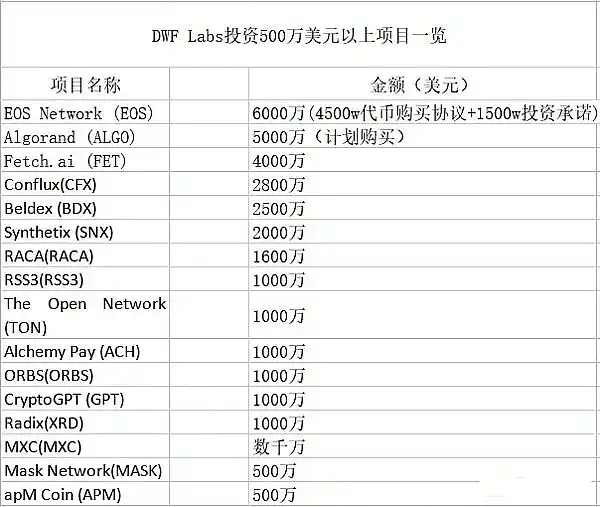
This CYBER incident is somewhat different from YGG. DWF seems to not directly manipulate the CYBER incident but rather takes on the role of doing bricklaying or being a rat warehouse. The nature of this incident is still different from the YGG incident. DWF's market-making strategy is summarized as "pump and dump". Retail investors should not act as adversaries to market makers.
NFT
Retrospect on the NFT cycle rotation: Who is rising against the trend?
Pudgy Penguins is the only project with a significant increase in floor price, while Invisible friends and Moonbirds have experienced the largest decline in floor price.
Bitcoin Ecology
Inventory of the three major contract technology directions of Bitcoin
Bitcoin has three main contract technology directions - script technology, smart contracts, and readable financial contracts.
Three of them have made trade-offs in security, cost, scalability, and usability in Bitcoin transactions. Script technology and readable financial contracts have much better security and cost in trading than smart contracts, but the scalability brought by Turing-complete smart contracts is the best. Readable financial contracts give up the scalability in other categories and focus on the contractual scalability of currency finance. In terms of usability, readable financial contracts enable people without programming experience to freely combine and use them, while smart contracts and script technologies require professional programming experience.
Readable financial contracts may have the opportunity to become the main solution for Bitcoin contract technology expansion.
Ethereum and Scalability
Fidelity: Feasibility study of Ethereum as a digital asset and potential income asset
Ethereum can be understood as a technology platform with ETH as a payment method. The perceived value of Ethereum is closely related to the supply and demand dynamics of network applications, which have changed significantly since The Merge. After Ethereum transitioned from PoW to PoS, token holders can now earn income, some of which comes from the increase in network usage. The overall platform usage of Ethereum may transfer value to token holders, that is, the value of tokens increases with the increase in Ethereum network and platform usage.
Currently, Ethereum is not a perfect network, so it is expected to be upgraded every year, which brings regular technical risks and unknowns, thus reducing its prospects. These unknown factors weaken Ethereum's prospects as a store of value. Although Ethereum can be used for various payment purposes, the instability of its fees is still a barrier to widespread adoption.
Currently, there is a relatively small relationship between address growth (a measure of adoption) and price.
Is zkSync's Rollup income $20 million? A look at the income gap between different Rollup operators
Rollup costs include operator costs, data availability costs, and verification costs (compressed transactions or messages from Rollup need to be settled on the underlying layer, which is the most expensive part of all steps), and income mainly comes from transaction fees (users pay gas fees on Rollup/Layer 2 to execute transactions, and Rollup operators are responsible for sorting, bundling, batch processing, or computing transactions that require proofs of validity), as well as token issuance.
At the same time, running a system inevitably incurs costs and generates income, which incentivize each participant to work.
NGC Ventures: Exploring the path of MEV redistribution
Facing MEV robots, users can easily become the relatively weaker party. To protect users, projects committed to optimizing the MEV problem provide users with private RPCs and promise that transactions broadcasted through this RPC will not be front-run, such as Flashbot Protect RPC and OpenMEV RPC (Sushiswap's MEV-resistant service provider).
Since it's impossible to completely avoid MEV extraction, users think it's better to get some rebates from searchers themselves. As a result, a win-win solution has emerged—MEV-Share.
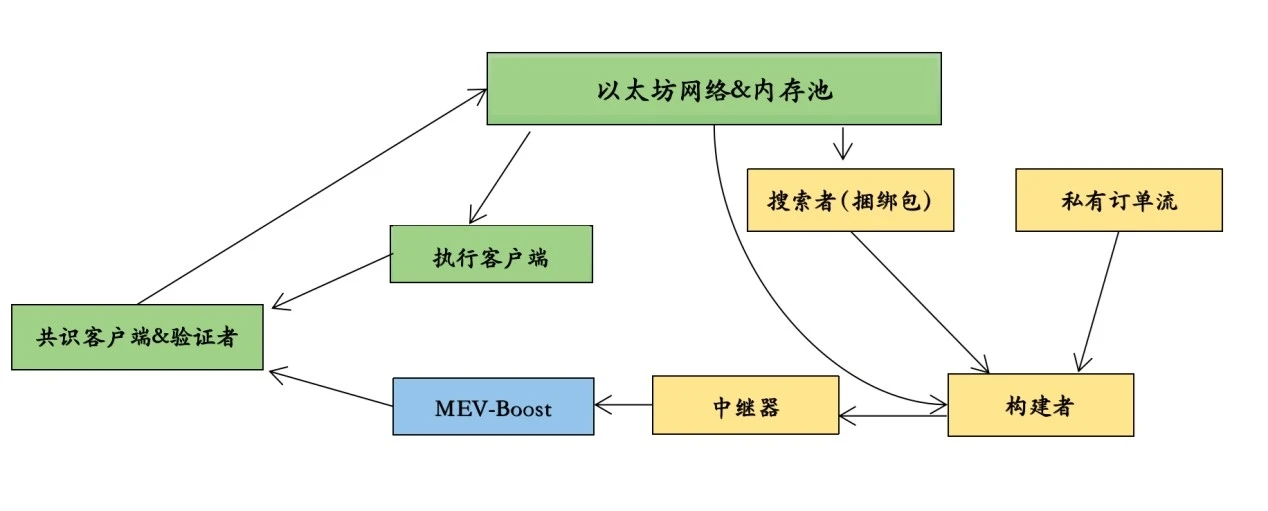
Five roles in the MEV-Boost supply chain: users, searchers, builders, relayers, validators
The MEV-Share protocol is included in Flashbots Protect. Users can connect to Flashbots Matchmaker through Flashbots Protect. Users can also configure their RPC requests to choose whether to share their order flow with registered block builders. Searchers can subscribe to Flashbots Matchmaker to search for programmable private order flows, and builders can receive order flows through MEV-Share. MEV-Share's role is to achieve collaboration and optimization of the MEV supply chain through programmable transaction data sharing.
In-depth analysis of Ethereum Inscriptions Protocol: A new Layer 2 track
Compared to contracts, the execution aspect of inscriptions has shifted from contract methods to atomic transactions, persistently storing all content on the chain through calldata, achieving decentralized storage, and enabling lower gas fees. The launch mechanism and market trading methods of inscriptions can better help retail investors counter the risks of poor-quality project teams withdrawing liquidity and dumping prices.
In the experience of Ethereum Inscriptions, it is found that Inscriptions can natively integrate with all existing infrastructure, such as nodes, wallets, etc. The scalability of the Inscriptions ecosystem is certainly not as good as the contract ecosystem, but there are already some solutions available for some basic DEFI gameplay and AMM models on the market.
Storage
Filecoin: In-depth Discussion on the Importance and Business Potential of Distributed Data Computing
The fast-growing data circle faces two major challenges: slow and expensive mobile data, and heavy compliance tasks. There are two solutions: building on top of open-source data computing platforms or building on top of distributed data protocols. Distributed means maximizing choices. And the computing network usually needs to balance privacy, verifiability, and performance.
Week's Hot Topics Recap
In the past week, ARK Invest submits first Ethereum spot ETF application, FTX: actively cross-chains various tokens to its native chain, Former FTX executive Ryan Salame pleads guilty and will have over $1.5 billion in assets confiscated;
In addition, in terms of policies and macro markets, Japan's Financial Services Agency submits legislation amendment request to promote cryptocurrency tax reform;
Regarding viewpoints and statements, JP Morgan Chase: Grayscale's victory may force the SEC to approve multiple spot Bitcoin ETF applications, Arthur Hayes: Bitcoin has been in a bull market since the Silicon Valley Bank was taken over in March, CZ: The DeFi market is expected to surpass CeFi in the next bull market, Vitalik: The rise of the stablecoin RAI can solve the "monopoly" problem of the Lido LSD ecosystem, Vitalik and others jointly published research papers on "Privacy Pools" privacy protocols;
In terms of institutions, major companies, and head projects, JPMorgan plans to launch blockchain-based payment, settlement, and deposit tokens, which still requires regulatory approval. Grab supports Web3 wallet. MetaMask introduces the latest feature "Sell", which can convert cryptocurrencies into fiat. The MakerDAO community proposes allocating up to $100 million for the development and testing of tokenized US Treasury securities. CYBER governance farce: One person makes a wrong proposal, the official refuses to execute it. Binance: Users affected by the CYBER mining incident will receive a total of $1 million worth of compensation. Connext airdrop falls into a loophole.
In the NFT and GameFi fields, Google updates its advertising policy to allow for NFT game ad placements... Well, another eventful week.
Attached is the weekly editor's selection portal.
See you next time~





