Robinhood链的行情值不值得关注?


- 核心观点:Robinhood链上的meme币行情因龙头$CASHCAT暴跌35%而陷入混乱,短期回调属正常,但长期看,Robinhood链能否凭借其用户基础超越Solana和Base,成为下一个meme币主战场,仍存机遇与挑战。
- 关键要素:
- $CASHCAT从2.3亿美元市值高点回调至1.5亿美元,跌幅约35%,导致Robinhood链整体情绪冷却。
- 因疑似Robinhood CEO地址买入消息,$1从80万美元暴涨至1500万美元,但消息证伪后回落至100万美元,凸显市场投机性。
- 黑客盗取SpaceXAI官推推高$SCATMAN至250万美元市值,随后归零,类似事件被视为链上“末日迹象”。
- 本轮行情缺乏明显龙二,与之前的“太空狗”$ASTEROID及$ANSEM行情相似,资金不足是核心制约因素。
- 当前meme币市场本质为“注意力预测市场”,短期回落因龙头回调且缺乏持续催化剂,埋伏标的如$GME和$JUGGERNAUT处于左侧交易。
- 长期看,Robinhood链有望凭借其用户基础(GameStop事件参与者)和传统投资渠道,吸引散户资金,推动meme币生态扩容。
The day before yesterday, $CASHCAT briefly approached a market cap of $230 million, but has since retraced to around $150 million, a drop of nearly 35%.
As $CASHCAT pulled back, activity on the Robinhood chain has started to become chaotic and cool down. Yesterday, $1 experienced a rapid surge from about $800,000 to roughly $15 million in market cap after rumors surfaced that an address belonging to the Robinhood CEO was buying. However, this rumor was quickly debunked, and the token has now fallen back to a market cap of just over $1 million.
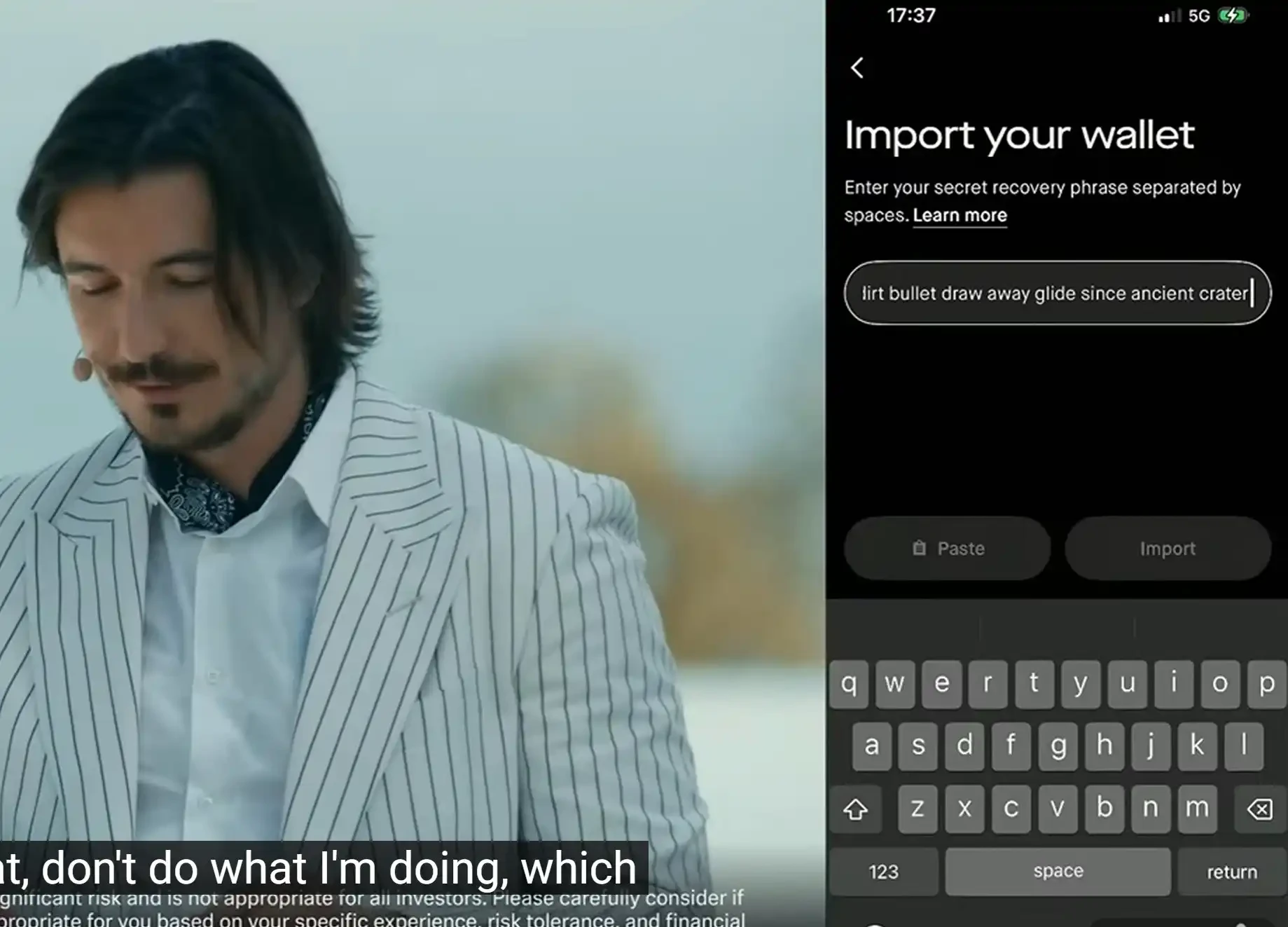
This address was previously used by the Robinhood CEO for a live demonstration, during which 9 out of 12 seed phrase words were accidentally revealed. Due to this partial leak, the address was already compromised about a year ago.
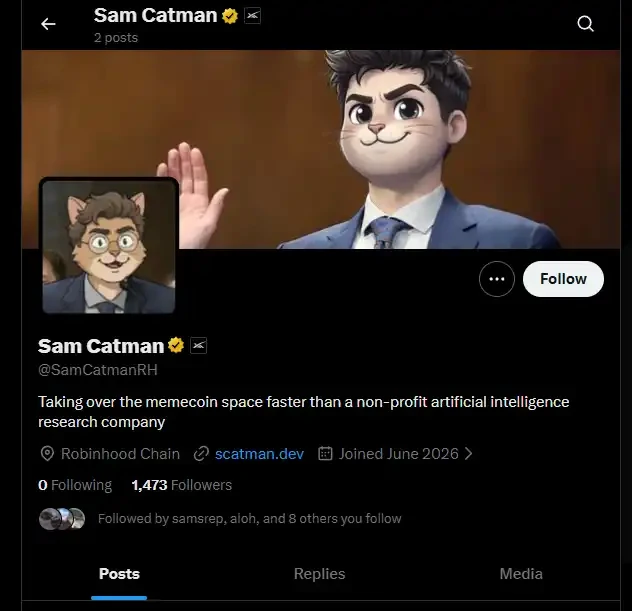
Another token that experienced dramatic ups and downs yesterday was $SCATMAN. Hackers stole the official SpaceXAI Twitter account to grant affiliate verification to the X account of this token, which mocks Sam Altman, and retweeted its posts. At its peak, the token's market cap exceeded $2.5 million, but it now sits at less than $100,000.
The overall sentiment on the Robinhood chain was already dampened by the $CASHCAT correction. With the emergence of what some consider "signs of the apocalypse," such as "suspected wallet purchases" and hackers stealing social media accounts to execute rug pulls, some players have started to declare that the "Robinhood wave is over."
Is it really over? To answer this, we need to analyze the several market trends this year to provide both short-term and long-term perspectives.
Short-term: A Normal Correction
If we recap the most direct catalysts for $CASHCAT's surge, one is this tweet from Robinhood CEO Vlad Tenev:
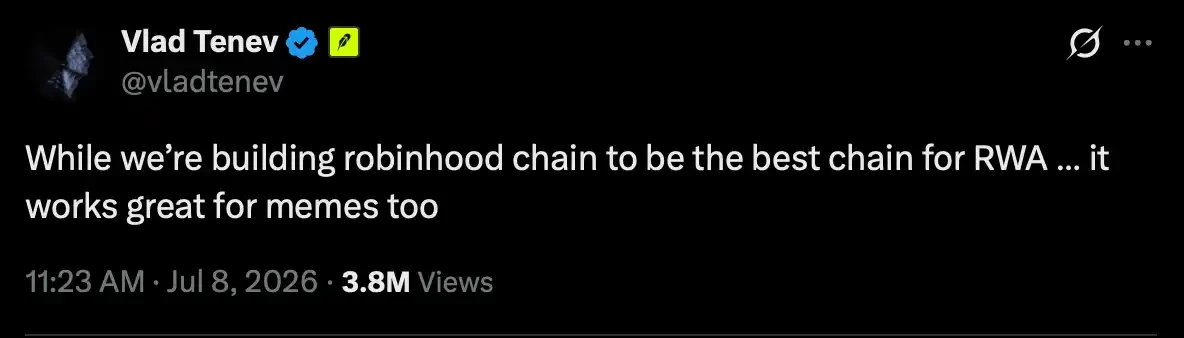
"When we build the Robinhood chain as the best RWA chain, it’s also great for memes."
Also on the morning of July 8th, Vlad followed the official $CASHCAT account on X, causing the token's market cap to instantly skyrocket from $10 million to nearly $50 million, continuing its upward trajectory.
Both catalysts were indispensable. One conveyed the attitude that the "Robinhood CEO supports meme coins on his own chain," while the other implied that "$CASHCAT is the officially endorsed leader on Robinhood."
Going back to July 2nd, when the Robinhood mainnet first launched, there were some players paying attention to this new chain, but not many. Most were observing it with a "new chain gold rush" mentality. No one could have predicted that less than a week later, the Robinhood CEO would personally step in and suddenly raise everyone's expectations to an extraordinarily high level.
Because of this completely unexpected shift in expectations, the market began repricing the outlook for the Robinhood chain, and did so heavily. Expectations included scenarios like "the Robinhood chain can bring retail stock investors on-chain" and "$CASHCAT on Robinhood could replicate the success of DOGE and SHIB." The rapid surge of $CASHCAT further fueled FOMO in the market.
However, the day's market movements also laid some groundwork for future issues. The main problem was that aside from $CASHCAT, there was no clear "second leader" emerging. This is very reminiscent of other market trends this year:
The ETH mainnet wave led by "Space Dog" $ASTEROID had no clear second leader, but was somewhat supplemented by Uniswap v4 hook narrative tokens like $UPEG and $SATO.
The Solana wave led by $ANSEM also had no second leader, with only tokens related to Ansem seeing gains.
In both of these previous waves, everyone hoped the leader would reach a $1 billion market cap, causing liquidity to spill over into other narratives and expand the range of PvE targets, but this never materialized. The primary reason remains insufficient on-chain capital; a $1 billion market cap is incredibly difficult in the current environment. Secondly, the explosive growth of these leading tokens stemmed from sudden attention events. "Space Dog" surged because Elon Musk agreed to make it SpaceX's mascot, and $ANSEM surged because Ansem himself acknowledged it. Growth driven by attention requires even larger attention events for continued upward momentum, but neither token experienced any further attention events capable of amplifying FOMO.
When attention events are unsustainable and cannot be amplified, the market dynamics shift towards "arbitrage" rather than "long-term holding." When almost all active on-chain players rush to the Robinhood chain to prospect for gold, they begin to meticulously analyze Robinhood's tweets, looking for angles. This includes tokens like $JUGGERNAUT (a meme image Robinhood CEO mentioned liking in a reply), $GME (the stock market saga Robinhood famously halted during its short squeeze), and $WALLET (allegedly deployed by a Robinhood employee). This phenomenon is essentially the spread of FOMO from those who missed the $CASHCAT rally, akin to people rushing to buy salt during a nuclear leak scare – they grab it first, hoping it's useful, but it doesn't matter if it isn't.
Everyone is chasing and trying to front-run *any* token that might be the next to receive a Robinhood interaction, betting on the unknown. This clearly illustrates that the current meme coin market is almost entirely an "attention prediction market." A short-term pullback is therefore logical. As the leader $CASHCAT corrects and Robinhood provides no further statements to reignite frenzy, tokens with suspected "insider" narratives, like $JUGGERNAUT and $HOODRAT, failed to break and hold the $20 million market cap resistance, further confirming that the Robinhood chain trend so far is not significantly different from the $ASTEROID and $ANSEM waves.
At this stage, aside from "insider" schemes, tokens that can maintain relative stability are those more likely to receive Robinhood interaction in the longer term, or those with their own narrative and attention-grabbing potential even without direct Robinhood interaction. For example, $GME maintains a market cap of $2-3 million, with the expectation that Robinhood might mention $GME again in the future, or that catalysts like GameStop's stock price movement or the sudden return of Roaring Kitty could trigger a rally. Another example is $JUGGERNAUT; since the Robinhood CEO mentioned it as his favorite meme image, another mention could spark significant growth.
However, this kind of "playing left field" is essentially betting on potential attention and has little to do with traditional meme coin community building. Expectations that Robinhood will consistently support the meme coin ecosystem or list its own chain's meme coins in the future are premature and overly optimistic. Yet, it is precisely through such optimism that massive gains like $CASHCAT are achieved. You can't win the lottery if you don't buy a ticket.
Long-term: The Existence of Competition Inspires Optimism
When the "Space Dog" wave ended, players returned to Solana. When BSC's brief "token generation" wave ended, everyone returned to Solana. Solana's dominance in the meme coin market has, to some extent, become a matter of user habit – "For memes, go to Solana" is becoming a culture and routine.
Precisely because of this foreseeable competition, Robinhood's nascent chain inspires long-term speculation: "What if the Robinhood chain becomes the next Base or Solana, or even surpasses them, ushering in a full-blown meme bull market on its platform?"
This is not impossible. After all, the "stock meme-ification" trend is intensifying, and Robinhood was the stronghold of retail investors during the GameStop saga. Its user base comprises stock investors who accept, are accustomed to, or even enjoy meme-style trading. If a meme coin like $GME on the Robinhood chain starts to rally, and this is broadcasted through channels that can reach traditional investors, a similar scenario could potentially draw both users and capital onto the chain.
Meme coins, or rather, trading based on memes, represent a significant trend. Both bullish and bearish news revolve around market sentiment fluctuations; memes just make this process more direct and engaging. As the market scale expands, negative memories of fragmentation and scams will naturally fade, as players won't need to compete for scraps in a limited pond.
Long-term optimism for the Robinhood chain is an expectation of sustained, deep support for meme coins from Robinhood as a company, and even more so, an expectation for a broader audience for meme coins in general.