Vitalik與Aya香港談話:以太坊生態正在進入多節點未來


- 核心觀點:以太坊正在從以以太坊基金會(EF)為中心的協調模式,轉向由EF聚焦協議核心價值、Ethlabs、Ethereum Institutional等多個專業組織分工協作的多節點生態,體現EF「減法哲學」,旨在提升生態長期韌性與機構採用能力。
- 關鍵要素:
- EF於6月23日重組,組織結構覆蓋協議、訪問、用戶、社區、機構五層,目標為聚焦長期戰略與核心價值CROPS(抗審查、開源、隱私、安全)。
- 獨立研發組織Ethlabs成立,由前EF研究員創立,獲Bitmine、Joe Lubin等支持,專注於為機構採用、Agentic Finance等下一階段需求開發協議。
- Ethereum Institutional作為非營利組織上線,承接EF機構對接職能,面向全球政策制定者與機構推廣以太坊作為中立數位公共基礎設施。
- Etherealize持續推動以太坊與傳統金融融合,聚焦代幣化、原生結算與機構級隱私,旨在構建面向萬億美元市場的金融基礎設施。
- EF主席Aya Miyaguchi強調「Walk-away Test」哲學,即EF的成功在於系統無需EF也能獨立運行,減少生態依賴以促進競爭。
- Vitalik Buterin區分核心協議開發(需長期協調與共識)與L2開發(類自由市場),強調EF應服務於協議的長期信任與中立性。
- ETH HK Hub在香港成立,連接華語與全球社區,並作為亞洲機構採用與建設者協調的重要節點,由SNZ與ETHTAO運營。
Author: @cynthiaju333;Reviewer: @NPC_Leo
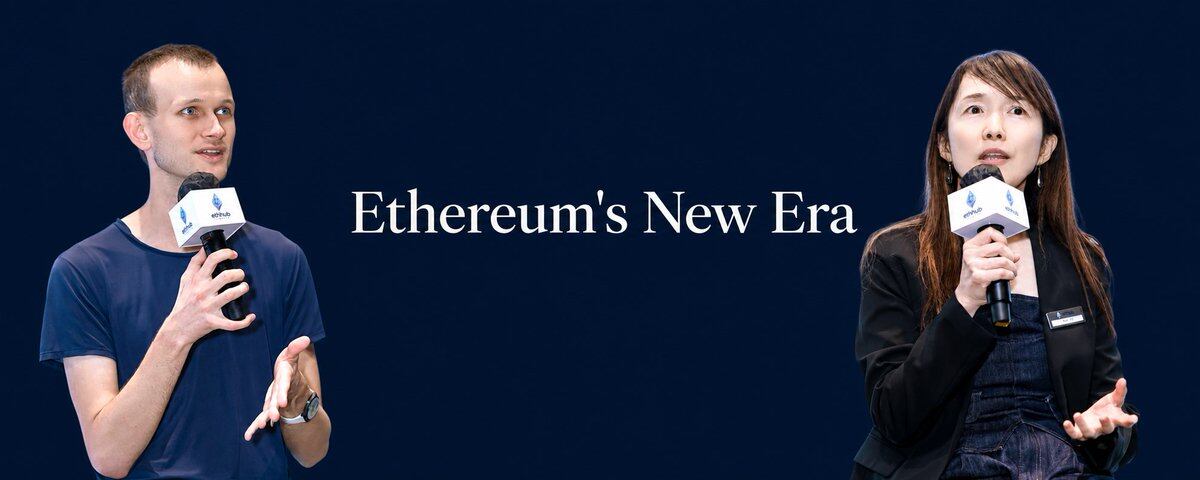
In the past two months, a series of significant events have occurred within the Ethereum ecosystem: the Ethereum Foundation (hereafter EF) completed an organizational restructuring, Ethlabs was established as an independent non-profit R&D organization, Ethereum Institutional officially launched as an independent institutional adoption front, and Etherealize continued to advance the narrative of Ethereum on Wall Street and in capital markets. The community has engaged in extensive discussions regarding the EF's structural reorganization, the formation of new community-driven teams, initiatives for institutional adoption, and the division of R&D responsibilities and governance structures.
On April 21, 2026, ETH HK Hub officially opened in Hong Kong, where two important conversations took place. One was a dialogue in Chinese between Vitalik Buterin and Hong Kong Legislative Council member Duncan Chiu. They discussed topics ranging from the twelve-year development of the Chinese-speaking community, Layer 2, core protocol development, the anti-quantum roadmap, Layer 1 scaling, and the directions truly worth building toward in Ethereum next. The other was an English-language roundtable featuring EF Chair Aya Miyaguchi, Councilor Duncan Chiu, and QZ, a Partner at an ecosystem fund. This discussion focused on the EF's role, the philosophy of subtraction, the Walk-away Test, and Hong Kong's position within the Ethereum ecosystem.
Looking back from today, over two months later, how can we gain a deeper understanding of the changes within the entire Ethereum community? The two conversations between Vitalik and Aya provide important clues and references for us: they make it easier to understand that Ethereum is entering a new phase of development, a multi-node future for the community, and potential directions for continued evolution.
What happened to Ethereum in the past two months?
On May 24, Vitalik Buterin published a long post on his X account, publicly outlining his personal views on the future direction of the EF. He emphasized that the EF will pursue "longevity over breadth," reduce ETH sales and the Foundation's financial expenditures, and focus more on core values CROPS (Censorship/Capture Resistance, Openness, Privacy, Security). He also pointed out that the EF is not the center of Ethereum, but rather "one node, with a defined purpose," and advocated for the ecosystem to form a pluralistic landscape with multiple specialized nodes working in synergy.
On June 23, the EF officially announced its new organizational structure on its official blog. The new structure includes protocol, access, user, community, and institutional layers, along with supporting structures for operations and management. Through this restructuring, the EF aims to align its organizational form more closely with long-term strategic goals, ensuring the sustainable future development of Ethereum.
Almost simultaneously, the independent non-profit R&D organization Ethlabs announced its establishment, co-founded by five former EF senior researchers: Ansgar Dietrichs, Barnabé Monnot, Caspar Schwarz-Schilling, Josh Rudolf, and Julian Ma. Funding support comes from Bitmine, Sharplink, Joe Lubin, SNZ, and others. Its goal is to prepare Ethereum for the next phase of demands, including institutional adoption, agentic finance, DeFi, stablecoins, and RWAs, while collaborating with the EF in different areas to advance Ethereum protocol development and jointly build a multi-node ecosystem.
On July 1, the EF Global Policy Strategy Team released a guide for governments and institutions: "Ethereum for Governments and Institutions: Why Neutral Infrastructure Is Crucial Now." This report actively helps global policymakers and large institutions gain a deeper understanding of Ethereum. Its core premise is: today's world needs "shared, neutral digital public infrastructure not controlled by any single centralized entity," and Ethereum is the public, programmable network designed precisely for this purpose.
On the same day, Ethereum Institutional officially launched as an independent non-profit organization, positioning itself as the "dedicated institutional front door" for the Ethereum ecosystem. It took over the institutional outreach work handled by the Ethereum Foundation's go-to-market team over the past year, operating with a clearer mission, broader geographic coverage, and long-term financial independence. Its key focus areas include Institutional Education & Engagement, Institutional Insights, ETH & Ecosystem Marketing, Standards & Best Practices, and Institutional Events.
Concurrently, Etherealize continues to push forward the connection between Ethereum and traditional finance. Its website positions itself as "Rewiring Wall Street with Ethereum" (Rewiring Wall Street with Ethereum), building financial infrastructure targeting multi-trillion-dollar markets for tokenization, Ethereum-native settlement, and institutional-grade privacy. Wall Street's interest in Ethereum is shifting from proof-of-concepts and pilot projects towards viewing the public chain as production infrastructure; the discussion scope is also expanding from stablecoins to tokenized stocks, bonds, real estate, and investment funds.
Together, these events point to a larger change: Ethereum is moving from a stage where the EF bore much of the coordination and public narrative, towards a new stage where multiple specialized organizations take on different capabilities. The EF is focusing more on protocol governance, credible neutrality, self-sovereignty, and long-term resilience. Ethlabs handles R&D and infrastructure development for the next wave of adoption. Ethereum Institutional manages institutional education, standard-setting, market awareness, and outreach to global financial institutions. Etherealize continues to advance Ethereum's narrative within capital markets and traditional finance.
These organizations are not part of a centralized plan, nor should they be simply understood as outsourced entities or replacements for the EF. They collectively reflect an emerging, clearer division of capabilities within the Ethereum ecosystem: protocol neutrality, institutional adoption, capital market narrative, applied research & development, and local community coordination are now being shared by different nodes.
More precisely, Ethereum is entering a new phase of development and ecosystem structure. And if we go back to the scene at the ETH HK Hub on April 21, it becomes clear that what Vitalik and Aya discussed that day were precisely the long-term principles underlying this change.
EF Chair Aya on the Philosophy of the Subtractive Organization
During the roundtable at ETH HK Hub, Aya Miyaguchi repeatedly touched on a concept: the Walk-away Test.
Her point was that the EF's long-term goal is not to become a larger, more controlling central organization, but to allow the entire system to continue functioning even without the EF.
She stated: "Ethereum must pass the Walk-away Test—the entire system must be able to operate normally even without the Ethereum Foundation."
Aya recalled on site that she joined the EF during the ICO craze. At the time, many suggested the Foundation expand rapidly, establishing positions like CTO and CMO, akin to traditional tech companies, to take on more centralized functions.
But the EF did not do this.
She explained: "If the Foundation builds everything for the entire ecosystem, participants will become dependent. In the long run, this weakens competition, and without competition, optimal solutions cannot emerge."
Behind this lies a fundamental belief of Ethereum: the health of the system does not stem from the strength of a single organization, but from the ecosystem's own ability to continuously generate new capabilities, new organizations, and new builders.
So when Aya says: "Success means the Foundation does less, while Ethereum becomes stronger,"
This statement gains a more specific context two months later.
From this perspective, the emergence of Ethlabs, Ethereum Institutional, Etherealize, and global Ethereum community Hubs appears more like an external manifestation of the EF's subtractive organizational philosophy: as the base protocol matures, the ecosystem no longer needs an all-powerful command center, but rather multiple organizations sharing a common belief, independent of each other, each shouldering different responsibilities.
Vitalik on the Boundaries of Protocol Coordination
In his conversation at ETH HK Hub, Vitalik also made a very important distinction that is highly relevant today.
He said, "Core protocol development and L2 development are completely different in difficulty. L2 is more like a free market. If an outsider creates something better, they have a chance to win."
But core protocol is different. Core protocol development requires long-term coordination with existing developers, achieving consensus among client teams, researchers, the community, and upgrade roadmaps.
Therefore, the truly important question is: whether these efforts still serve Ethereum's long-term protocol goals, whether they still uphold credible neutrality, security, privacy, censorship resistance, and Ethereum's fundamental attributes as public infrastructure.
Ethereum's core work remains the continuous evolution of a decentralized protocol through long-term coordination.
Why Hong Kong?
In Aya's roundtable, she mentioned, "The community Hub emerging in Hong Kong is itself a manifestation of the EF's subtractive philosophy."
If Ethereum's future is not driven by a single center but built by multiple independent nodes, then the local Hub is not just a venue or a community event organizer. It acts more like a new type of ecosystem infrastructure.
It connects not only developers but also institutions, researchers, capital, policymakers, public goods builders, and new participants entering Ethereum from traditional finance, AI, hardware, stablecoins, RWAs, and payments.
Hong Kong happens to be at these intersections. It is an international financial hub, a meeting point for Eastern and Western capital, policy, and technological contexts; it connects Chinese-speaking builders with the global Ethereum community, and is adjacent to Shenzhen's hardware, AI, and manufacturing ecosystem.
Therefore, when Hong Kong and Singapore appear in the global layout of Ethereum Institutional, when SNZ appears among the supporters of Ethlabs, and when ETH HK Hub becomes Asia's first physical Ethereum community center. These all point towards a common trend: Asia is becoming a crucial node for Ethereum's institutional adoption and builder coordination.
This is also the role SNZ and ETH HK Hub aim to play. Our role is to establish a long-term coordination node in Hong Kong and Asia, a place where builders, researchers, institutions, capital, policymakers, and the global Ethereum community can meet, and to extend the dialogues from events into long-term construction.
Two Months Later, What Has Really Changed?
Over the past two months, many have been asking: What happened to the EF? Who left? Who founded new organizations? Will Ethlabs replace the EF? Does Ethereum Institutional mean Ethereum is actively competing for the institutional market?
If we start anew from the two conversations on April 21, perhaps the answers become clearer.
The EF is becoming more focused on what it should protect most: protocol neutrality, long-term security, openness, privacy, censorship resistance, and self-sovereignty. Simultaneously, more specialized organizations are emerging within the ecosystem, taking on R&D, institutional adoption, capital market narratives, local community coordination, developer education, and policy communication.
The EF doing less does not mean Ethereum is doing less. On the contrary, it calls for more people, more organizations, more regions, and more Builders to step forward.
Perhaps the biggest narrative thread over the past two months is Ethereum continuing to prove what it has always believed:
A resilient ecosystem relies on the continuous generation of new nodes, new forms of collaboration, and new builders.
The existence of ETH HK Hub is precisely to participate in such a future.
ETH HK Hub is co-operated by SNZ and ETHTAO, with support from the Ethereum Foundation.