「炒股賺3000萬辭職」字節員工復盤:一切始於拼多多的兩塊硬碟


- 核心觀點:作者從拼多多發現大容量機械硬碟持續單向漲價這一反常信號,通過層層溯源,推斷出此乃AI數據中心大量採購企業級硬碟引發的零售供給擠壓,並據此買入希捷股票,最終獲得帳面大幅浮盈。
- 關鍵要素:
- 作者在拼多多購買硬碟後,發現其價格持續單向上漲,而非季節性促銷波動,利用比價工具確認這是整條產品線的普遍現象。
- 深入調查發現,AI大模型訓練產生的海量數據,需要依賴低成本的大容量機械硬碟(nearline)進行長期存儲,而非SSD。
- 希捷等廠商優先供應利潤更高的數據中心訂單,擠壓了零售端供給,這是零售硬碟漲價的根本原因,且其財報顯示營收和毛利率創紀錄。
- 作者通過分析13F報告發現,投資希捷的機構數量在2024年接連有序增長,確認了專業資金對該行業的共識,增強了加倉信心。
- 作者總結的交易方法論:從日常消費品的反常漲價入手,用數據驗證趨勢,再向上追溯產業鏈核心上市公司,最後用機構持倉數據確認方向。
Original Title: "Buying a Hard Drive on Pinduoduo Led Me to Unexpectedly Invest in Storage | How Ordinary People Can Trade Using 'Everyday Information'"
Original Author: Leto Bao (X: @leto_bao)
All the following information was shared last year in the ByteDance US Stock group, including trading targets, position profits, and losses — all verifiable.
Last August, I initially just wanted to buy two hard drives.
At the time, I was building a small quantitative trading platform and wanted to pull some tick-level market data locally for storage. Dozens of terabytes of data needed a place to live, so I ordered two large-capacity Seagate drives on Pinduoduo. Looking back later, this hard drive purchase was the starting point for my entry into the storage sector over the past two years.
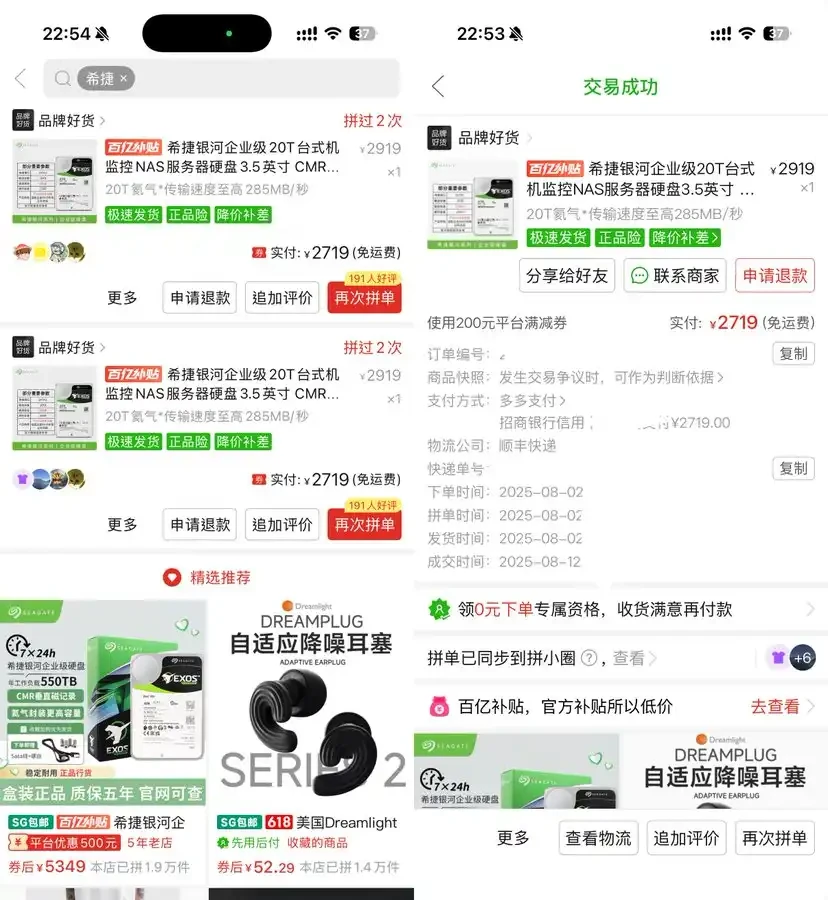
The Price of Hard Drives Started Changing Daily
After the hard drives arrived, I saved the link, planning to buy more if needed. Checking back a few days later, the price had increased; a few more days passed, and it rose again. The same model, the same store — prices were adjusted multiple times within a week, always upwards, never down.
For a highly standardized industrial product with massive production capacity, the retail price shouldn't exhibit this kind of sustained, unilateral upward movement. I saw it as an abnormal signal worth investigating, not just a simple merchant price hike.
Using price comparison tools like Keepa and Manmanmai, I pulled the price curve for this hard drive over the past few months and compared it with several other large-capacity models from Seagate and Western Digital. The conclusion was consistent: it wasn't an issue with a single model; the entire line of large-capacity mechanical hard drives was rising — sustained and unilateral, not a short-term fluctuation caused by promotions.
At this point, it was essentially confirmed that a larger underlying cause was at play.
Tracing the Thread: AI is Snatching Up Hard Drives
Digging deeper, the logic became clearer.
The market focuses more on AI's demand for GPUs, but its demand for storage is equally massive. Large model training and inference generate vast amounts of data that need long-term storage. For long-term, low-cost data storage, the primary solution isn't SSDs but large-capacity mechanical hard drives. The drives used in data centers are called nearline enterprise hard drives, heavily purchased by major cloud providers like Microsoft, Amazon, Google, and Meta.
Seagate happens to sit right in the middle of this demand wave. Its promoted HAMR technology significantly increases single-drive capacity, perfectly aligning with data center needs. With limited production capacity, manufacturers prioritize supplying higher-margin enterprise orders, thereby squeezing retail supply. The price increase I saw on Pinduoduo was essentially the procurement demand from AI data centers being transmitted down to the consumer price point.
I checked Seagate's financial reports at the time: revenue in the latest quarter grew 39% year-over-year, with record gross margins. The market was also beginning to price the data storage sector as a part of the AI industry chain.
After confirming the logic, I bought 500 shares at around $150 and shared the rationale, cost, and position in the company's internal US stock exchange group.
What Gave Me Confidence to Add Positions: The Subsequent 13F Filings
Being convinced myself wasn't enough; I needed to confirm whether institutional capital was making the same judgment.
One very useful piece of public data in the US stock market: institutions managing over $100 million must disclose their US stock holdings quarterly via the 13F filing. This is essentially a legal, public record of institutional holdings, accessible to anyone.
I didn't add positions immediately. Instead, I wanted to observe the trend for another quarter or two. A change in a single quarter could be coincidental; a consistent direction over consecutive quarters is more credible. When the 13F for the third quarter came out in November, and I connected the line of institutional holdings in Seagate over the past year, the direction was clear:
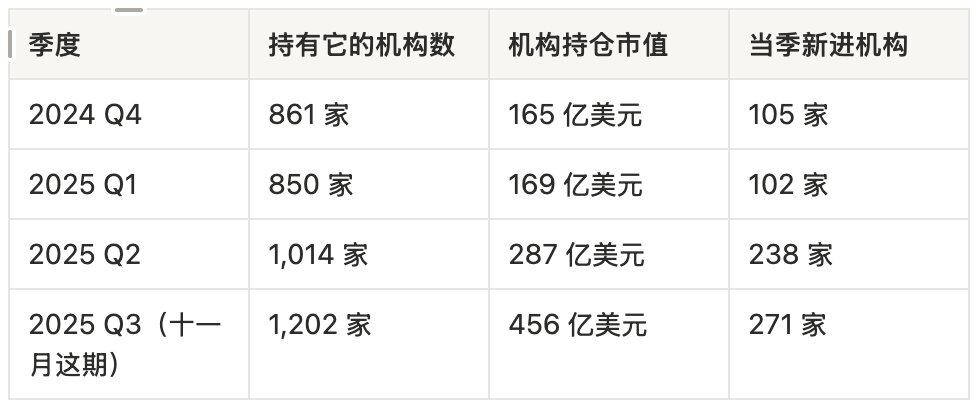
In the second half of 2024, this stock was largely ignored, with the number of holding institutions hovering around 800, even slightly declining. Entering the second quarter of 2025, an obvious inflection point appeared, accelerating further in the third quarter: the number of holding institutions increased from over 800 to over 1,200, with the number of new institutions entering each quarter also increasing.
It should be noted that the total market value of holdings surged to $45.6 billion within a year, largely driven by the stock's own price increase, not entirely from new capital inflows. However, 'breadth' indicators like the number of institutional holders and new positions are more telling. Their quarter-over-quarter increase suggests this wasn't the bet of one or two funds, but a wave of professional capital consistently entering the market.
Only after confirming this did I feel confident enough to significantly increase my position, begin seriously researching the storage sector, and subsequently continue adding to positions in $STX and $SNDK via LEAPS CALLs.
Looking Back Now
On the day I bought the hard drive, Seagate closed at just over $150; today it's around $965 — a six-fold increase. Last year, it briefly surpassed Palantir to become the top gainer in the S&P 500 for the year. Just the initial 500 shares represent a paper profit of around $400,000, not to mention the subsequent additions.
That a simple purchase of two hard drives could lead to such a trade still seems somewhat unexpected now.
Summarizing This Thought Process
It's actually not that complicated:
· Abnormalities in everyday encounters (rising prices, shortages, queues) often appear earlier than news or financial reports. Ordinary people sometimes get first-hand signals earlier than professional institutions.
· Don't stop at the impression of 'it seems more expensive.' Plotting the price as a curve usually helps determine whether it's a trend or just noise.
· Ask further up the chain: Is this driven by a long-term, structural demand? Then find the listed companies that directly benefit and are in a key position within the industry chain.
· Finally, use 13F filings to verify institutional sentiment, and look at the trend over consecutive quarters, not just a single one.
This method doesn't guarantee success every time, but it at least bases the buy decision on logic, not just a feeling.
Finally, a Clear Statement of Risk
This was a successful instance. I've also tracked a specific price increase signal that later turned out to be just a short-term fluctuation. Those cases weren't shared in the group, but they were equally real. Survivorship bias is obvious here.
The above is a personal review and does not constitute investment advice. All gains and losses are your own responsibility.
But I endorse this line of thinking: pay attention to anomalies you encounter daily, ask one more layer of 'why,' find the listed company behind it, and then use 13F filings to see if professional capital agrees. Next time something you regularly buy inexplicably rises in price, think it through: who is making the profit, and is that company publicly listed?