BitTorrent推出BTTInferGrid,打造去中心化AI推理算力基礎,有望推動BTT價值全面躍升


- 核心觀點:BitTorrent推出BTTInferGrid,建構去中心化AI推理算力網絡(DePIN),透過聚合全球閒置GPU資源,以加密經濟激勵重構算力分配機制,旨在緩解AI產業面臨的算力短缺與中心化壟斷問題,並推動BTT代幣向AI算力生態核心價值載體升級。
- 關鍵要素:
- BTTInferGrid透過「應用層-計算層-結算層」模組化架構,實現AI推理任務的請求、排程與自動化激勵閉環,提供按需付費的高效服務。
- 網路採用無需許可接入與動態供給機制,所有達標GPU均可參與;透過多維度評分(工作量、延遲、穩定性)進行激勵分配,打破大算力壟斷。
- BTT代幣在生態中承擔支付、激勵及質押等多重角色,貫穿算力使用、貢獻獎勵與網路安全保障全流程,有望從傳輸代幣升級為AI算力網絡核心代幣。
- 規劃清晰的階段性目標:2026年完成網路啟動並支援主流開源模型;2027年擴展至綜合算力平台;2028年及以後定位為AI原生基礎設施。
- 已原生適配阿里通義千問Qwen系列及Meta Llama系列等主流開源模型,開發者透過標準化API即可直接呼叫推理服務,降低應用落地門檻。
On June 17, BitTorrent, the world's leading decentralized file transfer ecosystem, announced the launch of its core AI strategic product, BTTInferGrid, building a decentralized computing network for AI inference scenarios.
BTTInferGrid is a major AI product strategically upgraded by BitTorrent based on its mature decentralized storage service, BTFS. It embodies BitTorrent's deep technical expertise accumulated over years in core areas such as P2P network protocol design, global distributed node governance, and large-scale resource scheduling, giving the platform inherent advantages for large-scale application and commercial implementation from its inception. The official launch of this product not only marks BitTorrent's entry into the decentralized AI infrastructure赛道 but also officially heralds a new chapter in empowering the AI industry with distributed computing power.
Leveraging a crypto-economic incentive system and distributed consensus mechanisms, BTTInferGrid seamlessly connects globally idle GPU computing resources with the diverse inference needs of AI developers. It provides open, verifiable, pay-as-you-go efficient inference services for next-generation AI applications, while also enabling idle GPU holders to easily monetize their resources, creating a win-win scenario for both computing supply and demand.
From a technical infrastructure perspective, BTTInferGrid reconstructs the traditional centralized computing supply system through distributed computing aggregation and intelligent scheduling mechanisms, endowing AI infrastructure with greater resource elasticity and resilience against risks. From an industry landscape perspective, it helps computing shed its scarcity and monopoly attributes, transforming it into a freely circulating digital means of production. This allows every GPU holder to participate in value creation and revenue distribution, fostering a new industry paradigm of universal access to and efficient circulation of computing resources.
BitTorrent Launches BTTInferGrid to Build a Decentralized AI Inference Computing Base
"Computing power, algorithms, and data" are the three core elements of AI development, and the strategic value of computing power has been elevated to an unprecedented level in 2026. The "computing power shortage" is no longer just a long-term industry warning but has evolved into the primary bottleneck constraining AI's progress.
Globally, rental costs for high-end Nvidia GPUs continue to rise, and hardware supply remains chronically tight. Leading AI companies like OpenAI and Anthropic frequently experience server outages due to insufficient computing reserves. Even tech giants and top academic institutions struggle to secure adequate computing power. In its recent Nasdaq IPO filing, SpaceX acknowledged that the computing demands of its AI systems have significantly exceeded current market supply, even considering reclaiming computing resources previously lent to Anthropic for its own needs. Recently, Microsoft's cloud platform Azure was reportedly forced to urgently request computing resources from competitor Amazon AWS to address the massive gap created by the surge in code commits on GitHub during the AI era. Meanwhile, AI labs at top universities like Stanford and MIT have suspended multiple large model training projects due to computing shortages, and many graduate students have had their thesis defenses delayed as a result.
It is against this backdrop of intensifying global supply-demand contradiction for computing power that BTTInferGrid was created. It aims to build a decentralized AI inference computing network (DePIN) by aggregating globally scattered idle GPU computing resources in a decentralized manner, precisely matching the business needs of a wide range of AI developers. It seeks to break down the barriers and monopolies formed by traditional centralized computing service providers, maximize the utilization of global idle hardware resources, establish a new generation of universal, open, and shared computing infrastructure, fully unleash the potential of idle global hardware, and ensure every unit of computing power is fully utilized, maximizing its value.
To ensure the efficient implementation of the entire operating system, BTT InferGrid adopts a modular layered architecture design, establishing a three-layer collaborative system: "Application Layer – Computing Layer – Settlement Layer."
- Application Layer: Serving as the service entry point for developers, this layer provides a user-friendly deployment environment supporting the rapid implementation of various AI-native applications, such as AI chatbots, intelligent agents, and other diverse scenarios.
- Computing Layer: As the core computing hub of the entire ecosystem, this layer handles the critical responsibilities of AI model inference operations, real-time request responses, and task scheduling.
- Settlement Layer: Responsible for the automated operation of the entire economic system, this layer covers the entire process, including computing staking, task settlement, contribution reward distribution, and malicious node penalties. It executes on-chain transactions in a trustless manner, ensuring fair and transparent value exchange between computing providers and consumers without the need for intermediaries, providing a solid economic trust foundation for the entire network.
The three layers collaborate efficiently through standardized interfaces: the Application Layer initiates inference requests, the Computing Layer dispatches computing resources for execution, and the Settlement Layer automatically distributes incentives based on execution results. These three layers support each other, forming a closed-loop system that constitutes a high-performance, highly trustworthy, and sustainable decentralized AI inference infrastructure.
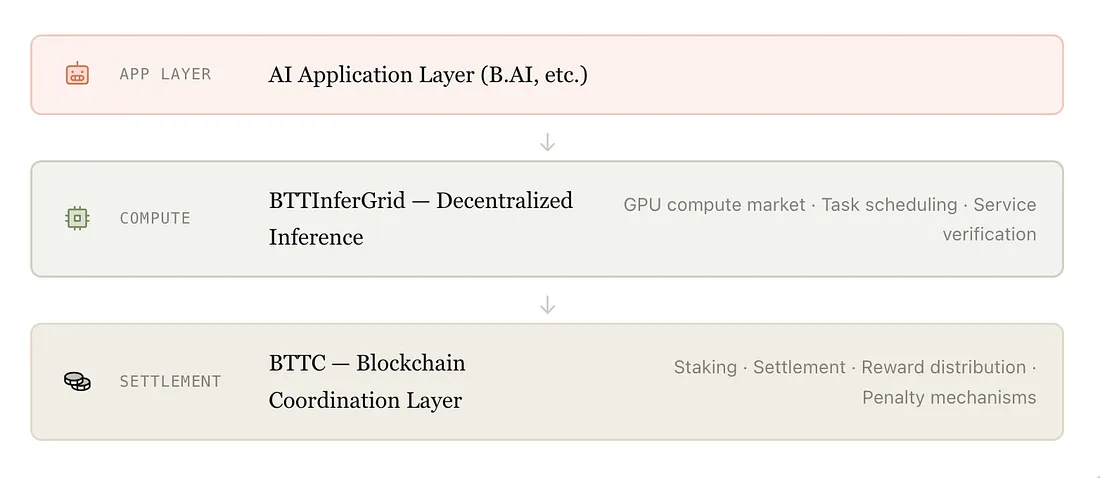
Based on this three-layer architecture, BTTInferGrid offers several advantages, including distributed node autonomy, permissionless demand-driven access, and end-to-end trust and verifiability, establishing an efficient, robust, open, and barrier-free distributed computing operating environment.
From a network architecture perspective, BTTInferGrid employs a globally distributed node deployment strategy. All nodes are co-owned by the community and operated in a distributed manner, with no single data center or operating entity controlling the network core. This inherently decentralized design completely avoids the common single points of failure and operational interruption risks of traditional centralized platforms, endowing the network with strong censorship resistance and 7×24 uninterrupted service resilience, providing a highly available operating base for various AI inference tasks.
Regarding computing resource access and scheduling rules, BTTInferGrid implements a permissionless, open mechanism: all GPU devices meeting performance standards can freely join the network without needing approval from a centralized authority. Furthermore, the overall computing supply is entirely driven by real business demand, with incentives calculated based on the actual computing utilization of nodes and comprehensive service performance. This is complemented by a dynamic supply adjustment mechanism, flexibly allocating resource scale based on real-time computing load across the network. This mechanism enhances the efficiency of computing resource turnover and ensures long-term, stable returns for computing providers commensurate with their contributions.
In terms of trust mechanisms, BTTInferGrid embeds trust logic throughout the entire business process. The entire network relies on a robust crypto-economic system to automatically handle operations like computing scheduling, task assignment, and revenue settlement. Every AI inference computing task can be traced back, and computational results support on-chain cross-verification. Through the underlying mechanism design, the network fundamentally prevents irregularities such as false computing claims and data tampering, ensuring the authenticity and integrity of all computing tasks, allowing demand-side users to use it with confidence and supply-side participants to engage securely.
In summary, the distributed node architecture endows the computing network with autonomy and high stability; the demand-driven permissionless access model ensures efficient circulation and long-term economic sustainability of computing resources; and the fully verifiable end-to-end trust system secures the ecosystem's baseline. The deep integration of these three core characteristics makes BTTInferGrid not just a technologically advanced distributed computing network but a long-term stable, highly trustworthy, future-oriented decentralized AI infrastructure.
BTT Poised to Become the Core Value Token of the Decentralized AI Computing Network, Potentially Broadening Ecosystem Application Boundaries
As the native value token of the BitTorrent ecosystem, with the official launch and continued expansion of BTTInferGrid, BTT's strategic positioning may undergo a critical upgrade. Its application scenarios could potentially extend from traditional distributed transmission and storage tracks into the entire AI computing infrastructure industry chain, continuously broadening the ecosystem's value boundaries.
In the past, BTT served as the circulation vehicle for BitTorrent, the world's leading decentralized file transfer network. Today, leveraging the new AI computing network BTTInferGrid, it is expected to evolve into the core token for orchestrating the decentralized AI computing network, assuming dual roles of value transfer and ecosystem governance.
The crypto-economic incentive mechanism of BTTInferGrid is the underlying engine driving the network. It connects off-chain idle GPU computing power with the inference needs of AI developers, automating task scheduling, result verification, and revenue settlement through token incentives, ensuring a transparent match between supply and demand and governance.
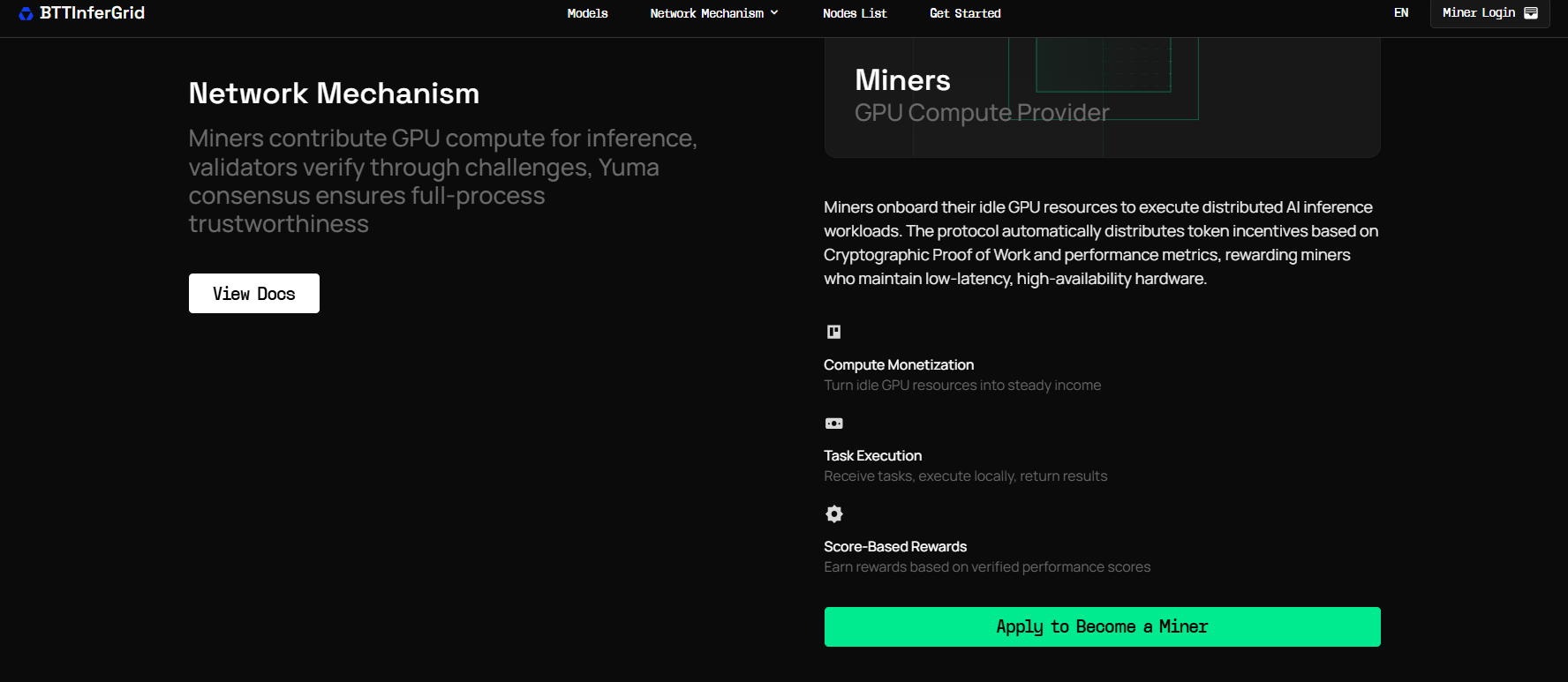
Within the BTTInferGrid system, the continuous operation of the ecosystem relies mainly on the collaborative participation and division of labor among three core roles: Miners, Users (AI Developers), and Validators, collectively building an autonomously operating decentralized computing network:
- Miners (Computing Suppliers): Contribute idle GPU resources to undertake and execute AI inference tasks, earning corresponding rewards based on actual workload, task completion quality, and dynamic performance scores.
- AI Developers (Computing Consumers): Can access the global distributed computing pool via a unified, standardized API, significantly reducing computing costs.
- Validators (Network Guardians): Audit miners' computational performance through random challenges, identifying abnormal behaviors like node cheating or low-quality computing. They earn corresponding rewards by maintaining network security and service quality.
These three participant groups, relying on a decentralized consensus mechanism, form a complete closed loop where interests are symbiotic and mutually constraining, jointly driving the continuous evolution and positive cycle of the BTTInferGrid ecosystem. The core link connecting the interests of all parties and driving the healthy operation of the ecosystem is the crypto-economic incentive system tailored for BTTInferGrid.
Through the circulation of tokens, this system achieves precise quantification and fair distribution of computing value, transforming behaviors like computing provision, task execution, and result auditing into clear, quantifiable incentive signals: Miners receive token rewards for contributing idle GPUs and completing inference tasks with high quality; Validators earn income by maintaining network security; and AI Developers pay fees based on actual computing consumption. The interests of these three parties achieve dynamic balance through the flow of the token economy, thereby constructing a sustainable value closed loop.
Within this framework, BTT is expected to become the unified native incentive and settlement base token for the BTT InferGrid ecosystem, permeating the core aspects of the entire computing ecosystem. It will comprehensively cover the payment for AI computing resource usage, contribution incentives, and dynamic allocation processes, ultimately building a closed-loop economic system where "computing contributors receive rewards, computing users pay conveniently, and ecosystem participants share value."
Specifically, BTT tokens can play multiple core roles within the BTTInferGrid network: As a payment medium, AI developers use BTT (or its equivalent tokens) to pay for inference services, enabling "pay-as-you-go" consumption. As an incentive tool, Miners receive token rewards based on verified actual computational contributions, and Validators earn income for providing audit and challenge services, continuously attracting global idle resources to join the network. As a staking asset, Validators must stake tokens to participate in scoring and verification, and computing nodes also need to stake a certain number of tokens to qualify for task acceptance. Any improper behavior triggers a slashing mechanism, effectively ensuring network security and fairness from an economic standpoint.
From this perspective, BTT is not only poised to be the value carrier matching computing supply and demand but also the underlying core driving force supporting the efficient, fair, and long-term operation of the entire decentralized AI computing economy. On one hand, token incentives continuously attract more idle GPU resources to join the network, expanding computing supply. On the other hand, the accompanying staking and slashing mechanism ensures the stability and reliability of inference services. Furthermore, all settlement, reward, and penalty logic is automatically executed by smart contracts, effectively addressing common pain points of centralized computing platforms, such as information opacity and high trust costs.
As the BTTInferGrid ecosystem develops and thrives, BTT is expected to become a universal value anchor connecting distributed computing power with AI application demands, ushering in a new paradigm for the decentralized AI economy.
BTTInferGrid Reconstructs Global Computing Distribution Mechanisms, BitTorrent Opens a New Chapter in the Decentralized AI Track
Against the industry backdrop of intensifying global AI computing supply-demand contradictions and escalating centralized computing monopolies, BTTInferGrid reconstructs the computing supply model through distributed technology. It efficiently aggregates fragmented idle GPU resources worldwide, building an open, shared computing infrastructure. This allows AI developers to access elastic computing power with zero barriers while enabling every unit of idle computing power globally to realize its inherent value. Simultaneously, leveraging innovative crypto-economic incentives and collaborative governance mechanisms, it opens up a value circulation closed loop between the supply and demand sides of computing, forming a mutually reinforcing and virtuous ecosystem cycle.
For Miners (Computing Suppliers), BTTInferGrid acts as a "value converter" transforming idle computing power into a sustainable income stream. Any idle GPU meeting basic performance thresholds can permissionlessly join the network, contribute computing power, and earn rewards.
Unlike the crude model of traditional distributed computing platforms that distribute rewards purely based on "hardware computing capacity," BTTInferGrid employs a multi-dimensional scoring weighted incentive model. The network comprehensively evaluates core indicators such as a node's actual effective workload, task response latency, service stability, and result accuracy, dynamically calculating and distributing corresponding rewards. This mechanism fundamentally breaks the "large computing power monopolizes rewards" paradigm, allowing small and medium-sized miners providing high-quality, reliable services to also earn outsized returns, institutionally ensuring the service quality of the entire network. Additionally, miners participating in the network's early construction will enjoy ecosystem incentives like exclusive reward multipliers, providing first-mover advantages.
For AI Developers, BTTInferGrid offers open, verifiable, and flexibly pay-as-you-go AI inference computing services—a computing solution entirely different from traditional cloud vendors. It effectively addresses multiple industry-wide pain points such as "expensive computing power, poor elasticity, and trust difficulties," significantly lowering the trial-and-error threshold for deploying AI applications.
Firstly, BTTInferGrid provides elastic computing scheduling, dynamically allocating resources based on AI inference load. Developers do not need to pre-purchase hardware or sign long-term contracts, completely freeing them from the resource lock-in of centralized cloud vendors and enabling true on-demand, flexible scaling. Secondly, it adopts a decentralized market-based pricing and precise token-based billing model, eliminating the high premiums of centralized platforms and significantly reducing inference costs, bringing computing expenditures back to reasonable levels. Most critically, BTTInferGrid builds a decentralized multi-validator audit network. Through mechanisms like random challenges, cross-verification, and staking slashing, it technically prevents computing fraud and result tampering, ensuring every inference computation is authentic, traceable, and verifiable. These multiple advantages complement each other, making BTTInferGrid not only a cost-effective channel for accessing computing power but also a decentralized AI inference infrastructure trusted by developers.
In terms of product development, BTTInferGrid has formulated clear, actionable short-term, medium-term, and long-term development plans to steadily advance the iterative upgrade and ecosystem expansion of the decentralized AI computing network:
Short-term Goal (2026): Focus on network launch and basic service deployment. While gradually increasing the number of online GPU nodes, complete core node launch and inference service validation. Add support for mainstream open-source models like DeepSeek and Qwen, and launch API services for developers and enterprise clients.
Medium-term Goal (2027): Focus on ecosystem closure and expanding capability boundaries. Based on the stable operation of inference services, comprehensively enhance network performance and ecosystem richness. Upgrade from a single inference service to a comprehensive computing platform (e.g., model fine-tuning, cross-chain resource access), building a complete developer toolchain and ecosystem support system.
Long-term Goal (2028 and beyond): Aim to become AI-native infrastructure, building a collaborative network integrating computation, storage, and smart contracts. Provide underlying support for AI agents and automated applications, ultimately becoming the preferred decentralized inference layer for global open-source AI applications, providing elastic, universal, and trustworthy computing support for large-scale, high-concurrency next-generation AI application scenarios.
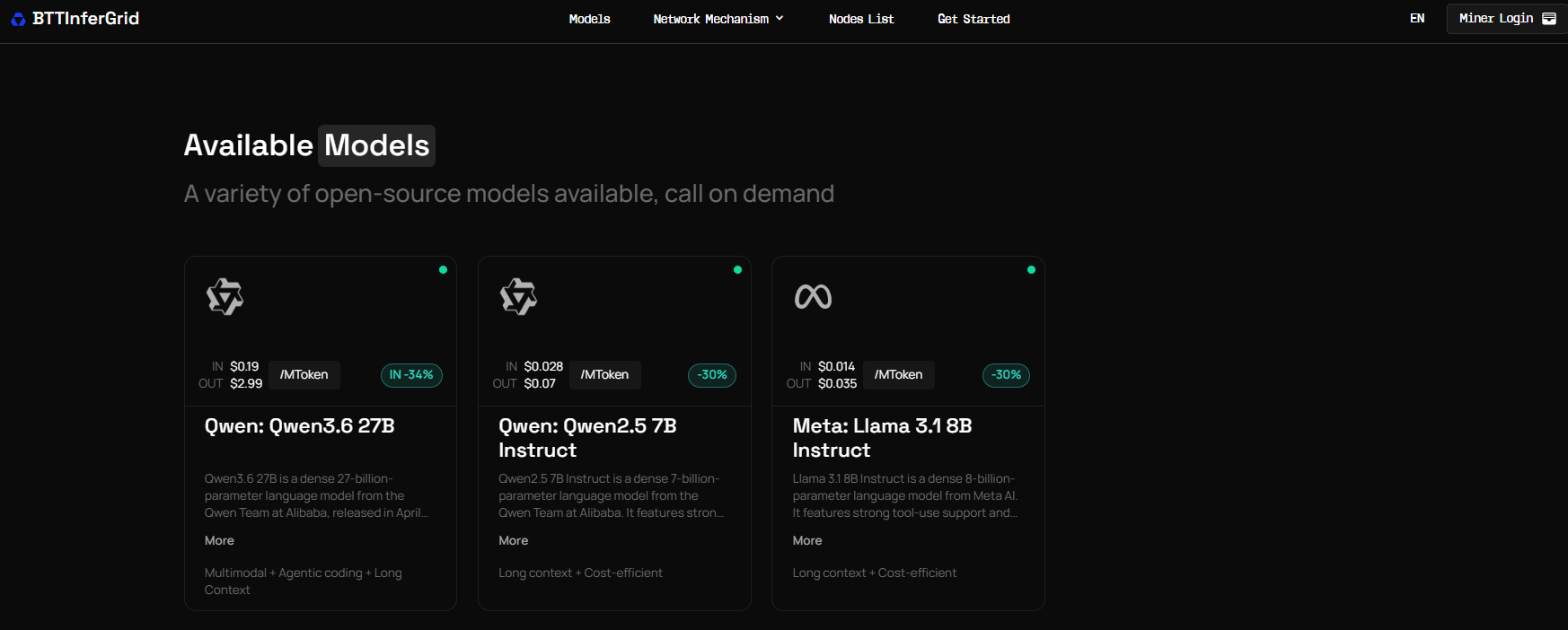
In ecosystem development, BTTInferGrid has already completed native adaptation for several industry-leading open-source large models, including mainstream models like Alibaba Cloud's Qwen3.6 27B, Qwen2.5 7B Instruct, and Meta's Llama 3.1 8B Instruct, covering diverse business scenarios such as general conversation, code generation, and content creation. Developers do not need to deploy and debug models themselves; they can flexibly invoke them on demand through standardized API interfaces, further lowering the usage barrier and significantly shortening the AI application development and deployment cycle.
Currently, users can submit miner access applications through the BTTInferGrid official website to participate early in network building and share in ecosystem development dividends.