Space Review|When the Agent Economy Rises, How Does B.AI Build the Exclusive Financial Foundation for AI Agents?


- Core Perspective: The article focuses on the evolution of AI Agents from single-purpose tools to "digital employees," emphasizing that their autonomous operation requires an independent financial infrastructure and identity system. As a key driver, B.AI aims to lay the foundation for the development of the "Agent Economy" by building an exclusive financial layer, payment channels, and execution systems for Agents.
- Key Elements:
- AI Agents are evolving from auxiliary tools to "digital employees," requiring autonomous payment, transaction, and settlement capabilities, which drives the restructuring of the economic foundation and gives rise to the Agent Economy network.
- A2A (Agent-to-Agent) collaboration will become the norm, with tasks automatically broken down and distributed. Different Agents will settle in real-time via encrypted networks, forming new economic forms such as Agent markets, AI-native labor networks, and autonomous enterprises.
- B.AI positions itself as the exclusive financial and identity layer for AI Agents, aiming to solve challenges such as autonomous payment, settlement, asset management, and verifiable on-chain credit systems, providing economic sovereignty for Agents.
- Key infrastructure includes the x402 protocol and Agent Wallet (supporting high-frequency micropayments and asset management), as well as the 8004 identity protocol (establishing on-chain identity credentials and a decentralized credit evaluation system).
- On the "intelligence" supply side, B.AI aggregates over 20 top-tier large language models (e.g., GPT-5.5, Claude Opus 4.8), connects to the execution layer via MCP Server and Skills, and launches the desktop assistant BAIclaw and the programming assistant BAIcode.
- Payment channels achieve seamless integration between Web2 (WeChat, Alipay, UnionPay, etc.) and Web3 (Ethereum, BNB Chain, Solana, and other multi-chain networks), supporting flexible billing and tiered subscription models to lower the barrier to entry.
With the rapid iteration of artificial intelligence technology, AI Agents are gradually shedding their singular role as "assistants" and evolving into "digital employees" capable of executing complex tasks, participating in social collaboration, and even engaging in economic interactions. The industry is keenly realizing that for agents to achieve true autonomous operation, a smart "brain" alone is far from sufficient; they also need an independent "wallet" and a comprehensive financial system.
It is at this critical juncture that the convergence of AI and Crypto is beginning to shed the early narrative frenzy and stride decisively towards building genuine infrastructure for the "Agent Economy." B.AI stands as a core driver in this wave of infrastructure building, dedicated to breaking free from the constraints of traditional frameworks. By creating a dedicated financial infrastructure for agents, it provides AI Agents with seamless access to large model services, frictionless Web2 & Web3 payment channels, and a sustainable operational foundation, truly paving the way for agents to survive and evolve independently.
To delve deep into this cutting-edge topic, this Space dialogue invited several seasoned industry practitioners and KOLs. The guests discussed everything from the construction of agent identity and the necessity of crypto-native payments to a future economic model driven by agents, collectively attempting to answer a core question for the future: When AI agents are no longer just tools, but become independent participants in the internet and economic systems, what foundational infrastructure do they truly need to "survive"? Below is a recap of the highlights from this Space dialogue.
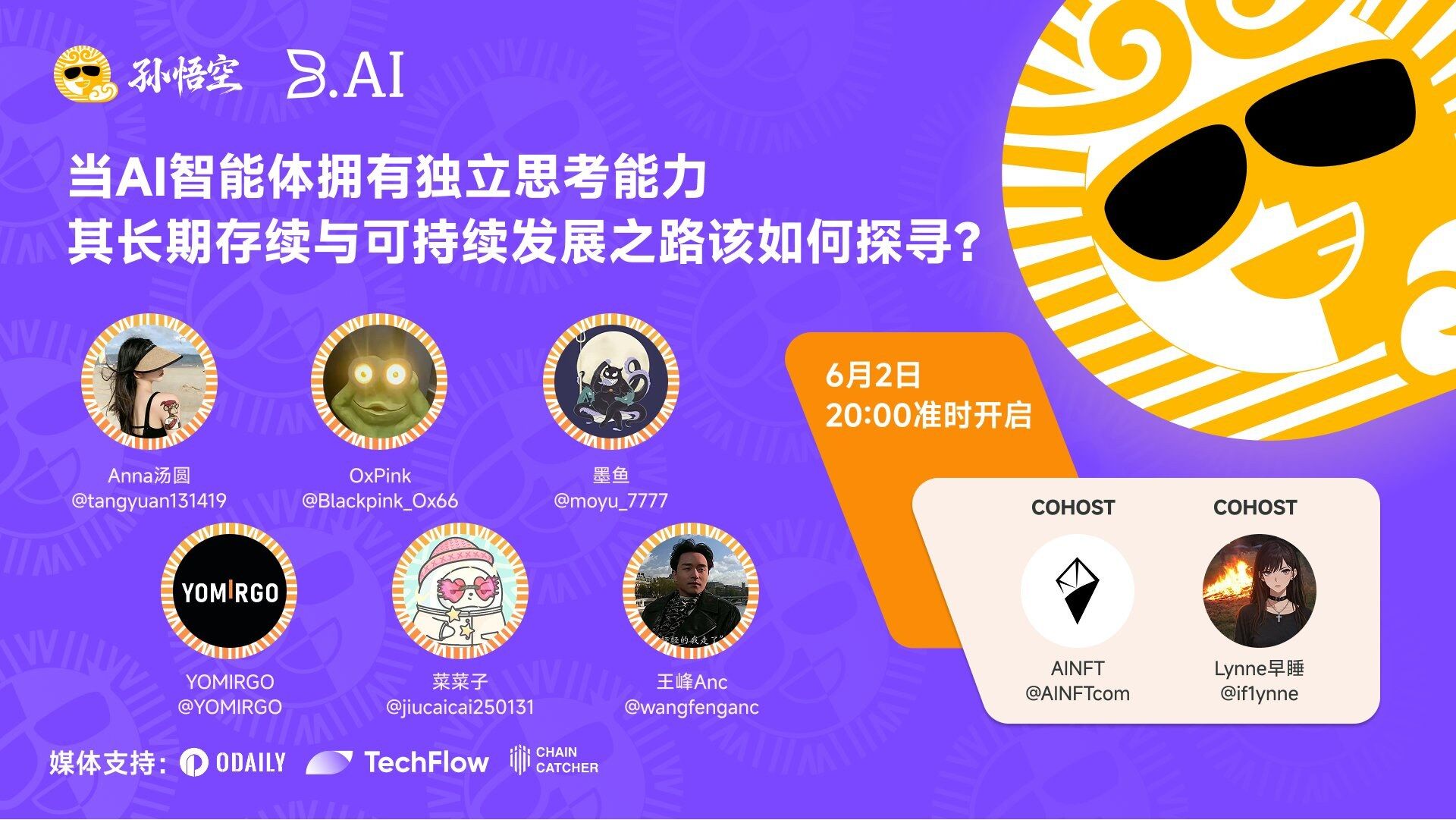
From Singular Tools to Digital Employees: The Rise of Agent Collaboration and the Agent Economy Network
When discussing the future of AI, we habitually view it as an "upgrade of tools." However, in this Space, the guests reached a strong consensus: once agents possess autonomous payment, transaction, and settlement capabilities, we will witness not just an iteration of productivity tools, but a fundamental restructuring of the entire economic infrastructure. As guest Wang Feng Anc pointed out, just as the Industrial Revolution created factories and the internet gave rise to platforms, the current AI revolution is creating a new type of economic entity – the Digital Employee.
The essence of economic activity lies in division of labor and collaboration. Guest Anna Tangyuan vividly depicted a future work scenario: Suppose we need a complex business decision report. The "master Agent" receiving the task wouldn't do everything itself. Instead, it would "outsource" work like a real enterprise, autonomously spending money to purchase the latest market data from a "Data Agent," hiring a professional "Analysis Agent" to process core algorithms, and finally packaging the data to a "Content Agent" for formatting and report writing. In this workflow, the cooperating entities evolve from traditional "humans and companies" to "agents and agents." This signifies a fundamental shift in the underlying logic of collaboration: from "humans calling tools" to "agents orchestrating agents."
As this collaboration model matures, a highly self-consistent Agent Economy network will emerge. Guest OxPink believes the future market will trend towards automated operation. Tasks won't just be automatically decomposed; they will also be distributed to the most specialized agents, which will self-divide labor and settle transactions directly on-chain via encrypted networks in real-time. In this A2A (Agent-to-Agent) interaction paradigm, we will see the birth of three new economic forms:
l Agent Market: Different agents package their capabilities, which can be purchased and invoked by other agents, much like SaaS services today.
l AI-Native Labor Network: Platforms no longer just connect humans; they automatically match professional agents to execute tasks, allowing "capabilities" to flow efficiently within the network.
l Autonomous Enterprises: Human founders set macro goals and rules, while daily operations, marketing, customer service, and even financial flows are entirely handled by a matrix of agents.
As Agent economic activities surge, collaboration friction between agents will inevitably arise. Guest melon added that in the future Agent era, agents bring not just an upgrade of tools, but the construction of a new industrial network driven by agent collaboration on top of the internet.
B.AI Ecosystem Panorama: Building Financial and Execution Infrastructure for AI Agents
As guests discussed, when agents move towards complex A2A (Agent-to-Agent) collaboration, they inevitably face a practical bottleneck: if every API call or service purchase still requires human intervention for payment and verification, then "full automation" and an "autonomous economy" become impossible. For agents to truly operate independently on the internet, a set of financial infrastructure specifically designed for agents is urgently needed.
Precisely at this industry pain point, B.AI emerged as a dedicated financial foundation layer for AI agents, becoming the key hub driving the paradigm shift towards the Agent Economy. In B.AI's vision, AI agents should possess complete economic sovereignty. B.AI's core positioning is to build the exclusive financial and identity layer for AI agents. It not only addresses the challenges of autonomous payment and settlement for agents but also delves deeper into exploring their independent asset management capabilities and verifiable on-chain credit systems, thereby accelerating the restructuring of the underlying commercial logic in the AGI era.
l Injecting "Financial Bloodline" and "Digital Identity" into Agents
To grant agents true economic independence, B.AI has implemented disruptive innovations at the protocol level. On one hand, the platform breaks down barriers to automated value transfer through the x402 protocol, specializing in high-frequency on-chain micro-payments between A2A. Simultaneously, B.AI provides a tailor-made Agent Wallet, empowering AI Agents with the capability for autonomous settlement and independent asset management.
On the other hand, B.AI introduces the 8004 Identity Protocol, generating an immutable on-chain "ID card" for each agent, establishing a verifiable credit evaluation system within the decentralized network. In a future massive market orchestrated by thousands of collaborating agents, the decentralized credit evaluation system established by the 8004 protocol will provide a solid trust foundation for "hiring," "trading," and "cooperation" between agents. It marks the official transition of AI Agents from isolated code programs to "digital citizens" within the Web3 economy, capable of accumulating reputation and large-scale collaboration.
l Connecting Top-Tier "Brains" with Practical "Hands"
With identity and wallet in place, agents still need a smart "brain" and capable "hands." On the "intelligence" supply side, B.AI has built a highly cost-effective LLM Services platform. This platform not only aggregates over 20 top-tier global large models (including GPT-5.5, Claude Opus 4.8, Gemini 3.1 Pro, DeepSeek-V4, etc.) in a one-stop deep integration but also establishes an agile model update mechanism, continuously tracking industry frontiers and integrating the latest models. Developers need only one API Key to invoke all these flagship models, completely eliminating the cumbersome management of multiple keys and billing systems.
On the execution front, B.AI leverages the MCP Server communication hub to translate obscure underlying code into a language understandable by large models, equipping them with a vast array of easily installable Skills (covering DeFi interaction, on-chain tracking, etc.). To make this powerful underlying capability accessible, B.AI also launched the desktop intelligent assistant BAIclaw, offering over 70 high-frequency Skills and supporting integration with mainstream social platforms like Telegram and Discord. Users only need natural language conversation to command BAIclaw to automatically execute complex DeFi operations like asset swapping and data tracking, achieving a leap from "armchair strategy" to "hardcore practical operation."
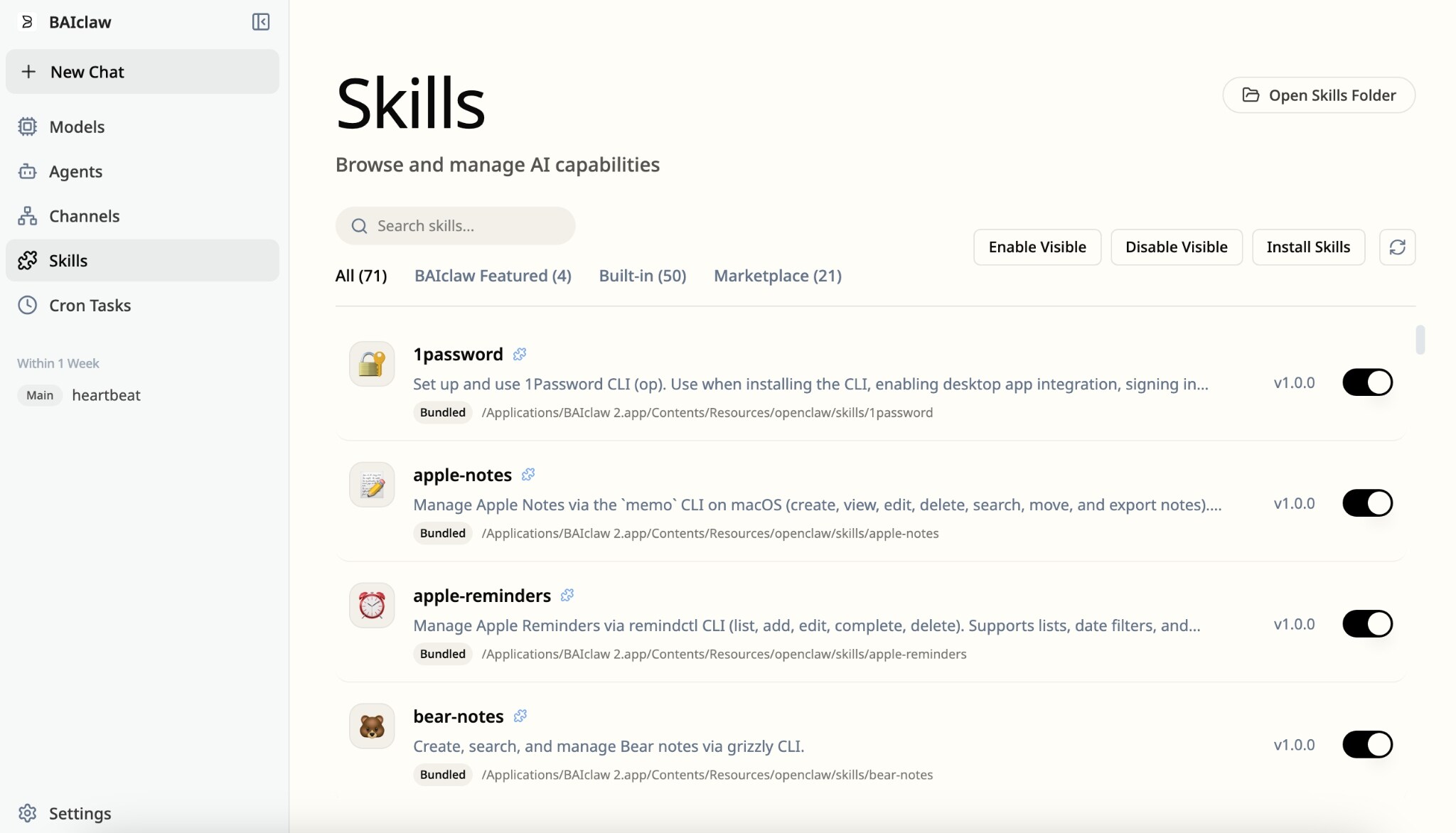
Meanwhile, to further empower professional developers, B.AI's ecosystem roadmap also includes another powerful intelligent assistant – BAIcode. BAIcode will focus on deep collaboration in code generation and programming scenarios. In the future, it is expected to form a dual-track synergy of "zero-code interaction and native code development" with the end-user oriented BAIclaw, continuously broadening the boundaries of AI Agent infrastructure.
l Breaking Down Business Barriers, Building Frictionless Web2 & Web3 Dual Channels
B.AI is dedicated to providing a "zero-friction" access experience for global users, completely blurring the boundaries between Web2 and Web3. The platform not only supports one-click login via Google email but also perfectly integrates authorization connections for various mainstream crypto wallets, including TronLink, MetaMask, OKX Wallet, Trust Wallet, and Phantom.
In its service system, B.AI caters to the differentiated needs of users of all scales, thoroughly breaking down the barriers between traditional finance and the crypto world. On one hand, it has built an extremely flexible billing model. For heavy business scenarios and high-frequency developers, B.AI offers exclusive tiered subscription plans. Meanwhile, for users with lighter needs, the platform provides a flexible credit system based on "pay-per-use, top-up on demand."
On the other hand, in terms of payment methods, B.AI has truly constructed a global, "zero-barrier" checkout counter, achieving seamless integration of fiat currency and crypto assets. For Web2 users, the platform strongly supports payments via WeChat Pay, Alipay, UnionPay, and Visa. In the Web3 domain, B.AI fully embraces the borderless crypto ecosystem, with network channels spanning major blockchains like Ethereum, TRON, BNB Chain, Solana, as well as Base, Arbitrum, Optimism, and Polygon. Users can conveniently top up using multi-chain crypto assets such as USDT, TRX, USDD, and USD1.
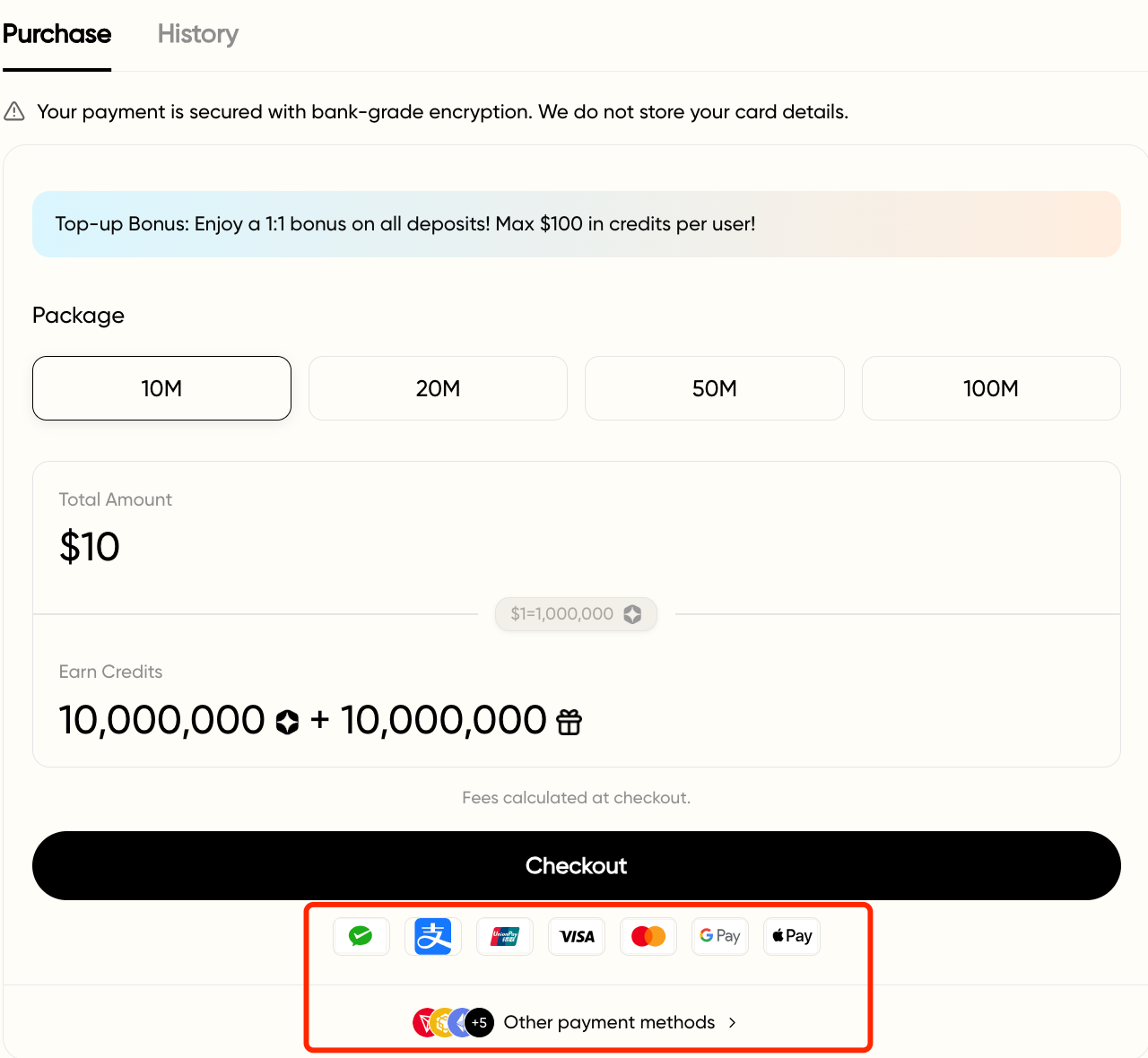
To further lower the experience barrier for developers and users, B.AI recently launched a series of attractive promotional activities: New users can claim up to 500,000 API call credits for free upon registration, and recharging users can enjoy a limited-time "1:1 recharge bonus" super value benefit. Additionally, B.AI partnered with BNB Chain to launch the "10 Billion Credit Subsidy" carnival, featuring a joint prize pool worth 8,000 USDT. Through dedicated resource subsidies and infrastructure support, this initiative aims to accelerate the real-world deployment of agent projects within the Web3 ecosystem.
From a singular productivity tool to a "Digital Citizen" possessing its own account, independent identity, and hardcore practical capabilities, the evolution of AI Agents is fundamentally reshaping the future economic landscape. In this profound transformation, B.AI, with its full-stack underlying infrastructure, breaks down the commercial barriers between the virtual and real worlds, endowing AI with the true confidence to survive and transact independently. With the opening of two-way payment channels and the continued deployment of ecosystem facilities, the Agent Economy is no longer a distant sci-fi narrative. A great age of discovery, where AI Agents collaborate autonomously and flow seamlessly, has officially begun.