Polymarket 六週年:浴室、流亡與回家


- 核心觀點:Polymarket 在上線六週年之際,從一個紐約疫情封城期間浴室内誕生的邊緣實驗,成長為獲得 ICE 投資、CFTC 許可並進入華爾街日報、主流體育聯盟和電視直播的全球最受關注的預測市場,但其成功之路充滿監管衝突與「回家」的曲折。
- 關鍵要素:
- 技術起點與早期驗證:2020年6月上線,利用Polygon和USDC降低交易摩擦,並透過2020年美國大選市場(交易量800萬美元)首次證明其作為公共事件訊號的潛力。
- 監管重創與海外流亡:2022年1月,CFTC指控其營運未註冊的二元期權市場,導致140萬美元罰款並被迫屏蔽美國用戶,進入近三年的海外營運低潮期。
- 公共事件驅動的爆發:2023年Titan潛水器事件和2024年美國大選週期使平台獲得主流關注,累計交易量達數十億美元,並成功提前反映Biden退選等重大政治事件。
- 監管和解與回歸路徑:美國DOJ和CFTC在2025年未提出指控,Polymarket透過收購CFTC註冊的交易所QCX獲得進入美國監管框架的入口,並於同年獲CFTC的no-action letter。
- 機構級接納與商業化:ICE(紐交所母公司)以最高20億美元戰略投資入股,估值升至150億美元;平台與NHL、UFC、MLB等體育聯盟簽訂獨家合作,並試點交易手續費,預估年化收入超2億美元。
- 爭議與未來挑戰:平台仍面臨監管灰色地帶與道德爭議(如將災難事件市場化),預計將發行代幣並進行空投,且美國用戶仍可透過海外站訪問。
On June 17, Polymarket celebrated its sixth anniversary since launch.
In the crypto world, six years is a long time. Long enough for a narrative to go from bubble to rubble, and long enough for a product to evolve from a fringe experiment to mainstream infrastructure. Six years ago, Polymarket was just a prediction market built by a young founder in his bathroom during the New York pandemic lockdown. Six years later, it has entered the balance sheets of Google, the WSJ, sports leagues, the CFTC regulatory framework, and ICE, the parent company of the New York Stock Exchange, becoming the world's most-watched "information market."
Looking at today alone, Polymarket appears to be a classic success story: surging trading volume, skyrocketing valuation, its founder joining the ranks of the youngest self-made billionaires, and prediction markets moving from the crypto niche into mainstream media and live sports broadcasts. But if you pull back the timeline, the story is far from smooth. It's not a history of uninterrupted product growth, but rather an adventure of constantly being shown the door, yet persistently trying to re-enter through the front gate.
Polymarket's earliest proposition was simple: When the world is full of uncertainty, can prices get closer to the truth faster than the media, experts, and polls? COVID, the US election, the Titan submersible, Biden's withdrawal, the Trump Whale, the FBI raid, the CFTC approval, the ICE investment—over these six years, it has repeatedly turned real-world events into markets, and just as repeatedly been pushed back by the rules of the real world.
Therefore, the significance of Polymarket's sixth anniversary lies in witnessing how a crypto product born in a bathroom found itself at the intersection of finance, media, sports, and regulation. What BlockBeats wants to tell in this article is exactly these six years of Polymarket: how it survived, how it was expelled from the US, and how it bought its ticket home.
The Bathroom Gambler
In October 2013, an email landed in the inbox of the U.S. Securities and Exchange Commission.
The sender was a 14-year-old named Shayne Coplan, still a high school student in Manhattan. According to a version he later shared, the email came from a teenager who had read "Flash Boys" and was captivated by Electronic Communication Networks. The email body was short, but the tone had a unique teenage mixture: half naivety, half confidence.
He first introduced himself, saying he was a sophomore in a Manhattan high school working on an ECN-based stock exchange. His first order of business was to confirm the idea was "completely legal" and could comply with SEC regulations.

Shayne Coplan
On December 2, 2024, Coplan shared this old email on X with only the caption: "What people call an 'overnight success' takes a decade." Looking back over ten years later, the email reads like an overly neat foreshadowing. Coplan, of course, didn't know back then that what he would eventually build wasn't a traditional stock exchange, but a prediction market that lets the world bet on the future with prices. Nor did he know that this market would later be forced out of the US due to regulatory issues, only to try and walk back in through the front door a few years later.
Polymarket's Prehistoric Story
Coplan grew up in Manhattan, raised by his mother, with his father being a film professor at NYU. He attended public school in Hell's Kitchen, not an elite preparatory school for the children of Wall Street. The impression he later gave wasn't that of someone trained in the traditional financial system. He seemed more like a kid who grew up immersed in internet culture, cryptocurrency, entrepreneurial biographies, and the streets of New York.

Coplan credited his high school graduation to "cramming, caffeine, and Wikipedia." Photo: Shayne Coplan/Facebook
During those years, he started getting into cryptocurrency. According to media reports, the entry point even had a whiff of early internet serendipity: while downloading pirated music, he stumbled upon crypto, started researching it, and even tried assembling his own mining rig. For many his age, the internet was for games, music, and social platforms; for Coplan, it was more like a stairway leading directly to a hidden basement. Following this staircase, he saw a new financial world without teachers, entrance tickets, or age restrictions.
In 2014, the Ethereum presale began. Coplan bought ETH at around $0.30 per coin. This early investment later became the seed funding for his entrepreneurial journey.
Around the same time, he walked into the offices of the lyrics website Genius, uninvited. After sending many emails with no response, he simply showed up at their office door. NYMag later described the then-Coplan as having unruly curly hair and an almost encyclopedic knowledge of billionaire tech entrepreneurs. Genius eventually gave him an internship.
This experience is important to the Polymarket story because it shows that Coplan's early research wasn't about finance, but about "how people turn an internet idea into reality." He annotated pages for Zuckerberg, Travis Kalanick, and others on Genius, as if sketching a blueprint for his own future path. A teenager repeatedly reading these people's stories, breaking them down, was essentially learning a path: how a fringe idea enters the mainstream world.
He later enrolled at NYU to study computer science but dropped out after just one semester to focus full-time on crypto entrepreneurship. From 2018 to 2019, he bought the domain union.market and built a product called Union Market, focusing on yield-generating digital assets. This project didn't really take off.
But failure didn't drive him away from the "market" problem. During that time, he read economist Robin Hanson's papers on futarchy. The core idea of futarchy is radical: if markets can aggregate information, can prediction markets help society make decisions? In other words, can prices reflect not just asset values, but also the probability of future events?
Coplan wrote to Hanson, saying he wanted to build prediction markets. Hanson didn't take it too seriously. The reason wasn't complicated: prediction markets weren't a new concept; there had been too many attempts over the decades, with far more failures than successes. The field always sounded correct in theory but was always difficult to truly integrate into public life.
By the end of 2019, Coplan was completely disillusioned with crypto. He was 21, had been a dropout for two and a half years, hadn't achieved anything big enough, and was running out of money. Looking back at the birth of Polymarket, it's easy to frame it as a story of a "genius founder spotting an opportunity." But on the real timeline, it looks more like a person at a low point, continuing to search for an exit within an old idea.
What truly changed everything was 2020.
COVID Breaks the Mold
In March 2020, New York became the epicenter of the COVID-19 pandemic in the US.
Times Square emptied, Broadway closed, restaurants put chairs upside down on tables, and subway cars held only a few masked passengers. The sound of ambulances became the city's backdrop. Every morning, people's first thought wasn't checking the weather, but checking new cases, hospitalizations, deaths, governor briefings, and new lockdown rules.
For the vast majority of New Yorkers, the lockdown meant fear, stagnation, and endless waiting. Some lost jobs, some left the city, and some were trapped in small apartments, constantly refreshing the news.
Everyone was asking the same questions: When will the lockdown end? Will cases keep rising? When will the vaccine arrive? Will the presidential election be rewritten by the pandemic? But the answers from traditional information channels were unstable. Experts, media, government, and social platforms—every voice seemed certain, yet each certainty was quickly overturned by new realities.
This was precisely the environment prediction markets needed. Not because people suddenly liked to gamble, but because life was filled with unavoidable and unpredictable real-world problems. The pandemic turned the "future" from an abstract concept into something everyone had to face daily. Everyone was predicting, but most predictions didn't have a price.
Coplan saw the opportunity.
He developed the product in the bathroom of his apartment on the Lower East Side. He would later repeatedly refer to it as his "makeshift bathroom office."
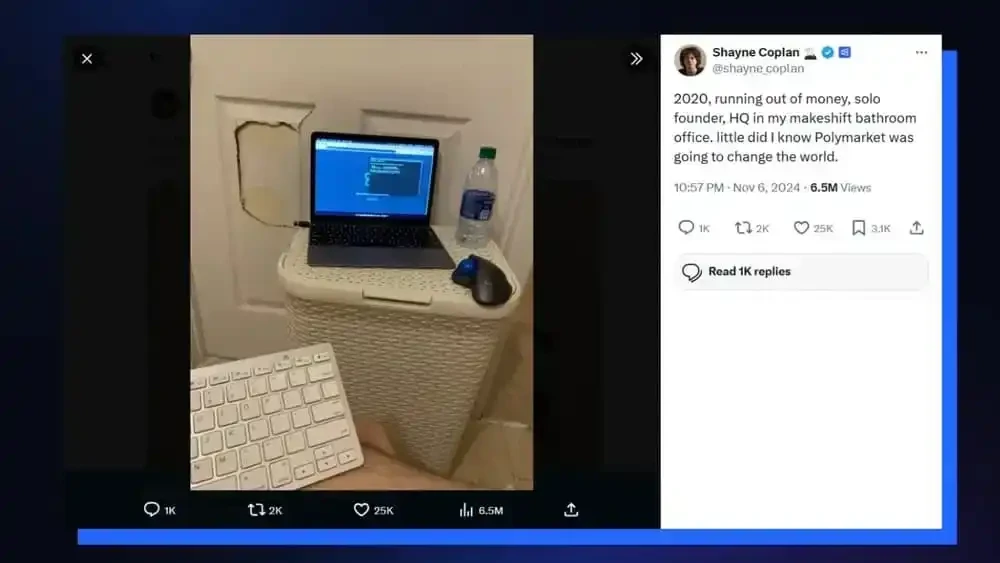
A young man with almost no resources, in the world's most chaotic time, trying to build a market to price that chaos. The pandemic made everyone a predictor, and Coplan wanted to compress the judgments scattered across chat groups, comment sections, expert interviews, and traders' desktops into a tradable price.
He had no co-founder, was running out of money, and had to inventory his apartment belongings, figuring out what he could sell for rent. The product name was also in flux: Union.market, Union Marketplace, finally settling on Polymarket. The name later sounded natural, but at the beginning, it was just a new entrance emerging from the wreckage of an old project.

Polymarket founder Shayne Coplan, Source: CBS '60 Minutes'
In June 2020, Polymarket officially launched. Technically, it used Polygon and USDC for settlement, offering lower fees, faster speeds, and a user experience closer to a typical internet product compared to earlier Ethereum mainnet prediction markets like Augur.
The early markets were straightforward: ETH price, US COVID-19 case trajectory, the 2020 election. These markets seemed diverse, but they all pointed to the same question: When the world is surrounded by uncertainty, are people willing to use real money to express their judgment about the future?
Four months later, the answer began to emerge.
In October 2020, the US presidential election entered its final sprint. The pandemic wasn't over, mail-in voting became a new battleground, the echoes of racial justice protests still reverberated in the streets and TV debates, and the shadow of economic recession weighed on household bills and market expectations. Trump tried to prove he could lead the country out of the crisis, while Biden framed the election as a chance to "return to normal."
That fall, every part of American society was being pulled by politics. TV stations ran polls 24/7, analysts deliberated endlessly over red and blue maps; social media was filled with conspiracy theories, partisan mobilization, and arguments over mail-in ballots; Wall Street tried to gauge the direction of taxes, regulation, and fiscal policy; ordinary people searched for a sliver of certainty between the pandemic and the election. Everyone was asking: Does Trump still have a chance? Is Biden's lead really solid? If vote counting drags on, will the market crash first?
Polymarket was still a niche crypto tool at launch, but the election gave it its first true public test. In October, Polymarket closed a $4 million seed round led by Polychain Capital, with participation from Naval Ravikant, Nick Tomaino of 1confirmation, and others.
For a product just out of the bathroom, this money wasn't just capital; it was a signal: at least some crypto investors believed prediction markets could become useful again.
In November, the Biden vs. Trump showdown reached its climax. Polymarket's market price had consistently pointed to a Biden victory for weeks before the election. The "Will Trump win?" market saw over $8 million in trading volume. Looking back, $8 million isn't huge, incomparable to the tens of billions during the 2024 election cycle. But at the time, it was enough to prove one thing: someone was willing to put their political judgment on a chain-based market.
This $8 million wasn't the endpoint of a commercial success, but the beginning of a product proposition. It proved Polymarket wasn't just a temporary pandemic toy or a self-amusing crypto experiment. It provided the first tangible sample that answered the question: "Can market prices become real-time signals for public events?"
Of course, Polymarket in 2020 was still small. It was more of a niche crypto tool than a reference source for mainstream political media. Coplan was still running his own social media, DMing investors one by one, asking for retweets and likes. Vitalik Buterin tried Polymarket around the same time and praised its UX for being friendly to non-crypto users. This was a significant endorsement, because one of the biggest past failures of prediction markets was having beautiful concepts but products that were too difficult to use.
Getting Hit by Regulation
In 2021, Polymarket evolved from a personal project into a company with over a dozen employees. Users grew from thousands to tens of thousands of MAUs. A more complete team began operating around it: some focused on product, some on market, some on community, and some handled the constant stream of settlement disputes. It was no longer just a page Coplan built in his bathroom, but a real trading venue producing prices, disputes, and news material.
The internal team culture was very "rebel/maverick," carrying the typical aura of a crypto startup: build it first, make the market run, then deal with the rules and boundaries.
It was the 2021 crypto bull run, where almost everyone believed speed mattered more than order. DeFi, NFTs, DAOs, GameFi—every day brought a new narrative, and every new narrative challenged old rules. Polymarket was part of this atmosphere.
Simultaneously, Coplan continued to accumulate social capital within the crypto culture. Using the identity of ethsquiat, he collected a large number of NFTs and was an early supporter of crypto artists like FEWOCiOUS. This wasn't the core storyline for Polymarket, but it's useful for understanding Coplan. For this generation of entrepreneurs, identity, capital, taste, and product are often intertwined; a wallet address can sometimes tell you more about who you are than a business card.
But Polymarket was different from most crypto products. NFTs could be called art, DeFi could be called a financial experiment, and DAOs could be called organizational innovation. But once prediction markets start dealing with real-world events, they directly hit the boundaries of financial regulation. Polymarket could call itself an information market, but regulators saw something else: users using money to bet on event outcomes, which looked like unregistered event contracts.
So the CFTC's questions became more specific. The issue was no longer "Is your product interesting?" but "Are you qualified to offer these contracts?" The more markets Polymarket had, the sharper the questions became. ETH prices, COVID cases, presidential elections, policy events—users saw these as information, but in regulatory documents, they could be binary options.
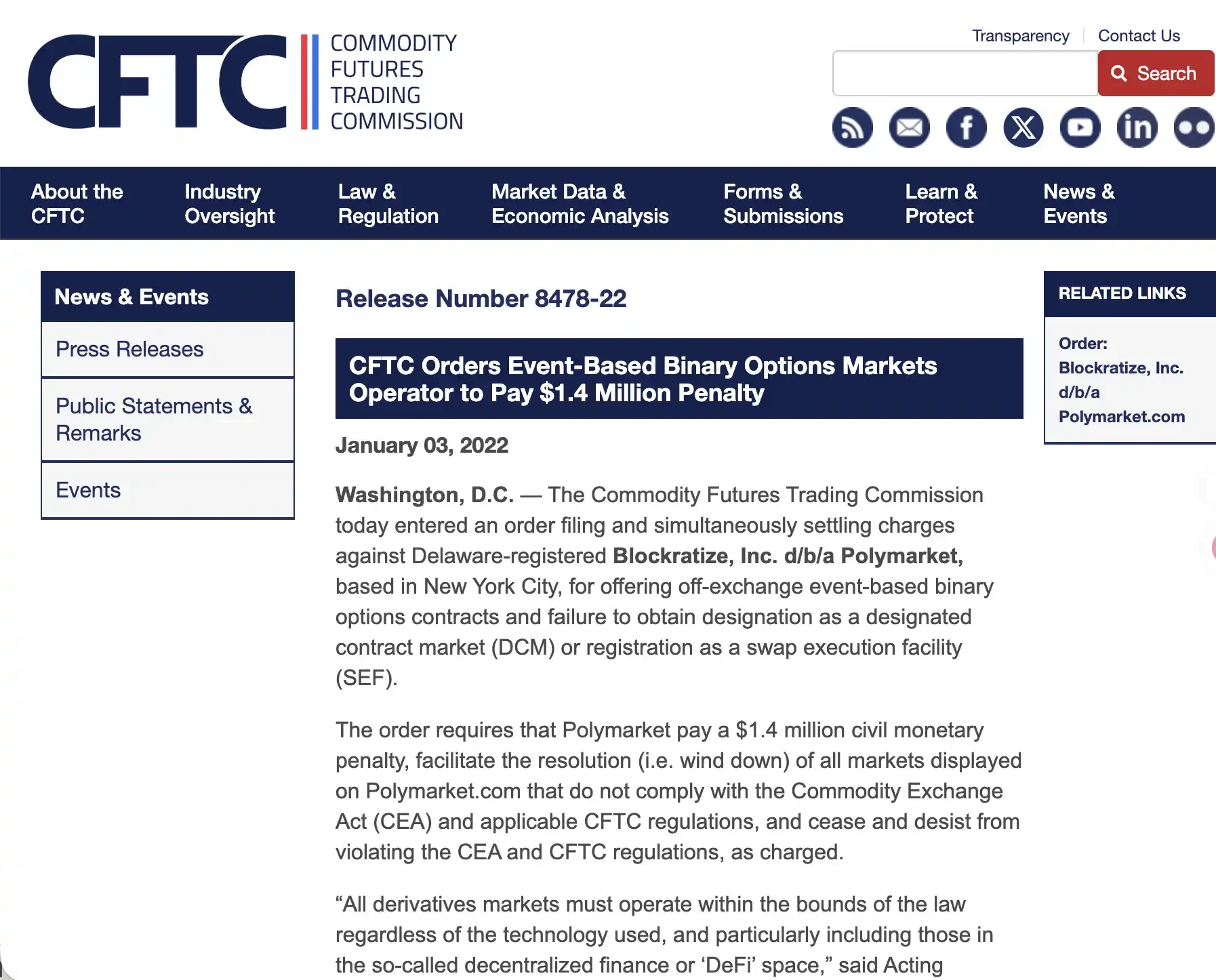
On January 3, 2022, the CFTC issued a cease and desist order to Polymarket, alleging that it operated unregistered event-based binary options markets—specifically, off-exchange binary options contracts not offered on a designated contract market. The penalty included a $1.4 million civil monetary fine, requiring it to wind down non-compliant markets and cease violations. The CFTC also noted that Polymarket received a reduced penalty due to substantial cooperation. At the time, Polymarket had offered over 900 event markets.
Following the penalty, Polymarket began geo-blocking US users.
A platform still operating out of New York, still run by its American founder, and still serving global political and financial events, was forced to move its core trading outside the US, even though many of the events discussed on the platform were still happening in America.
Exile and Explosion
After the CFTC penalty, Polymarket entered a strange state. It didn't die, but it was no longer whole. It kept running, serving overseas users, and continuing to list various markets, but it had lost its most crucial and symbolic home market.
For a New York-based company, this was an awkward position. It wasn't total failure, because the product was still alive; it wasn't true success, because US users were locked out. It felt more like an exile: the company was in America, but the product had to pretend America didn't exist.
In May 2022, former CFTC Chairman J. Christopher Giancarlo joined Polymarket's advisory board and became its chair. Giancarlo is known in crypto circles as "CryptoDad." The signaling effect of this appointment was clear: after being penalized by regulators, Polymarket began to build its compliance narrative.
But a compliance narrative couldn't immediately change its situation. An advisory board isn't a license, and a former regulator's name can't automatically open the US market. From 2022 to 2023, Polymarket entered a downturn. The platform operated purely overseas, and its scale shrank. By the end of 2023, its cumulative total trading volume was about $73 million. This number could still be discussed then, but compared to the explosion of the 2024 election cycle, it feels like a different era.
Doldrums are the hardest to write about and are easily overlooked because they lack a single reusable photo, a tweet that becomes a headline, or the drama of a regulatory raid. But for a startup, real fate is often determined in these times: no applause, growth not fast enough, the external narrative cooling down,