小红书的第二次大航海,这次驶向AI


- 核心觀點:小紅書正面臨AI顛覆其「生活經驗」護城河的生存危機,被迫加速將用戶積累的真實經驗轉化為AI驅動的工具與生意,但必須在商業化與保護真實內容生態之間尋求平衡。
- 關鍵要素:
- 小紅書的護城河建立在十三年來數億用戶沉澱的具體、帶有溫度且具個人化價值的生活經驗(如消費決策),每日搜索量近六億次,這是最核心的資產。
- AI的「預製菜」式答案雖簡化決策,卻會抹平經驗中具體的前提條件與猶豫過程,威脅其用戶信任根基;平台已採取AI治理措施(如清理AI代寫)以保護真實內容。
- 小紅書透過成立AI一級部門Dots、收購AI搜索產品點點、建設RED Skill工具平台等方式,主動將經驗結構化,意圖從「翻筆記」升級為AI直接給出客製化答案。
- 戰略投資轉向AI硬體(如雲望創新)與模型公司(如月之暗面),並取得支付牌照,旨在打通從用戶需求發現、決策到交易完成的完整商業閉環。
- 商業化數據(如面部精華決策週期29天)顯示其價值在於捕捉用戶的「猶豫時刻」,透過AI更精準地匹配廣告,讓廣告「住進答案裡」。
Author: Sleepy
At the end of 2022, shortly after the launch of ChatGPT, Mao Wenchao borrowed an employee's phone. He typed a question into the dialogue box: Will Xiaohongshu be disrupted?
Reportedly, from then on, he required his team to report AI progress every two weeks. A bi-weekly report suggests that the machine had yet to provide a reassuring answer.
In August 2023, he wrote in an internal letter that while chatting with foreign friends, he discovered that a vast number of questions people ask on ChatGPT revolve around life experiences – how to choose a product, how to use it, how to avoid pitfalls. This overlaps significantly with Xiaohongshu's core business.
However, he quickly added that this is because overseas markets lack such accumulated experience, while Xiaohongshu possesses it. This moat, he argued, would not be easily shaken by AI for the time being.
Previously, the term "moat" was mainly used by entrepreneurs pitching to investors, but this time, it sounded like he was reassuring his own anxious self.
That year, Xiaohongshu just turned ten. Its monthly active users exceeded 300 million. It turned profitable for the first time, with revenues of $3.7 billion and a net profit of $500 million. It was projected that profits would double the following year to over $1 billion.
In business history, companies die in two ways: from poverty or from wealth. Countless have died from poverty, which is unremarkable. Dying from wealth, however, always makes headlines. Kodak had money in the bank when it died. Nokia was still the industry leader.
Having money and surviving long are two different things. Affluence does not eliminate fear; it only transforms fear into a series of concrete actions.
In 2026, these actions intensified.
On June 8th, Xiaohongshu launched RED Skill, allowing a component to be attached under notes that can be copied and used by an Agent.
Earlier, on April 30th, it established the AI first-level department, Dots, consolidating models, infrastructure, and engineering products, reporting directly to the new President, Conan.
Even earlier, it acquired the development team behind the AI search product "Diandian" and obtained a payment license.
Names like MiniMax, Moonshot AI (月之暗面), and a string of AI hardware companies began appearing on its strategic investment list.
Over the past thirteen years, the consumption experiences, lifestyle habits, and daily judgments left in notes by hundreds of millions of users form Xiaohongshu's true foundation. Now that AI has arrived, it needs to reprocess these judgments—first into answers, then into tools, and finally into a business. If it doesn't want to wait for disruption, it must act first.
But can experience withstand such processing? To answer this, we need to go back to 2013, back to China's own Age of Discovery.
The Age of Discovery for Seventy Million People
In June 2013, Miranda Qu quit her job at a foreign company and co-founded Xiaohongshu with Mao Wenchao in Shanghai. Their first product wasn't an app; it was a PDF, "Xiaohongshu Overseas Shopping Guide."
That year, China's outbound tourist trips exceeded 70 million, equivalent to the entire population of France traveling abroad simultaneously.
The Europeans' Age of Discovery brought back spices, gold, and colonies. The Chinese Age of Discovery brought back cosmeceuticals, rice cookers, and travel guides. Though the items are mundane, human nature is the same – everyone wants to bring the good things from afar back home.
The world of foreign goods suddenly opened up. Duty-free shelves were crowded with tourists holding up their phones, with no one to tell them what was worth buying. The information gap was a goldmine. Whoever could first gather the experience of those who had been there would become the mine owner.
That PDF was posted on the website and downloaded 500,000 times in less than a month. Within months, it evolved into an app. A few years later, it found its way into the phones of hundreds of millions of people.
When facing a dilemma, Chinese people rarely consult a manual; they ask a person.
Fei Xiaotong wrote in "From the Soil: The Foundations of Chinese Society" that trust in rural society was not based on contracts but on familiarity. Apprentices learned from masters, new brides asked their mothers-in-law, and first-time city-goers sought out fellow townsmen. For millennia, experience was passed down this way, generation to generation. It wasn't fast, but it sufficed.
"Suffice" depended on two conditions: people living close together and life moving slowly. Over the past few decades, both conditions failed. Hundreds of millions left their hometowns to live in apartment buildings where they didn't even know their neighbors' names. The number of available goods exploded from a few hundred on the supply shelf to billions on e-commerce pages. It's hard to ask an elder who has never used a robot vacuum which model to buy. The "experienced one" hadn't had the experience yet.
The internet promised to solve this problem but only magnified it. People invented the internet to get information, only to find so much information that they dared not trust any. Because most online information comes from sellers, whose job isn't to help you judge, but to persuade you to spend. Judgment can only come from someone who doesn't make money off you.
Xiaohongshu aggregated the "I've tried it" experiences from hundreds of millions of strangers. A girl from Guangzhou writes that a certain foundation causes her oily skin to cake. A young man from Shenyang documents eleven pitfalls he encountered during home renovation. A mother writes about her weeks-long indecision between two types of baby food.
The authors are mostly unknown, not experts. Their writing is hardly rigorous, and it may contain sponsored posts or genuine mistakes. But these words have warmth.
Encyclopedias seek definitions; advertisements seek persuasion. These notes seek nothing. They are simply testimonies, flawed testimonies. Ironically, it is this imperfection that makes them most credible in the court of user opinion. A testimony too perfect seems rehearsed. Later, the industry gave this phenomenon a name: "Cao Zhong" (seeding/grassroots marketing).
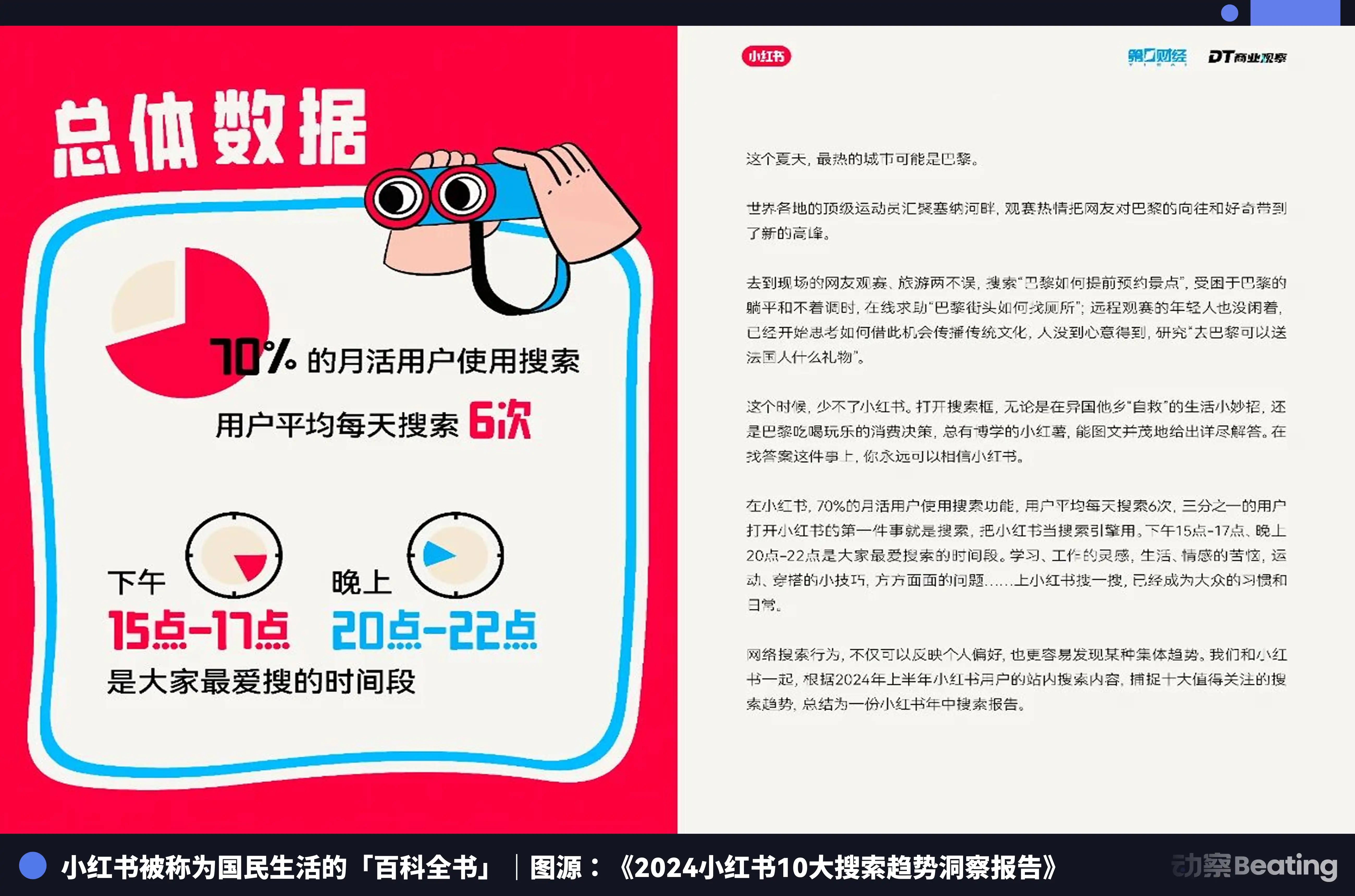
By the end of 2024, this app was processing close to 600 million searches daily. People rarely search for encyclopedic knowledge here; most search for life. Renovation, serums, travel guides. Search engines give you information; Xiaohongshu gives you others' experiences. Of course, this includes advertisements. It may not always provide the most precise answer, but people still look, because many questions in life don't have standard answers.
Behind those 600 million searches lie 600 million moments of hesitation—countless people scrolling through their phones late at night, unable to make a decision. This is Xiaohongshu's true foundation.
Then, AI arrived.
Patience Has Worn Thin
The thirty-year history of the internet is a history of diminishing human patience.
In the era of web portals, information was organized into directories; you had to find it yourself. The search engine era turned it into links; you had to click yourself. With news feeds, you didn't even need to search; algorithms fed you content. Each change chipped away at our patience. Now, with the AI generation, information is directly delivered as answers, and human patience has run out.
Don't blame the users. Human love for convenience is boundless. Wheels, elevators, remote controls – all were invented for this purpose. Once someone gets used to an AI chatbot, returning to the days of manually browsing through posts and filtering them is a tough sell.
Xiaohongshu's predicament is that its most valuable asset is the hardest to compress into a single answer.
In the past, people would browse twenty notes, compare, hesitate, and finally make up their own mind. This process was slow because you'd see three people praising it, two regretting it, and one reminding you the product is good but fragile. Someone writes that a hotel has thin walls but great breakfast. The comment is useful because it comes from a specific person. You can roughly guess what they care about and decide if their experience is relevant to you.
AI is like a pre-made meal factory: in goes the taste of life, out comes a standardized recipe. It's undeniably convenient, but the hesitation, the failures, and the prerequisites that it strips away are precisely the most valuable parts of experience.
Experience always sprouts from a specific person. Skin type, city of residence, budget – all these determine the usefulness of advice. The machine's answers lack these prerequisites, sounding like a slogan. And slogans can't help you pick a foundation.
Xiaohongshu understands this danger. Patience cannot be preserved. If that happens, its 600 million daily searches become merely the training data for someone else's model. It becomes a mine, an open-pit one, where anyone passing by can dig up ore.
So, it must act itself. It wasn't too late to start. From 2023 onward, it developed its own model, "Xiaodigua," launched the AI painting tool "Trik," and internally tested the dialogue product "Da Vinci." Most of these products didn't make a big splash, but they weren't wasted. They served as probes, helping Xiaohongshu figure out what AI could actually do for it.
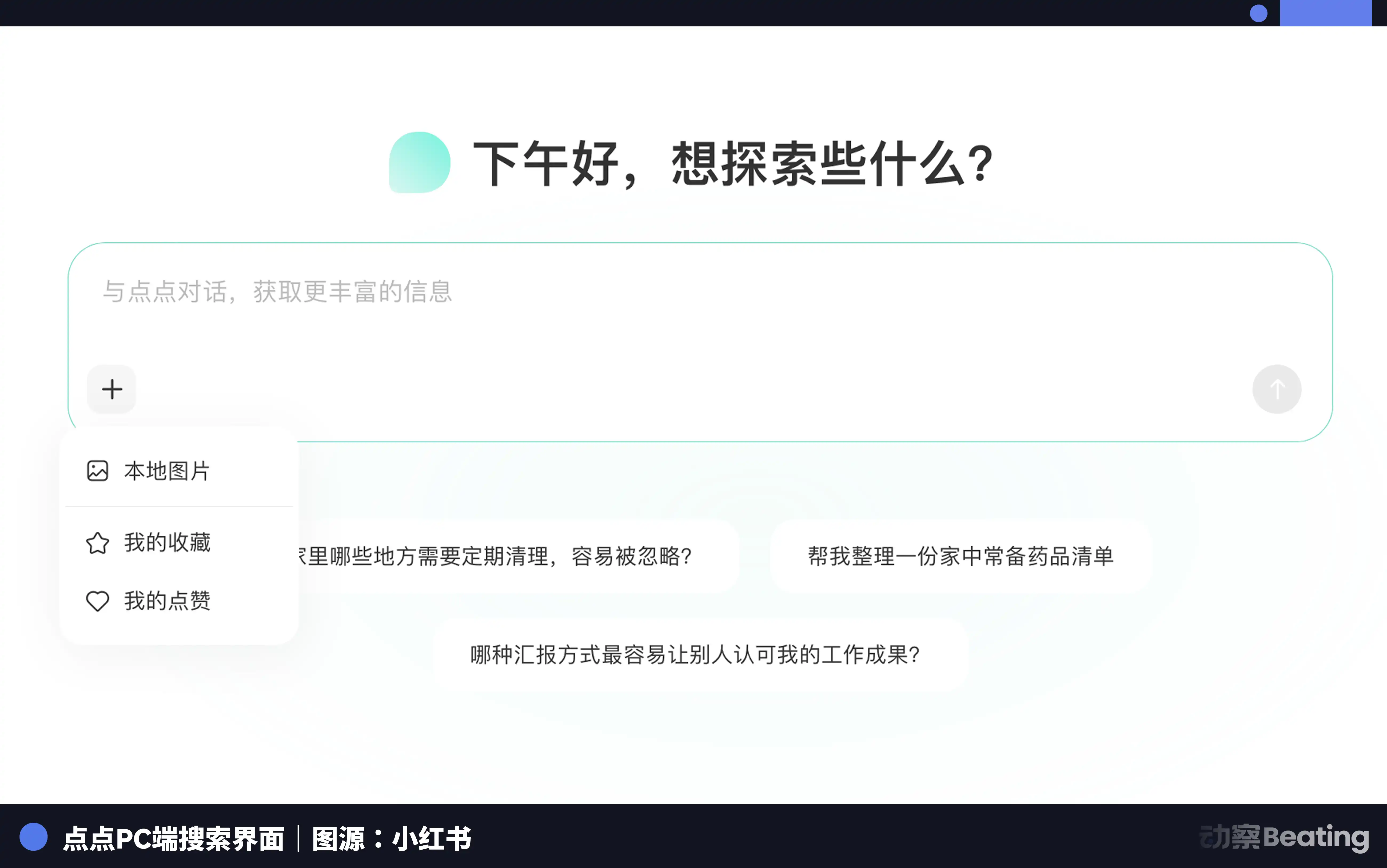
The true direction was charted by "Diandian." Focusing on life search, it merges in-app notes with web-wide information, accepting both text and voice queries. Xiaohongshu eventually acquired the company behind it. Diandian wasn't a blockbuster hit, but a scout's mission isn't to capture the city.
It scouted one crucial thing. In the past, searches started with a keyword, like handing over an address. Now, queries start from a situation, handing over a whole set of problems. People no longer just search for "Okinawa family trip." They ask, "How should I plan a five-day trip to Okinawa with a three-year-old, on a budget of 15,000 RMB, wanting to stay close to the sea?"
To solve these complex problems, Xiaohongshu has successively published research on multimodal retrieval and search understanding, and open-sourced the image editing model FireRed and the search agent framework REDSearcher. It has no intention of competing with tech giants for a seat at the table of general-purpose models. Others compete on parameters and benchmarks. What Xiaohongshu needs is to understand, deconstruct, and recompose the genuine human experiences scattered across text, images, videos, and comments into concrete, actionable suggestions. With the establishment of Dots this year, this line of work has moved from experimental periphery to core business.
Xiaohongshu wants to do the work of browsing twenty notes to piece together an answer for the user. But one answer only solves one problem. What it truly wants is to transform experience into a reusable capability.
Notes Grow Hands and Feet
This is exactly what RED Skill does. It turns experience from content into a tool.
Shortly after its launch, Xiaohongshu quickly promoted it with incentive programs and curated lists. 300,000 people started writing AI Skills. A PPT generation tool created by Guicang, which previously garnered over 10,000 stars on GitHub, saw tens of thousands of installations within days of its debut on Xiaohongshu.
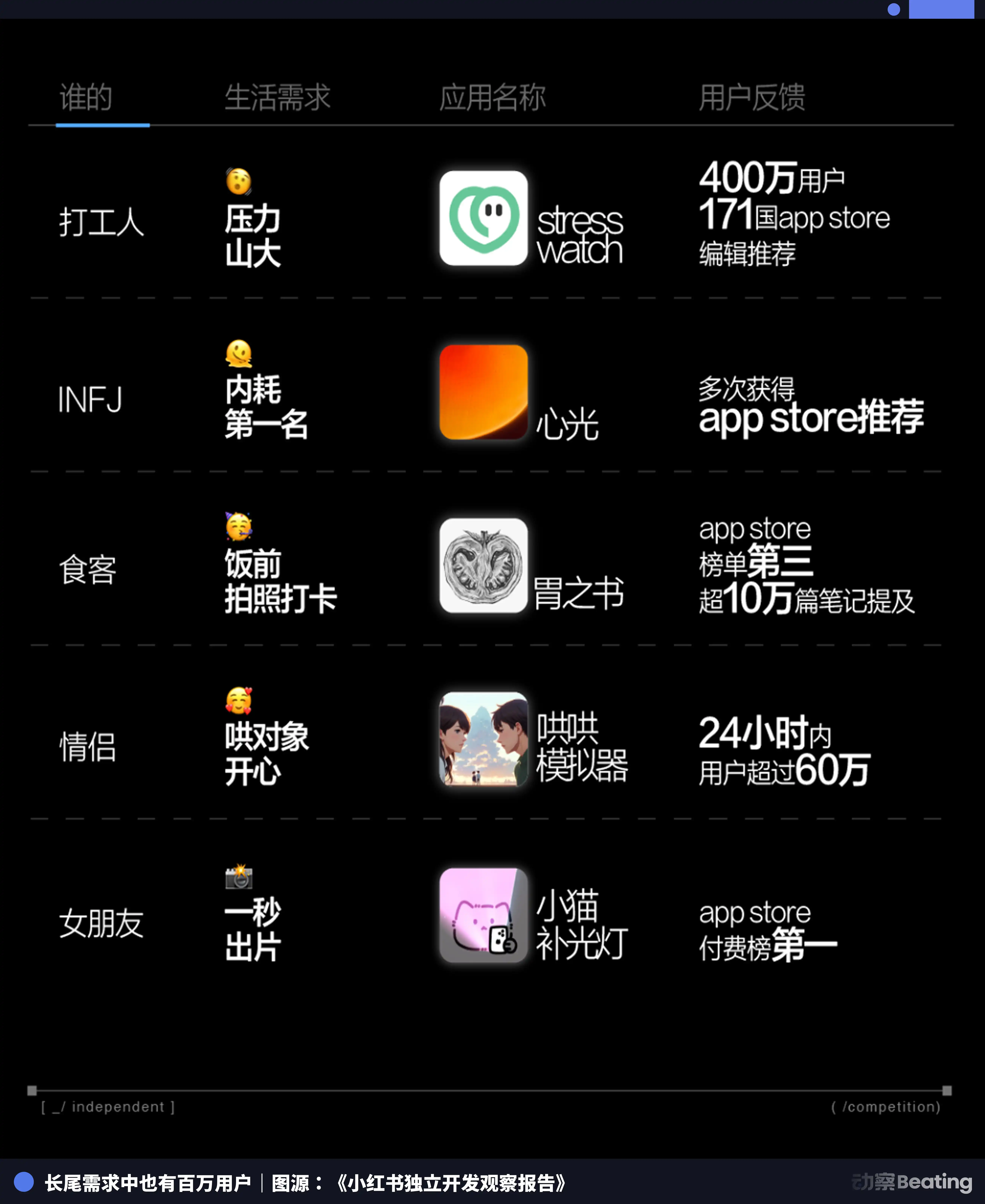
Earlier, last year's Independent Developer Contest received 1,355 projects. This spring's inaugural hackathon was a 48-hour closed-door event with a prize pool of 500,000 RMB. 60% of participants were born after 2000, the youngest being just twelve years old. Notes about "Building in Public" on the platform have now exceeded 1.1 million.
While these numbers are not yet proof of a mature ecosystem, they clearly indicate Xiaohongshu's ambition.
Previously, developers looking for a product launchpad would head to GitHub or Product Hunt. These places are full of peers and investors, but not necessarily everyday users. Someone might give you a star, someone might give you a valuation, but not necessarily an order.
Xiaohongshu is targeting this gap. Developers document their progress here. Users post feature requests in the comments. Bloggers share their hands-on experiences as notes. The platform then uses curated lists to aggregate initial attention. For an AI tool, writing the code is just the beginning. It needs to be tested, discussed, and translated into something ordinary people can understand and use.
Building tools might not be Xiaohongshu's strongest suit. But bringing tools into people's lives? It excels at that.
For thirteen years, creators on Xiaohongshu were storytellers – writing vividly, making trustworthy recommendations, building influence slowly. Users follow you because they trust you first. In the AI era, creators are starting to become craftspeople. Calling a scholar a craftsman might sound like a downgrade, but it's merely a change in the measurement system. A creator's weight now starts to be determined by how many people install their tools, how many times their tools are invoked, and how many tasks they actually help users accomplish.
For those who write notes, your experience was once only visible. Now, it can also be invoked. And if it can be invoked, it can be priced.
Reaching Beyond the Search Query
In December 2024, Dai Lidan, a partner at Capital Today, joined Xiaohongshu as Head of Strategy, tasked with establishing the strategic investment team. With a background in computer science from Peking University, she worked on Baidu Image Search and Baidu Maps before getting an MBA from Harvard and returning to Capital Today. She has walked the path of technology, product, and capital.
Before her arrival, Xiaohongshu's investments were mostly in consumer brands – M Stand coffee, Moody contact lenses, food, trendy toys, maternal and baby products – investing in the lifestyles of young people, the business it knows best. After she arrived, financial investments and strategic investments were separated, and the strategic investment team pivoted toward hard tech and AI. Xiaohongshu appears on the shareholder list of MiniMax. It was also involved in Moonshot AI's over $1 billion funding round.
Its bets are not limited to screen-bound AI.
In the Shenzhen Nanshan Science Park area, centered around DJI's headquarters, a cluster of AI hardware companies has formed. Starting in the second half of 2025, Xiaohongshu invested nearly ten startups here through its investment arm, moving quickly—sometimes closing a deal in a day or two—and willing to pay a higher valuation to secure a stake.
Two of these investments were made via its subsidiary "ShuNengShengQiao." One was in Yunwang Innovation, transforming the traditional foam roller into an AI massage robot capable of sensing where the body aches and adjusting its pressure and motion accordingly. The other was in Skyris, which makes companion robots that float on helium, interacting with users via wings, LED eyes, and voice.
The industry likes to call Xiaohongshu the "gateway for life decisions." These eight words look great on a PPT slide, but great-sounding words are often disconnected from reality.
A decision is already a very late stage in the process. When someone searches "how to use a foam roller," the need has already been vocalized. Before it becomes a search query, the need often has no name; it might just be a persistent ache in the shoulder, or the feeling of being home alone for three hours.
In the past, Xiaohongshu operated downstream, waiting for people to write down their life experiences. Now, it wants to move upstream, proactively seeking out needs that haven't yet turned into search terms.
In 2024, Xiaohongshu's parent company also acted as an LP in a fund under GSR Ventures, an early investor in Xiaohongshu itself. GSR discovered the company at a startup competition in 2014 and invested the following year. A decade later, the investee became the investor. With this fund allocation, Xiaohongshu gained a long-term channel to early-stage projects.
Of course, investing early doesn't guarantee accuracy. AI hardware has yet to prove it can scale commercially. Mass production, supply chains, after-sales service – each is a grueling challenge, and none are businesses Xiaohongshu is familiar with. The bigger headache is data. The device knows when your shoulders ache; the platform wants to know why you're aching, too. Knowing too little makes the product weak; knowing too much introduces privacy risks.
Yet, it must invest anyway. Its real fear isn't today. It's the fear that tomorrow, someone who is up late, unable to make a decision, won't open Xiaohongshu to browse notes, but will simply pose their question to another AI.
When Advertising Lives in the Answer
The story of Xiaohongshu cannot be separated from monetization.
On this platform, experience and commerce have always been intertwined. Behind skincare advice are skincare products. Behind renovation guides are building material suppliers. Users want to avoid detours. Merchants want to be seen. The platform wants to make money. Each desire is reasonable on its own. Together, they require a set of rules.
In November 2025, Xiaohongshu acquired a payment license (Dongfang Payment) through a subsidiary, filling the final missing piece.