






SpaceX 首次公開募股(IPO)首日攻略:別當成一般熱門股來炒


- 核心觀點:SpaceX IPO 首日並非普通股票交易,其低流通籌碼(約3%)和高散戶配售比例(約30%)將導致劇烈的雙向波動。投資人應放棄傳統技術分析,轉向以訂單流為主的交易策略,等待市場生成價格結構後再行動,長期判斷則需仰賴後續的供給測試。
- 關鍵要素:
- SpaceX IPO 定價為135美元,籌資750億美元,估值達1.7兆美元,但初期流通籌碼僅約3%,這會放大價格波動,任何適度的買盤都可能造成顯著衝擊。
- 散戶配售比例約30%,是正常水準的3至4倍,這增加了首日的不確定性:散戶既可能追漲,也可能獲利了結,形成第一波供給。
- 上市後的第15個交易日可能納入那斯達克100指數,這將帶來對價格不敏感的被动買盤,可能改變資金性質,並引發主動型資金提前卡位。
- 歷史上的熱門IPO(如Coinbase、Airbnb)顯示,高關注度不代表單邊上漲,它們初期往往經歷劇烈的雙向波動,更適合訂單流交易者而非趨勢跟隨者。
- 首次財報公布後將迎來股份解禁,後續在第70、90、120、180天及一年後均有分階段解鎖,長期投資者必須關注新增供給能否被市場消化。
Original Title: SpaceX IPO Day: What Retail Traders Don't See (The Orderflow Read)
Original Author: The Flow Horse
Original Compilation: Peggy, BlockBeats
Editor's Note: Against the backdrop of mega IPOs, AI narratives, and the repricing of risk assets, the market discussion surrounding SpaceX's listing is shifting from "how much is this company worth" to "how will it be traded after listing." But as SpaceX becomes one of the most closely watched tech assets, a more critical question emerges: On the first day of a new stock with no historical price, no mature options structure, and no clear distribution of shares, should investors understand it through a valuation framework or through market microstructure?
This article is a compilation of The Flow Horse's video content on trading strategies for SpaceX's IPO day. The focus is not on discussing SpaceX's long-term fundamentals but on dissecting the capital flows, float, index inclusion, and lockup expiry rhythm it may face in its initial listing phase. The video's author is a market trader with a long-term focus on IPOs and order flow trading, whose perspective is closer to the order book and trade execution than traditional company valuation analysis.
In this content, the SpaceX IPO is broken down into a set of more fundamental structural issues: It's not simply a question of "should I buy or not," but rather a process where traders, retail investors, passive capital, and internal shareholders reprice the stock within limited liquidity across different time windows.
First, retail investors are the most likely to misjudge the first-day trading environment. In the past, when retail investors traded hot stocks, they typically relied on trend lines, support and resistance, prior highs and lows, and opening momentum. But on the first day of the SpaceX IPO, there is no historical chart, no volume profile, no mature options structure, and before the first candle, the market has no reusable price memory. What truly determines short-term direction now is the order book, trade volume, VWAP, opening range, and where buyers and sellers form real turnover. This means retail investors who chase the first wave of the opening rally or prematurely use technical analysis to find so-called trends are most likely taking the highest risk before a structure has formed.
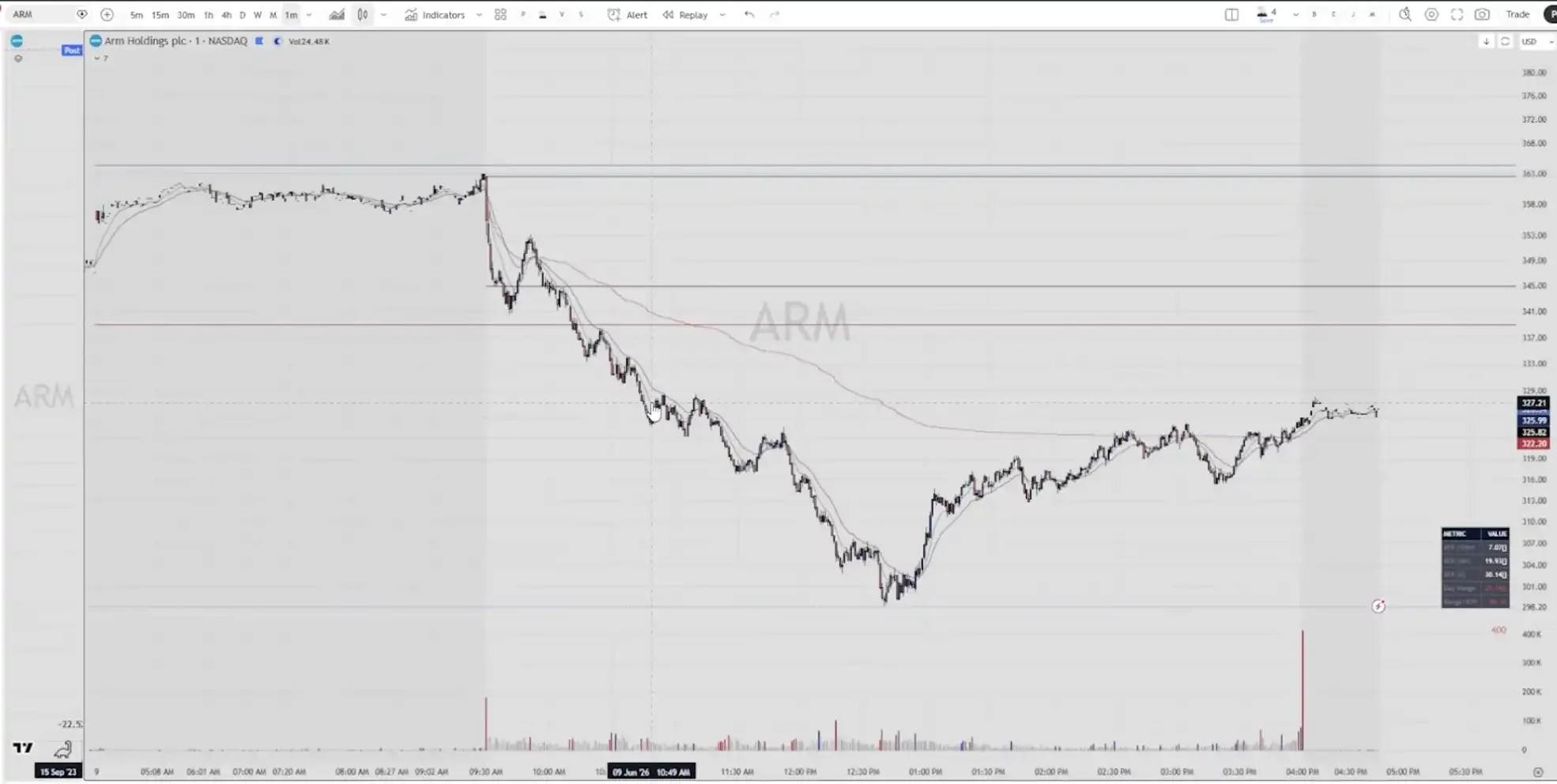
Second, past hot IPOs do not support the narrative of "inevitable one-way upward movement in the early days of listing." Coinbase, Airbnb, and ARM all generated immense hype, but they did not immediately provide a stable trend in their early listing days; instead, they first experienced violent two-way volatility. In the past, the market easily interpreted hot IPOs as the crystallization of consensus sentiment; now, a more accurate understanding is that they often first become a venue for repeated turnover between short-term capital, profit-taking positions, and new buyers. This means even if SpaceX has a strong narrative and high oversubscription, it does not mean the first week is suitable for trend followers. Those truly suitable for first-day participation are often traders who can quickly read order flow, control position size, and accept two-way volatility.
Third, the first-day strategy should shift from "predicting the direction" to "waiting for the structure to form." In the past, many traders habitually preset a bullish or bearish view before the open and then used the first wave of price action to verify their judgment. But for an IPO like SpaceX with a low float, it's more necessary to let the market draw its own structure first: Is there support near the $135 level? Is the 5-minute opening range effectively broken? Does the VWAP retracement hold? Are there continuously refreshing hidden buy/sell orders in Level 2? The core of trading now is not to be the first to draw a conclusion, but to judge who holds the initiative after the market generates its first set of price coordinates. This means the most important thing is not to enter as early as possible, but to avoid being forced into a trade at the most chaotic, widest-spread, and most emotional point.
Fourth, investors must understand that different stages are dominated by different capital. For the first 15 trading days, SpaceX is more like a short-term trade driven by low float, emotional capital, and order flow. Around the 15th trading day, the expectation of Nasdaq index inclusion may bring a second phase of price-insensitive buying. After the first earnings report, unlock supply begins to test market absorption. Further out, lockup expiries at 70 days, 90 days, 120 days, 180 days, and one year for major shareholders will gradually provide more reliable long-term signals. In the past, IPOs were often judged by whether the first-day gain or loss determined success. Now, SpaceX looks more like a series of consecutive liquidity tests. This means long-term judgments should not be based on first-day sentiment, but on whether prices can form a stable bottom after new supply enters the market.
Fifth, trading SpaceX may not necessarily only occur in SpaceX itself. Correlated assets in the aerospace and space economy, such as Rocket Lab and LUNR, may act as proxy stocks for capital expressing the same theme during the listing period. In the past, IPO trading usually revolved around the primary stock itself. Now, when the primary stock has too low a float, too high volatility, and too wide spreads, related assets might actually offer a clearer trading structure. This means the market is not just trading SpaceX's stock; it is also trading the industry narrative and liquidity spillover it activates.
If this article were compressed into one judgment, it would be: SpaceX IPO day belongs to traders; long-term judgment must wait for the supply test. For traders, the first day could be the "Super Bowl" of order flow trading; for investors, the first day's price move should not be over-interpreted. In this sense, the core question of the SpaceX IPO is no longer simply whether to buy on the first day of listing, but whether participants can first determine which game they are entering: Day 1 is about order flow; the long term is about supply absorption capacity. Confusing the two is precisely why most retail investors are most likely to lose money.
The following is the video content (edited for readability):
Why Most Retail Investors Might Lose Money in the SpaceX IPO
The most dangerous part of SpaceX's IPO day is that many people will treat it like trading any other popular stock.
Normal stocks have historical price ranges, prior highs and lows, volume profiles, and enough market memory. Traders can refer to past support and resistance, moving averages, options open interest, and cost basis. But IPO day is a blank chart. Before the first candle appears, the market has no real trading history.
This means drawing trend lines prematurely is meaningless, and chasing the first wave of a rally after the open is very susceptible to being stopped out by a counter-move. Especially in a low float environment, prices can spike quickly on temporary buying, but can just as quickly fall back on profit-taking or institutional supply. Retail investors looking only at price gains and sentiment are most likely to enter at the noisiest point.
The real trading logic on SpaceX's first day is the real-time formation of the auction mechanism (where buyers and sellers find a balance at different prices). Traders need to observe: Who is willing to bid up the price? At what level are sellers continuously replenishing? At which prices is there high volume but the price fails to advance? These order book signals are far more important than any pre-drawn technical pattern.
Trading Details: $75 Billion Raise, 3% Float, and High Retail Allocation
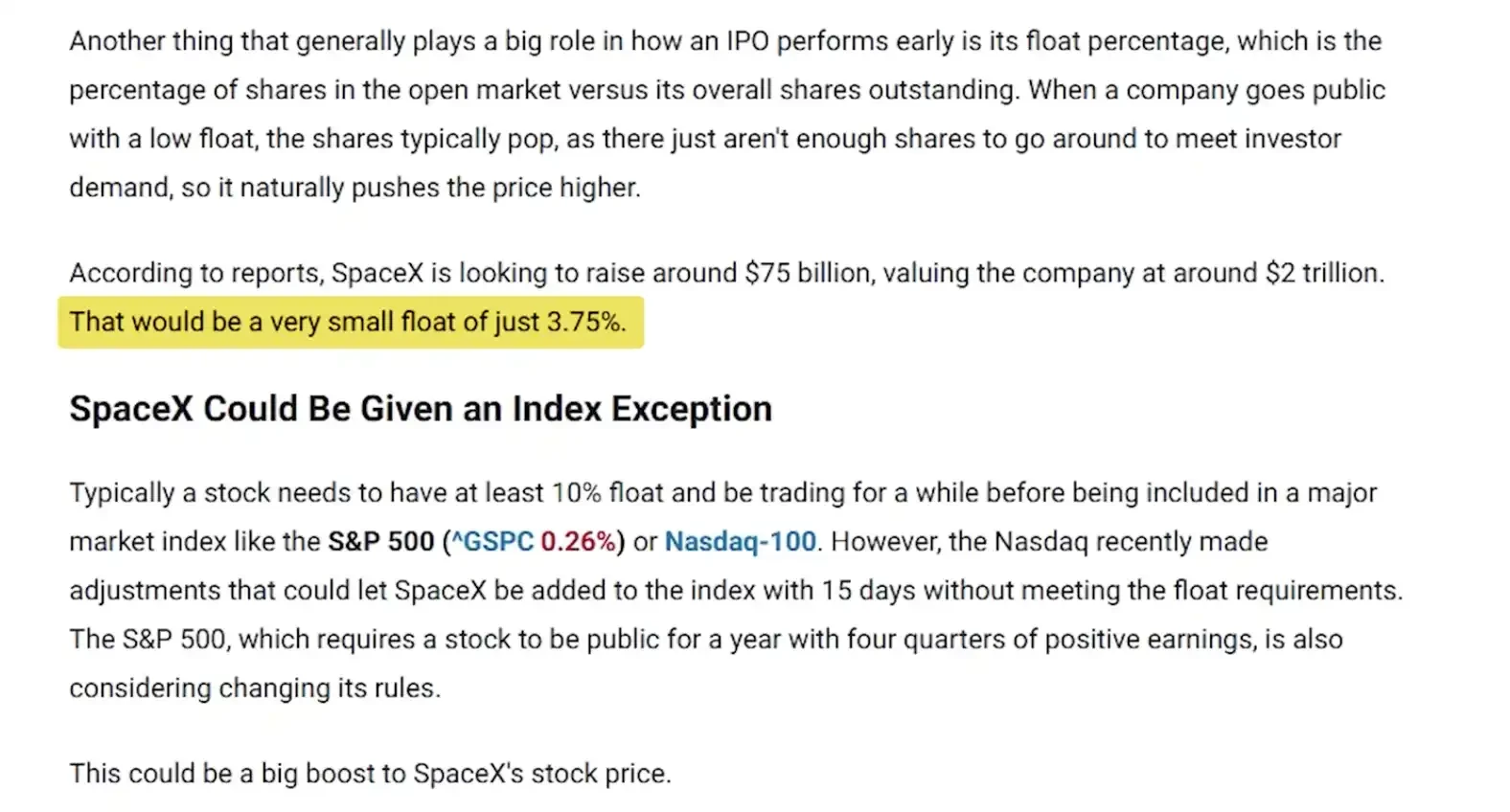
SpaceX's IPO plans to issue approximately 555 million shares, raise about $75 billion, priced at $135 per share, giving it a total valuation of roughly $1.7 trillion. This scale alone makes it a market-wide event.
But what truly determines first-day volatility is not just the raise size, but the float. Only about 3% of SpaceX's shares will be freely tradable in the initial listing period. This means even a moderate amount of buying can have a significant impact on the price. Retail chasing, active fund positioning, and small institutional purchases can all cause the price to deviate from fundamentals in a short time.
Another special variable is the retail allocation. This IPO's retail allocation could be around 30%, roughly 3 to 4 times that of a typical IPO. This makes post-open trading harder to judge. On one hand, more retail investors holding shares beforehand might reduce the "can't buy" FOMO buying pressure on the first day. On the other hand, these early allottees might also take profits immediately after the open, creating the first wave of supply.
Therefore, the core of the SpaceX IPO isn't simply judging "oversubscription is good," but understanding the share structure: an extremely low float amplifies both upside and downside, while a high retail allocation could make both first-day buying and selling more aggressive simultaneously.
Day 15: Nasdaq Index Inclusion Could Change Capital Nature
Another key date is the 15th trading day after listing. Under its current plan, SpaceX could be added to the Nasdaq 100 Index (NDX). This arrangement is still subject to final rules and actual results, but the trading logic it implies is very important.
In the early listing phase, the main price drivers are fast money, retail investors, active funds, and emotional capital. This capital is price-sensitive and enters and exits quickly based on volatility. But after index inclusion, the market introduces another type of capital: passive capital.
The characteristic of passive capital is that it is price-insensitive flow (capital that *must* buy due to index rules or portfolio requirements, not because the price is cheap). Index funds, ETFs, and related tracking products need to allocate according to the rules, making this buying more mechanical and easier for the market to front-run.
Therefore, before the 15th trading day, active capital might try to front-run (buying ahead of the deterministic buying). If SpaceX has already established upward momentum in the initial listing period, the mechanical buying from index inclusion could further amplify the trend. However, if the first two weeks are weak, this buying wave alone may not be sufficient to turn the market around.
This is another aspect that distinguishes the SpaceX IPO from a normal first-day trade: it's not a single point event but a sequence of capital flow nodes.
Day One is Order Flow Trading, Not Chart Trading
The most important judgment for SpaceX's first day is: don't treat it as chart trading.
Regular traders are used to asking: Where is support? Where is resistance? Where is the prior high? Where is the volume profile? Where is the options max pain? But on IPO day, most of these questions have no answer. No historical chart means no reliable technical structure; no mature options market means no reference for open interest.
The real questions on day one are: Where do buyers and sellers agree? Where is there a large amount of turnover? Does the price find buying support after breaking below the IPO price? Are there sellers continuously supplying shares during a rally? This is the core of order flow trading.
The first few key price levels must be drawn by the market itself on that day. First is $135, the set IPO price in the video. Traders should observe price action relative to $135: does a break below recover quickly? Can a move above sustain itself? If every dip below $135 finds buying support, it suggests this level could become an early cost anchor. If every attempt to stay above $135 is met with selling, it suggests stronger supply overhead.
Next is VWAP (Volume Weighted Average Price, representing the average cost of trading for the day). An hour into trading, whether the price is above or below VWAP, and whether it finds support on a pullback to VWAP, directly reflects who is in control between buyers and sellers.
Finally are the first-day high and low. After the close, the first day's high and low become the most important structural references for the following days. For a new stock with no historical chart, the first day's price range is the first coordinate system the market creates.
Four Types of Capital Flows Driving the Price
The price volatility during the initial phase of the SpaceX IPO can be broken down into four types of capital flows.
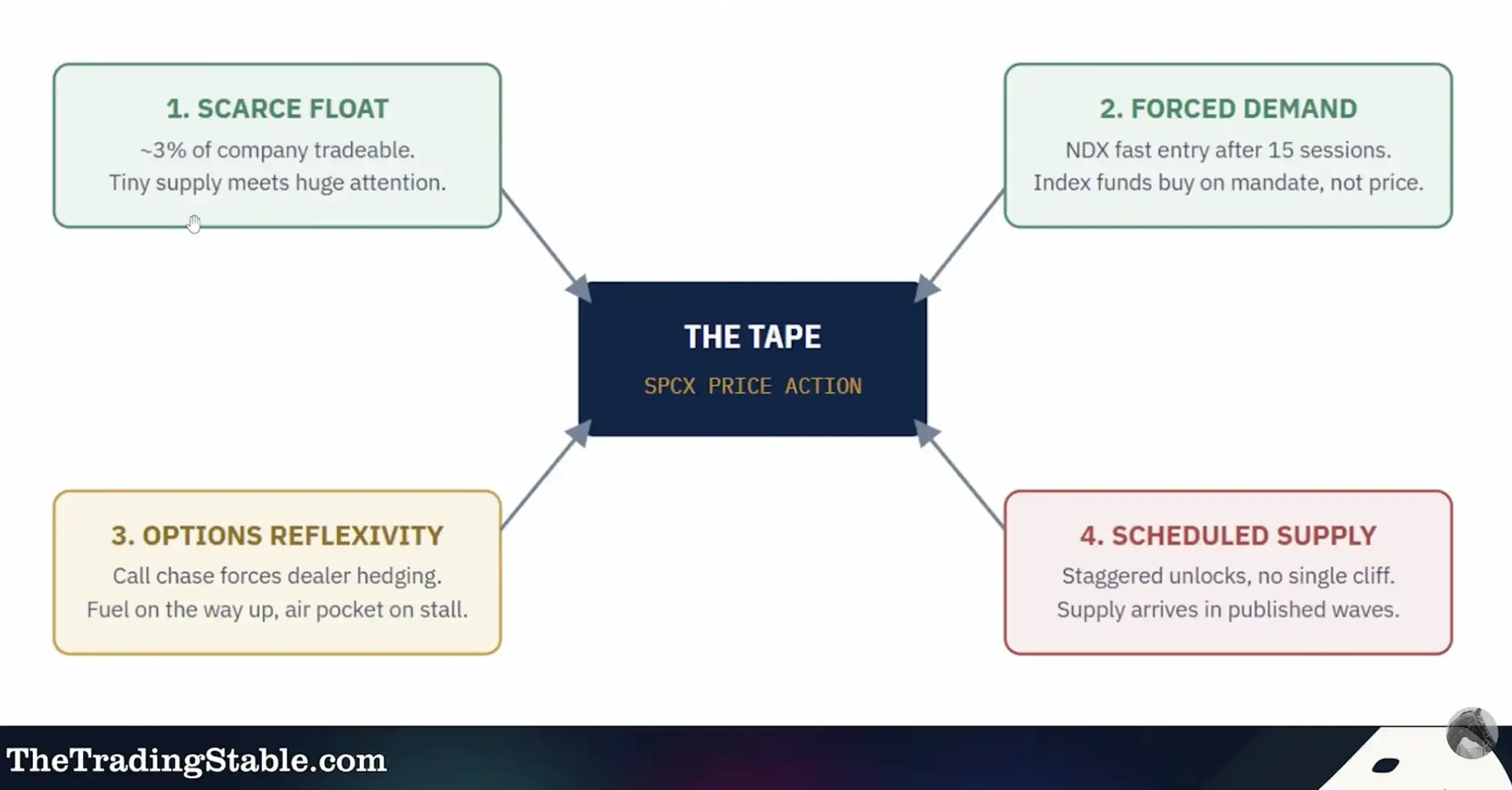
First is the scarcity-driven buying from the extremely low float. A 3% float means there are very few shares available for trading. A slight concentration of demand can push the stock price up rapidly. This is why shorting blindly on the first day is very dangerous. A low float stock won't necessarily go up forever, but it can most easily squeeze shorts in a short period.
Second is the passive buying from Nasdaq index inclusion. If included in the NDX on the 15th trading day, index funds and related products must buy according to the rules. This capital places orders based on index weight, not valuation. For bulls, this is an ideal mechanical demand. For short-term traders, it's a recognizable time window to trade ahead of.
Third is options reflexivity (where the options market feeds back and influences the underlying stock price). Once options start trading, if retail investors heavily buy call options, it may force market makers to buy the underlying stock to hedge, creating a gamma cycle (options buying pressure forces market makers to buy stock to hedge, further amplifying the rally). However, this mechanism typically doesn't appear immediately on day one and may not mature in the first week.
Fourth is share unlocks (restricted shares gradually entering the market). This brings new supply and is a risk all long-term investors must monitor. What's special about SpaceX is that it may not simply have one massive unlock after 180 days, but a phased release of shares.
Unlock Schedule: Not a Single Cliff After 180 Days
A common risk point in traditional IPOs is the end of the 180-day lockup period, when early investors and employee shares are unlocked en masse, suddenly flooding the market with supply. But the unlock structure for SpaceX, as described in the video, is more complex: it may not be a single cliff, but a series of phased liquidity events.
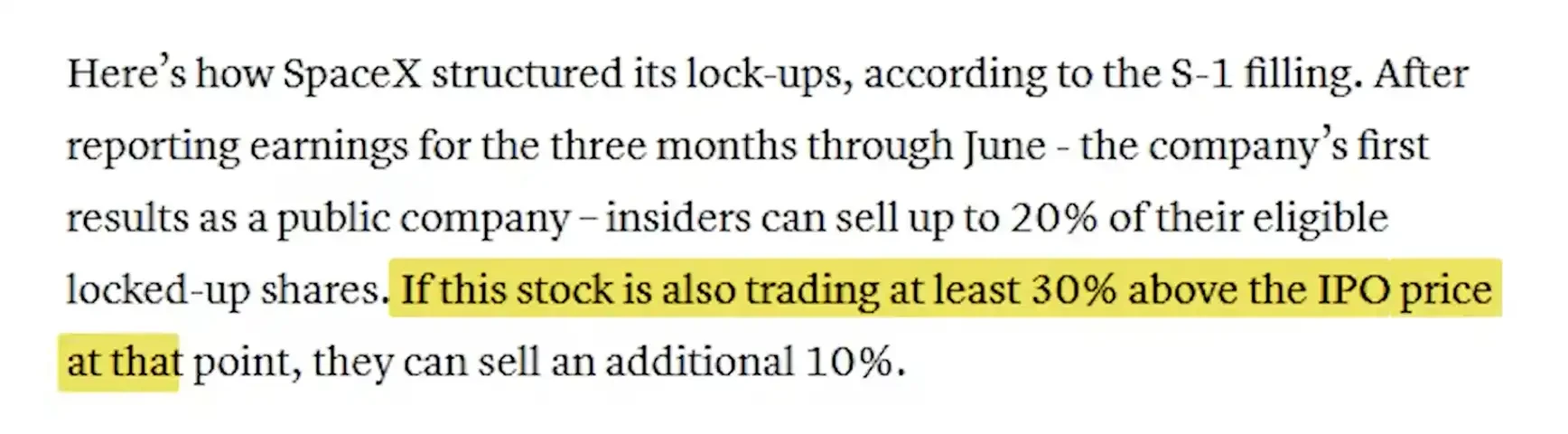
First, two days after the first earnings report, up to 20% of eligible shares could be unlocked. This means the earnings report itself is both a performance event and a supply event. If the stock price is inflated by sentiment before the earnings, the new supply post-earnings could dampen the momentum.
Second, unlocks may also be tied to price performance. If, in the 10 trading days before the earnings report, the stock price closes above $135 + 30% for 5 days, an additional 10% of shares could be unlocked. This type of arrangement causes the rally itself to trigger more supply, creating a dynamic equilibrium: the sharper the rise, the more sellable shares become available later.
Subsequent dates are equally important. The video mentions that around day 70, day 90, and day 120, approximately 7% of shares could unlock each time, with full unlocking after 180 days. Regarding employee shares, about 5% of employee holdings might be sellable immediately after the first earnings report, without any additional performance or price condition. Elon Musk and the largest holders would likely need to wait over a year, approximately 366 days.
These dates are especially important for long-term investors. Judging whether SpaceX has formed a true bottom cannot be based solely on the first day's performance, but on whether buy-side demand can absorb each new wave of supply entering the market.
Lessons from Past IPOs: Coinbase, Airbnb, ARM Didn't Start with One-Way Trends
Hot IPOs easily create an illusion: since market attention is high, the stock should just keep going up after listing. But the early trading of Coinbase, Airbnb, and ARM all show that hype does not equal a one-way trend.
The video mentions that these hot IPOs all experienced massive volatility in their early days. Early volatility for Coinbase was around 119 points, Airbnb around 53 points, and ARM around 22 points. The specific numbers aren't the point; they illustrate that the first days and weeks of hot IPOs are often periods of violent two-way trading, not stable trends.
This environment is more suitable for intraday scalpers (traders who profit from frequent small price movements) and order flow traders, not ordinary trend followers. Trend traders need structure, and the initial IPO phase is precisely when structure is most lacking.
SpaceX could be more extreme. It is already heavily oversubscribed, and a higher proportion of retail investors might receive allotments. This means that after the open, there will be both chasing capital and profit-taking capital; some will want to buy into the day-15 index inclusion expectation, while others will see the high hype itself as a selling opportunity. The crowding of bullish and bearish forces simultaneously often results not in a clean trend, but in high turnover, high volatility, and high noise.
First Day Trading Strategy: Wait for the Market to Draw Structure, Then Act
The first rule for trading SpaceX on day one is: don't chase the first wave of the opening.
The opening moment is usually when noise is greatest, spreads are widest, and sentiment is most extreme. Especially in a low float environment, the first upward move might just be a transient sweep of orders, and the first downward move might just be a sharp drop due to lack of liquidity. A truly tradeable structure requires waiting for the market to form.
The first observation point is $135. If the price breaks below $135 but quickly recovers and re-establishes itself above the opening range and VWAP, it suggests real support underneath. Conversely, if the price repeatedly tries to stay above $135 but gets sold back down, it


