






Hyperliquid 盤前合約爭議:說好的 SpaceX 股本數字,怎麼就不算了?


- 核心觀點: Hyperliquid 生態內的交易市場 TradeXYZ 正式確認,其 SpaceX 盤前合約 SPCX 不會進行股本 Rebase,其定價僅基於市場對 A 類普通股單股價格的預期,與公司總股本或市值無關,此前文件中提到的「118.7 億股」僅為教學範例。
- 關鍵要素:
- TradeXYZ 澄清其盤前合約是追蹤隱含單股價格的永續合約,總股本和公司市值均非輸入參數。
- 此前文件中出現的「118.7 億股」數字,官方解釋為教學範例,因引發誤解已被移除。
- TradeXYZ 確認未來在 SPCX 及所有市場中,不會使用、公佈或依賴任何基於總股本或市值的計算基準。
- SPCX 預計在 SpaceX 首次公開募股(IPO)後,切換至標準的外部預言機定價,價格將逐步收斂於公開市場交易價格。
- 社群爭議核心在於用戶已接受「118.7 億股」作為產品規則,官方的解釋變更引發了關於透明度與預期管理的質疑。
- 幣安等競爭平台曾對類似合約執行 Rebase,將股本調整至 130.8 億股,凸顯了不同平台之間產品邏輯的差異。
Original: Odaily Planet Daily (@OdailyChina)
Author: Azuma (@Azuma_eth)

Yesterday, Odaily Planet Daily published an article analyzing the reasons behind the significant price differences in the pre-IPO contracts for SpaceX on platforms like Binance, OKX, and Hyperliquid. For background, we recommend first reading: Why are the price spreads so large for SpaceX pre-IPO contracts across different exchanges?.
The article mentioned that when Hyperliquid previously listed the SpaceX pre-IPO contract, SPCX, via the ecosystem market TradeXYZ (through HIP-3), the documentation disclosed a share count of approximately 11.87 billion shares. However, this reference was later deleted, sparking community speculation about whether the market would subsequently undergo a Rebase.
- Odaily Note: A Rebase refers to correcting share data and corresponding position sizes based on real-world conditions. For example, on the evening of June 8th, Binance announced it would rebase its pre-IPO contract SPCX, adjusting the share count from the estimated 11.87 billion to the 13.08 billion shares disclosed in the latest IPO plan.
TradeXYZ Confirms: No Rebase!
Today, TradeXYZ officially responded to this matter.
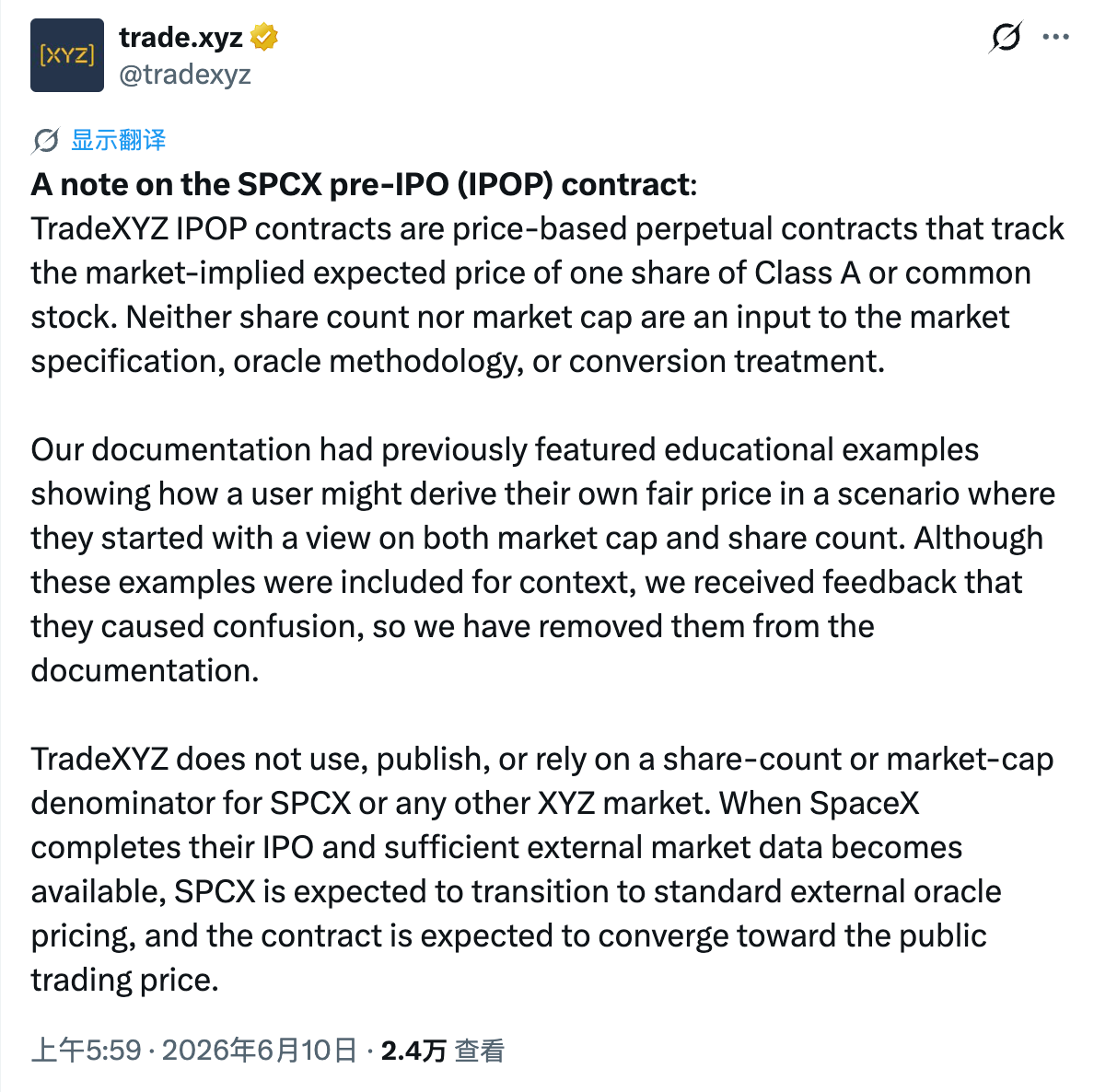
TradeXYZ stated that its pre-IPO contracts, including SPCX, are price-based perpetual contracts that track the market's implied price per share of Class A common stock (or common stock). The total share count and the company's market capitalization are not input parameters in the market rules, the oracle pricing methodology, or the final conversion mechanism.
Regarding the "11.87 billion shares" figure that previously appeared in the documentation, TradeXYZ explained that the earlier documentation contained some educational examples. These examples illustrated how users could derive a "reasonable stock price" given their own expectations for the company's market cap and total shares. They were intended only to help with background understanding. However, the team received feedback that this content could be misleading, and it has therefore been removed from the documentation.

To clarify, TradeXYZ confirms that it will not use, publish, or rely on any calculations based on total shares or market capitalization for SPCX or any other XYZ markets in the future. When SpaceX completes its IPO and sufficient external price data becomes available in the market, SPCX is expected to transition to a standard external oracle pricing mechanism. At that time, the contract price will gradually converge towards SpaceX's public market trading price post-IPO.
In plain terms, TradeXYZ has confirmed it will not correct share data via a Rebase. As for the previously mentioned "11.87 billion shares," it was just an example – they advise not to take it seriously. Going forward, TradeXYZ's pre-IPO contracts will not mention share data; they will simply track whatever the actual share count of the company is in reality.
Community Controversy: What happened to the stated numbers?
Unsurprisingly, this statement from TradeXYZ has sparked significant controversy within the community. The core reason is that for SPCX participants (especially those who only opened positions on Hyperliquid), the general expectation was that SPCX's pricing logic was directly linked to SpaceX's share count.
The "11.87 billion shares" figure was explicitly written in the official documentation. Early on, TradeXYZ also explained that if an investor expected SpaceX's valuation to be at a certain level and assumed a total share count of around 11.87 billion, they could derive a corresponding reasonable price range. Consequently, many users had already considered this part of the product's rules.
Now, the official team has deleted the data and claimed this content was merely "educational examples," which understandably gives some users a feeling of being "backstabbed."
Although TradeXYZ's statement today attempts to emphasize a different product logic – unlike platforms such as Binance and OKX, which map stock prices through market cap and share count, TradeXYZ prefers to view SPCX as an independent trading market where the price directly reflects market participants' expectations for SpaceX's future stock price, rather than a theoretical result calculated from share data.
However, it is not easy for the vast majority of users to understand the nuanced differences in product rules and designs across different platforms. Simultaneously, platforms like Binance and OKX are publicly discussing share counts, valuation mappings, and rebase mechanisms, naturally leading the market to apply the same logic to evaluate TradeXYZ and Hyperliquid.
The divergence between user perception and product design has ultimately evolved into this debate about product transparency and expectation management.
The Pre-IPO Contract Market: Will the Landscape Change?
Regardless of how this controversy ultimately concludes, the SpaceX pre-IPO contract has already become the largest and most closely watched "IPO rehearsal" in the history of the crypto market.
More importantly, with more unlisted star companies like Anthropic and OpenAI being brought onto blockchain-based trading markets, the pre-IPO contract track itself is entering a new phase of competition.
In the past, the competition between exchanges focused more on who could list a hot target first. However, following the SPCX incident, the market may start paying more attention to another aspect: who has clearer rules, whose pricing logic is more transparent, and who can provide users with a more stable and predictable product framework.


