加密 CEX 紛紛搶進美股業務,傳統券商迎來「不速之客」


- 核心觀點:加密交易所正積極布局美股業務,以因應自身流量困境並抓住美股溢出需求。Binance的「直連券商」與Bitget的「代幣化」是兩條主要路徑,後者透過提高資金效率和7x24交易,意圖與傳統券商爭奪全球主流資產定價權。
- 關鍵要素:
- 傳統美股需求旺盛,但非美投資者受監管和成本限制,加密CEX透過代幣化或直連券商入局,試圖解決真實流動性、滑價和資產權益等早期痛點。
- Binance模式透過介紹經紀商和券商基礎設施Alpaca提供真實美股交易,資產覆蓋廣但未深度整合生態,用戶資金效率較低。
- Bitget模式發行1:1鏈上憑證rToken,同樣接入真實美股流動性,並支援7x24交易、作為合約保證金和質押借貸,提升資本效率。
- 代幣化美股在非交易時段或極端行情下的流動性依賴造市商,可能產生價格波動;產品需證明託管透明並處理好分紅、拆股等公司行動細節。
- 加密CEX的核心優勢在於資金效率和生態延展性,能實現股票、穩定幣、加密資產共享保證金;挑戰在於產品體驗和合規邊界。
- 長期趨勢是傳統金融與加密金融融合,最終可能形成多資產金融平台,代幣化美股是加密交易所開始與傳統機構競爭全球定價權的重要一步。
作者:momo,ChainCatcher
Selling U.S. stocks has become a top priority for crypto CEX.
On one hand, the spillover demand from U.S. stocks is simply too tempting. The U.S. stock market has been persistently hot over the past few years, and investors outside the U.S. have seen surging demand for star assets like Nvidia, as well as upcoming IPOs from SpaceX and OpenAI. Traditional brokerages, constrained by regulatory uncertainties and compliance costs, struggle to efficiently capture this global investor traffic. However, with the SEC approving Nasdaq's pilot program for tokenized stock trading, and Wall Street's experiments with tokenization, it has become possible for crypto CEX to enter the U.S. stock market.
On the other hand, this trend also exposes the traffic challenges faced by crypto CEX themselves. The hotter the U.S. stock market gets, the colder the crypto market becomes, with no strong catalysts in sight to turn the tide in the short term.
However, the crypto industry has never determined winners during bull markets; it always reshuffles during crises and turning points. The worst of times often represent the best of times for crypto CEX. The major regulatory crackdown of 94 (Sept 4, 2017) cemented Binance's dominance, and today, the U.S. stock business might be shaping up to be the new dividing line for crypto CEX.
Looking at the recent accelerated push into U.S. stocks, there are primarily two paths: "direct connection with traditional brokers" and adhering to "U.S. stock tokenization." This article uses Binance and Bitget as representatives of these two paths, comparing their similarities and differences across over a dozen specific dimensions, and exploring whether these crypto CEX moves into U.S. stocks can eat into the market share of traditional brokerages.
1. Why Were Previous U.S. Stock Products on Crypto CEX Lackluster?
Before the formal comparison, let's briefly discuss why, after most major exchanges launched U.S. stock products last year, CEX platforms have recently rolled out new U.S. stock offerings again.
The previous generation of U.S. stock products mostly came in two forms: one was Contracts for Difference (CFDs), where users traded the price movements of stocks without actually owning the underlying shares; the other was integrating with RWA/tokenization platforms like Ondo, packaging U.S. stock exposure into on-chain assets and then placing them within the exchange's gateway.
These two approaches solved the "availability" problem but didn't fully address the "usability" issue.
CFDs are more like trading tools, suitable for short-term directional bets, but far removed from real stock assets. The early tokenized stocks, in terms of actual user experience, also had many pain points.
First, whether the underlying assets were truly U.S. stocks and their liquidity was the biggest concern for users. Additionally, there were many experiential issues. Bitget CEO Gracy Chen, when discussing the new generation of tokenized U.S. stock products, mentioned several common pain points reported by users of the previous products. For instance, excessive slippage on large orders made the trading experience feel less like buying blue-chip stocks and more like trading illiquid on-chain assets; dividend processing wasn't smooth, lacking synchronization on the token side when the underlying stock paid dividends; corporate actions like stock splits or reverse splits often left users confused about price and holding mappings.
Another issue was capital efficiency. Early tokenized U.S. stocks were mostly just a "tradeable asset." After buying, users generally had to hold them and wait for price fluctuations. It was difficult to use them as margin for contracts or unified accounts, and integrating them into the exchange ecosystem (e.g., wealth management, lending) was challenging. For crypto users, this undermined the composability and capital efficiency that tokenization should offer.
The recent CEX U.S. stock solutions largely focus on improving these pain points. Binance and Bitget's new moves represent two different paths. The former leans more towards direct broker connection and real stock trading, while the latter attempts to integrate real U.S. stock liquidity, tokenization mapping, and the exchange ecosystem through Reality/rToken.
Next, we will compare the details of the two solutions across several dimensions where users have experienced pain points.
2. Two New Paths for U.S. Stocks: Direct Broker Connection vs. Adhering to Tokenization
1. Product Underlying: What Exactly Are Users Buying?
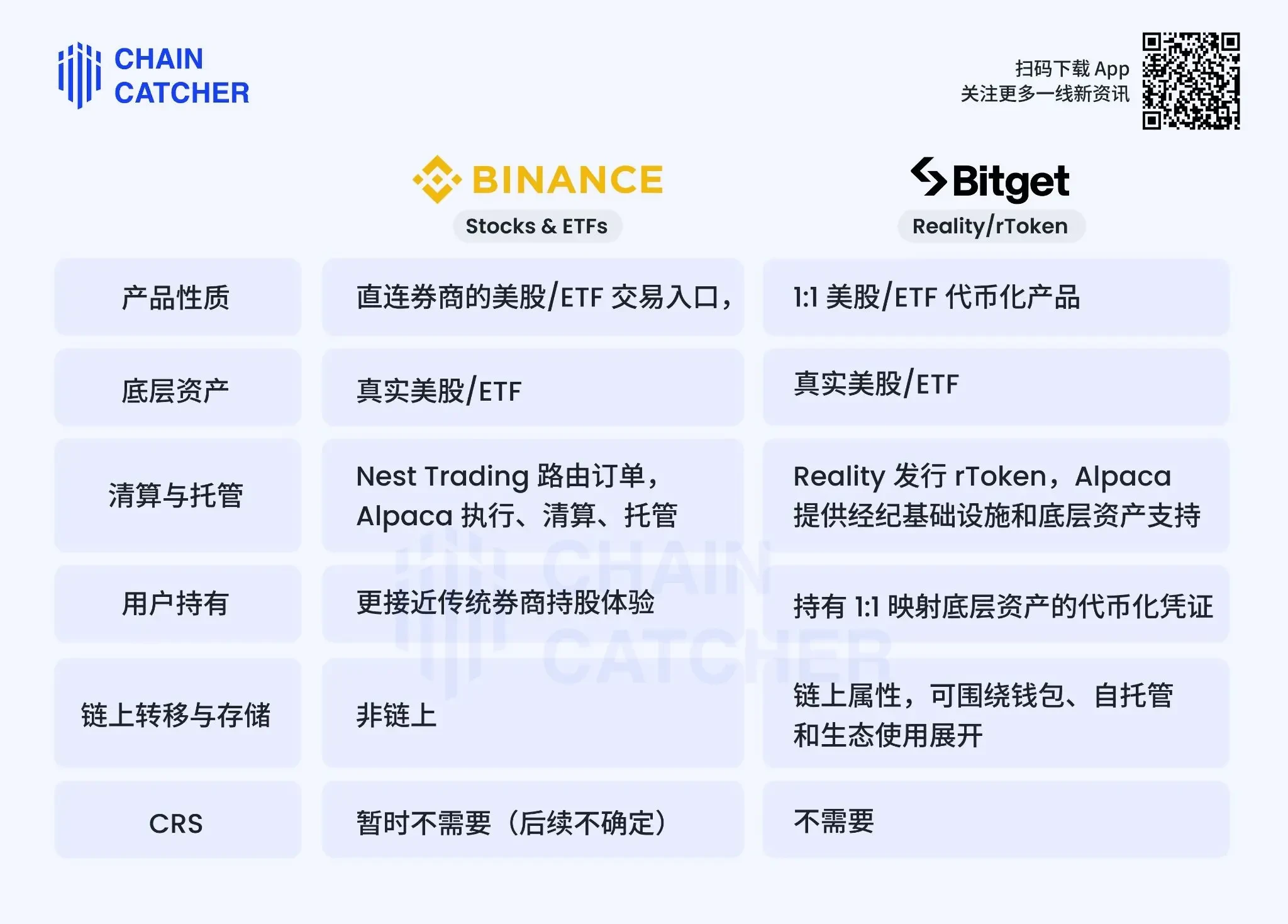
Both Binance and Bitget's current products have solved the fundamental issue of directly connecting to U.S. stock liquidity, and both utilize the underlying custodian Alpaca for this purpose. Alpaca is a compliant U.S. stock brokerage infrastructure, currently also supporting the underlying operations of other key tokenization players like Ondo Finance, Dinari, and xStocks.
Specifically, Binance takes the "broker gateway" route. Its U.S. stock business uses introducing broker Nest Trading to handle orders, with the backend connected to Alpaca for execution, clearing, and custody.
In contrast, Bitget takes the "tokenization" route. Users hold rToken, but orders are executed via Reality's on-chain desk directly connected to the U.S. stock market. The underlying stocks are custodied by Alpaca, with rToken serving as a 1:1 on-chain certificate. Therefore, the price and depth of rToken are not matched internally on the platform but are connected to real U.S. stock liquidity.
But since rToken is not the user directly holding stocks in a traditional brokerage account, where does the security guarantee for this tokenized certificate come from? Currently, Bitget's official response is that it is secured through three layers: custody by a licensed broker, independent asset segregation, and real-time proof of reserves.
Regarding CRS (Common Reporting Standard), Bitget's rToken currently does not involve CRS at the traditional brokerage account level. Binance's path is closer to a broker, and may be subject to regulatory implications later.
In summary, both solve the "are these real U.S. stock assets" question. Binance is more like a broker gateway, while Bitget tokenizes real assets into its on-chain ecosystem, emphasizing on-chain attributes and capital efficiency.
2. Asset Rights: Beyond Price Fluctuations, What Else Do Users Get?
For users, buying a U.S. stock isn't just about the price; it involves a range of rights and corporate actions like dividends, dividend taxes, stock splits, reverse splits, mergers & acquisitions, delistings, and voting rights. The closer the product is to a real stock, the less ambiguity there can be regarding these details.
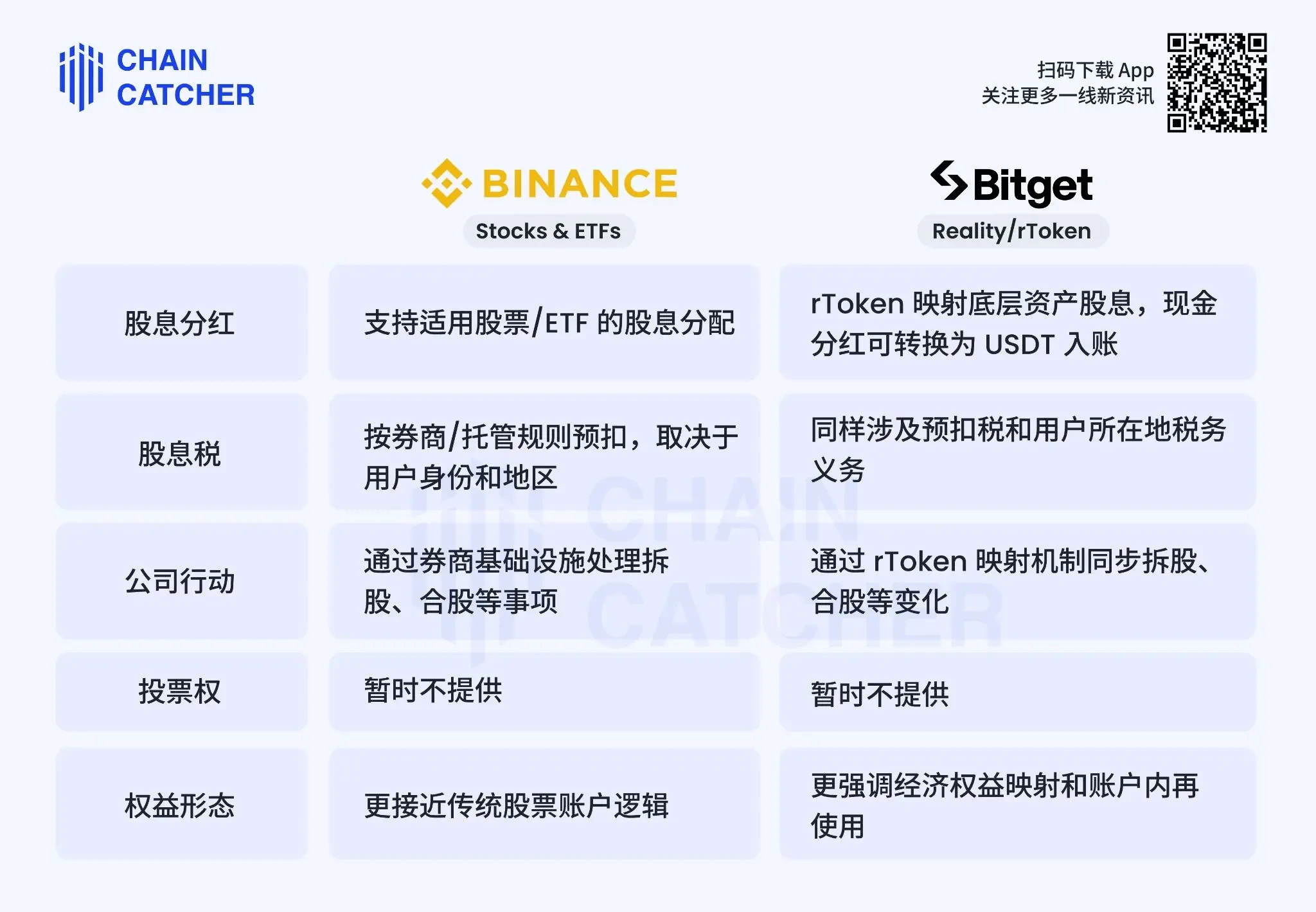
Based on public information, the latest solutions from Binance and Bitget are no longer just letting users trade a price symbol of U.S. stocks. Both are filling in the fundamental economic rights associated with real U.S. stocks.
Corporate actions like dividends, dividend taxes, stock splits, and reverse splits essentially rely on underlying brokerage infrastructure like Alpaca for processing. Therefore, in terms of these basic rights, the direction of both platforms is similar. As long as the underlying U.S. stock undergoes a dividend payment or corporate action, the platform needs to synchronize the corresponding results to the user's account.
The difference lies in the method of delivery. Binance reflects it more within the U.S. stock account, while Bitget maps it to the token side via Reality/rToken. Stock dividends are distributed 1:1 to the account in token form in real-time, while cash dividends are automatically converted to USDT and credited directly to the account.
Voting rights are also not a major differentiator. Whether it's the broker gateway model or the rToken model, under structures involving non-U.S. users, fragmented holdings, and platform nominee holdings, users typically do not directly enjoy the shareholder voting rights of the listed company. Voting rights are not a core selling point for these types of products.
The advantage of Bitget's tokenization approach is that it can achieve everything the direct broker connection model can regarding stock rights, plus it can further transform these stock rights into more efficient, transferable assets once they enter the CEX ecosystem.
3. Trading Experience and Capital Efficiency
Now let's look at the overall trading experience and asset efficiency.
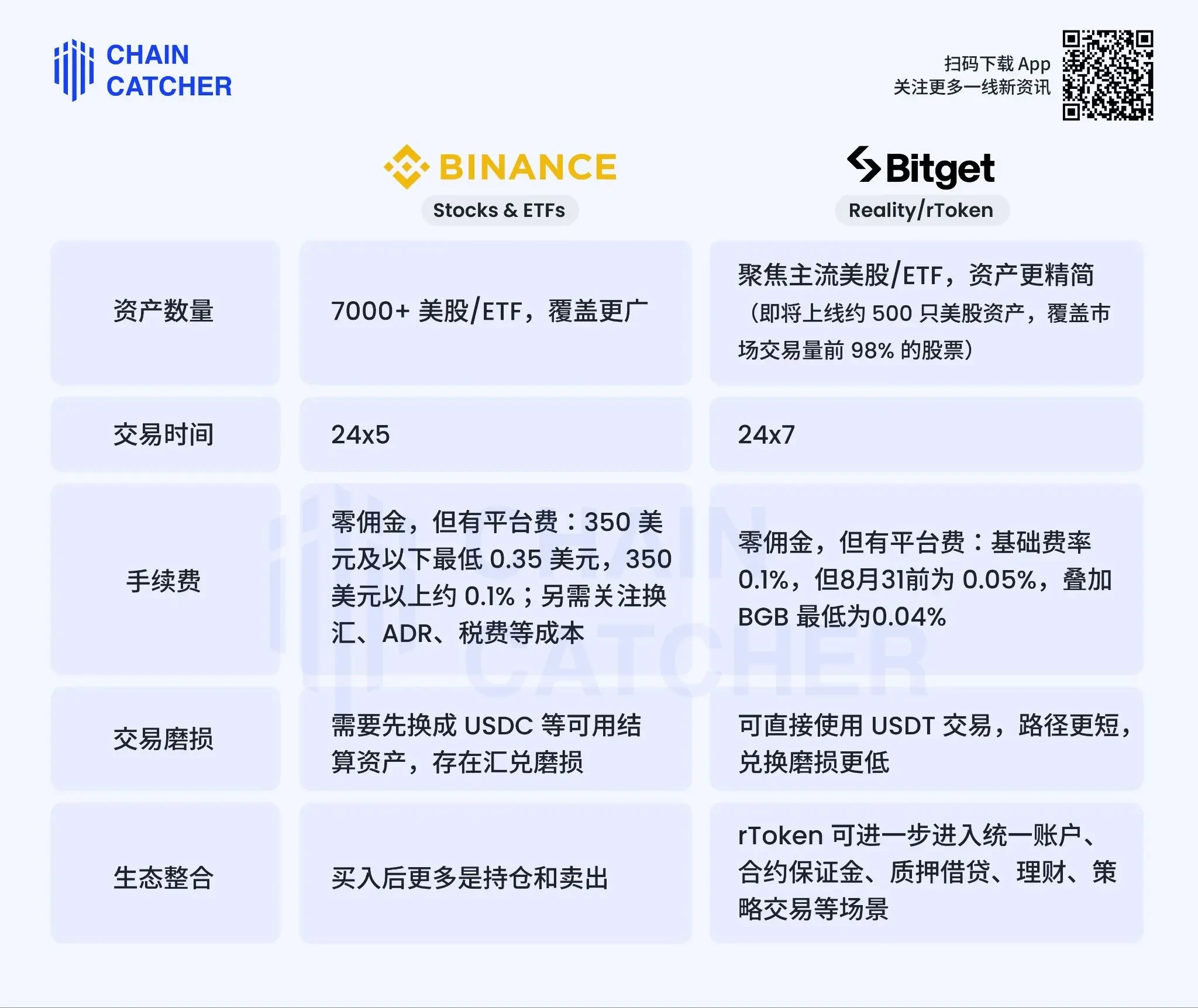
In terms of asset count, Binance offers wider coverage. Bitget focuses on mainstream stocks, planning to list 500 U.S. stocks accounting for the top 98% of market trading volume, emphasizing curation and liquidity coverage.
Regarding trading hours, Binance generally aligns with traditional U.S. stock market hours. Bitget, through tokenization, can offer 7x24 hour trading, which is more aligned with crypto user habits.
One might ask, where does liquidity come from when the U.S. market is closed? Bitget's CEO responded on Twitter that it is provided by third-party market makers who hold spot inventory to meet buy/sell demand. This means liquidity during non-U.S. market hours is not unlimited. One-sided buying during weekends or extreme market conditions could push prices higher, potentially leading to larger volatility when the market opens on Monday.
Regarding fees, Bitget's fees currently appear lower. While both offer zero commission, Bitget charges a platform fee with a base rate of 0.1%, reduced to 0.05% until August 31st, and as low as 0.04% when using BGB, making it more favorable for high-frequency users.
In terms of trading friction, when Binance settles with USDC etc., users holding USDT need an additional swap. Bitget directly uses USDT, providing a shorter path.
The most significant difference lies in ecosystem integration. Binance's current U.S. stock product is not deeply integrated with its ecosystem. Bitget's rToken, however, can enter the unified account system, be used as contract margin, staking, or lending, thereby improving capital efficiency. It currently supports tokenized stocks of 15 companies like Nvidia and Micron for use as contract margin.
Let's summarize the pros and cons of the two paths.
The biggest advantage of Binance's direct broker connection model is that it brings users closer to traditional U.S. stock trading. Because the underlying assets are real U.S. stocks with liquidity sourced from the real market, and its asset coverage is broader, it also offers stronger trust for users without crypto trading experience. However, the problem is that it's relatively simple, and user capital efficiency is not fully realized.
The advantage of Bitget's tokenization model is that it achieves the core benefits of direct broker connection (liquidity and dividends) while also improving capital efficiency. It allows users to trade 7x24, use tokenized stock assets as contract margin and in other trading scenarios, and offers lower fees. However, for more cautious users, directly holding the stock might feel more secure than holding a token. But it is expected that as Bitget refines the experience of these tokenized U.S. stocks, user concerns will gradually diminish.
3. Can Crypto Exchanges Eat the Lunch of Traditional Brokerages?
U.S. stock trading has never been just a competition among crypto CEX platforms. In the long run, crypto CEX will inevitably have to compete with traditional brokerages.
1. The Advantages and Challenges of Crypto CEX Selling U.S. Stocks Are Concrete
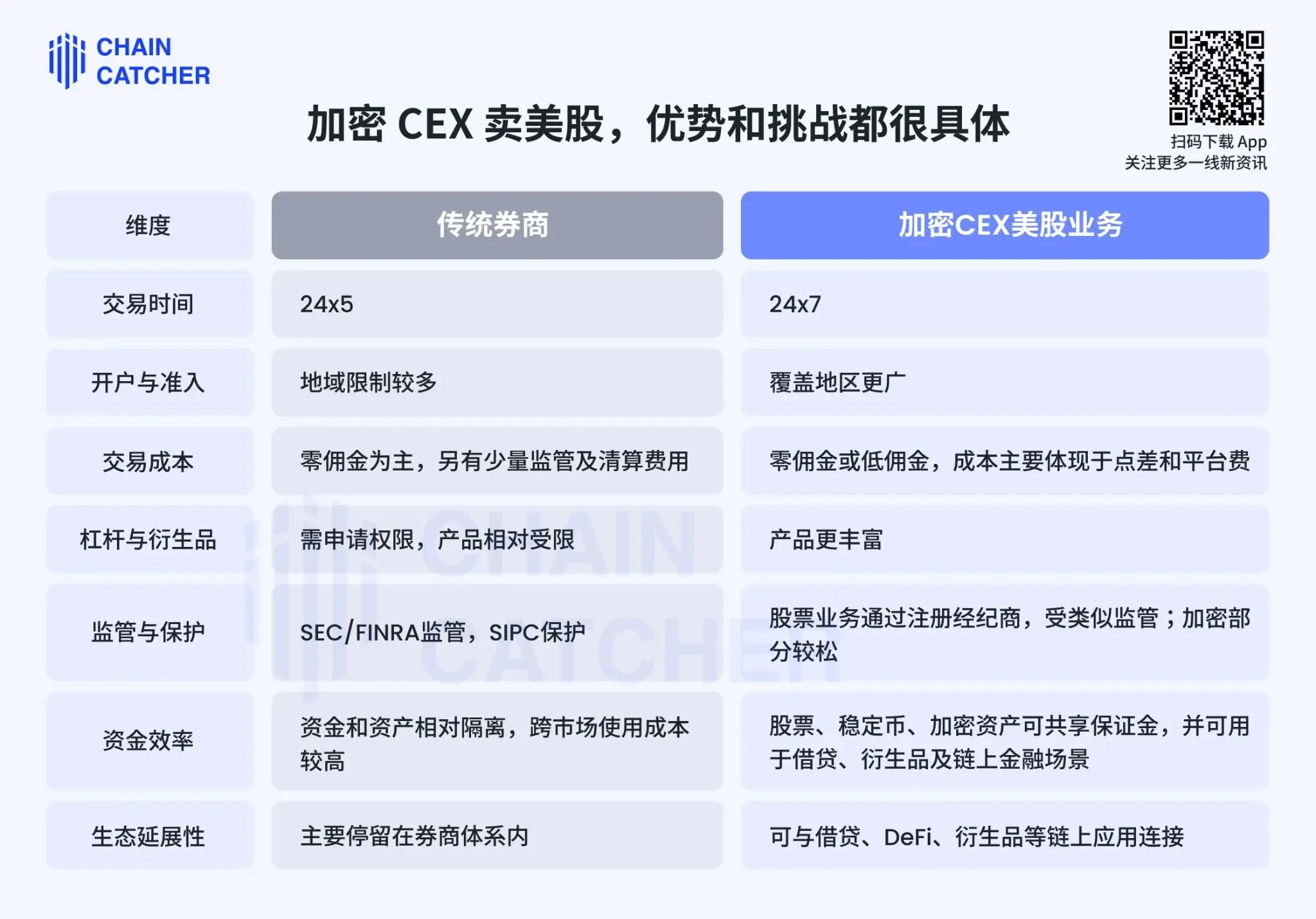
Looking at several key dimensions, the advantages of crypto CEX over traditional brokerages lie in these areas: trading hours – crypto CEX can achieve 24/7 trading through tokenization, better meeting investor needs. Account opening and accessibility – traditional brokerages face more geographical restrictions, while crypto CEX covers a broader global user base.
However, the core advantage lies in capital efficiency and ecosystem extensibility. In traditional brokerage accounts, stock funds are relatively isolated from other assets, making cross-market utilization costly. Crypto CEX, on the other hand, allows stocks, stablecoins, and crypto assets to share margin, and can be used for lending, derivatives, and on-chain financial scenarios. This is perhaps why Bitget insists on the tokenization path – bringing U.S. stocks on-chain, making them assets that are 7x24 tradable, collateralizable, and reusable. This is currently the strongest differentiator from traditional brokerages.
The challenges are also concrete. The closer a product gets to the real stock market, the more users expect CEX platforms to meet traditional financial product standards. Platforms must prove the underlying stocks are real, ensure custody and reserves are transparent, and meticulously handle details like dividends, stock splits, taxes, and liquidity. Especially for tokenized products, price stability and sufficient liquidity during off-hours or extreme market conditions will directly determine user trust.
2. The Endgame Might Not Be One Replacing the Other, But Both Moving Towards a Panoramic Exchange
Currently, the larger trend is that traditional finance and crypto finance are converging.
On one hand, crypto CEX are no longer content with just crypto-to-crypto trading. Binance has directly connected to a broker for U.S.