






Trump's 43 Minutes: Strongman Narrative Unravels, Media War Escalates


- Core Argument: By analyzing a press conference marking Trump's return to the public eye, the article reveals a loss of personal control and an institutional crisis. It argues that the U.S. President is expanding personal power by attacking the media and weakening the civil service, posing severe challenges to the survival of independent media.
- Key Elements:
- During a 43-minute press conference, Trump prioritized discussing trivial matters like the renovation of the reflecting pool and comparing rally sizes, while avoiding core issues such as health and military operations in Iran, exhibiting a paranoid and defensive stance.
- He signed an executive order removing job protections for approximately 8,000 senior federal employees, making it easier to fire them, further substituting institutional constraints and professional judgment with personal loyalty logic.
- The article parallels Trump's attack on a CNN reporter with the editorial independence crisis at CBS's "60 Minutes," pointing out that mainstream media are under dual political and commercial pressures, eroding their independence.
- The author argues that when media outlets compromise to pander to political power, independent journalists and creators become a crucial force in maintaining the public factual space, calling for support through paid subscriptions for independent media.
- The article notes that the House of Representatives passed a war powers resolution (215:208) to end military operations in Iran, with four Republicans defecting, signaling the beginning of cracks in Trump's party loyalty.
Original Title: A16Z's Global Mission
Original Author: a16z
Original Translation: Peggy
Editor's Note: This article chronicles the full process of Trump's reappearance in public after disappearing for over a week. Facing questions about his health, military actions in Iran, and cracks within his own party, he needed this appearance to reassert control. However, the entire speech kept deviating from core issues: from the renovation of the National Mall's reflecting pool, to comparisons with the crowd size at Martin Luther King Jr.'s rallies, to attacks on reporters, Democrats, and multiple American cities. The 43-minute press conference gradually devolved into a political performance filled with grievance and anxiety.
The article focuses on two main aspects. First, it exposes the state of Trump's personal disposition and leadership style. Through his humiliation of reporters, attacks on cities and political opponents, and the abrupt ending followed by staff quickly clearing the room, the author presents an image of a president who is out of control, agitated, and highly defensive. Second, it discusses the institutional changes revolving around Trump. It mentions that an executive order he signed will weaken job protections for senior federal employees, making it easier to replace more experienced civil servants based on political stance or insubordination. This indicates that professional judgment and institutional constraints within the government are being squeezed by a stronger logic of personal loyalty.
The latter part of the article extends the discussion to the media. The author argues that Trump's attack on a CNN reporter, along with the crisis of editorial independence within mainstream outlets like CBS, shows that American news organizations are under dual pressure from political power and commercial interests. When mainstream media begins to compromise with power, independent journalists and creators become a vital force for maintaining public truth. This is why the author repeatedly calls for supporting independent media.
While this article has a strong tone and clear political stance and mobilization appeal, the questions it raises are of practical significance: When power continuously attacks reporters, weakens the civil service system, rewards loyalty, and punishes dissent, can the public still obtain sufficiently reliable information? When the commercial interests of media organizations intertwine with political pressure, how long can journalistic independence last? Trump's appearance provides a window for observation, reflecting the deepening institutional tensions in American politics: the expansion of personal power, the erosion of media trust, the pressure on the civil service system, and the continuous contraction of the public truth space.
The following is the original article:
At 3:50 PM today, the President of the United States suddenly reappeared in public after disappearing from public view for over a week. He hadn't attended any public events since visiting Walter Reed Medical Center. Now, with bad news mounting and questions about his deteriorating health growing louder, Donald Trump had no choice but to show up. For 43 minutes, Trump and his supporters tried to project an image of a strong leader in control. But what the world saw was a paranoid man: praising an authoritarian leader as "my friend, a good man"; attacking a reporter as "a young, beautiful woman who never smiles," saying she has "hatred in her eyes"; while desperately maintaining the illusion that everything is under control.
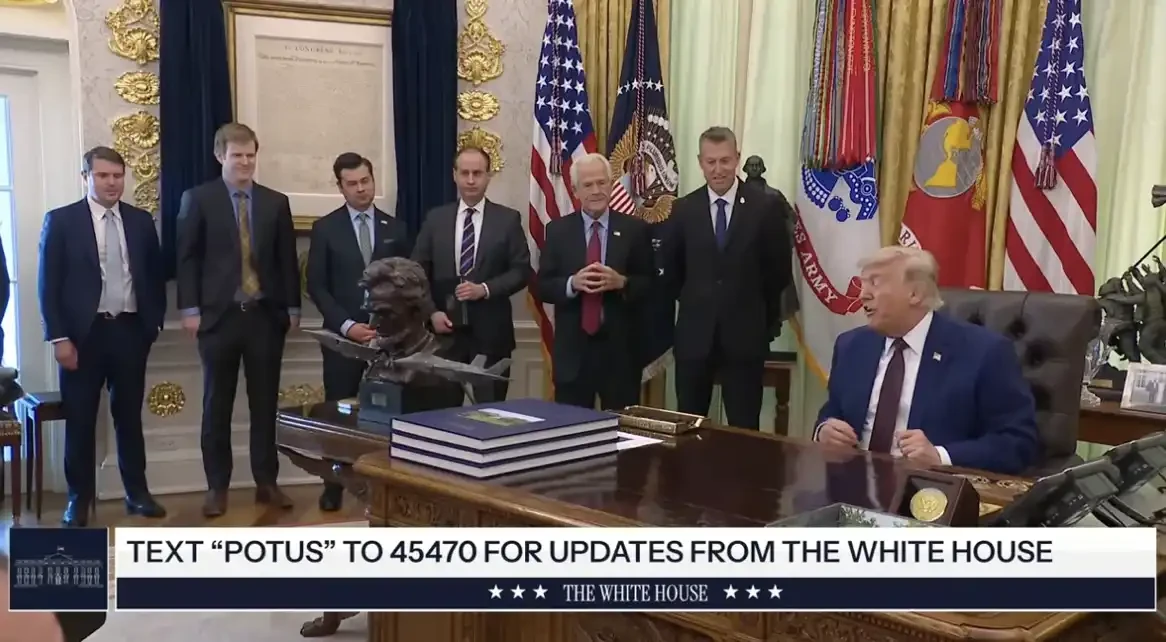
It all began with Trump's current favorite project: a picture of the reflecting pool. Before signing any documents or answering any questions, the president spent several minutes talking about the reflecting pool on the National Mall. He described its length, had staff bring pictures, and compared it to some of the tallest buildings in the world. He talked about the Empire State Building, the World Trade Center, and the Sears Tower, as if a flat pool of water could be stood upright like a skyscraper. He told the camera the pool would become "the blue of the American flag" and boasted about how many truckloads of garbage had been removed from it. This man, who had been out of public view for over a week, chose to start his reappearance not by addressing his absence, his health, or the crises facing the nation, but by talking about a pool.
Then, his rambling turned to the truly nauseating and most telling part. He began describing the location where Martin Luther King Jr. delivered one of the most important speeches in modern American history and used it to claim his own rally crowds were larger than King's. "They say he had a million people, and I only had 25,000," he said, then insisted that if you put two pictures side by side, "My people are more. They are denser. My people are denser."
For Trump, everything is a competition because everything stems from insecurity. Facing that reflecting pool, where Dr. King once spoke of justice, equality, and the unfulfilled promises of American democracy, the first thing that came to Trump's mind was crowd size. Not the speech, not the movement, not the courage it took to stand there in 1963 demanding America live up to its ideals. The only thing he thought about was whether he looked bigger. And the people standing next to him just nodded, smiled, and agreed.
Truly serious matters were buried beneath this absurdity. He signed two executive orders. One reshapes the customs enforcement system. The other removes long-standing job protections for about 8,000 senior federal employees, making them subject to dismissal at will. These protections were created to ensure government officials are accountable to the law, the Constitution, and the public interest, not to the personal commands of the president. Without them, ability will no longer be more important than obedience; dissent becomes a reason for firing; and those who should speak truth within the government will quickly learn their jobs depend on telling the leader what he wants to hear.
After that, everything returned to his personal grievances. He attacked the judge who ruled against him in the "anti-weaponization fund" case, calling the ruling from a "radical left-wing judge." He repeatedly portrayed himself as a victim, especially when talking about the search of his own home, seeking sympathy. When a reporter asked about the $1.776 billion "slush fund," he simply said: "I like it. I think it's very important."
Then, he began to reframe his war in Iran. After launching strikes against Iran without Congressional approval, he wanted people to believe it wasn't really a war at all. "It's not a big deal for us," he said. "We have a strong military. It's not a big deal for us." At the same time, he assured everyone that the stock market was soaring, retirement accounts were growing, and costs were falling. The war is insignificant, the economy is perfect. If your grocery bill shows otherwise, then you must doubt your own eyes.
Then his topic drifted to communism. He had posted about it earlier on Truth Social and was clearly quite proud of himself. The first post read: "Has anyone ever seen a happy communist?" The second was longer: "Communists are always popular with voters early on, or as they say, with 'the people'! But eventually, the country, state, or city goes to hell!" When a reporter read his own words back to him, he immediately perked up. "I just wrote that," he said. "Do you like it? Do you think it's well written?" He was desperate for praise. For a president, it was an awkward moment visible to the entire world.
Then came the familiar routine. He called New York, Los Angeles, and parts of California communist. He performed what he imagined a communist agitator would say in the first person: "You never have to pay rent again." "I'll end your mortgage." "I'll give you free food." "Follow me, and you'll have the greatest life." He played the villain in his own one-man show. He called the Governor of Illinois a "lazy man" and the Mayor of Chicago a "low IQ person." He went city by city, demeaning the country he leads, listing places he claims are failing, before once again casting himself as the only one who can save them.
Then, right in the middle of all this, he suddenly stopped. No conclusion, no natural ending. He was still speaking, still drifting from one grievance to another, and then abruptly said: "Thank you very much, everyone." Almost immediately, his staff sprang into action. "Thank you, media. Thank you, media." Reporters were ushered out of the room, the area was cleared. Trump remained seated behind his desk, his face blank, his shoulders slumped, seeming to sink into his chair.
We've seen this process before. Something shifts, the event ends abruptly. The room is cleared, staff move quickly, the same phrases are repeated, almost like a rehearsed signal. We don't know the trigger. It could be a medical issue. It could be a cognitive issue. But we know that this is not how normal press events end, nor how presidents typically conclude public appearances. And it happens often enough that those around him seem to know exactly what to do when it occurs.
Amid that long tirade, CNN reporter Kaitlan Collins stood there doing her job while he turned his fire on her. He called CNN "thoroughly dishonest," "a very corrupt organization," called the network garbage. He looked at her and said she "never smiles," called her "a young, beautiful woman" standing there with "hatred in her eyes." When she tried to speak, he cut her off: "Wait, quiet." He told her: "You should be ashamed of yourself." He repeatedly called Democrats "the Dumbocrats." Then he said something I can't forget. Speaking about Democrats, and then about her, he said: "They have a problem. You have a problem too."
While he was saying others had problems, he was sitting there, gripping his right hand with his left, holding it down. His face was puffy, his right eye sometimes so swollen he could barely keep it open while walking. His speech would become slurred, then suddenly clear up. He would erupt, then go flat and monotone, then erupt again. As a human being, it's hard not to feel embarrassed for him watching this. But as an American, it's harder: thinking of everyone who has fought for this country, and realizing that after nearly 250 years of democratic self-governance, this is the leader we are showing the world.
We have to ask why. With bad news mounting, members of his own party publicly breaking from him, questions about his health growing louder by the hour, why did he spend his first public appearance in over a week attacking a reporter for not smiling? The answer is simple. He is trying to discredit the very people whose job it is to tell us the truth, because what is happening is too damaging for him. If he can make us stop trusting the media, then what the media reports doesn't matter anymore. That's the whole game.
We must understand this game because it goes far beyond one reporter and one bad afternoon. When the authoritarian can no longer reliably deliver his own propaganda, when the man himself starts to slur his words, lose his train of thought, and get hurried out of rooms, the machine around him does not stop needing propaganda. It just needs someone else to deliver it for him. So it reaches out to seize the institutions that should belong to everyone. It takes over the media.
We saw this at CBS this week. Scott Pelley, who worked for the network for 37 years, was fired. The day before, at an employee meeting, he accused new management of "murdering this program" – referring to 60 Minutes, known for its accountability journalism. Then, he released a written statement confirming many of our worst fears. He said new management asked him to include false content and bias in a politically sensitive story. He said he was asked to incorporate unverified claims and had so far refused. He said politicians were being invited to choose which reporters interview them. He also said the network's new owners were casting aside the program to, in his words, "curry favor with the Trump administration of the moment."
CBS is gone. Its independence and credibility are gone with it. We will likely lose CNN too. They won't stop. We will continue to lose these mainstream media outlets one by one because the people who own them have done the math. It's easier to make money telling people what the strongman wants them to hear than it is to tell them the truth. The truth has no oligarch behind it; lies have a bottomless purse. Those in charge of these companies have seen how this president rewards loyalty and punishes others, and they have decided to take what they can while they can, even if they don't believe it will last. They don't care if it lasts, they only care about the immediate moment.
So, this work will increasingly fall to those without deep pockets. Independent journalists, investigative reporters, writers, and creators, especially in dark times, they still show up every day, often paying a real price for it. Our country cannot survive if these voices are silenced, because a nation whose people don't know what's happening to them is not a free nation. You can already see the consequences of a lack of awareness. Many people around us have no real conception of what is actually happening. And those actively seeking the truth increasingly find only the version someone paid to feed them.
When I started writing these articles, I made a promise: every time this government attacks the media, attacks the First Amendment, attacks the right of the American people to hear truth to power, I will call it out. Today, Trump did exactly that. And I am calling it out. This is an attack on our right to know, an attack on our right to understand how this government is dismantling our country. He sent a direct message to every journalist and member of the media: I'm coming for you, too. To the public, he said: You cannot believe anything the media tells you. Our response must be that we will not back down, and we will support those who are still speaking out, still reporting the truth.
The way to navigate this history is to match our money with our voice. Every time this government attacks the First Amendment, we respond by funding those who defend it. This is the most direct form of resistance we can take right now. Independent media is how the truth survives when every other system is captured. I have been writing every night for a year, with no corporate support and no sponsor money. No one can reach into my articles and change a single word. Every article I write is free for everyone because the truth should not be locked behind a paywall. But all of this is possible because some people choose to support this work through paid memberships, because they understand what is happening and choose to support it. Thank you for standing with me in resistance.
Tonight, I ask you again, don't just think of my voice. Think of every writer, journalist, podcaster, independent outlet you turn to when you need the truth. Think of those still enduring relentless attacks in their email inboxes while facing even greater pressure from the federal government. Think of those who continue to speak out even when it comes at a great cost. Because what this government is trying to build requires our silence. And our most powerful act right now is to ensure that those who refuse to be silent can continue to persist. Every paid subscription supporting an independent voice is a vote against Trump and the actions of his supporters.
And the reason Trump is growing increasingly desperate is because on this very day, the same day the President attacked a reporter and her network, the House passed a war powers resolution demanding he end his war in Iran. The vote was 215 to 208. Four Republicans crossed party lines to support the resolution.
It still needs to pass the Senate. Procedurally, it is largely symbolic. But that's not the point. The point is that members of his own party have finally openly broken ranks and voted against him. This is Trump's greatest fear: disloyalty. Someone said no. Someone realized they should be more afraid of their constituents than they are of him. This is precisely what made that man so agitated during today's event.
Because that is exactly what he is doing now. He is pushing people past a tipping point. This man's cruelty, his paranoia, his growing intolerance for even the slightest hint of disloyalty, is costing him the people who once protected him. They watch him slur his words, lose his train of thought, lash out in all directions, and they start to do their own cost-benefit analysis. So, one by one, they begin to pull back. That is why I still have hope for America. You should too.


