






“无限印钞”漏洞潜伏四年,隐私币ZEC一日腰斩


- 核心观点:Zcash 创始人披露其隐私池 Orchard 曾存在严重伪造漏洞,虽已修复,但市场因担忧历史存在“无限量、不可检测”的假币而恐慌抛售,ZEC 代币日内跌幅超 50%,并引发对项目安全信任的全面危机。
- 关键要素:
- 安全研究员于 5 月 29 日发现 Orchard 电路中存在约束不完整漏洞,并在本地成功生成测试版伪造 ZEC,验证了攻击路径。
- 该漏洞被描述为“无限量、不可检测的伪造 ZEC”,利用其可在不违反正常交易逻辑的情况下凭空创造资产。
- 由于 Orchard 的隐私特性,无法量化或追踪历史上是否存在伪造 ZEC 流入,也极难从密码学层面证明其未发生,导致市场信心崩塌。
- BitMEX 联创 Arthur Hayes 在漏洞曝光后清仓所有 ZEC 持仓,其作为关键叙事推动者的退出,加剧了市场恐慌和叙事降级。
- 社区认为漏洞在 2022 年启用后潜伏近四年才被 AI 辅助发现,动摇了 Zcash 对供应量和隐私安全的核心假设,信任危机远超价格回调本身。
Original | Odaily Planet Daily (@OdailyChina)
Author | Asher (@Asher_ 0210)

In the early hours of June 5, Zcash founder Zooko Wilcox stated that a critical counterfeiting vulnerability had been confirmed in Orchard, the new-generation privacy pool launched by Zcash in 2022. Although Zcash officials emphasized that the vulnerability has been fixed and assessed the likelihood of exploitation as low, it has still been difficult to stem the spread of market panic.
After the news broke, Zcash's token ZEC quickly plummeted, with a short-term drop exceeding 30%; by the afternoon, the sell-off had not stopped, and panic continued to spread, with the price once falling to around $250, extending the intraday decline to over 50%.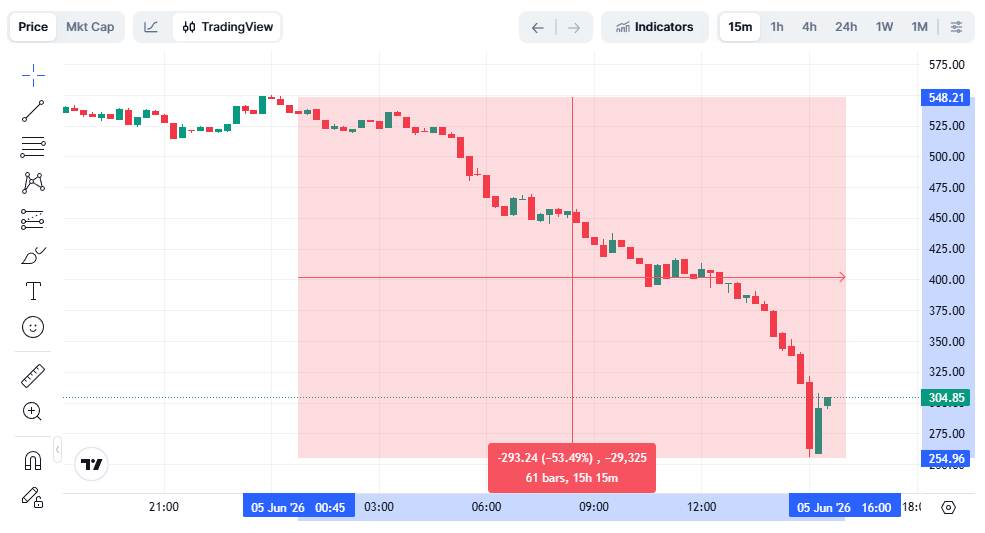
After security researcher Taylor Hornby discovered the issue on May 29, he successfully verified the vulnerability in a local environment and generated a test version of counterfeit ZEC, further proving the vulnerability was an exploitable attack vector. Currently, the biggest controversies surrounding Zcash are twofold: First, whether counterfeit ZEC has ever appeared within the privacy pool over the past four years; second, how the official team can prove that no counterfeit ZEC has entered the privacy pool, an immensely difficult task to prove false.
Where Did the "Unlimited Supply" of ZEC Come From?
Orchard (Zcash's privacy-protecting "shielded pool") relies on zero-knowledge proof circuits for security, with the core rule being asset conservation: spending in each transaction must come from legitimate inputs, and ZEC cannot be created out of thin air. Users can hide their balances and transaction amounts, but the system must verify the legitimacy of transactions.
Security researcher Taylor Hornby discovered an under-constrained condition within the Orchard circuit. An attacker could input data that should not be accepted, yet the verification might still return a successful result. In other words, without needing administrator privileges or node control, and not being a backdoor vulnerability, as long as the system mistakenly deems the transaction legitimate, non-existent ZEC could be recorded as legitimate assets within Orchard.
Shielded Labs termed this an "unlimited, undetectable counterfeit ZEC" vulnerability.
Vulnerability Fixed, But Historical Questions Linger
In typical security incidents, the biggest fear is the scale of losses; for Zcash, the most troublesome aspect of this crisis is that the losses cannot be directly quantified.
If an attack occurred on the transparent chain, the market could at least see the attacking addresses, fund flows, and affected assets. However, transaction amounts, balances, and fund paths within Orchard are inherently hidden. Once counterfeit ZEC has appeared in the pool, it is extremely difficult for outsiders to determine whether it remains stuck in Orchard or has gradually flowed out through normal transactions.
More critically, Orchard is not a completely isolated black box. Users can move assets between different pools, allowing both real ZEC and potentially counterfeit ZEC to mix within the pool.
The Zcash ecosystem can emphasize that no evidence of vulnerability exploitation has been found and that the probability of malicious use is low. But for traders, "no anomalies detected" and "proven to be clean" are not the same thing.
This is the core reason for ZEC's expanding decline. Until the question of whether counterfeit ZEC ever existed in Orchard is proven, the credibility of ZEC's supply will remain under a shadow.
Arthur Hayes Liquidates, Triggering Market Confidence Crisis
After the ZEC vulnerability was exposed, BitMEX co-founder Arthur Hayes' public liquidation further amplified market panic.
Arthur Hayes stated on platform X that he had sold all his ZEC holdings. Hayes mentioned learning about the attack yesterday but initially failed to grasp its conflict with his narrative framework. The 30% drop in ZEC prompted him to reconsider, leading him to close his entire position for profit. He added that while he believes the possibility of additional minting is extremely low, it cannot be formally proven impossible at the cryptographic level. He stated he would continually reassess the situation; if his assumption is disproven, he would buy back, hoping to establish a position at a lower price. He noted that privacy is priceless and would not mind buying back at a higher price.
This had a significant impact on ZEC. Over the past period, Arthur Hayes had been a major proponent of the ZEC narrative. His bullish view was based on the long-term logic of privacy assets regaining value in the context of AI, government surveillance, and the expansion of big tech companies. Therefore, his liquidation was not just a major holder taking profits; it felt more like a public downgrade of the current ZEC narrative.
When the leading narrative supporter chooses to exit first, long positions originally supported by conviction and expectation become more prone to collective profit-taking and risk aversion.
Community Sentiment Spirals, ZEC's Price Correction Becomes a Trust Crisis
Possibly influenced by Arthur Hayes' liquidation, community discussions about ZEC quickly shifted from "Should I buy the dip?" to "Can I still trust it?"
On one hand, the community repeatedly emphasized the severity of the vulnerability itself. Compared to the short-term price drop, many users were more concerned that a vulnerability theoretically capable of creating unlimited counterfeit coins had lain dormant in Orchard for nearly four years. To them, the price decline was just a surface symptom; what truly shook confidence was the core security assumption of Zcash being called into question.
On the other hand, the process of AI assisting in discovering the vulnerability further fueled distrust. Taylor Hornby, aided by AI tools, conducted a targeted review of the Orchard circuit, ultimately discovering the vulnerability, writing an exploit program, and generating counterfeit ZEC in a local environment. Although AI did not perform the audit independently, the narrative that "a critical vulnerability existing for years was quickly unearthed with AI assistance" spread rapidly within the community.
This turned public opinion against Zcash's development and auditing systems. The community questioned how a vulnerability existing since 2022 could go undetected for years on the mainnet. If constraint omissions are possible in a core privacy pool, how can users trust Zcash's commitments regarding supply and privacy security?
Therefore, this decline is not just profit-taking. Until Zcash provides a more convincing proof, no one is truly willing to hold ZEC long-term.


