SpaceX IPO 臨近:一場藏在指數基金裡的世紀收割


- 核心觀點:本文認為SpaceX的IPO並非商業成功,而是一場精心設計的財富轉移:透過修改指數規則,迫使被動指數基金在高估值下接盤,使早期投資者套現離場,而普通退休投資者將承擔風險與損失。
- 關鍵要素:
- SpaceX估值核心依賴Starship,但其技術仍未兌現(V3發射僅達121英里,遠低於所需軌道),且軌道數據中心和xAI業務同樣缺乏實質支撐。
- 納斯達克、標普500修改規則,允許SpaceX在低流通盤(5%)條件下快速納入指數,並以虛高權重計算,迫使大量被動資金在高估值時買入。
- 內部人士鎖定期(180天)結束後,恰逢指數再平衡,指數基金被迫在內部人士拋售解禁股的同時繼續買入,形成系統性風險轉嫁。
- 即使IPO成功,SpaceX仍面臨巨額資金缺口(至2030年約2350億美元),未來將無休止地進行稀釋性融資,股東還需接受強制仲裁及不利司法管轄。
- 此次IPO可能衝擊股票和加密市場流動性(30%份額面向散戶),並成為AI泡沫的壓力測試,若失敗可能終結當前投資週期。
- 文章建議投資者遠離SpaceX,因其更像一種不受市場、法律或監管審查的「宗教」,做空風險極高。
Original title: The SpaceX IPO Will Be the Theft of the Century
Original author: Lawrence Fossi
Translation: Peggy, BlockBeats
Editor's note: In the author's view, the SpaceX IPO is not an inspiring story of a "commercial space giant going public," but a meticulously engineered transfer of wealth. The article first questions the core valuation basis of SpaceX: whether it's the heavier Starlink satellites, orbital data centers, NASA's Artemis missions, or the narrative of lunar and Martian colonization, almost everything relies on a Starship far more mature than the current version. However, in the author's opinion, Starship's technical delivery remains highly uncertain, and the xAI and data center narrative cannot truly support its massive valuation.
The sharper critique lies in the financial structure. The author argues that rule changes by Nasdaq, the S&P 500, and FTSE Russell could allow SpaceX to quickly enter major indices with a low float, forcing massive passive index funds to buy in at inflated valuations. This creates an exit window for early private investors, insiders, and long-term capital providers, while ordinary 401(k) and IRA retirement account investors passively assume the risk. This is what the article calls a "Rikishi moment"—index funds, once hailed as a boon for ordinary investors, are publicly shamed and degraded in an absurd scenario. The low-cost index fund, originally John Bogle's gift to the common person as a market tool, could now, due to rule rewrites, become a channel for capital exit and risk transfer.
The article further argues that even if the IPO succeeds, SpaceX may still face massive funding gaps, continuous dilutive financing, lack of governance rights, and mandatory arbitration. Its impact extends beyond SpaceX itself: this IPO could disrupt liquidity in both stock and crypto markets, act as a stress test for the AI bubble, and potentially damage the long-established trust in index funds. The author's conclusion is not to short SpaceX, but to warn investors that when Musk-style narratives, passive index fund capital, and market frenzy intertwine, the most dangerous thing is often not that the story isn't grand enough, but that ordinary people have no right to choose not to participate.
Below is the original text:
As the SpaceX IPO approaches, here are some observations and predictions:
1. From a Business Perspective, SpaceX Will Be a Spectacular Failure
Substantively, SpaceX's entire valuation logic rests on the Starship project. And by "Starship," I mean a Starship far more powerful than the version we have seen so far.
· Heavier V3 Starlink satellites require Starship for launch.
· To make these launch missions—and other launch services for third parties—more economical, a reusable Starship is needed.
· The promised orbital data centers require Starship.
· Fulfilling SpaceX's obligations to NASA's Artemis program requires Starship.
· Any lunar or Martian colony also requires Starship. SpaceX's IPO filing even predicts "trillion-dollar markets on the Moon, Mars, and beyond."
But the problem is that Starlink satellites operate in orbit about 300 miles above Earth, while the highest altitude Starship has ever reached—during the latest Version 3 launch, where both the booster and upper stage were lost—was only 121 miles. There is a significant distance and a massive amount of extra fuel needed to go from 121 miles to 300 miles. Will Lockett has calculated why the Version 3 Starship is, in his words, essentially "useless."
And this doesn't even touch on the physical near-impossibility of orbital data centers, or the extremely low probability of Starship completing the cryogenic propellant transfer mission required for Artemis III.
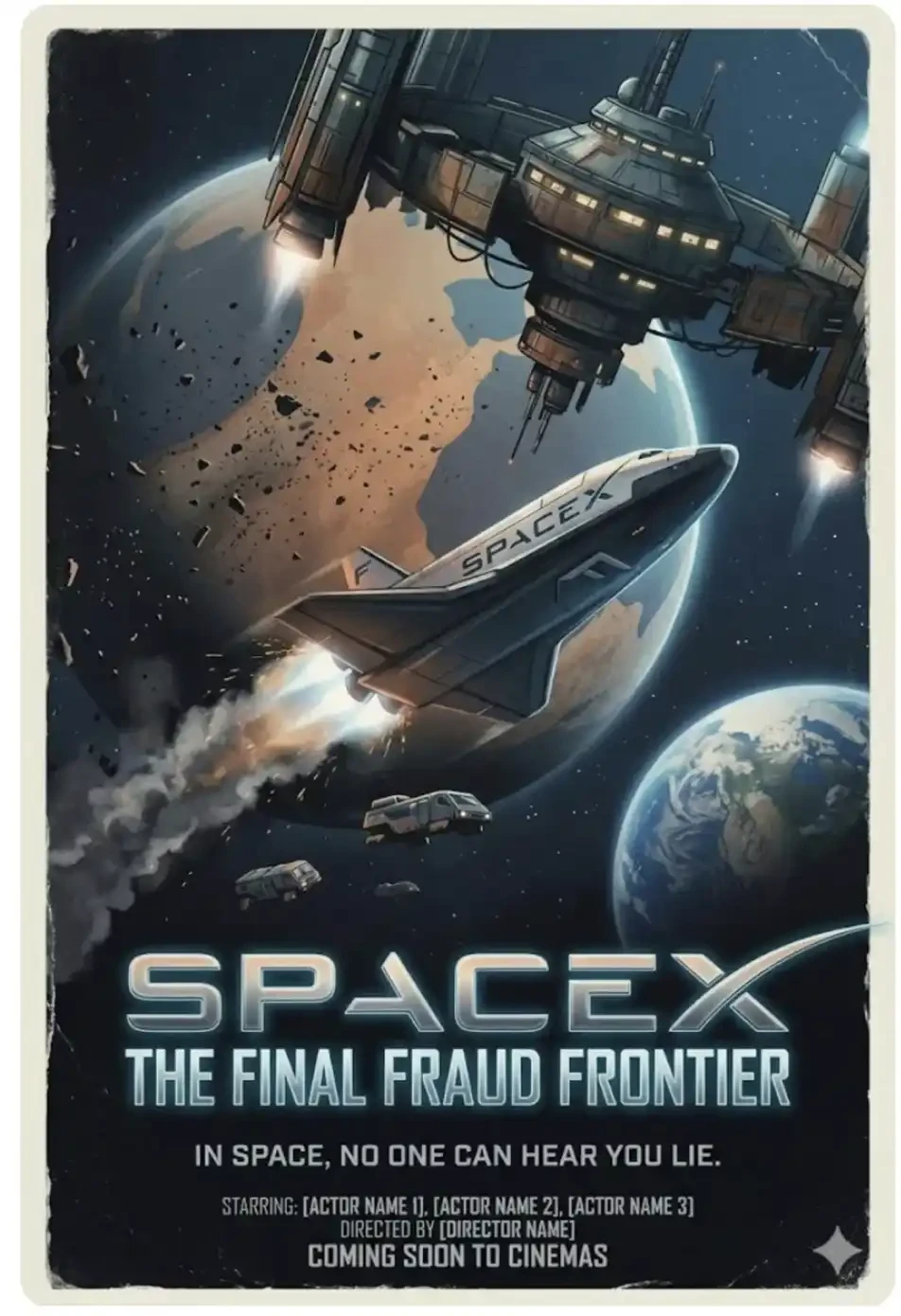
(I've used this analogy before, but I like it too much not to use it again.)
Of course, you might think that even without the orbital data center story, xAI is the real key to SpaceX's ultimate success. If so, I suggest you look into the facts Patrick Boyle discusses in this YouTube video (starting at 10:25). As Boyle points out: this company's (xAI) AI products account for 93% of the total addressable market SpaceX claims to have; but its flagship product, Grok, isn't even used by its own engineers. And it's trying to spend $60 billion to acquire competitor Cursor just to make its product actually work.
As for the much-hyped $15 billion annual contract with Anthropic, Boyle raises an obvious question: xAI is essentially renting the compute power and hardware from its Colossus and Colossus II data centers to its competitor, Anthropic. This strongly suggests that xAI is currently unable to fully utilize its own data center capacity. (Boyle also raises a less obvious point: Anthropic can cancel this three-year agreement at any time with just 90 days' notice.)
However, it will take time for all these hard facts to fully surface. How long? Two years? One year? Maybe less?
But one thing I am unfortunately quite certain of: these facts won't fully come to light before the various private investors who have invested in SpaceX over the past two decades have had ample opportunity to dump their shares for massive profits onto an unsuspecting public.
2. As a Wealth Transfer Machine, SpaceX Will Be Staggeringly Successful
A series of rule changes by Nasdaq, the S&P 500, and FTSE Russell almost guarantee that SpaceX's IPO will greatly enrich SpaceX insiders while pillaging unsuspecting ordinary retirement investors who put their 401(k)s and IRAs into broad-based index funds.
A. Nasdaq Fires the First Shot in This Shameful Parade
As early as March 10, when rumors about the SpaceX IPO were still in their early stages, the author of the Substack column *Keubiko's Musings* published a prescient article titled *The Shame of Nasdaq*, with the subtitle: "How to manipulate an index to please a billionaire."
Nasdaq not only eliminated the so-called "listing seasoning" requirement, allowing SpaceX to enter its index just 15 days after its IPO; it also changed the way it weights stocks with a low public float in the Nasdaq 100 index.
SpaceX will be an extremely low-float stock, with only 5% of shares available for sale. Yet Nasdaq will calculate its weight as if the public float was 15% of total shares outstanding. According to Keubiko: The index is giving a restricted, tightly controlled float an imaginary weighting worth tens of billions of dollars. Hundreds of billions of dollars of price-insensitive passive capital will be legally and rule-bound forced to massively buy this stock within a few days. You are essentially forcing a massive firehose of index capital into the narrow liquidity of a garden hose. This is a recipe for creating a massive, artificial supply-demand squeeze.
Oh, but it gets worse. Much worse. As Keubiko writes, the math here will become "truly brutal."
Once the 180-day lock-up period for insiders ends and SpaceX's public float exceeds 20%, Nasdaq will calculate the stock's weight based on 100% of total shares outstanding.
Of course, Musk has perfectly timed the end of the lock-up to coincide with Nasdaq's index rebalancing in mid-December. Keubiko writes again: Index funds will be rule-bound forced to buy tens of billions more of this stock at the exact same time insiders can start dumping their unlocked shares onto the market. Don't you already feel your liver being compressed into foie gras?
Since Keubiko first blew the whistle in that article, many financial journalists and market experts have realized what is happening. You can now find numerous articles describing how Nasdaq, by rewriting rules, is ensuring that millions of passive investors—the ordinary people putting their retirement savings into broad-based index funds—are forced to buy SpaceX stock at absurd valuations.
B. Other Major Indices Join the Parade
In this race to the bottom, the S&P 500 has also amended its rules to fast-track the inclusion of index constituents, no longer requiring the relevant company to prove continuous profitability.
Predictably, FTSE Russell was not far behind and quickly followed suit.
C. The "Rikishi Moment"
Phil Bak recently gained significant attention with an excellent Substack article titled *The Rikishi Moment*. The title comes from a profound humiliation suffered by the late, great—but deeply flawed—baseball player Pete Rose.
Bak is fully aware of the precious gift that Vanguard's John Bogle, the inventor of the low-cost index fund, gave to ordinary investors. But a once incredibly beneficial market tool, in the hands of cynics and unscrupulous actors, has become a tool of evil. Bak writes: John Bogle is no longer with us. I can only imagine how he would view what is happening to index funds today. I can only imagine his equally sad eyes. I can only imagine his equally bewildered, weary acceptance as he watches his great invention, once standing so high, fall into the sewer of fraud.
D. Who Will Benefit from This Theft?
This question seems too easy to answer, doesn't it? Of course, Elon Musk, and his long-time facilitators like Antonio Gracias, Steve Jurvetson, and Ira Ehrenpreis.
But the beneficiaries extend far beyond Musk's inner circle. As the brilliant Rupert Mitchell (author of *Blind Squirrel Macro*) said on a recent podcast: In the past 20 years, pretty much everyone who is anyone has had the opportunity to buy SpaceX—and did buy SpaceX. Believe me, everyone holds it. There is no sovereign wealth fund, no institution, no mutual fund, no private equity firm, no crossover hedge fund that doesn't have a massive position in this stock—and they bought it at prices far lower than what the IPO will offer to the public.
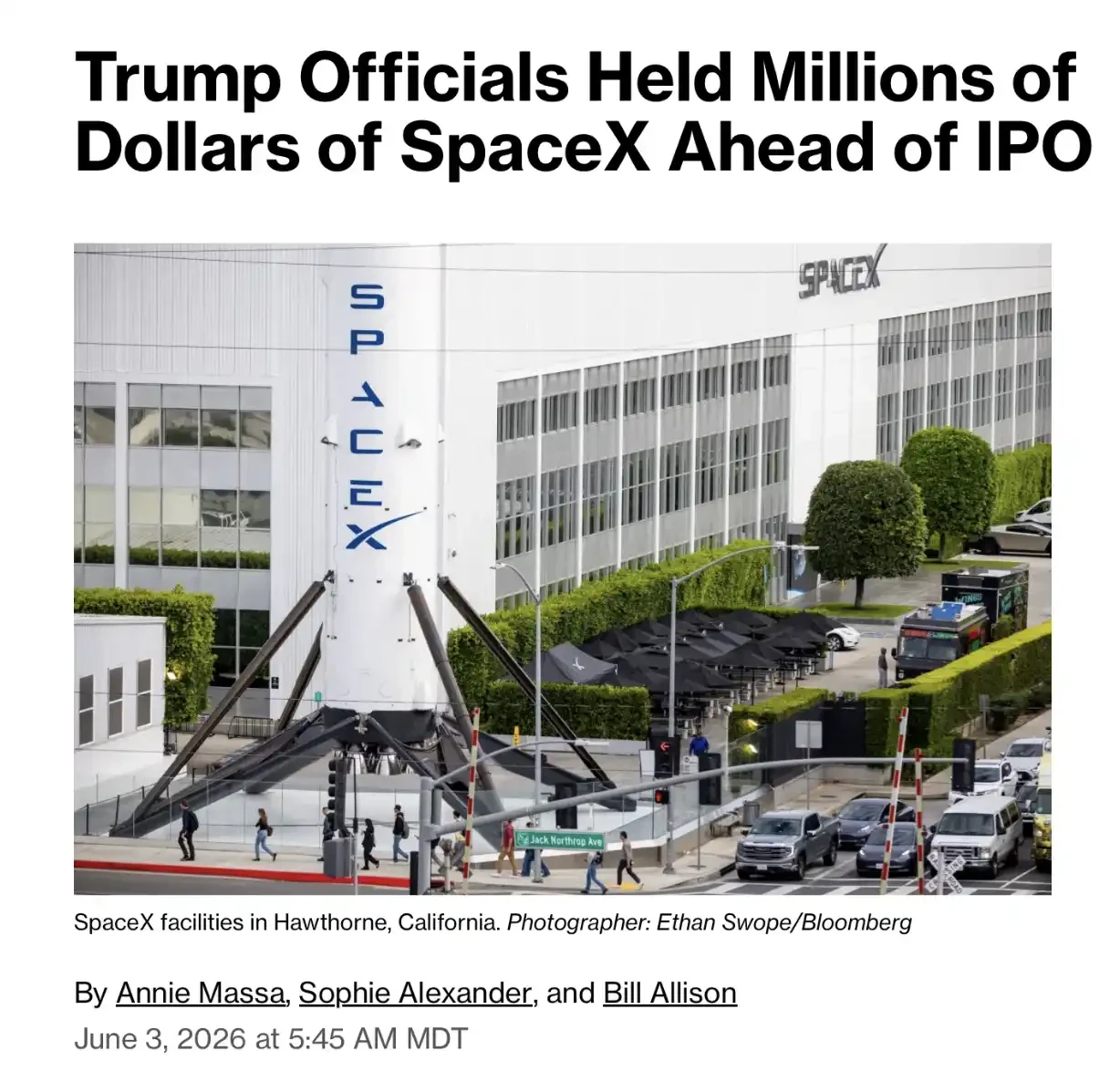
Unsurprisingly, guess who else we can add to Rupert's list:
3. What Happens After the Thieves Leave the Scene?
This question is easy to answer: disappointing business performance (see Part 1 of this article) and endless equity dilution.
SpaceX's IPO, even including the "greenshoe option," can raise at most around $85 billion. But a close reading of its registration statement—as Greg Collins of Cape Fear Advisors has done—reveals that by 2030, SpaceX's capital requirements will be around $235 billion.
Assuming SpaceX raises $85 billion through the IPO and uses $20 billion to pay down debt, that still leaves a funding gap of $170 billion. (Collins expects a smaller raise and a larger gap, but either way, it's massive.)
Of course, an obvious solution is to drain Tesla's cash reserves: either through a merger or by further forcing Tesla to invest in SpaceX. But Tesla's cash is far from enough to fill SpaceX's furnace of capital expenditures.
The future will be—and even the S-1 filing has previewed it—endless dilutive financing. Buried deep in SpaceX's amended S-1 filing is this warning: We may issue a substantial amount of equity in connection with future transactions.
Even this statement can be considered misleading. Not the "we will issue a lot of equity in the future" part; that is almost certain to happen.
The problem is: Are these issuances really for "future transactions"? Elon, what you really mean to say is: In order to fulfill the transactions SpaceX has already committed to in the S-1 filing, isn't it?
As for any potentially misleading statements or false information in the registration document, or any current or future misconduct by Musk and other executives and directors, aggrieved investors will have almost no recourse.
SpaceX shareholders will be forced into mandatory arbitration. They will have no meaningful voting rights. And governance disputes will be decided by a new Texas commercial court, presided over by Musk-friendly judges—without the possibility of a jury.
4. Final Thoughts
The following thoughts are in no particular order. Also, remember that the only law Elon Musk can't seem to break with impunity is the "Law of Unintended Consequences."
A. It Could All Collapse
The SpaceX IPO could be a disaster from the start, or even be delayed or canceled. The reason is simple: there may be too many shares looking for buyers too quickly, and not enough capital in the market to absorb them.
Rupert Mitchell and Ben Brey discussed these possibilities in a highly informative written report and subsequent podcast.
B. It Could Impact Stock and Crypto Markets
SpaceX is offering an unprecedented 30% of the share issuance to retail investors, who must get the cash from somewhere.
Therefore, this IPO could trigger massive and disruptive selling. The most obvious candidates for liquidation are stocks and crypto assets, as those wanting to participate need to sell other holdings to raise funds. In fact, some of the downward pressure on Bitcoin in recent weeks might partially stem from this kind of selling. (Michael Saylor's recent actions have added fuel to this fire.)
C. It Could Prick the AI Bubble
Chris Irons of *Quoth The Raven* believes the SpaceX IPO will serve as a market referendum on whether the AI investment bubble can continue to inflate.
If SpaceX successfully goes public with overwhelming demand, it suggests that despite all the red flags, investors still willingly suspend traditional investment discipline and continue to believe the story. But if the result is disappointing, it could mark the beginning of the end for this investment cycle.
(In a recent podcast with Adam Taggart, Chris described the current financial market as "a digital casino on cocaine.")
D. It Could Permanently Damage the Popularity of Index Funds
For decades, index funds have provided ordinary people—those without sophisticated financial knowledge but needing to invest for retirement—with broad market exposure at very low costs.
But the SpaceX IPO is a massive trap for these ordinary people. If the scenario I foresee unfolds, they will be forced to buy at severely inflated prices, only to watch their purchase inevitably depreciate in value.
This could leave a stain on index funds severe enough that 401(k) plan sponsors and administrators, and financial advisors more broadly, might no longer recommend them as suitable investment vehicles.
E. Do Not Try to Short SpaceX!!
Elon Musk is a figure with a cult-like following. More importantly, he has proven time and again that he is virtually immune to effective market, legal, or regulatory scrutiny.
Musk's critics have been right about many things: Tesla's terrible fundamentals, the lies about Full Self-Driving, the Robotaxi fantasy, the shaky accounting. But they were wrong when they thought these issues would affect the stock price.
One day, somewhere, someone will make a lot of money shorting Tesla or SpaceX. But that person probably won't be you.
For now, the best way to understand Tesla is perhaps not as a financial investment, but as a religion. Today, SpaceX can be added to that category.
So my advice is: stay away. Tend to your garden. Play with your kids. Read a good book. Listen to some great classical music. Here is a piece I recently heard and am happy to recommend.