對談VanEck CEO:儲存晶片股是供需錯配泡沫,多數加密項目五年後消亡


- 核心觀點:VanEck CEO Jan van Eck認為,Nvidia因軟體生態、規模優勢和電力效率已轉變為AI基礎設施核心,具備深層護城河;而儲存晶片股的上漲更像階段性供需泡沫,中長期審慎。他同時指出,區塊鏈、穩定幣和比特幣將留存,但多數加密項目和代幣生態會在5-10年後消失。
- 關鍵要素:
- Nvidia競爭優勢:已從單一GPU製造商轉型為AI「主機」,擁有軟體生態、生產規模和更高電力效率,遠期本益比僅20倍出頭,是投資組合中的穩健資產。
- 儲存晶片股風險:利潤爆發主要源於價格上漲而非銷量大增,缺乏像Nvidia那樣深的競爭護城河,中期面臨新進入者和客戶節約用量的壓力。
- 加密行業展望:當前正經歷「加密寒冬」且不會回頭,區塊鏈概念、穩定幣和比特幣會留下,但大多數項目和應用將在5-10年後失去意義或消亡。
- 2026年趨勢:被稱為「公司控制鏈」之年,華爾街金融機構正吸收區塊鏈優勢但仍掌控生態,穩定幣法案首次讓科技公司具備與銀行體系競爭的能力。
- 宏觀風險與黃金:美國政府債務問題令人擔憂,若市場對其履約能力失去信心,黃金作為中長期避險工具短期也可能被拋售;黃金正重新成為全球第一貨幣。
- AI投資建議:AI算力需求高漲而供給不足,半導體處於核心位置,建議在回調時買入而非追高,並採用分散化方式參與。
Compiled & Edited by: ShenChao TechFlow
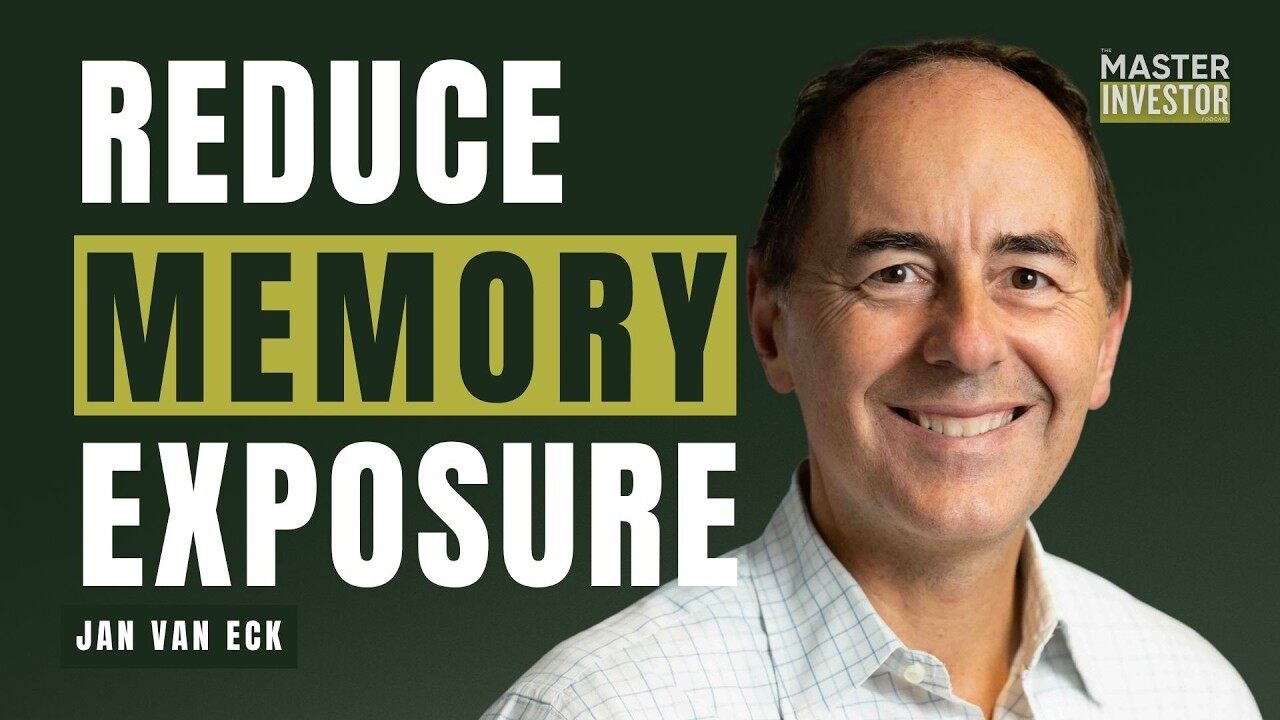
Guest: Jan van Eck (CEO of VanEck)
Host: Wilfred Frost
Original Title: Memory Is A Bubble, But Nvidia Protected – Jan Van Eck On Semis Surge
Podcast Source: The Master Investor Podcast with Wilfred Frost
Air Date: May 27, 2026
Editor's Introduction
This episode of the podcast welcomes Jan van Eck, CEO of VanEck. His core thesis is: Nvidia has transformed from a single GPU manufacturer into the "host" for AI infrastructure, with moats built from its software ecosystem, scale, and power efficiency. However, the surge in memory chip stocks looks more like a bubble driven by cyclical supply-demand imbalances.
The head of VanEck, which manages approximately $225 billion in assets and was an early proponent of the Bitcoin ETF, distills the investment themes for the next decade into three key areas: AI computing infrastructure build-out, the rise of India, and excessive fiscal leverage in developed economies like the US, UK, and Japan.
More provocatively, he labels 2026 as the "Year of the Corporate Control Chain," arguing that Wall Street will absorb the benefits of blockchain, stablecoins, and programmable money. However, most crypto projects and software will become irrelevant in 5 to 10 years; Bitcoin, stablecoins, and the blockchain concept will remain, while many token ecosystems will disappear.
Key Quotes
AI, Semiconductors & Memory Chip Stocks
- "From an AI perspective, the problem is simple. Compute demand is here, but supply is below. Semiconductors are clearly at the core of this structure."
- "Nvidia is no longer just a GPU manufacturer; it's more like the host for AI. The cyclical, hyper-competitive nature of a single chip maker is not its whole story today."
- "Nvidia's advantage comes not only from production scale but also from chips that generate higher efficiency per dollar of electricity. With a forward earnings multiple just over 20x, I still see it as a solid asset in the portfolio."
- "The profit explosion in memory chip stocks is not primarily due to selling more products but because of price increases. This means companies using these chips will start looking for ways to reduce usage."
- "I don't like calling tops easily, but I am cautious on memory chip stocks. In the medium to long term, they lack the deep competitive moat that Nvidia has."
ETFs, Active Management & Asset Allocation
- "VanEck's investment philosophy is to look back from a decade hence: By 2036, which major themes truly changed the world and financial markets?"
- "ETFs are a scale game; the larger the assets, the broader the client base you can serve. Many active management strategies, especially private equity and hedge funds, can have diseconomies of scale."
- "Even though the ETF vehicle itself can be passive, deciding which ETFs you own, how to allocate, and when to adjust positions is inherently a very active decision."
Macro Debt, Gold & Hard Assets
- "If the market truly loses confidence in the US government's ability to fulfill its obligations, I don't know where to hide. Even gold, a medium-term hedge, could be sold off in the short term."
- "I believe gold is re-establishing itself as the world's primary currency. If not the US dollar, I don't see China or India becoming international reserve currencies."
- "The government bond market is one of the strangest, most inefficient markets in the world. It can lock into a certain mindset and become disconnected from reality."
- "The nuclear energy ETF grew from under $20 million to $4.7 billion, underpinned by a drastic policy shift. Both US parties, along with countries like Japan, have re-embraced nuclear power."
Crypto, Stablecoins & Corporate Control Chain
- "I call 2026 the 'Year of the Corporate Control Chain'. Banks, trading firms, and financial institutions want to absorb the best parts of blockchain while still controlling their own ecosystem."
- "I believe we are in a crypto winter, and it's not turning back. Many projects and software will be neither interesting nor alive in five to ten years."
- "The concept of blockchain will remain, stablecoins will remain, Bitcoin will remain; but many other parts of the ecosystem, in my view, will disappear."
- "The stablecoin bill, for the first time, allows tech companies to compete with the banking system. But banks have survived competition from money market funds before."
India & SpaceX IPO
- "You can't fight demographic trends. India has continuously pursued pro-business reforms under Modi. There's no reason such a country shouldn't grow at a higher rate."
- "SpaceX is massive. As an ETF issuer, we are happy to see it enter the public markets. The liquidity flowing into the economic system will be in the hundreds of billions."
Frenzied Memory Chip Stocks
Wilfred Frost: Our guest today is Jan van Eck, President and CEO of VanEck and its affiliates. VanEck, founded by his father, has become a major player in the ETF industry, managing approximately $225 billion in assets. Jan is a frequent podcast guest known for his direct and insightful views, which is why we're thrilled to have him. Jan, welcome to the show.
Jan van Eck: Wilfred, it's great to be doing this show for the first time.
Wilfred Frost: I want to start with a specific ETF. Fair to say, it's been a big driver of your recent performance and sits right at the center of the current market: SMH, the VanEck Semiconductor ETF. It's been performing remarkably. I understand it's now around $65 billion in AUM, correct?
Jan van Eck: Roughly that size.
Wilfred Frost: It's become the primary vehicle for investors seeking semiconductor exposure. Up 58% year-to-date, 135% over the past twelve months. Even more striking, it has an annualized return of about 29% since inception.
Jan van Eck: That's crazy, right?
Wilfred Frost: Truly incredible. Achieving that through compounding is very difficult. You could retire now.
Jan van Eck: Yeah, we should probably close the fund now.
Wilfred Frost: But I bet you won't, which is why you're here. SMH grew to $65 billion over the past year or so. How much of that is price performance versus inflows?
Jan van Eck: A huge portion is price performance. I'd be surprised if inflows accounted for more than 10% to 20% of the growth over the last 12 months.
Wilfred Frost: That's interesting. I would have thought inflows were a bigger factor. What do you think is driving its rise? Maybe that's a simple question, but is it purely the AI theme?
Jan van Eck: Yes. VanEck's investment philosophy is to look at things from a big-picture, macro perspective. I call it the "10-year macro." Thinking back from 2036, what themes will have most profoundly impacted the world, and therefore financial markets? This perspective helps filter out a lot of noise.
I think at least three things will remain: AI, the rise of India, and excessive fiscal leverage led by the US, UK, and Japan. From an AI perspective, the logic is simple. Compute demand is very high, and supply can't keep up. Semiconductors are clearly at the core of this.
Drilling down, you get to Nvidia. Our ETF has outperformed other semiconductor ETFs partly because it focuses on just the top 25 stocks and allows the largest holding to go up to 20%. So it has essentially hitched a big ride on Nvidia.
Nvidia itself could be a whole show. Are we still comfortable with semiconductors and Nvidia? My personal answer is yes. No one can guarantee a company won't lose its competitive moat, but I think Nvidia will certainly be among the leaders in ten years. Partly because it has become like the host for AI, rather than just the single chip or GPU maker it once was. That old model was both cyclical and highly competitive.
Today's Nvidia has software, cost advantages, production scale advantages, and higher power efficiency – meaning more efficient chips per dollar or pound of electricity. Its forward earnings multiple is just over 20x. So, even though Nvidia hasn't been the hottest stock in SMH over the last nine months, I still see it as a very solid part of the portfolio.
Wilfred Frost: According to your latest disclosures, Nvidia is about 17% of SMH, and TSMC is about 9%. I want to dig into them later. You mentioned the Nvidia exposure is key, but it's also interesting that the performance this year, or at least over the last nine months, hasn't been solely driven by mega-caps like Nvidia. A lot of semiconductor companies were left behind by the AI theme and are only now catching up.
Jan van Eck: Exactly right. There's some thought, and some luck, in SMH's methodology. When you only pick the top 25 names, in this investment era of the last 15 to 20 years, it's been the large caps that truly led the market. There are certainly more than 100 semiconductor companies. Filtering out the bottom ones, often in more competitive spaces, essentially removes the drag.
Of course, this doesn't apply to all investment periods. But during this period, it has amplified the impact of these big winners.
Wilfred Frost: Short-term, with a 58% gain year-to-date, the rally has clearly broadened out significantly. Memory chip stocks have surged particularly hard. Can this kind of move sustain?
Jan van Eck: I doubt this specific performance is sustainable. We just saw historic moves in May, so I don't think it will continue at this pace. But I don't necessarily think the market pricing is irrational. Coming back to the super-macro view, if demand is high and supply is low, capital markets are essentially telling entrepreneurs: "Come here, we need your capital, we are willing to value your capital highly because we need to build AI compute centers." This isn't surprising.
I think this ten-year perspective works because humans are naturally inclined to look backward. When a big trend emerges, whether it's the rise of a country or a major technology, you can't just look at the last few quarters of company earnings or past uses of the technology to understand the scale of investment needed.
Of course, not all technology trends pan out. There are many false trends and false technologies in the world. But AI is clearly grabbing global markets by the scruff of the neck and shaking them.
Wilfred Frost: Another short-term question. The KOSPI hit another all-time high today. It has tripled over the last 18 months, which is incredible for a country index, driven mainly by Samsung and SK Hynix. Last week, on one day, the Korean index jumped 12%. Does this remind you of the other side of the coin? Like late 2021, when some meme stocks soared, followed by a sharp correction in 2022. I know these memory stocks, especially those two, have phenomenal earnings-per-share estimates, so it's different from meme stock mania. But are there similarities that raise a red flag for you?
Jan van Eck: Within the AI ecosystem, I would say there are indeed some bubbles. Going back to the end of last year, the question was the financial sustainability of the OpenAI ecosystem. In what I call the OpenAI ecosystem—companies like Oracle, which levered up to build compute for OpenAI, and CoreWeave—both were down 50% at one point.
So even within the big AI trend, you can have localized bubbles, or company-specific bubbles. To your question, I do think the memory sub-sector is a cyclical moment. It's hard to call a top in times like these, but I personally am cautious on memory chip stocks because, in the medium to long term, they don't have what I consider to be as deep a competitive moat as Nvidia.
There will be new entrants in this space. There is a shortage right now, giving them pricing power. The main reason for their profit explosion isn't a massive increase in sales volume – they have capacity constraints. The real reason is they raised prices. This also means that companies using these memory chips will start looking for ways to reduce their usage.
So I agree with your feeling that it feels quite bubbly. In our active management funds, we are reducing exposure to the memory space.
Wilfred Frost: Nvidia is about 17% of SMH, TSMC is second, then Intel, Broadcom, AMD, Micron, Texas Instruments, Qualcomm – major US companies each around 6% or 7%. Does TSMC have a similarly defensible moat to Nvidia? Different kind, but just as defensible?
Jan van Eck: I think so. TSMC not only has manufacturing capability but also the capital capacity to build incredibly expensive chip fabrication facilities. I suspect one common advantage for Nvidia and TSMC is that they work with a wide range of participants in the ecosystem, seeing almost all clients. Therefore, they can see where technology is heading and how customer demand will change. Most people would say TSMC will still be there in ten years and will be a survivor.
Wilfred Frost: You mentioned Oracle or CoreWeave had significant drawdowns from their late October highs to the March low around the "Iran War low". Oracle was nearly cut in half, which is significant for a company its size. I heard you say on another podcast that we shouldn't worry too much about an overall AI bubble because it has already popped, in a way. The question is, how do you have confidence in buying the right companies during these moments? Especially since many of the big, discussed companies are not public yet, and investors can only participate through proxies.
Jan van Eck: This might sound like an ETF issuer's answer, but from a company level, a diversified approach is definitely more sensible. From a timing perspective, if you are in a trend like this, it's better to buy during the pullbacks rather than chase it right now. We talked about SMH's cash flows earlier. I suspect a lot of the assets in that fund came from investors who bought years ago and let the appreciation happen naturally. This is somewhat healthy because there isn't too much "fast money" chasing it.
Of course, money is chasing memory chip stocks and chasing the hottest parts of the ecosystem. But broadly speaking, we are still overweight semiconductors in our model portfolios, though we are feeling slightly inclined to take some profits here.
ETFs & Asset Management
Wilfred Frost: