






CBRS 飆漲 300% 之後,Anthropic 和 Polymarket 的 Pre-IPO 還有機會進場嗎?


- 核心觀點:MSX 麥通 Pre-IPO 產品透過 Cerebras 案例驗證了從申購到現貨交易的完整流程閉環,並推出第二期標的 Anthropic 與 Polymarket,分別代表 AI 生產端入口與預測市場基礎設施這兩個高估值賽道。
- 關鍵要素:
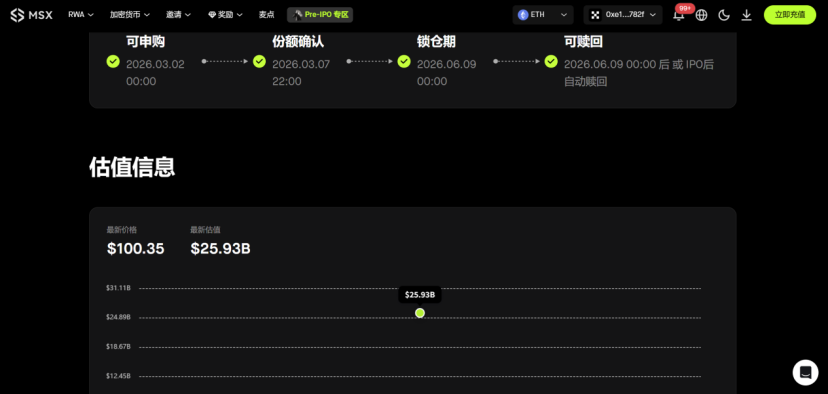
- Cerebras(CBRS)Pre-IPO 首期完成閉環驗證:申購價 100.35U,上市首日高點綜合收益率超過 300%,證明了申購 → 上市 → 現貨交易的鏈路可行性。
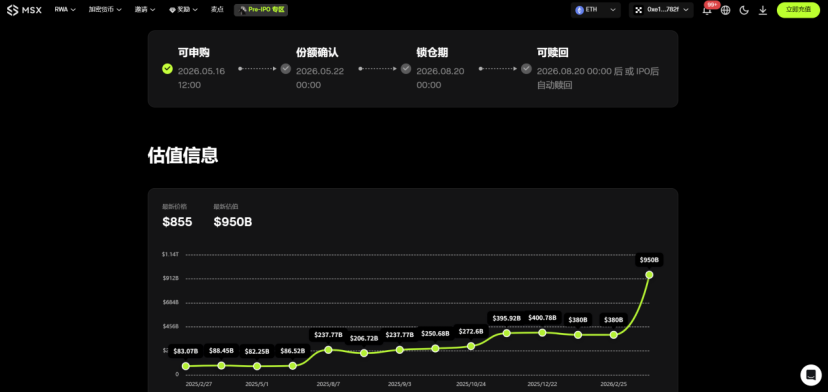
- 第二期標的 Anthropic 申購價 855U(對應估值 9500 億美元),Polymarket 申購價 152U(對應估值 150 億美元),價格處於市場相對低點。
- Anthropic 在過去 15 個月內,估值從 615 億美元飆升至近兆美元(約 15 倍),主要驅動力來自 Claude Code 等產品進入企業工作流程,成為 AI 生產力入口。
- Polymarket 在不到一年內,估值從 10 億美元攀升至 150 億美元(約 15 倍),其作為現實世界事件定價的基礎設施,連接加密貨幣與宏觀事件,獲得 ICE 等機構投資。
- 第二期產品延續退出路徑:若標的 IPO 則自動贖回/轉換,否則用戶可在 2026 年 8 月 20 日後申請贖回,確保參與的閉環機制。
The Pre-IPO track is entering its second half, marked by profit realization and closed-loop verification.
Last week, MSX Maitong's first Pre-IPO project, Cerebras (CBRS), completed a closed-loop verification: from Pre-IPO subscription, IPO listing, to spot trading – a full-chain closed loop. Based on the initial subscription price of 100.35 U and the high on the first day of listing, the comprehensive return rate for participating users once exceeded 300%.
New targets are now taking the baton.
On May 16, 2026, the Second Phase of MSX Pre-IPO officially opened for subscription, featuring Anthropic and Polymarket as the underlying assets. The subscription price for Anthropic is 855 U, corresponding to a valuation of 950 billion USD; the subscription price for Polymarket is 152 U, corresponding to a valuation of 15 billion USD.
This is not an ordinary asset launch. For users who participated in the first Pre-IPO, the CBRS.M case, which successfully moved from subscription to trading in just over two months, provides a clearer reference point for subsequent Pre-IPO projects.
Especially the two new targets, Anthropic and Polymarket, have both undergone valuation leaps of 10 times or more in the past year. They respectively represent the most coveted productivity gateway in the AI era and the event pricing infrastructure within prediction markets. So, are they worth participating in?
I. Pre-IPO Completes its First 'Full-Process Closed-Loop' Verification
Recently, Pre-IPO has visibly become a new asset class fiercely contested by on-chain US stock and crypto trading platforms.
From SpaceX, OpenAI, and Anthropic to Cerebras and Polymarket, top private companies have long been core targets for various platforms. These represent the most sought-after directions for global capital, including AI, aerospace, defense technology, and prediction markets, and also represent high-quality assets that ordinary investors have long found difficult to access directly.
This is not hard to understand.
In traditional financial markets, early stakes in top-tier pre-IPO tech companies like Anthropic and SpaceX are often allocated to primary market funds and large institutions. Even if ordinary investors identify the trend, it's difficult for them to get a corresponding entry point. Often, they can only participate at the IPO or public trading stage, by which time the company's valuation has usually been marked up multiple times, and the investment dividends have significantly diminished.
Therefore, in the past two months, since MSX Maitong launched its Pre-IPO product in early March, almost all major trading platforms have started covering popular private companies with their own products. Although the implementation logic varies, the core essence is the same: meeting users' demand for 'early access to high-quality assets'.
However, as more and more platforms enter the Pre-IPO track, the focus of competition has begun to shift.
The first half was about who could cover hot names faster; the second half is truly about who can provide a clearer and more complete product chain. While users can subscribe with relatively low barriers, can the assets smoothly transition to spot trading after listing? Crucially, are the exit and settlement paths clear? Does the platform have real case studies to verify this?
The emergence of CBRS.M last week provided a concrete reference sample at this critical juncture.
After the first MSX Maitong Pre-IPO launched on March 2nd, participating users subscribed to CBRS Pre-IPO shares at 100.35 U. When Cerebras listed on Nasdaq, the MSX platform simultaneously launched CBRS.M spot trading. This provided a subsequent trading and exit path for the assets held by Pre-IPO users. Calculated based on the high on the first day of listing, the comprehensive return rate for participating users once exceeded 300%.
This means that MSX Pre-IPO Phase I verified not just the selection ability for a single project, but a complete product mechanism covering subscription, holding, listing, spot trading, and stablecoin settlement, all integrated into an executable chain.
More importantly, the timeline for this sample was relatively short: only a little over two months from the Phase I subscription to the Cerebras listing. The Alpha effect was rapidly amplified by the market. It is precisely because of this sample that the launch of Anthropic and Polymarket signifies more than just 'two more hot targets,' but rather the beginning of consecutive Pre-IPO profit realization.
II. Anthropic and Polymarket: Two 'Red-Hot Favorites' with Soaring Valuations
The most noteworthy aspect of MSX Maitong's Pre-IPO Phase II is that Anthropic and Polymarket represent two highly representative asset directions.
Anthropic corresponds to the productivity gateway of the AI era, while Polymarket corresponds to prediction markets and event pricing infrastructure. They are respectively the leading tracks in the current 'Internet' and 'Web3' industries.
Particularly interesting is that both have experienced substantial valuation leaps in the past year, which is why they are paired together in this Pre-IPO phase.
1. Anthropic: From 61.5 Billion to Nearly One Trillion USD in 15 Months
First up is the widely known Anthropic.
Besides the imagination for AI business models brought by Claude Code, Anthropic's appeal in the capital market over the past year has largely stemmed from its incredibly fast valuation leap. Looking just at the numbers, the curve is very steep:
• In March 2025, Anthropic announced a $3.5 billion funding round, with a post-money valuation of $61.5 billion;
• In September 2025, the valuation rose to $183 billion;
• In February 2026, it completed a $30 billion funding round, reaching a valuation of $380 billion;
• According to recent reports from Bloomberg and other media, it is negotiating a new funding round at a level exceeding $900 billion;
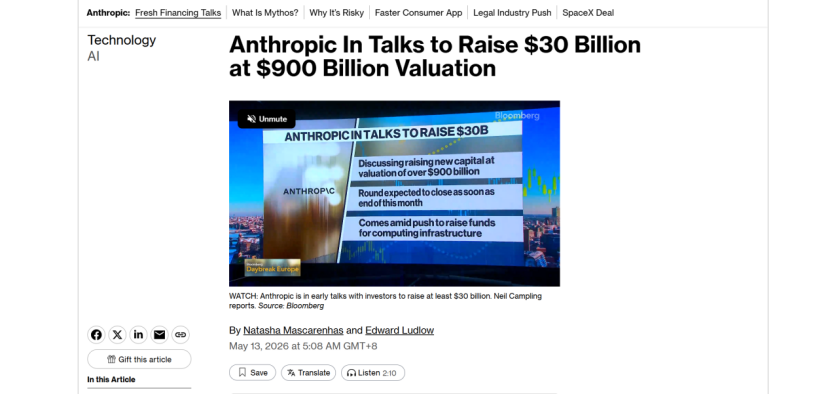
In other words, in 14 months, Anthropic's valuation surged from $61.5 billion towards the trillion-dollar threshold, an approximate 15-fold increase. Even within the most aggressive AI cycles in the primary market, this curve is an extreme example.
Behind this is not just capital chasing the AI craze, but a change in the pricing logic of the AI industry. As is well known, the early market focused on model capabilities, followed by computing power reserves, engineering efficiency, and commercialization speed. The next stage's core variable is increasingly about whether models can truly integrate into enterprise workflows and become part of productivity infrastructure.
For instance, Claude's greatest advantage is that it is no longer just a chat tool; it is entering code processing, enterprise collaboration, and intelligent agent execution scenarios. The growth of products like Claude Code has extended Anthropic's imagination space from general AI applications to developer productivity and enterprise software infrastructure.
In other words, Anthropic's valuation potential doesn't just come from 'Claude being easy to use,' but from its potential to become a key productivity gateway in the AI-native era. This is one of the core logics for selecting Anthropic for this Pre-IPO phase. It sits at the most central position of the AI application layer, possessing strong product mindshare, robust user growth, deep enterprise scenario penetration, and high capital attention.
Of course, Anthropic is a typical target with high certainty, high attention, and high valuation. The key is not just the current valuation, but whether it remains on the main line of long-term capital narrative and industrial expansion. Especially at a point just one step away from a trillion-dollar valuation, whether it eventually goes public via IPO, gets acquired, or remains private, Anthropic's current valuation level could serve as an important reference anchor for the market.
2. Polymarket: Prediction Markets Evolve from Crypto App to Information Pricing Layer
Compared to Anthropic, Polymarket's story is more native to crypto, but its potential is not limited to the crypto industry.
Polymarket's core application allows users to express judgments on real-world event outcomes through market prices. Politics, macro policies, sports events, geopolitical conflicts, tech product launches, and regulatory results can all be transformed into tradable probabilities.
This differs from stocks, bonds, and commodities in traditional financial markets. In the past, understanding real-world events relied mainly on media reports or polls/research reports. This information often suffers from lag, bias, or noise. The unique feature of prediction markets is that they allow different participants to directly convert judgments into prices, forming a real-time changing probability signal.
Interestingly, like Anthropic, it has also experienced a rapid valuation leap:
• In 2024, Polymarket completed a $70 million funding round;
• In June 2025, it completed a $200 million funding round, with a valuation exceeding $1 billion;
• In October 2025, ICE, the parent company of the NYSE, invested up to $2 billion, corresponding to a valuation of approximately $8 billion;
• In April 2026, Reuters reported, citing The Information, that Polymarket was in talks for a $400 million funding round, valuing it at approximately $15 billion;
This means that in less than a year, Polymarket's valuation rapidly jumped from the billion-dollar level to the $15 billion level. Compared to traditional crypto applications, this is no longer just a story of trading volume or user growth; it's a process of re-pricing prediction markets as a new type of information infrastructure.
This is why Polymarket has continuously garnered attention in recent years. It is both a crypto-native application and inherently connected to real-world events. As the market continues to expand, Polymarket has the opportunity to evolve from a crypto application into the pricing infrastructure for real-world events.
Therefore, although Anthropic and Polymarket operate in different industries, they have both become some of the most representative top-tier assets in their respective fields. Having experienced rapid valuation leaps in the past year, this is the underlying logic for MSX Pre-IPO Phase II placing them side by side.
III. Pre-IPO Needs Not Just an Entry Point, But Also an Exit
Returning to the Cerebras case, it is worth mentioning again before the launch of Phase II, not because every Pre-IPO project can replicate CBRS.M's short-term gains, but because it verified the most fundamental issue of Pre-IPO products: whether the closed loop from subscription to exit can be completed.
After all, for users, a low-barrier entry point is helpful, but ensuring a complete exit path from subscription to final settlement is more critical.
The full chain of CBRS.M proves that MSX Pre-IPO is not simply about offering a 'conceptual share'. It establishes a set of executable product mechanisms around subscription, holding, listing, spot trading, and stablecoin settlement. Users can choose to continue holding the assets after listing, or complete their exit through the spot market.
This is the key differentiator between a Pre-IPO product and simple synthetic assets or price guessing games. It provides users with a clear, executable path when the underlying asset is listed, converted, or redeemed. For instance, MSX Maitong's Pre-IPO Phase II also continues with relatively clear exit arrangements. According to product rules, beyond subscription, users can watch for two key milestones:
• First, if the underlying asset completes an IPO, it will enter an automatic redemption/conversion process post-IPO according to platform rules;
• Second, if the asset has not yet IPO'd before that, users can apply for redemption after August 20, 2026, 00:00, according to platform rules (specific execution methods are subject to the rules on the MSX platform page);
The significance of this design is that it doesn't just sell users a 'story to buy'. It incorporates the subsequent exit path into the product structure from the very beginning of the subscription. For assets like Pre-IPO, which naturally have longer cycles and higher information uncertainty, clear redemption and conversion rules are themselves an important part of a user's judgment of a platform's credibility.
From this perspective, the Alpha effect of CBRS.M is not an isolated event, but an external validation of the Pre-IPO product capabilities across the industry. Therefore, the significance of MSX Pre-IPO Phase II's Anthropic and Polymarket lies in further expanding this asset boundary based on this foundation: extending from AI chip infrastructure to AI application gateways and prediction market infrastructure.
Objectively speaking, when high-quality targets, clear exit paths, and stablecoin trading experiences are combined, Pre-IPO has the potential to become a significant incremental entry point for the on-chain US stock ecosystem. It can meet users' demand for participating in early-stage high-quality assets while also enriching the asset hierarchy of RWA trading platforms.
Furthermore, it's worth noting that MSX Pre-IPO Phase II not only launched these two high-attention targets, Anthropic and Polymarket, but also did so with some appealing prices and valuations.
Based on observable quotes for similar Pre-IPO targets in the current market, Anthropic and Polymarket have become hot private assets sought after by multiple platforms. However, there are significant differences between platforms in terms of quoted prices, trading formats, and underlying structures. Some platforms trade them as spot assets, while others offer price exposure via synthetic assets or perpetual contracts. When users actually participate, what matters is not just 'whether the target exists' but 'at what price they can participate'.
In this regard, MSX Phase II offers Anthropic at a subscription price of 855U, corresponding to a valuation of $950 billion for this phase, and Polymarket at a subscription price of 152U, corresponding to a valuation of $15 billion. Compared to quotes and valuation anchors on some other platforms in the market, MSX's subscription prices for both targets are relatively lower, still providing users with a relatively attractive entry price and a clear product structure. For assets like Pre-IPO, which are inherently high-volatility, high-attention, and high-valuation-elasticity, the entry price itself directly impacts the subsequent risk-reward ratio.
Overall, Cerebras has enabled on-chain Pre-IPO to complete its first truly meaningful verification.
It proved not just the selection judgment for a specific target, but the feasibility of the entire product mechanism. From subscription, holding, listing, spot trading to final stablecoin settlement, this chain was genuinely executed for the first time in the context of a top-tier tech IPO scenario. This also provided a more intuitive experience for everyone, showing that once the entry point for early-stage high-quality assets like Cerebras is brought on-chain, its profit elasticity and potential are no less than any native on-chain asset.
But the long-term value of Pre-IPO has never been determined by the short-term performance of a single project. It depends on whether the platform can continuously find epoch-defining high-quality targets and transform them into product entry points accessible to ordinary users.
This fact is harder to replicate than a 300% return and is more worthy of attention than any single profit figure.
The arrival of Anthropic and Polymarket represents the second answer sheet from MSX Pre-IPO. As for whether it can continue to withstand verification and deliver a near-perfect answer, we leave the verdict to the market.


