Anthropic和OpenAI,親手斬斷了盤前幣股的邏輯


- 核心觀點:Anthropic與OpenAI相繼聲明,不認可未經董事會批准的股票轉讓(包括透過SPV的間接持股),導致盤前股票代幣市場暴跌,揭示了此類代幣的法律風險,可能引發行業「去泡沫化」。
- 關鍵要素:
- Anthropic和OpenAI均宣布,未經董事會同意的股票轉讓無效,不承認買方股東權利,且明確禁止SPV(特殊目的公司)收購其股份。
- 市面上盤前股票代幣(如Prestock上的ANTHROPIC、OPENAI)多基於SPV架構,其價值依賴SPV持有的原始股有效性;公司不認帳可能導致代幣價值歸零。
- SPV「套娃」結構增加風險:多層嵌套的法律透明度低、管理費層層稀釋收益,且任何一層股權被判無效就崩塌價值鏈。
- 市場反應劇烈:ANTHROPIC代幣單日大跌20.62%至1082美元,OPENAI代幣大跌26.82%至1440美元,投資者恐慌於確權風險。
- 盤前合約產品(不持有真實股票,僅對賭IPO價格)受影響較小,因其依賴價格博弈而非股權支撐。
- 業內觀點分歧:一方認為頭部公司封殺SPV將終結盤前代幣邏輯;另一方認為投資者理應承擔非官方渠道的交易風險。
- 此次事件被視為對投機者的風險教育,有助於為野蠻生長的盤前股票代幣市場劃定邊界並「去泡沫化」。
Original: Odaily Planet Daily (@OdailyChina)
Author: Azuma (@azuma_eth)

The pre-IPO stock token market has just experienced a dramatic shake-up. The epicenter of this earthquake comes from two announcements by AI giants Anthropic and OpenAI.
Anthropic and OpenAI Both Refuse to 'Acknowledge' Unauthorized Sales
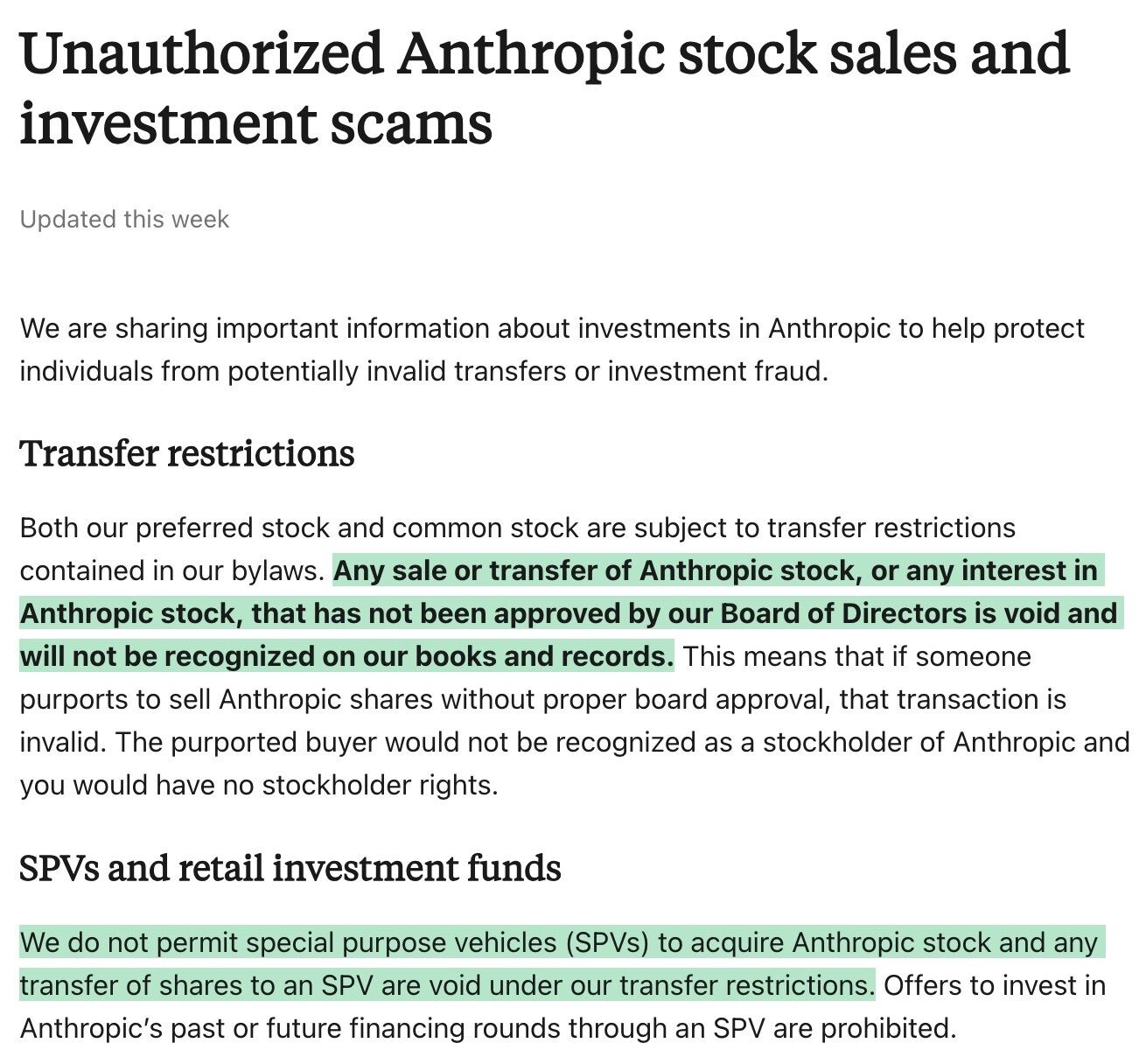
Today, Anthropic updated an official statement released in February this year, titled 'Unauthorized Anthropic Stock Sales and Investment Scams'.
In the article, Anthropic explicitly states: "Any sale or transfer of Anthropic stock, or disposition of rights to Anthropic stock, that is not approved by our Board of Directors is void (note the use of the word 'void') and will not be recognized on the company's books and records. This means that if someone sells Anthropic stock without the Board's approval, the transaction will be deemed invalid. The so-called buyer will not be recognized as a shareholder of Anthropic and will not have any shareholder rights."
Shortly after Anthropic's update, OpenAI also issued a statement saying: "All equity is subject to transfer restrictions. Without the company's written consent, no shares may be transferred, directly or indirectly. Any sale without such consent is not only unauthorized but also void."
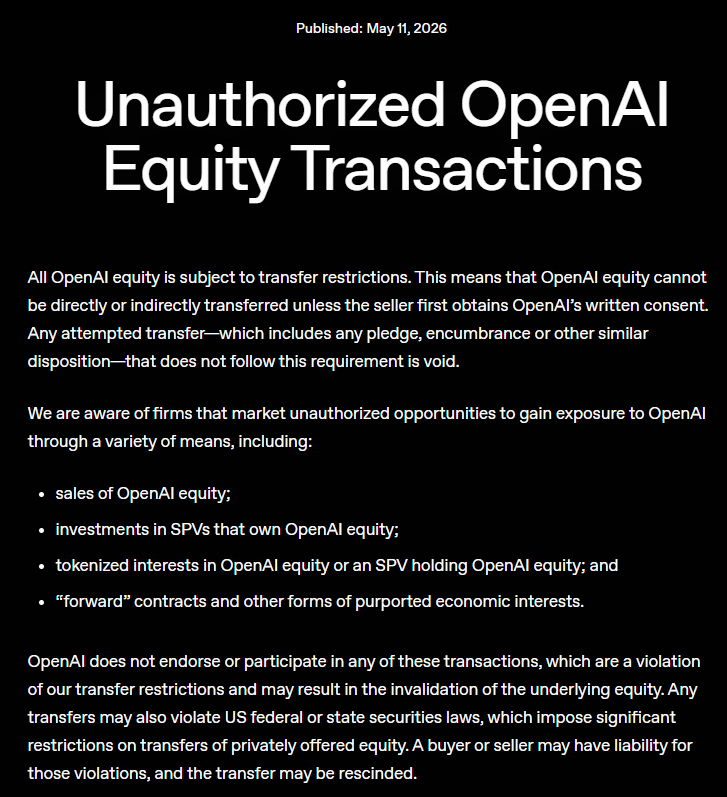
In the announcements from both Anthropic and OpenAI, they each explained that the company's preferred and common stock are subject to transfer restrictions stipulated in its bylaws; therefore, all stock transfers require board approval.
Anthropic also specifically emphasized that the company does not allow 'Special Purpose Vehicles' (SPVs) to acquire Anthropic shares, and any transfer of shares to an SPV violates the company's transfer restrictions... Certain investment funds may claim to offer indirect channels to invest in Anthropic stock, but these funds are likely attempting to circumvent the transfer restrictions. Therefore, any third party claiming to offer Anthropic stock for sale to the public – whether through direct sales, forward contracts, stock tokens, or other mechanisms – could be fraudulent, or offer worthless investments due to Anthropic's transfer restrictions.
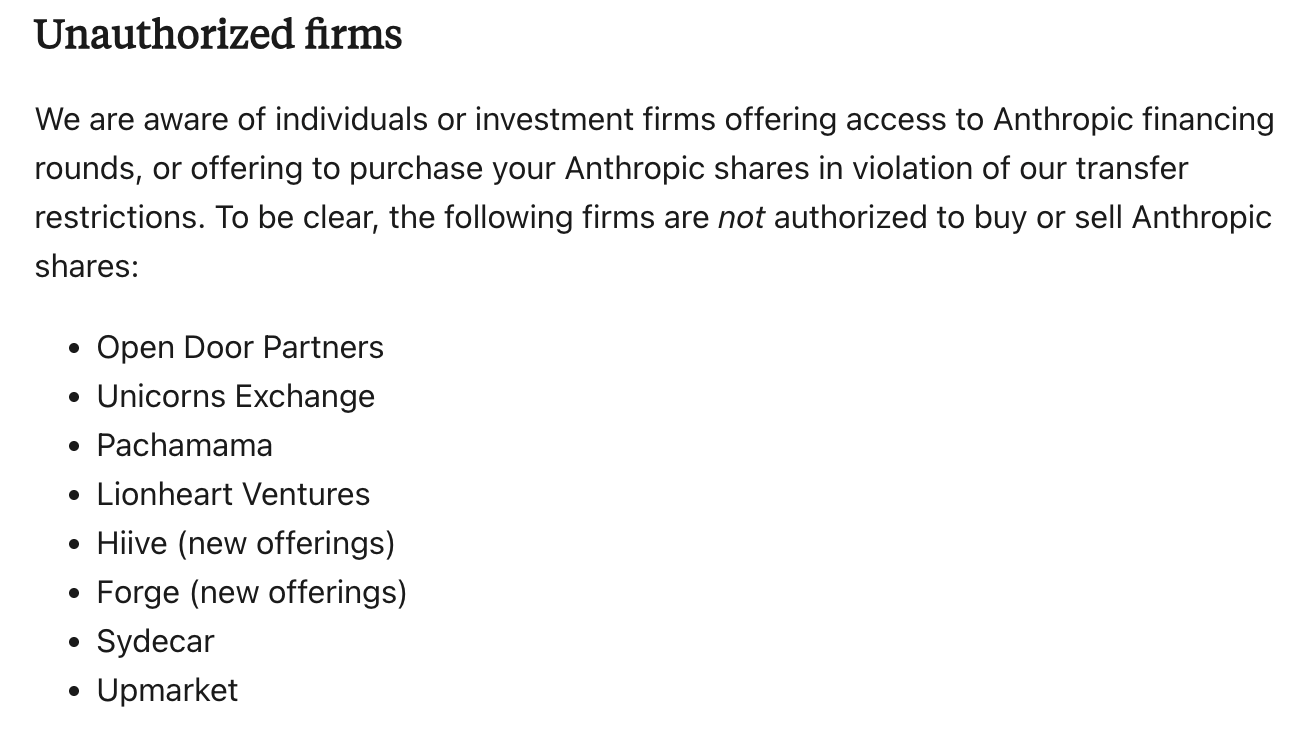
- Note from Odaily: The image shows unauthorized equity transfer platforms named by Anthropic.
What is an SPV?
To understand why this update has such a massive impact on the pre-IPO stock token market, one must first understand what an SPV is.
In traditional pre-IPO stock trading, directly transferring original shares is extremely difficult, not only due to company charter restrictions but also involving complex legal procedures. It is in this context that SPVs emerged.
An SPV is a separate legal entity established for a specific transaction or investment purpose. It can be understood as a 'shell company specifically designed to hold a certain asset' – multiple investors can contribute capital to the same SPV, indirectly holding shares of a certain company or class of assets, thereby achieving goals like concentrated shareholding, lowering entry barriers, and optimizing legal and tax structures. SPVs are particularly common in popular pre-IPO stock trading. Since many prominent companies are often unwilling to directly bring in a large number of small shareholders, institutions usually establish an SPV first, which then makes a unified investment in the target company.
For example, what the market calls 'participating in Anthropic or OpenAI share subscription early' essentially means investors first contribute capital to a specific SPV, which then uniformly acquires the unlisted equity of Anthropic.
Currently, most pre-IPO stock token platforms (like Prestock) on the market adopt an SPV structure.
- The platform or its partners register an SPV in a certain jurisdiction. The sole task of this SPV is to buy Anthropic's original shares on the secondary market (usually from employees or early investors);
- The platform then issues derivative tokens on-chain (e.g., ANTHROPIC or OPENAI). These tokens are legally defined as 'claims on the economic returns of this SPV';
- Ideally, these tokens are pegged 1:1 to the original shares. For every 1 token issued, the offline SPV should hold a corresponding share of the stock.
But the current problem is that Anthropic and OpenAI have now explicitly stated they 'do not recognize unauthorized stock transfers'. This means that if an SPV transfers stock without the board's approval (which is practically impossible to get), the stock held by that SPV might be considered invalid in the eyes of Anthropic and OpenAI – if the SPV's stock is invalid, then the 'economic returns' represented by the on-chain tokens become worthless.
The 'Matryoshka' Risk of SPVs
A major reason Anthropic and OpenAI are so resistant to SPVs is that, as their pre-IPO stock tokens continue to be vigorously traded (Anthropic's pre-IPO valuation once soared to $1.4 trillion, far exceeding its latest funding round valuation), the risk of SPVs being over-financialized has begun to emerge.
Among these risks, the most noteworthy is the 'Matryoshka' problem of SPVs – many investors buying pre-IPO stock tokens think they are buying company shares, but they are actually only buying a claim on the economic returns of a specific SPV. More alarmingly, many SPVs do not directly hold Anthropic's original shares but are actually nested two or three layers deep in other SPVs.
This 'Matryoshka' structure is actually very dangerous.
- Legal Transparency Issue: With each additional layer, the authenticity of the underlying asset becomes more obscure. It's very difficult for investors to confirm whether the bottom-tier SPV has obtained board approval for the transfer.
- Management Fee Exploitation: Each layer of SPV charges management fees, performance fees, and dividends. After skimming at each layer, the investor's actual returns are severely diluted.
- Risk of Total Loss: If the equity transfer at any single layer is deemed 'void' by Anthropic, the entire value chain collapses instantly.
For both reputational and investor protection reasons, Anthropic and OpenAI clearly do not want to see this situation develop.
Pre-IPO Stock Tokens Plummet, Contracts Relatively Stable
Once the announcements from Anthropic and OpenAI gained traction, the market reacted immediately.
ANTHROPIC on PreStocks saw a sharp drop, falling below $1000 at one point. As of 12:00, it was reported at $1082, a 20.62% drop in a single day; OPENAI was reported at $1440, a 26.82% drop in a single day.
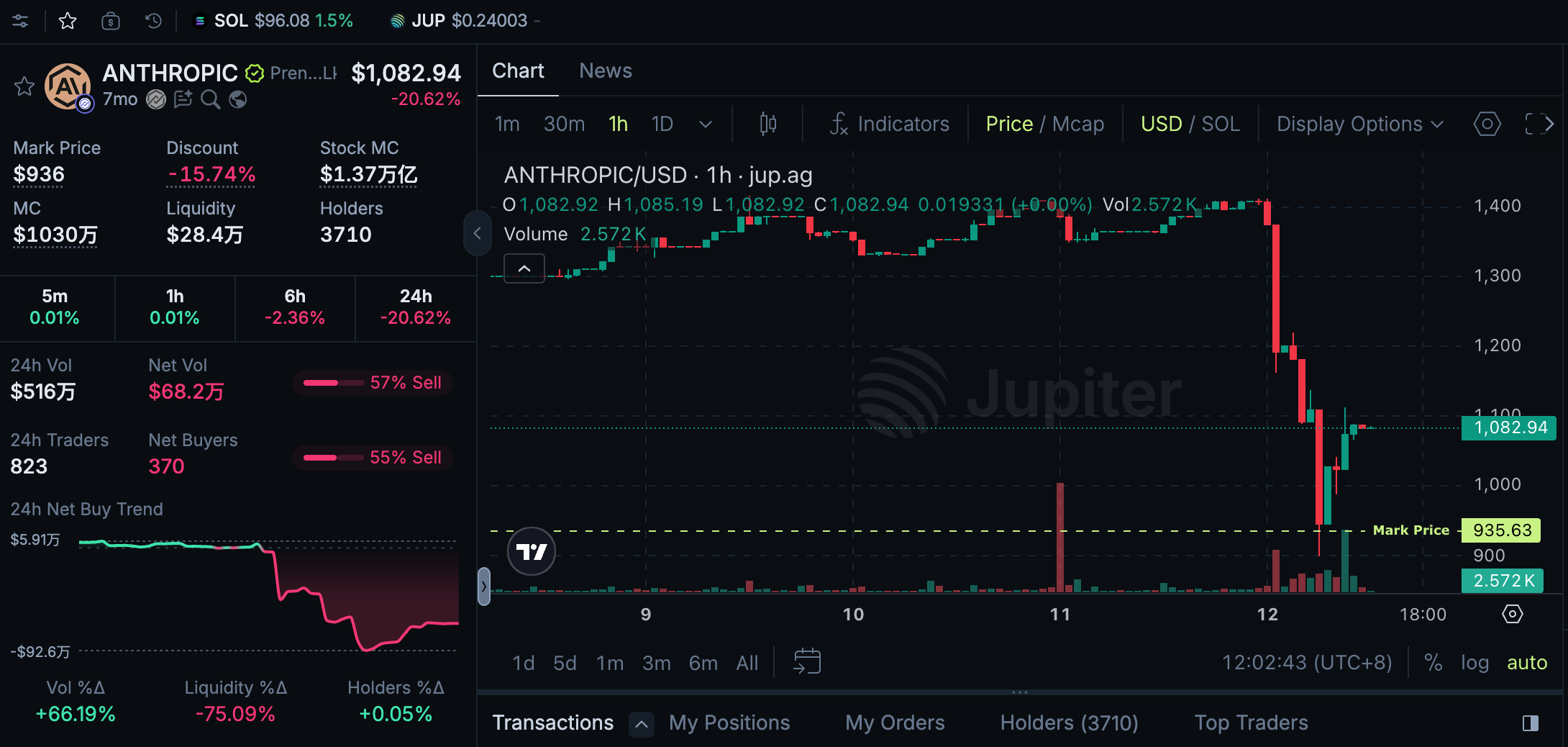
Investor panic is understandable. Since Anthropic and OpenAI clearly stated they do not recognize unauthorized shareholdings, the 'rights and interests' behind these tokens risk becoming 'worthless paper,' and holders may face significant costs in rights confirmation and legal proceedings.
Interestingly, while pre-IPO stock tokens are under pressure, another type of pre-IPO trading product has performed relatively stably – pre-IPO contracts relying entirely on two-way market speculation. The reason for this is that these products fundamentally do not hold any real stock, so the restrictions imposed by Anthropic and OpenAI have no impact on them. They are merely 'bilateral bets' on the future IPO price, relying on price negotiation between buyers and sellers.
Predicting Future Trends
In response to Anthropic and OpenAI's 'non-acknowledgment' stance, two distinct voices have emerged within the industry.
Some believe the logic of pre-IPO stock-token trading is now dead. If leading giants like Anthropic and OpenAI take the lead in cracking down on SPVs, other major players may follow suit. With the underlying equity support shaken, the value of so-called pre-IPO stock tokens is questionable.
However, others, including Rivet founder Nick Abouzeid, believe this is not surprising, trading pre-IPO stock tokens through unofficial channels has always been a gamble, and buyers should have had the awareness from day one that 'the company might not recognize it' – you lack the opportunity for direct investment, and obtaining it through other means always involves taking on certain risks.
In summary, at a time when premiums on pre-IPO stock tokens are continuously expanding and market sentiment is gradually heating up, the statements from Anthropic and OpenAI have certainly thrown cold water on the entire sector.
In the past few months, more and more investors have started to view pre-IPO stock tokens as a 'low-barrier channel to participate in the growth of top AI companies.' The valuations of some AI-themed pre-IPO stock tokens have clearly detached from reality, even leading to frenzied speculation far exceeding their latest funding round valuations. Against this backdrop, Anthropic and OpenAI's public 'fact-checking' is, to some extent, redrawing the boundaries for this wild and growing market.
For speculators, this is a risk lesson; but for the long-term development of the industry, the market might also need such a moment of 'de-bubbling'.