






Reviewing the Four Correct Predictions in the US-Iran Puzzle: Clues Hiding in Public Information


- Core Thesis: By analyzing four typical trading accounts on Polymarket's US-Iran conflict prediction market, this article reveals how systematic bets on "de-escalation," "continued stalemate," or "low-probability events" can generate high returns during periods of high geopolitical uncertainty. The underlying logic is that market sentiment often overestimates the probability of major, short-term changes.
- Key Elements:
- Case 1: All-in on a ceasefire, yielding a 3,503% daily return. An account purchased "Ceasefire by April 7" contracts at an average price of 2.8 cents, exploiting extreme odds. After the ceasefire was announced, it profited $450,000, exemplifying the strategy of "directional bets" and "covering low-probability events in bulk."
- Case 2: Wins big after consecutive losses, netting $510,000. Before the war broke out, an account bet on "US will attack Iran" 21 times, losing $39,000. It finally hit the jackpot on the day of the February 28 airstrike, yielding a 684% daily return. Its strategy was based on a strong conviction that a geopolitical event would "eventually happen," executed by "covering entire time windows."
- Case 3: Large capital bets on "nothing will happen," earning $147,000. An account invested $2.1 million to systematically purchase "No" options on all major contracts, betting that events like "permanent peace" were impossible in the short term. It captured the "premium" generated by optimistic market sentiment, with the core strategy being "arbitrage on insufficient time."
- Case 4: High-frequency trading shorts market panic, profiting $292,000. Through 2,000 trades, an account consistently identified and shorted "Yes" contracts that were overvalued due to panic. It leveraged the market pattern where "gradual stalemate" is undervalued and "major changes" are overvalued in geopolitical markets to achieve steady profits.
- Common Thread: The core logic of all successful accounts is not predicting specific dates or events, but exploiting market sentiment biases. In low-liquidity contracts, market pricing systematically underestimates the probability of sudden geopolitical turning points (e.g., a ceasefire) or overestimates the probability of short-term, dramatic change (e.g., regime collapse).
Original | Odaily 星球日报(@OdailyChina)
Author|jk
On February 28, 2026, a joint US-Israeli airstrike on Iran had already begun. This was less than two hours after Trump posted an 8-minute video on Truth Social, and Khamenei's death had not yet been officially acknowledged by Tehran.
But on Polymarket, the contract asking "Will the US strike Iran before February 2026?" had already reached $0.98.
From February 28 to April 30, Polymarket contracts surrounding the US-Iran conflict generated over $300 million in trading volume. During this period, the market experienced multiple high-volatility nodes: the start of the war, the blockade of Hormuz, the ceasefire announcement, the ceasefire breakdown, and the ceasefire extension. Each major event was accompanied by a drastic repricing of contract prices.
In this article, Odaily dissects four accounts that made significant profits during this period, focusing on one core question: What was the public information environment like when they placed their bets, and was their judgment justifiable at the time?
Case 1: All-in on Ceasefire, 3,503% Daily Gain, Profiting Over $450,000
Account: Fernandoinfante
On April 7, Trump announced a US-Iran ceasefire on Truth Social, causing the "Will there be a US-Iran ceasefire before April 7?" contract to jump from single digits to nearly $1. The beneficiary of this trade was Fernandoinfante, who had previously purchased 477,543 Yes contracts at an average price of 2.8 cents, costing a total of $13,200.
Single trade return: 3,503%, liquidated that day, profit of $450,000, equivalent to over 3 million RMB.
Before April 7, the public information on ceasefire negotiations was as follows: On April 5, Pakistan proposed a two-week ceasefire draft, which Iran formally rejected, countering with a 10-point plan including conditions for withdrawal, compensation, and full lifting of sanctions. On April 6, Trump threatened to expand strikes to power grids and bridges but subsequently delayed by 5 days, stating "negotiations are ongoing." Early on April 7, the market's consensus price for a ceasefire remained extremely low; 2.8¢ implied the market saw the probability of a ceasefire that day as less than 3%.
From a public information perspective, Iran had just rejected Pakistan's draft, Trump was still threatening bombing, there were no formal negotiation channels, and the Strait of Hormuz remained blocked. No mainstream media reported an imminent ceasefire on the evening of April 6.
What was the basis for this judgment?
First, information asymmetry. Polysights noted on Twitter that this trade was placed two days before the ceasefire announcement. If true, the purchase time was around April 5, when Trump had begun to soften his rhetoric (delaying the power grid strike by 5 days), and Pakistan's mediation channel remained open. Some Washington observers had started discussing "Trump needs a result" between April 5-6. A trader consistently tracking negotiation channels could potentially have reacted faster than market pricing to Pakistan's diplomatic moves, but this still requires extremely strong information gathering ability or insider channels.
Second, extreme odds betting. A price of 2.8¢ means that even if the probability of a ceasefire was only 10%, this was still a positive expected value bet. The trader's strategy: in the final stages of a geopolitical contract, systematically buy all low-priced Yes contracts, covering multiple expiration dates with small capital, waiting for one to trigger.
Fernandoinfante also had other losing trades, such as predicting the normalization of the Strait of Hormuz, the achievement of a permanent peace agreement, and the collapse of the Iranian regime (all of which failed), confirming this logic. He was betting on multiple directions simultaneously; the ceasefire was just one that happened to hit.
Of course, his own explanation was "Jesus told him."
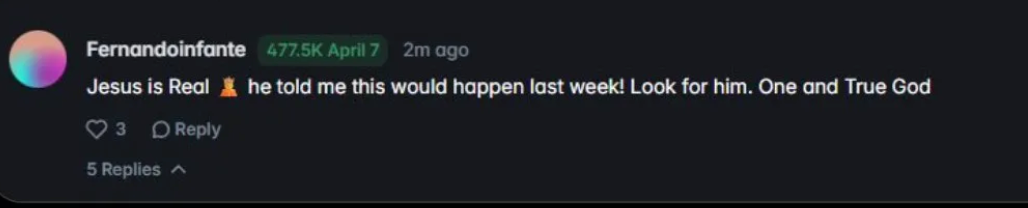
He himself claims to have received divine revelation.
So, what can be learned?
This person wasn't betting on a specific outcome, but rather on the general direction of "de-escalation of the conflict in some way." He bought contracts for ceasefire, permanent peace, Hormuz recovery, and regime collapse, executing a directional bet in a diversified manner.
Ultimately, only the ceasefire contract succeeded, with all others losing money. But one 3,500% return was enough to cover all losses and generate hundreds of thousands of dollars in net profit.
The logic of this structure is that in low-liquidity tail contracts, the market systematically underestimates the probability of sudden geopolitical turning points. When the probability of an event is priced at 2-3%, while the actual probability might be 10-15%, buying a batch of such contracts is reasonable in expected value terms, even if most go to zero.
Case 2: Continuous Losses Bottoming Out, Winning Big on the Last Day: The "Firm Conviction" Strategy
Account: Vivaldi007
Vivaldi007 registered on Polymarket in February 2026, less than three weeks before the geopolitical conflict erupted. From day one, he did only one thing: bet that the US would strike Iran.
His trading record is quite remarkable: Starting February 11, he systematically bought Yes contracts for every deadline – the 11th, 12th, 13th, 15th, 16th, 17th, 18th, 20th, 22nd, 25th, 26th – with average prices ranging from 0.4¢ to 3.6¢. Each trade went to zero, all were losses, totaling approximately $39,000.
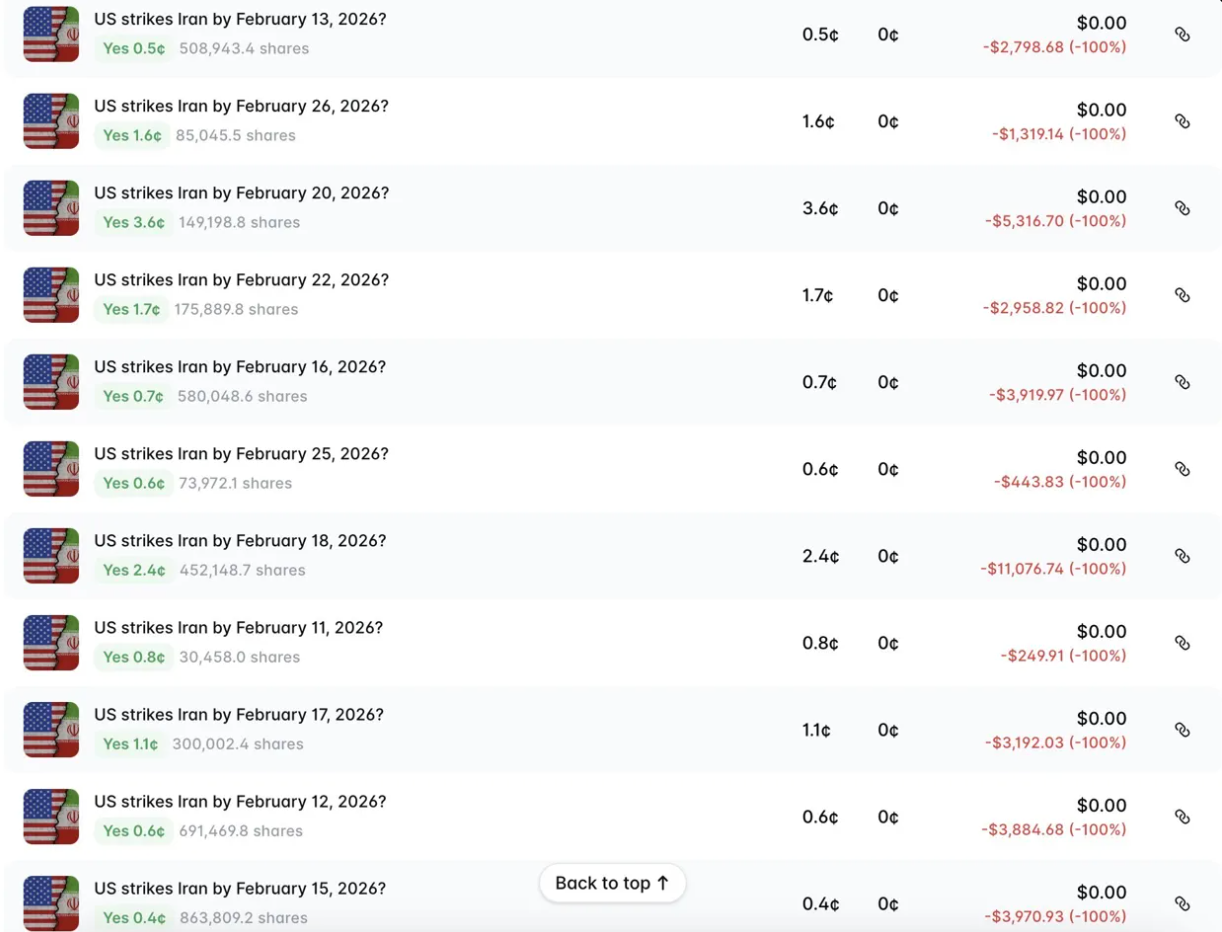
A strategy of persistent failure.
Then, on February 28, the joint US-Israeli airstrike began, and Khamenei was killed that day.
He held 504,416 Yes contracts for the February 28 deadline, with an average price of 12.7¢ and an investment of $63,986. He ultimately profited $437,930, a return of 684%. Combined with the same day's holdings in "Will Khamenei step down?" (bought at 53¢, +88%) and "Will Israel strike Iran?" (bought at 14.9¢, +571%), his total haul from the three contracts that day exceeded $629,000, covering all previous losses and netting $511,098.
Timeline Position and Information Environment at the Time
At the beginning of February when Vivaldi007 registered his account, several important events occurred on the public information front:
On February 6, indirect US-Iran negotiations restarted in Muscat, with Witkoff, Kushner, and CENTCOM commander Brad Cooper appearing on the US delegation list – the direct involvement of the military in negotiations was itself an anomalous signal. On February 13, Trump ordered the USS Gerald R. Ford carrier strike group to sail towards the Middle East. On February 17, Khamenei publicly stated "The US Navy can be sunk." On February 20, Trump gave a 10-day ultimatum and publicly threatened military action. On February 24, in the State of the Union address, Trump claimed Iran had restarted its nuclear program. On February 26, the third round of Geneva negotiations collapsed, with the US delegation leaving "disappointed." On February 27, several foreign embassies began evacuating non-essential personnel from Tehran.
Of course, the precedent of the Trump administration's actions in Venezuela was also an indispensable part of the consideration.
From February 11 to February 27, the market's pricing for "Will the US strike Iran in February?" never exceeded 15¢. The cost of buying all these deadlines was extremely low because the market as a whole still leaned towards the expectation that negotiations would continue.
The Logic of This Strategy
Vivaldi007's operation didn't predict a specific date but laid out positions across all deadlines within a time window, covering as many dates as possible with very low unit costs, waiting for one to trigger.
This strategy has several prerequisites structurally: First, he had a strong conviction about the direction of "the US will eventually strike," otherwise he wouldn't have continued betting from early February to late February. Second, he accepted sustained losses of up to $39,000. Third, his position on the February 28 contract was significantly heavier than on other dates ($63,986 vs. $250-$11,000 per other date), indicating he increased his bet on this specific date at some point, rather than allocating uniformly.
Case 3: Betting $2.1 Million on "Nothing Will Happen": A Large Capital's Strategy for Stability
Account: AdrianCronauer
The logic of this account's operations is completely different from the previous two cases. Fernandoinfante and Vivaldi007 bet on "something will happen," while AdrianCronauer bet on "nothing will happen."
He uniformly bet No on all major Iran contracts before the end of April: a permanent peace agreement will not be reached, Trump will not declare an end to military operations, Iran will not hand over enriched uranium, the Hormuz blockade will not be officially lifted by the US, and a diplomatic conference will not be held before the deadline. Every bet was a No, and every one won.
Compared to the previous two, the returns were not very high; the highest was only 8.45%, the lowest 0.44%. But the principal size made up for everything. Just the single bet "Will a permanent peace agreement be reached before April 30?" involved an investment of $630,305, yielding a profit of $53,257. "Will Trump stop military operations before April 30?" involved $529,058, yielding $10,568. Across 38 predictions with a 79% win rate, he deployed over $2.1 million in principal, accumulating a net profit of $147,464.
Timeline Position and Information Environment
The bulk of these trades were placed between early April and mid-April, the period after the ceasefire announcement but before the negotiations broke down.
When the ceasefire was announced on April 7, market pricing for "permanent peace agreement" and "end of military operations" briefly rose. AdrianCronauer's No positions were partly established during this window: When the market became optimistic due to the ceasefire news, pushing the Yes for "permanent peace agreement before April 30" up to 7-8¢, he bought No at 92¢, locking in the optimistic premium from the counterparty.
On April 11-12, negotiations in Pakistan lasted 21 hours and ended with "no agreement." JD Vance publicly stated that Iran "refused to accept our conditions." On April 13, the US announced a counter-blockade on Iranian ports. On April 17, Iran announced the reopening of Hormuz, only to close it again on April 18. By the time Trump extended the ceasefire on April 21, there were only 9 days left until the April 30 deadline, and negotiations between the two sides were effectively deadlocked.
Against this information backdrop, even a pricing of 7-8¢ for "permanent peace agreement before April 30" or "Trump stops military operations before April 30" seemed overvalued to AdrianCronauer.
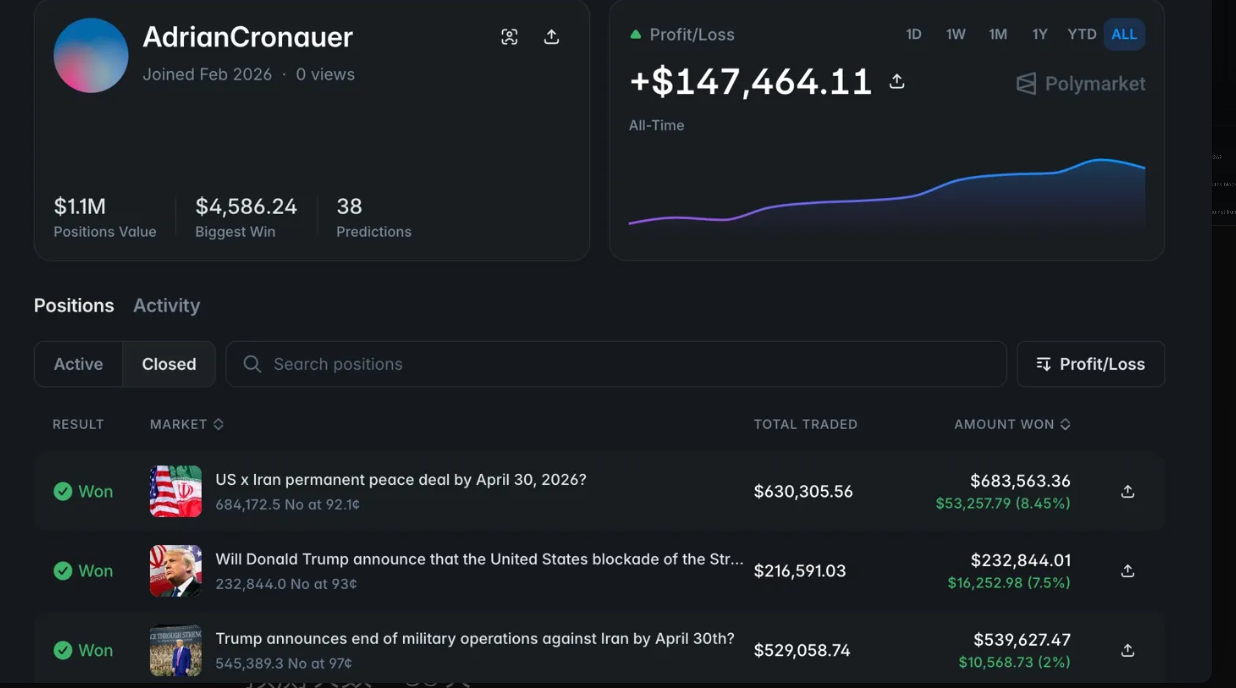
The Core Judgment of This Strategy
AdrianCronauer's operation was based on a relatively simple but continuously verifiable judgment: In highly uncertain geopolitical stalemates, major breakthroughs within short deadlines are always overestimated by the market.
He wasn't betting on specific negotiation outcomes, but on "not enough time." Events like a permanent peace agreement, a declaration ending military operations, or the transfer of enriched uranium, even if they eventually happen, have an extremely low probability of being completed within a few weeks. When the market prices the Yes for such contracts at 1-8¢, the corresponding No is at 92-99¢, offering a return of only 1-8%, but with very low risk. He used scale to replace return rate, spreading $2.1 million across over a dozen related contracts, systematically harvesting the market's optimistic premium.
Where is the risk?
The fatal weakness of this approach is a single black swan event. If Trump had actually declared an end to military operations before April 30, his $529,058 No position would have gone to zero. He bought No at 97¢, meaning he believed the probability of this happening was less than 3%. And Trump's decision-making has always been notoriously unpredictable.
However, based on the entire information environment of April, this judgment was supported: negotiations broke down, bilateral trust was extremely low, the internal leadership in Iran was divided, and the Hormuz strait repeatedly opened and closed. Any one of these conditions made the probability of a "formal agreement within 30 days" extremely slim.
Case 4: How to Replicate Case 3's Effect with Small Capital? The High-Frequency Trading Strategy
Account: 0xcd7..0d127
This account has no single massive profit story. 2,000 trades, $25.9M in total volume, $7,900 average position size, 75.5% win rate, cumulative profit of $292,000.
The PnL curve, starting from June 2025, climbs slowly, steadily, almost linearly to the upper right, with no obvious jumps or significant drawdowns.
The Essence of the Strategy: Systematically Shorting Market Panic
Analyst Jay Godiyadada's observation of this account on X hit the nail on the head:
The historical success rate of the Iranian regime in withstanding external shocks is about 95%, but in a state of panic, the market priced the Yes for "regime collapse" around 20%, causing the corresponding No to be undervalued by 15-20¢. Whenever the market pushed up the Yes price due to some event (declaration of war, leader killed, ceasefire breakdown), this account would take a large position in the No, harvesting that excess panic pricing. Then, as the situation gradually stabilized, it would take profits.
Take the contract "Will the Iranian regime collapse before June 30?" as an example. At the start of the war, when the situation was most chaotic and uncertain, the No price was pushed down to about 91¢, implying a market probability of regime collapse of nearly 10%. The account bought at this point. As the ceasefire took hold and the situation stabilized, the market reassessed the possibility of regime collapse, the No price climbed from 91¢ to 95¢, and the position was already floating a 4% profit.
In summary, this account was essentially swing trading within the prediction market.
The Difference Between This Account and Case 3
The two strategies look similar on the surface but have a key difference: AdrianCronauer is concentrated capital, low frequency, large positions – single bets of $500,000-$630,000, a few contracts, total trades: 29. 0xcd7 is diversified capital, high frequency, medium positions – average of $7,900, 2,000 trades, spanning multiple market categories (Iran, Greenland, Fed Chair), operating continuously for nearly a year.
AdrianCronauer's approach is closer to single-shot arbitrage, while 0xcd7 is closer to market maker logic: continuously identifying Yes contracts overpriced by emotion, systematically shorting them, and accumulating returns through frequency and win rate.
$25.9M volume, $7,900 average position, 2,000 trades
This means the account maintained a very high turnover rate most of the time. This style is very Meme-like; the trader doesn't wait for settlement but continuously scans the market, stepping in when pricing deviations offer a potential 5-10% profit margin. A 75.5% win rate across a sample of 2,000 trades is statistically significant and unlikely to be luck.
The core competency of this account, in Jay's words, is "status quo bias" – a systematic bet on the continuation of the current state. In geopolitical markets, major changes are always overestimated, and gradual stalemates are always underestimated.
Knowing this, and having enough capital and discipline to execute it consistently, is sufficient.


