






US stocks hit new highs day after day, are you starting to get scared?


- Core Viewpoint: Although U.S. stocks are continuously hitting new highs, the upward structure is highly concentrated in a few main themes like AI and semiconductors, and market breadth is deteriorating. The current risk is not that the index has peaked, but lies in position management. Caution is needed for a potential concentrated pullback in the second half of the year, triggered by insufficient delivery on expectations or changing conditions.
- Key Elements:
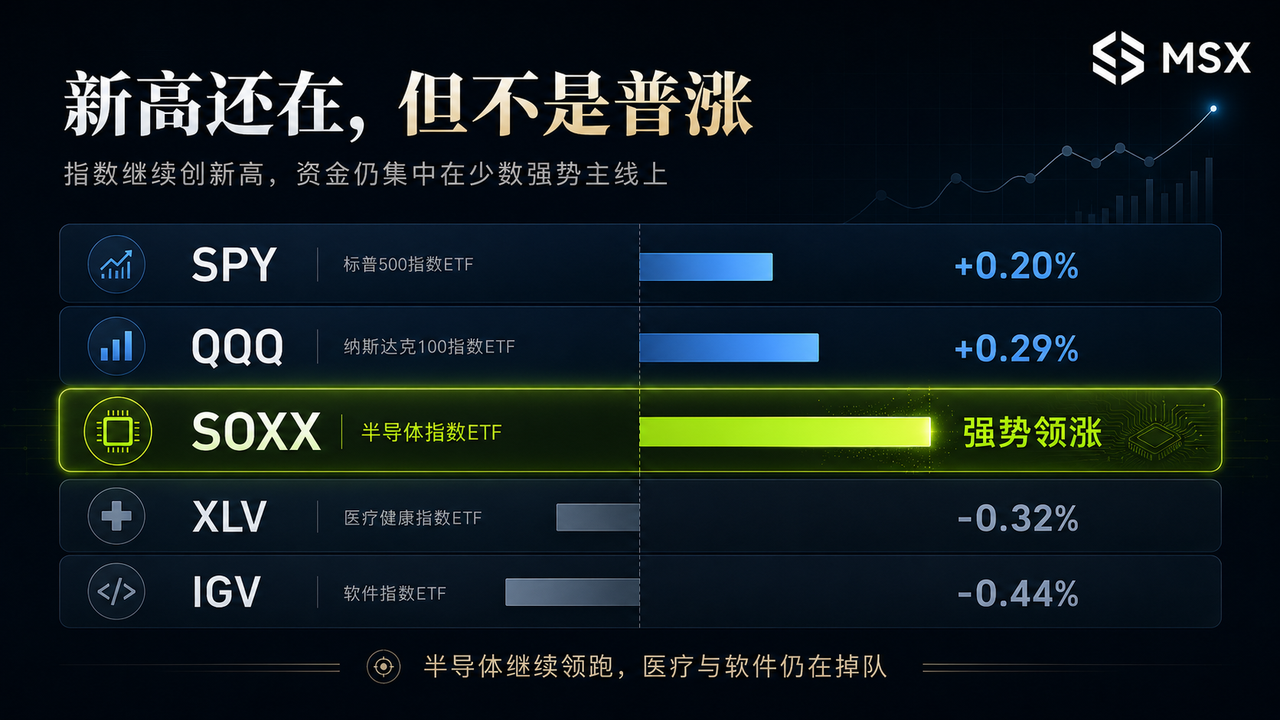
- Significant market divergence: Semiconductors (SOXX.M up 1.74%) and Tech (QQQ.M up 0.29%) strengthened, but sectors like Healthcare (XLV.M down 0.32%) and Software (IGV.M down 0.44%) lagged behind. Capital is only willing to pay for the most certain main themes.
- Evolution of high-market characteristics: The rationale for the rally has shifted from "repairing pessimistic expectations" to "delivering on optimistic expectations," making conditions like earnings reports, orders, and gross margins much more demanding, with greatly reduced room for error.
- Layered operational advice: Core assets (with earnings and orders) can be held, but tactical positions (sentiment-driven, high beta) should be reduced or profit taken according to discipline, avoiding turning short-term profits into long-term convictions.
- Key risk signals: Lagging stocks (like Healthcare, traditional consumer, SaaS) weakening while the index is at highs suggests that future pullbacks will start from these sectors. Software stocks face valuation challenges from AI disrupting traditional subscription models.
- Short-term focus: CPI, PPI, Retail Sales data from May 12-15, along with options expiration, constitute a stress test, examining whether tech heavyweights, semiconductors, and new buying power can continue to support high levels.
- Core verification points for the second half: Specific conditions like acceleration in AI orders, revenue realization, gross margins, cloud capex, and cooperation from interest rates. Overly optimistic expectations have already been priced in; any single link not being strong enough could lead to a rapid pullback.
The US stock market continues to hit new highs, and there's no debate about that.
At the close on May 11th Eastern Time, the S&P 500 rose 0.2% to 7,412.84; the Nasdaq rose 0.1% to 26,274.13, continuing to set new closing record highs.
But being strong doesn't mean it's easy to trade.
The issue now isn't whether the indices are up, but *what* is driving them up. The forces pushing the indices higher are still the same old main themes: AI, chips, semiconductors, and data centers. For example, on May 11th:
- The Philadelphia Semiconductor Index rose 2.6%, Intel (INTC.M) rose 3.6%, and Qualcomm (QCOM.M) rose 8.4%;
- The divergence in ETFs is even more direct: SPY.M rose 0.20%, QQQ.M rose 0.29%, and SOXX.M rose 1.74%;
- But the healthcare ETF XLV.M fell 0.32%, and the software ETF IGV.M fell 0.44%;
Looking at the Maitong asset pool, these core ETFs and related stocks already have clear trading mappings, clearly revealing the market's dynamics. Semiconductors are still surging, the AI hardware chain is still absorbing capital, and the market is willing to pay a premium only for the strongest themes. Meanwhile, healthcare is lagging, software is falling behind, and other sectors are increasingly becoming mere background noise.
In Maitong's view, the focus of current market trading is no longer just whether the indices will continue to rise, but whether the structure and breadth behind the rise can sustain the subsequent rally. We are currently in the most typical state of a high-level market: capital is still willing to go long, but only willing to pay up for the most certain, most crowded, and strongest assets.
Simply put, the market hasn't turned off risk appetite; it just doesn't intend to allocate risk budget to the majority of stocks anymore. So, **when looking at US stocks now, you can't just look at the indices. The stronger the indices, the more you need to look at the structure. The more new highs, the more you need to look at the breadth.**
Because the real trouble at high levels is never that the indices stop rising. It's that the indices are still rising, but the places where you can make money are getting fewer and fewer.
1. Have US Stocks Peaked?
What bothers most people right now isn't getting the direction wrong, but that their positions are starting to feel off.
If they sell, they fear missing out on further short squeezes. If they don't sell, they fear a single pullback will wipe out previous profits.
This is also the most typical state of a high-level market. Because the trend hasn't turned bad, the main themes are still there. AI hasn't fizzled out, semiconductors haven't weakened, and the tech heavyweights are still supporting the indices. As long as the crowding hasn't broken up, US stocks won't automatically fall just because they "look too expensive."
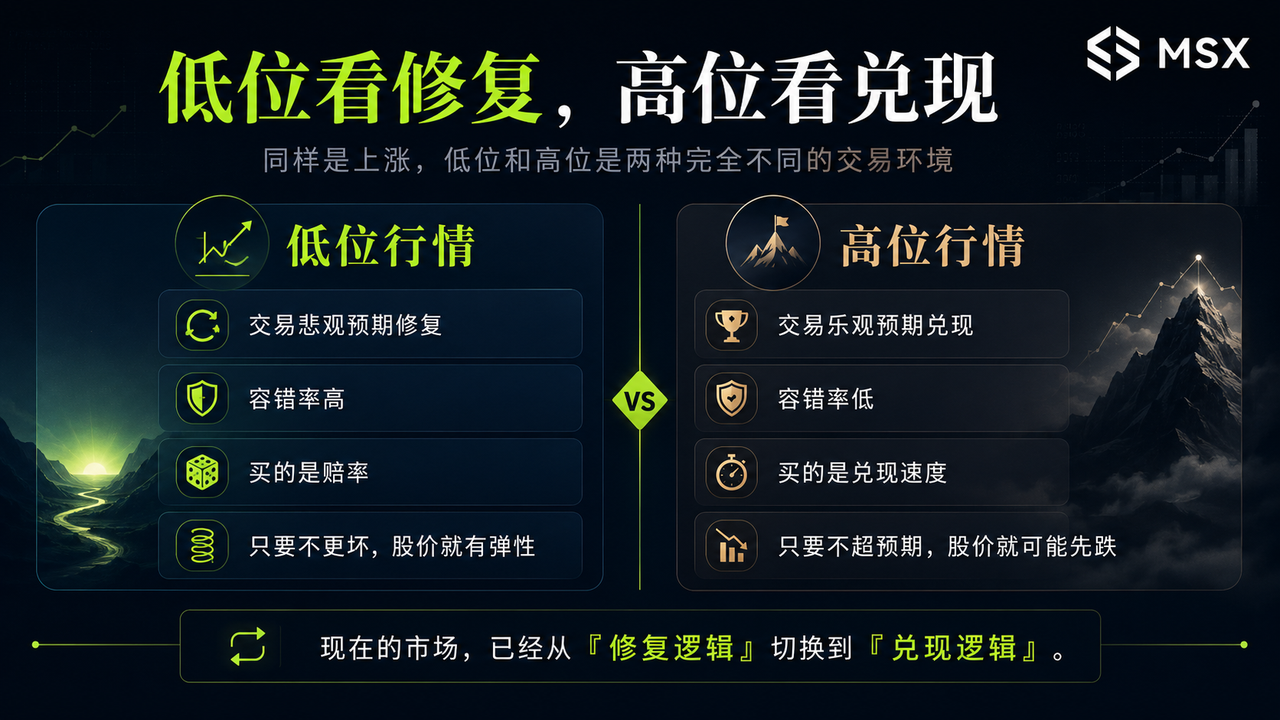
The problem is that the current rally is not the same as a rally from a low base recovery phase. At low levels, the market trades on repairing pessimistic expectations. As long as things don't get worse, stocks have elasticity. At high levels, however, the market trades on the realization of optimistic expectations. As long as there's no further upside surprise, stocks are likely to fall first.
These are two completely different markets.
Low levels tolerate mistakes; high levels almost never do. In other words, **buying at low levels is about betting on the odds, worrying about whether the market will recover. Buying at high levels is about the speed of realization, worrying about *why* prices should be even higher.**
So, objectively speaking, the worst thing to do now is to maintain the mindset from a low-level rally and keep pushing positions higher. Because once earnings reports aren't strong enough, orders aren't fast enough, gross margins don't hold, capital expenditures fall short of expectations, or inflation and interest rates rear their heads again, the sectors that rallied the most are often the first to be sold off.
This isn't because the logic suddenly vanished, but because the price had already factored in the most optimistic part of the logic long ago.
In short, now is not the time to guess the top; it's time to re-examine your positions.
So, have US stocks peaked?
I don't think we can jump to the conclusion that "US stocks have peaked" just yet. That would be premature – the trend isn't broken, the main themes aren't broken, and capital hasn't dispersed.
But these three "not broken" conditions don't mean you can just sit back and do nothing. **What you really need to guard against right now isn't a sudden crash this afternoon or a direct shift to a bear market at tomorrow's open.**
What you really need to guard against is a more significant and concentrated pullback sometime in the second half of the year.
The reason isn't complicated.
This rally has been too concentrated from the start. For example, AI expectations are already fully priced in, the elasticity of semiconductors has been traded to the extreme, options activity is too frothy, and interest rates and inflation haven't really created a comfortable enough environment for high-valuation assets.
As long as these conditions continue to align simultaneously, the indices can of course grind higher.
But that's precisely the problem. The current rally increasingly depends on "all conditions going right." If just one link in the chain breaks, the market could quickly switch from "continued short squeeze" to "focused pullback."
This is especially true given that pricing is already very picky. The market is no longer trading on basic judgments like "will AI grow or not?" Instead, it's trading on whether AI can always beat expectations, whether semiconductors can always outperform, whether capital expenditure guidance can be revised up repeatedly, whether major tech orders can be delivered consistently, and whether high valuations can continue to be justified by even higher expectations. This is the hardest part of a high-level market.
It's not just that bad companies will fall; good companies will fall too. It's not that the main themes have lost their logic; it's that they've become too expensive. So expensive that being merely 'good enough' is no longer sufficient.
Therefore, the most important thing at this level isn't to turn bearish or to keep psyching yourself up for a rally, but to reduce the net risk in your portfolio.
2. How to Operate Now?
In a word: keep what you should keep, reduce what you should reduce.
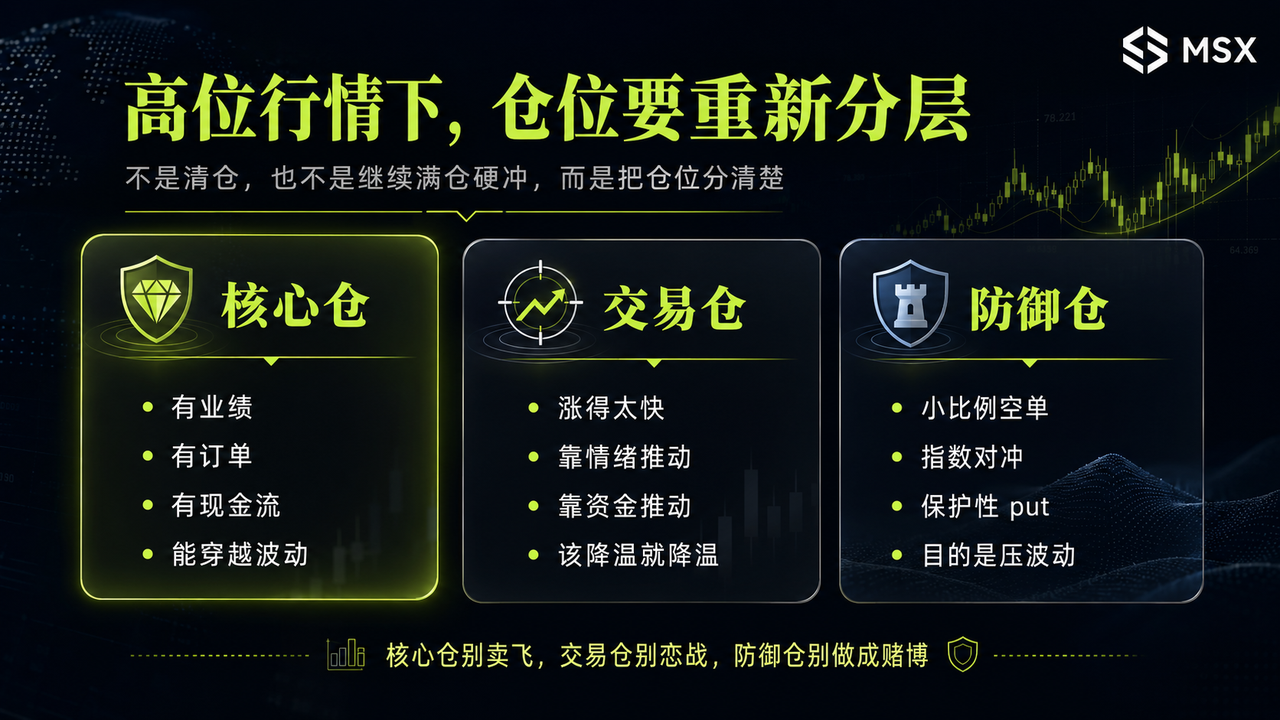
The most important thing to do next is to re-stratify your positions. Ultimately, **not all positions that are rising should be held in the same way.**
For example, core assets with real earnings, orders, cash flow, and industry standing shouldn't be dumped just out of "fear of the high level." Because **the most common and expensive mistake in a bull market isn't losing money; it's selling the real main themes, only to be too afraid to buy them back later.**
But trading positions shouldn't be handled this way. Positions that have rallied too fast, mainly driven by sentiment and capital flows, cannot be justified by long-term logic. They were always trading positions and should be treated as such:
- If they surge on high volume but fail to hold, reduce them.
- If the indices hit new highs but these positions don't follow, reduce them.
- If they break below short-term trend levels, don't stubbornly hold on.
The easiest mistake to make in a high-level market isn't getting the direction wrong; it's treating trading positions as core positions and short-term profits as long-term conviction.
These two things sound like psychological issues, but they are fundamentally account management issues. Core positions can withstand volatility because you're buying longer-term logic and stronger fundamentals. Trading positions cannot. Once a trading position loses its elasticity, it ceases to be a position and becomes a burden.
So, the best thing to do now isn't to deal with all positions at once, but first to ask yourself clearly: which positions are you willing to hold through the volatility? And which positions have you held onto only because they've been rising fast, hard, and intoxicatingly?
The former can stay; the latter needs to cool down.
Beyond this, you also need to pay more attention to lagging stocks moving forward.
For example, on May 11th, SOXX.M continued to rise by 2.39%. What does this tell us?
It tells us the AI hardware chain hasn't burned out, the market's strongest style is persisting, and the crowding hasn't dispersed. But precisely because the strongest direction is still surging, you need to look more closely at the stocks that can't keep up.
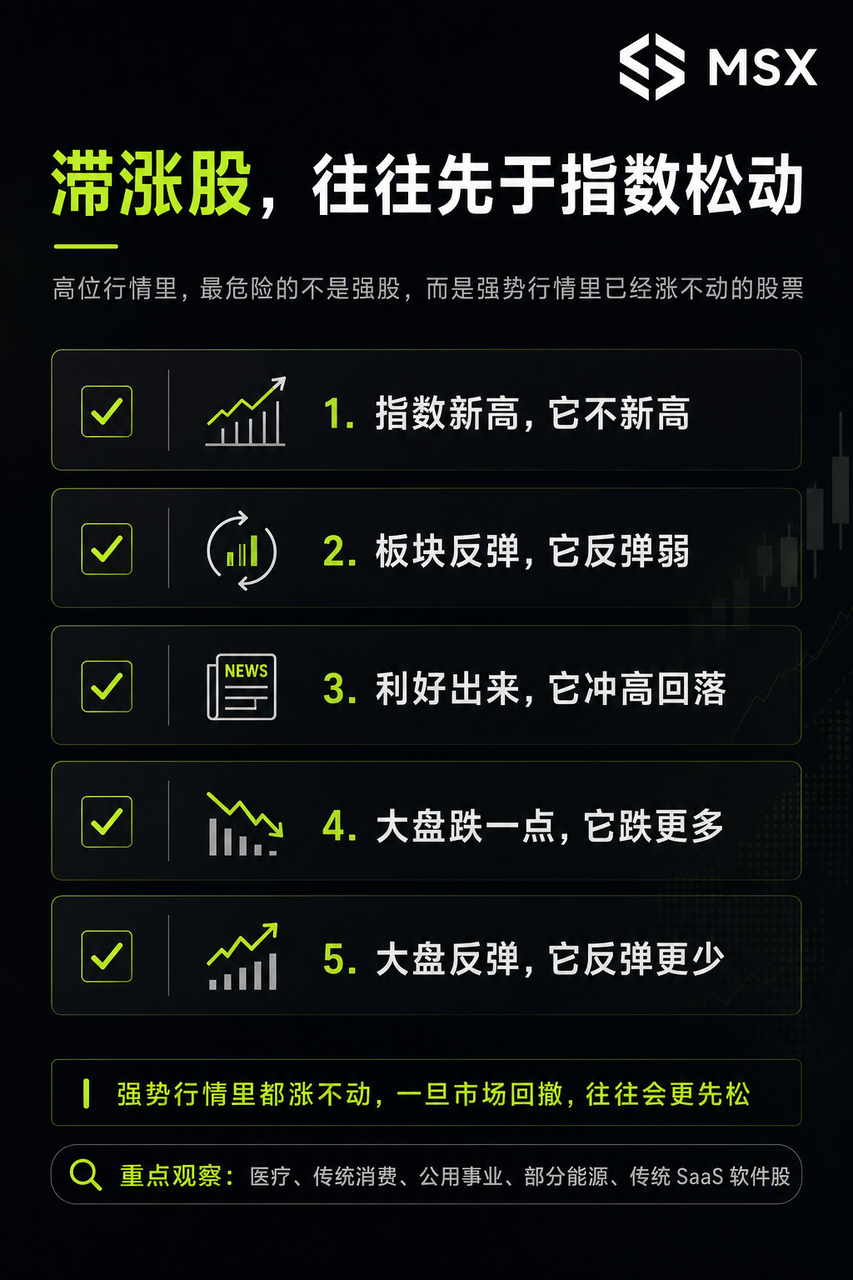
In a high-level market, the most dangerous things are never the ones everyone knows are strong. **The truly dangerous are the stocks that can't keep up when indices make new highs, can't rally when their sector bounces, and fall after positive news is announced.**
These lagging signals aren't complicated:
- Indices make new highs, but the stock doesn't.
- The sector bounces, but the stock's rally is weak.
- Good news comes out, but the stock spikes and falls back.
- The market dips a little, but the stock falls more.
- The market rallies, but the stock rallies less.
These types of stocks are already very dangerous in a strong market.
Because if they can't even rally when the market is good, they often don't play catch-up when the market pulls back – they fall first. Therefore, healthcare, traditional consumer staples, utilities, some energy stocks, and traditional SaaS software stocks can all be put on the lagging stock watchlist.
Software, in particular, deserves special attention. In this AI-driven rally, software hasn't entirely missed out, but the valuation logic for traditional SaaS is becoming increasingly shaky. Companies like Salesforce (CRM.M), Adobe (ADBE.M), ServiceNow (NOW.M), and Intuit (INTU.M) are certainly not bad companies.
The problem isn't company quality; it's that the market is starting to ask a new question: Will AI help them raise prices, expand revenue, and open up new demand? Or will it instead weaken the old story of charging per seat and premiums for tools?
In other words, the software sector is no longer rising together internally.
Capital is now looking very granularly. Who can turn AI into new revenue? Who is just using AI to survive? Who can maintain their valuation? Who is just a legacy of an old model with high valuations?
So **going forward, you can't just focus on the strongest stocks; you must also watch the lagging stocks. Strong stocks determine whether indices can hold steady; lagging stocks determine where a pullback will start first.**
3. The Right Hedge is Defense
At this stage, a portfolio can include defensive positions, but they aren't meant for betting on an immediate market reversal.
If you hold heavy long positions and don't want to easily sell your core holdings, you can use a small proportion of short positions, index hedges, or protective puts to manage volatility.
The key is "small proportion" and "managing volatility."
Simply put, this isn't about reversing your entire position to be bearish, nor is it about betting on a market crash tomorrow. The purpose of short positions here is to buy insurance. Because another common mistake people make at this stage is seeing lagging stocks and thinking they can use them as their main defensive hedge. This isn't necessarily correct.
Lagging stocks can be placed on the watchlist, and you can use a small position for auxiliary shorting after confirming a breakdown, but they may not be suitable as the core insurance for your portfolio.
Because what a defensive position should truly hedge against isn't what you dislike, but what you are most afraid of falling.
If the main risk in your portfolio comes from QQQ.M, semiconductors, and AI tech heavyweights, then what you truly need to hedge is the pullback in these same directions. For example, if you fear a Nasdaq pullback, look at QQQ.M; if you fear a semiconductor pullback, look at the SOX index; if you fear over-concentration in individual stocks, first reduce your high-beta positions yourself.
The worst thing to do at this point is to be fully long the most crowded tech themes while shorting a healthcare or consumer stock that has been weak for a long time, thinking you've completed a hedge.
That's not defense; that's just placing a bet somewhere else.
Always remember, the goal of a defensive position is never to make a lot of money. It is to make your portfolio less painful when the market is painful.
4. The Test on May 15th and a Look Ahead to the Second Half
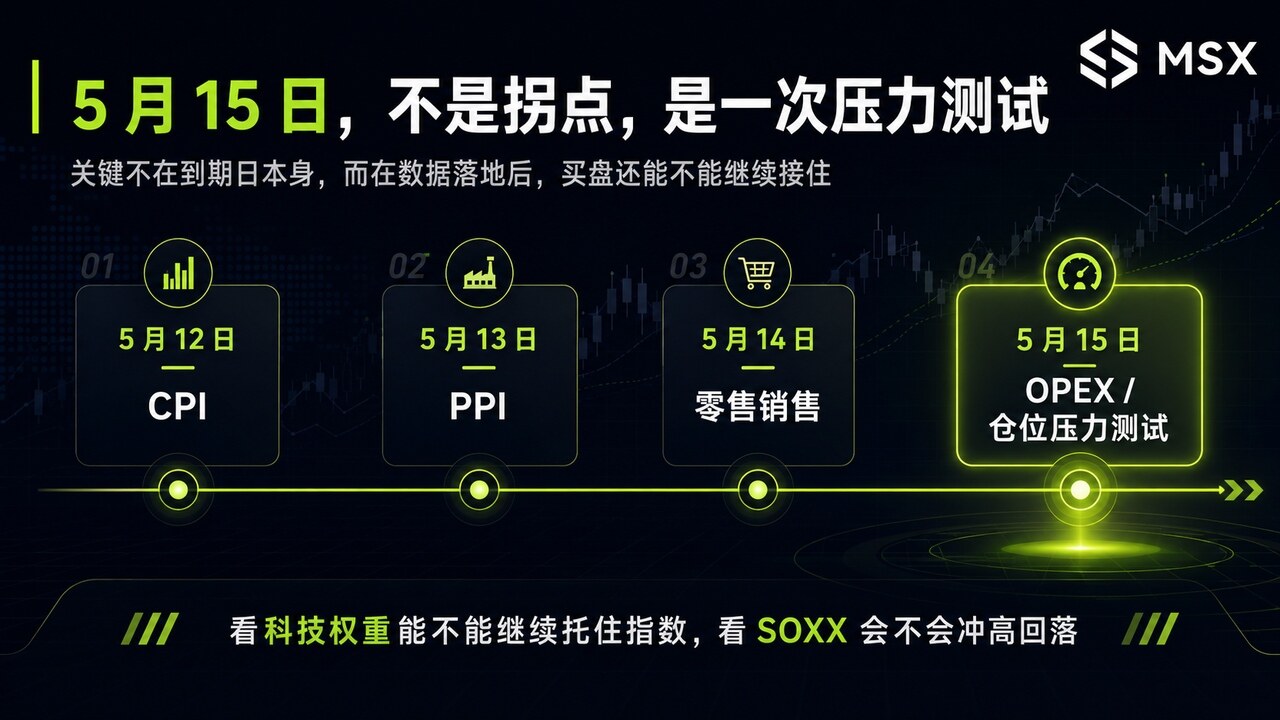
Looking at the short term, May 15th is an unavoidable window.
The reason isn't mysterious. It's sandwiched by a string of important variables. This date is the May standard options expiration (OPEX). At the same time, index options like SPX and XSP have long ceased to be just monthly events; the market's reliance on 0DTE and short-dated options is growing ever stronger.
Therefore, options expiration itself is more worth watching than in the past.
But what truly makes May 15th important isn't "it will definitely fall that day." It's that it falls right after a set of key data releases: April CPI is scheduled for 8:30 AM ET on May 12th; April PPI is scheduled for 8:30 AM ET on May 13th; April Retail Sales are scheduled for 8:30 AM ET on May 14th.
This means the market will first digest inflation, producer prices, and consumer spending data, and then enter the options expiration window. This combination is sensitive enough by itself.
If CPI and PPI are not hot, and retail sales aren't strong enough to reignite rate hike fears, tech heavyweights hold steady, and semiconductors remain strong, then May 15th is more likely to be just a high-level consolidation, or even see bulls pushing prices higher using the expiration structure.
But if the data leans hot, causing interest rates to rear up again, especially if QQQ.M and 





