加密市場宏觀研報:比特幣重返8萬美元,美伊局勢大逆轉與聯準會換帥


- 核心觀點:2026年5月,加密市場處於地緣政治(美伊衝突)、貨幣政策(聯準會換帥)與機構化深化(ETF逆勢吸籌)三重主線交織的複雜節點。儘管宏觀逆風持續,但機構與長期持有者的鎖倉行為及減半週期規律,表明當前更可能為牛市中的深度調整,而非熊市開端。
- 關鍵要素:
- 地緣博弈劇變:美伊「自由計畫」護航行動戲劇性暫停,但荷莫茲海峽實質封鎖風險未消。油價飆升已推高高盛核心PCE通膨預測至2.6%,形成「停滯性通膨式」宏觀環境,雙向壓制比特幣的避險屬性和風險資產估值。
- 聯準會政策十字路口:沃什接替鮑威爾任主席,其「鷹鴿混合」立場及內部分歧加劇政策不確定性。褐皮書顯示能源成本全線上漲侵蝕企業利潤,降息路徑將更曲折,對流動性敏感的加密市場構成中期壓制。
- 機構逆勢吸籌訊號明確:在價格回撤至76,000-81,000美元區間時,現貨BTC ETF單日淨流入高達6.3億美元。截至5月初,ETF總資產淨值達1,037.85億美元,佔BTC總市值的6.66%,表明機構在弱勢中穩健建倉。
- 供需結構深刻變化:自ETF獲批以來,已累計吸收超58萬枚BTC(約三年產量),疊加長期持有者供應量持續上升,雙重鎖倉格局導致實際流通供應收縮,為價格提供隱性底部支撐。
- 減半週期規律驗證:當前時點(2026年5月)處於2024年4月減半後的12-18個月價格發現窗口內。歷史規律顯示此階段多為「洗盤蓄勢」,而非週期頂部,但機構化新環境下的有效性存有不確定性。
1. Geopolitical Game: The Reversal of the "Freedom Plan" in the Strait of Hormuz and the Resurgence of Inflation
On May 4, 2026, U.S. President Donald Trump grandly announced on Truth Social that the United States would officially launch the "Freedom Plan" convoy operation for merchant ships in the Strait of Hormuz at noon Eastern Time that day, deploying missile destroyers, over 100 land and sea-based aircraft, multi-domain unmanned platforms, and 15,000 active-duty military personnel. The U.S. characterized it as a "defensive humanitarian operation," aiming to bypass the 60-day authorization limit for presidential military actions under the U.S. War Powers Act. However, just one day later, Trump issued another statement declaring that, given "significant progress in the comprehensive U.S.-Iran agreement," he decided to suspend the execution of the "Freedom Plan," but emphasized that the maritime blockade against Iran would "continue to be fully and effectively implemented." This dramatic reversal caught global markets off guard, with crude oil prices experiencing violent fluctuations following the announcement.
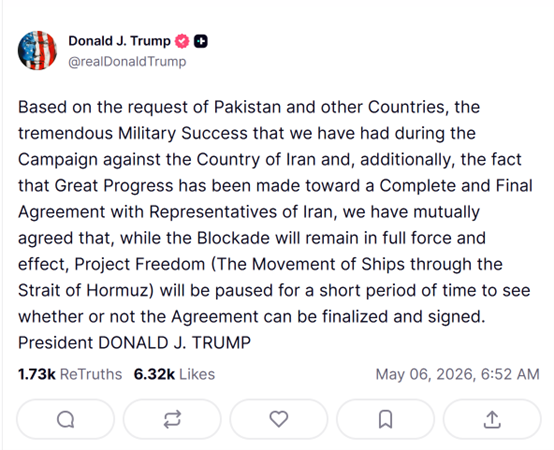
Iran's stance, however, was far more强硬 than the U.S. description. Ali Akbar Velayati, a foreign policy advisor to Iran's Supreme Leader, made it clear that the Strait of Hormuz has been closed and will not reopen "unless the national will of the Islamic Republic of Iran decides otherwise." All ships planning to transit the strait must submit an application via official email and obtain a transit permit from Iran. The Chairman of the Iranian Parliament's National Security Committee warned that any foreign armed forces (especially the U.S. military) approaching or entering the Strait of Hormuz would be targeted. On key issues such as the nature of the ceasefire, the right of passage through the strait, and whether the "Freedom Plan" is genuinely suspended, the positions of the U.S. and Iran are sharply divided, and the market's pricing of geopolitical risk is far from relaxed.
The direct consequences of this geopolitical game have already begun to show in global inflation data. Driven by the dual shocks of escalating U.S.-Iran military conflict and the UAE's announcement on May 1st to withdraw from the OPEC+ alliance, international oil prices continued to rise from late April to early May, pushing energy prices significantly higher. Goldman Sachs subsequently raised its year-end core PCE inflation forecast from 2.5% to 2.6%, and its overall PCE forecast from 3.1% to 3.4%. More concerning is that this inflationary push is not coming from overheated demand but from a supply-side shock (oil prices) coupled with tariff effects. This makes the Federal Reserve's monetary policy response mechanism more complex—hesitant to raise interest rates easily (for fear of exacerbating downward economic pressure), yet finding it difficult to initiate rate cuts (due to the increased risk of de-anchored inflation expectations). For Bitcoin, this "stagflationary" macro environment has historically exerted two-way pressure: its safe-haven attributes have not yet gained widespread consensus, while expectations of liquidity contraction continue to suppress risk asset valuations.
2. On the Eve of Fed Chair Transition: Beige Book Warnings and the Crossroads of Policy Independence
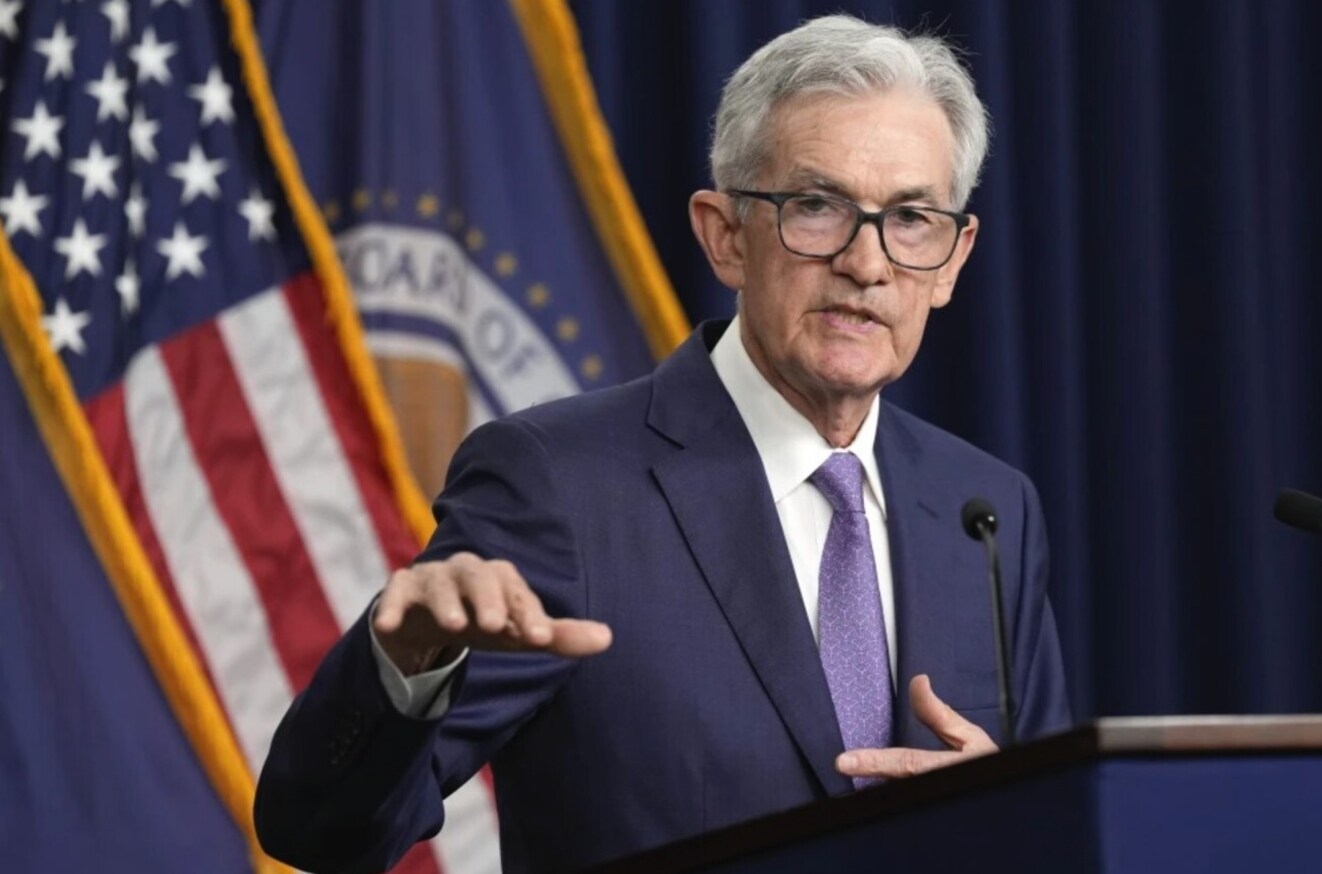
In mid-May 2026, the Federal Reserve is about to witness its most controversial chair transition in modern history: Kevin Warsh will officially succeed Jerome Powell as the Fed Chair. Powell, breaking a 75-year tradition, will continue to serve as a Federal Reserve Governor after stepping down as Chair. This arrangement is widely interpreted by the market as a political compromise indicating an "incomplete decoupling" between the White House and the Fed. Warsh's policy stance presents a delicate "hawkish-dovish mixture": he leans hawkish on inflation management and balance sheet management, emphasizing monetary policy discipline and framework restructuring, and has publicly criticized the Fed's ultra-loose policies over the past 20 years as "severely deviating from its mission." However, he leans dovish on long-term interest rate paths, acknowledging the natural dampening effect of technological progress on inflation and supporting rate cuts when data allows. This mixed stance creates significant divergence in market expectations regarding monetary policy in the "Warsh era," making it a key source of uncertainty for macro pricing in the crypto market in May.
The FOMC meeting that concluded on April 30 was Powell's last as Chair. As widely anticipated, the federal funds rate was held steady at 3.50% to 3.75%. The signals from the post-meeting statement and Powell's press conference were complex: on one hand, the impact of rising energy prices on inflation "has already begun to emerge and may expand further in the short term," and Powell explicitly stated that "currently, no officials support a rate hike, but some officials advocate for reducing the accommodative tone of the post-meeting statement." On the other hand, Powell emphasized that he would "not become a shadow chairman" after leaving office, attempting to soothe market concerns about damage to the Fed's policy independence. However, just days after the meeting, internal Fed divisions surfaced: Trump-nominated Governor Stephen Milan cast a dissenting vote in favor of a rate cut, while hawkish figures like Cleveland Fed President Beth Hammack and Minneapolis Fed President Neel Kashkari also voted against the decision (but in favor of holding rates steady). The deep internal division at the Fed casts a shadow of high uncertainty over Warsh's first FOMC meeting.
The Beige Paper released by the Federal Reserve on April 16 provides valuable grassroots insight into the current state of the U.S. economy. The report showed that 8 of the 12 Federal Reserve Districts experienced slight to modest expansion, economic activity was essentially unchanged in 2 Districts, and 2 Districts saw a slight to modest decline. The most closely watched inflation-related statement was: "Energy and fuel costs increased substantially across all 12 Districts." Businesses generally reported that input cost increases outpaced selling price increases, squeezing profit margins. Business decisions regarding hiring, pricing, and capital investment became more complex, with "wait and see" being the most common business strategy. For crypto assets, the core signal from the Beige Paper is that while the U.S. economy is not in recession, its growth momentum is being eroded by energy inflation. The Fed's path to rate cuts will be more tortuous than previously anticipated by the market, which constitutes a sustained constraining macro backdrop for the crypto market, known for its sensitivity to liquidity, in the medium term.
3. Deepening Institutionalization: Counter-Trend ETF Inflows and Mining Company Balance Sheet Optimization
Against the backdrop of a significant pullback in Bitcoin's price from its highs, the counter-trend buying behavior by institutional investors emerges as the most noteworthy structural signal in the crypto market in May 2026. According to SoSoValue data, on May 1st (Eastern Time), U.S. spot Bitcoin ETFs recorded a net inflow of a massive $630 million in a single day, with BlackRock's IBIT leading at $284 million and Fidelity's FBTC ranking second with $213 million. On May 4th, spot ETFs again saw a net inflow of $532 million. This capital flow shows a significant divergence from the BTC price trend: the price has been oscillating in the $76,000 to $81,000 range, yet ETFs continued to see net inflows, indicating institutional steady accumulation during a price weakness, rather than the retail investor pattern of chasing highs and selling lows. As of early May, the total net asset value of U.S. spot BTC ETFs had reached $103.785 billion, accounting for approximately 6.66% of BTC's total market cap. The continuous rise in institutional holdings is fundamentally altering Bitcoin's price discovery mechanism—transitioning it from a highly volatile speculative asset dominated by retail investors towards an asset class for institutional allocation.
From a broader perspective, the deepening institutionalization is reshaping Bitcoin's supply-demand balance sheet. Since the approval of U.S. spot Bitcoin ETFs in January 2024, the ETF channel has accumulated over 580,000 BTC, an amount equivalent to roughly three years of Bitcoin network issuance. Simultaneously, the supply held by long-term holders has been increasing steadily since mid-February 2026, indicating that long-term investors' willingness to hold actually rises during price corrections. This dual "institutional + long-term holder" lock-up pattern is causing the actual circulating supply of Bitcoin to contract continuously, providing implicit bottom support for the price amidst a macro headwind.
4. Bitcoin Returns to $80,000: Halving Cycle Patterns and the Bull-Bear Dialectic at the Current Node
At the point of early May 2026, Bitcoin is staging a key drama of a strong comeback from a deep correction. BTC hit a low near $60,000 in early February, then rebounded strongly and reclaimed the $80,000 mark in early May, representing a gain of over 33% from the bottom of this correction. This "return to $80,000" still represents a drawdown of about 46% from the all-time high set in October 2025. However, compared to the panic selling by retail investors and massive mine shutdowns during the bear markets of 2018 and 2022, this 2026 correction displays distinctly different structural characteristics: continued net ETF inflows, rising long-term holder supply, and leading mining companies optimizing balance sheets rather than cutting production and leaving. These signals collectively point to the assessment that the current situation is more likely a "deep correction within a bull market" rather than the "bull market has ended" start of a bear market.
Looking at the pattern of halving cycles, Bitcoin completed its fourth halving in April 2024 (block reward dropping from 6.25 BTC to 3.125 BTC). Historical data shows that the 12 to 18 months following a halving are typically the most intense period of price discovery. After the 2012 halving, BTC broke its previous ATH about 12 months later; after the 2016 halving, the main rally began roughly 17 months later; after the 2020 halving, it took about 12 months to reach the cycle peak. Using this historical pattern as a reference, the 12 to 18-month window following the April 2025 (Note: original text says 2024, but context implies the next halving cycle analysis) halving corresponds to April 2026 to October 2026, which is precisely the current period. This suggests that the current price correction is highly likely part of the "shakeout and accumulation" phase after the halving, rather than the cycle's top reversal. Of course, there is high uncertainty about whether this historical pattern remains valid in the new environment of deepening institutionalization.
From a technical perspective, the core battle range for Bitcoin after the "return to $80,000" is between $76,000 and $83,000. $80,000 itself is an important psychological level and short-term support, while $83,000 is the location of the 200-day simple moving average, a "bull-bear dividing line" fiercely contested by both sides. A confirmed daily close above this level would target the $89,000 to $94,000 range. On the downside, $76,000 is a low tested multiple times in April 2026; if lost, the technical downside target would point to the $70,000 to $65,000 range. Looking at momentum indicators, the RSI-7 has risen to 71.27, nearing overbought territory, suggesting short-term technical pullback pressure exists. However, the MACD formed a golden cross in mid-April, providing some momentum support for an intermediate-term upward move. Synthesizing the technical signals, the most reasonable assessment at this juncture is: BTC is in a "confirmation phase after the return to $80,000." Range-bound consolidation may persist for another 2 to 4 weeks until clear signals from macro catalysts emerge.
5. Outlook: Three Scenario Projections and Key Observation Nodes
Synthesizing the three main lines of geopolitics, Fed policy path, and institutional capital flows, the crypto market from May to July 2026 may evolve along the following three scenarios.
Scenario 1 (Probability ~35%): Geopolitical Détente + Dovish Fed Signals, BTC Challenges $89,000-$94,000. If the U.S. and Iran reach a substantive framework agreement within the negotiation window opened by the suspension of the "Freedom Plan," allowing the Strait of Hormuz to return to normal transit, oil prices fall from highs, and inflation expectations cool accordingly. Simultaneously, Warsh releases dovish signals in his first public speech after taking office on May 15th. The simultaneous warming of these two main lines would trigger a "double boost" effect: a significant recovery in risk appetite, accelerated ETF inflows, and BTC could break through $83,000 (200-day MA) within 2-4 weeks and challenge the $89,000 to $94,000 range. Key observation nodes for this scenario include: Warsh's inaugural speech around May 15th, the April U.S. non-farm payrolls report released on May 8th, and phased announcements regarding U.S.-Iran negotiations.
Scenario 2 (Probability ~45%): Protracted Geopolitical Stalemate + Fed Maintains Wait-and-See, BTC Consolidates in $70,000-$85,000 Range. This is the most amply priced neutral scenario by the market. The U.S. and Iran fail to reach a comprehensive agreement within the 4-week ceasefire period, but no new large-scale military conflict erupts, maintaining a "semi-blockade" status in the Strait of Hormuz. The Fed, under Warsh, maintains a "data-dependent" stance. In this scenario, BTC is most likely to maintain a wide-range consolidation pattern. ETF flows will be the most direct driver of short-term prices: if weekly net inflows remain above $300 million, prices will tend towards the upper bound; should net outflows reappear for a week, prices will test the lower bound support. Range-bound trading would be the most suitable strategy for most investors in this scenario.
Scenario 3 (Probability ~20%): Escalated Geopolitical Conflict + Runaway Inflation, BTC Retraces to $65,000-$70,000 Range. If the ceasefire collapses completely, Iran announces a full blockade of the Strait of Hormuz, pushing oil prices above $120 per barrel, forcing Goldman Sachs to further revise up its year-end PCE forecast. Hawkish Fed officials publicly discuss the possibility of "raising rates if necessary to combat inflation." This macro "perfect storm" would simultaneously impact liquidity expectations and risk appetite. BTC could break below the $70,000 psychological level. Although the probability is relatively low, if it occurs, leveraged positions in the crypto market would face systemic liquidation pressure. In this scenario, cash and short-term Treasuries are the optimal holdings, and Bitcoin positions should only be established after confirming the macro turning point.
6. Conclusion: Identifying Structural Signals Amidst the Macro Fog
The crypto market in May 2026 stands at a historic confluence of three main lines: geopolitics, monetary policy, and the institutionalization process. The dramatic reversal of the "Freedom Plan," the policy uncertainty brought by the Fed chair transition, the verification period for Bitcoin's post-halving cycle patterns, and the structural change of sustained counter-trend ETF accumulation collectively form an extremely complex and rich macro landscape. For investors, the key to navigating this phase lies in distinguishing "noise" from "signals": the back-and-forth of geopolitical events and the hawk-dove debates of Fed officials are essentially short-term noise. They affect prices intraday to weekly but cannot change the medium-term trend direction pointed to by the structural signals of deepening institutionalization and post-halving supply contraction.
Macro headwinds are often the best friend of long-term allocators. The macro pressures Bitcoin faces in May 2026—rising oil prices, the Fed's hawk-dove uncertainty, ongoing geopolitical conflict—are actually quite mild compared to the darkest moments of the March 2020 "liquidity crisis" and the 2022 "FTX collapse + aggressive Fed rate hikes." Meanwhile, the continuous rise in institutional holdings, the ongoing expansion of ETF product lines, and the fact that leading mining companies can still optimize their capital structures during downturns silently tell a larger narrative: Bitcoin is gradually evolving from a fringe speculative asset to a permanent member of the global asset allocation landscape. This process is fraught with volatility, but the direction is clear. We recommend focusing on three key variables: First, Warsh's inaugural speech around May 15th will determine the re-pricing direction for rate cut expectations. Second, substantive progress in U.S.-Iran ceasefire negotiations within the 4-week window will determine the evolution path for oil prices and inflation expectations. Third, if U.S. spot BTC ETF weekly flows show net inflows exceeding $500 million for two consecutive weeks, it would be the most direct signal of accelerated institutional accumulation. The macro fog will eventually lift, and those investors who maintain composure and identify structural signals within the fog will be the most composed winners in the next market move.