美國政府停擺難,因為兩黨早已算好這筆賬


- 核心觀點:文章分析認為,美國政府1月底再次停擺的可能性正在降低,因為當前撥款僵局本質上是兩黨為年底中期選舉進行的政治博弈,為避免留下政治污點並影響選情,雙方有較大動機通過妥協(如臨時撥款法案)來化解危機。
- 關鍵要素:
- 預測市場數據顯示,押注美國政府1月底停擺的機率已從高點80%降至42%,反映出市場預期轉向樂觀。
- 停擺爭議焦點在於對國土安全部(DHS)的撥款,民主黨藉ICE執法爭議發難,使共和黨陷入政治被動。
- 雙方核心關切是年底中期選舉,停擺可能造成的經濟民生問題將成為攻擊對方的政治籌碼。
- 民主黨已提出將國土安全部撥款法案與其他五項法案分開審議的妥協方案,為化解危機提供了路徑。
- 媒體報導顯示,白宮與參議院民主黨領袖正在醞釀協議,傾向於通過臨時撥款法案避免政府關門。
Original | Odaily(@OdailyChina)
Author|Golem(@web3_golem)
A major macroeconomic event this month is whether the U.S. government will shut down at the end of January. Last October, the U.S. government shut down for 43 days, and it only resumed operations after the passage of a temporary funding bill, which is set to expire on January 30th. If Congress fails to pass a formal appropriations bill or a new temporary bill, the U.S. government will face another shutdown.
The current dispute between the two major U.S. political parties primarily revolves around funding for the Department of Homeland Security (DHS). Democrats argue that ICE (Immigration and Customs Enforcement) had issues with its enforcement actions in Minnesota, resulting in two fatalities, and thus seek to strictly limit funding and related operations. Republicans disagree, viewing ICE as a crucial force in combating illegal immigration and welfare fraud, leading to a stalemate. (For details on the dispute between the U.S. parties, you can read: 《U.S. Government Shutdown Storm Looms Again, Will the Crypto Market Repeat the Crash Scenario?》)
It is precisely this confrontational stance and the approaching expiration date of the temporary funding bill that have sharply increased the probability of a U.S. government shutdown by the end of January in prediction markets. However, this morning, data from Polymarket shows that the probability of betting on a U.S. government shutdown by the end of January has continued to decline, currently dropping to 42%, down from a previous high of 80%.
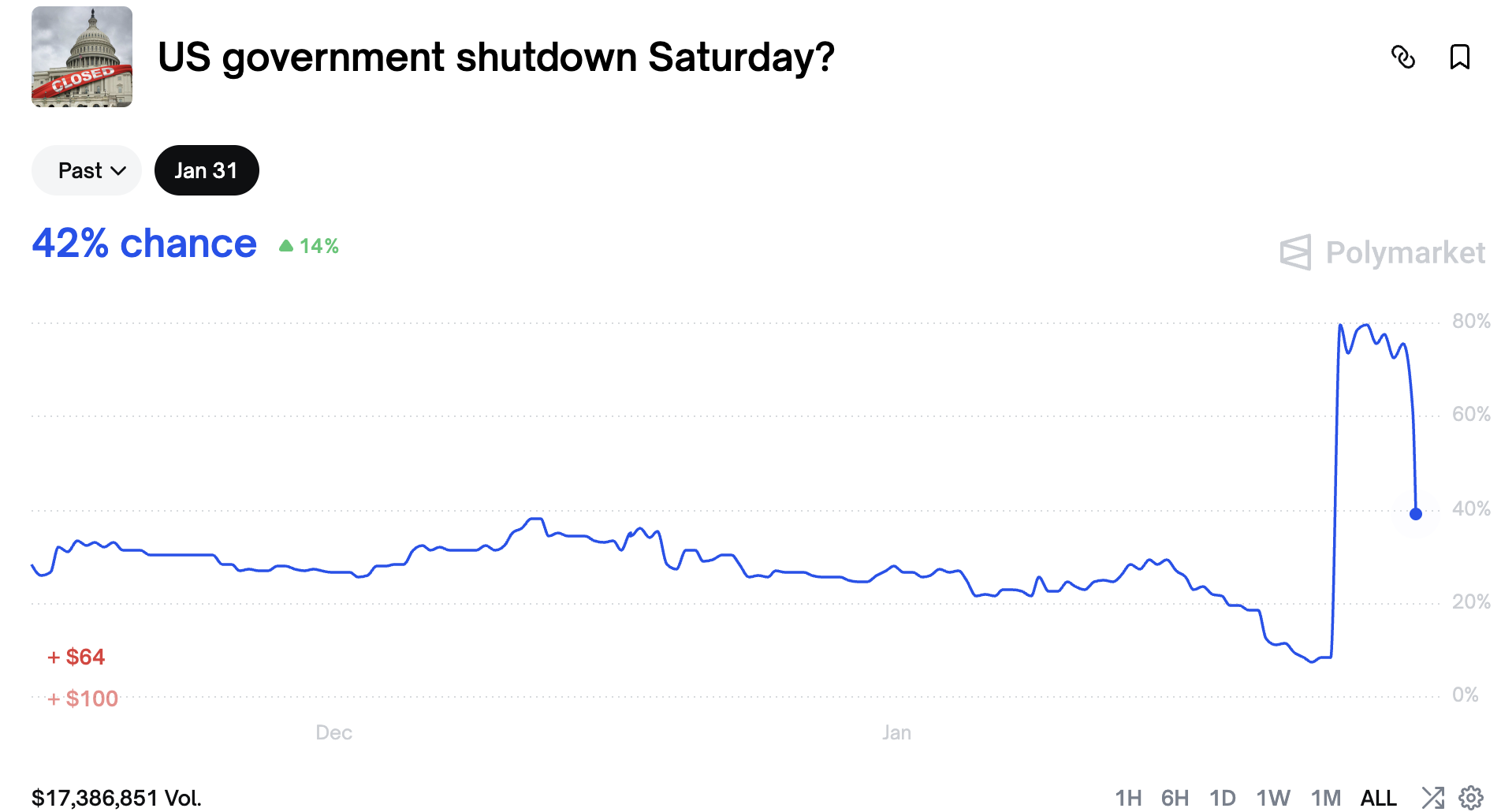
Price changes in prediction markets reflect the outcome of collective wisdom博弈. The rising probability of betting against a shutdown indicates that people believe the previously perceived high certainty of a government shutdown, as suggested by prediction market odds, no longer exists under the current U.S. political situation.
Midterm Elections Are the Key Focus for U.S. Parties
On January 28th, regarding the risk of another potential U.S. government shutdown, U.S. Treasury Secretary Bessent stated that the situation remains unclear but emphasized that President Trump has urged Democrats to avoid this outcome.
This government shutdown crisis is essentially because Republicans gave Democrats a political counterattack opportunity. The January 24th incident in Minnesota, where a U.S. citizen was shot and killed by ICE officers, is fundamentally a result of the Trump administration's intensified immigration enforcement, leading to large-scale public protests expressing dissatisfaction. Democrats seized this opportunity, using it as an excuse in the Senate to block the passage of the funding bill. Because it reflects voter sentiment, Democrats have gained political initiative with this countermove.
Republicans have thus been put in a passive position. If a government shutdown does occur, Democrats could subsequently blame the Republican administration for any resulting economic and social issues (delayed economic data releases, widespread flight delays at airports, etc.).
This series of potential chain reactions will also impact the issue that truly concerns both U.S. parties this year: the U.S. midterm elections.
U.S. "midterm elections" are held in the second year of a presidential term. All 435 seats in the House of Representatives are up for election, and approximately one-third of Senate seats are typically contested. Currently, Republicans hold majority seats in both the House (218 seats) and the Senate (53 seats). For Republicans to maintain their seat advantage after the year-end midterms and reduce governance difficulties, they cannot afford too many political "blemishes" this year.
Furthermore, although midterm elections do not involve the presidential election, they are seen as a "midterm referendum" on the incumbent president, influencing the president's policy direction for the latter two years and reshaping intra-party power structures and the candidate landscape for the next presidential election. Therefore, it is also extremely important for Trump.
From the above analysis, it's clear that this potential government shutdown is no longer a simple funding issue but a political battleground laid out in advance by both U.S. parties for the year-end midterm elections. The Republicans, being in a passive position, have a high probability of compromising to resolve the crisis and矛盾.
For Democrats, if Republicans compromise, it would also constitute a political victory.
Compromise is Already Underway
This U.S. government shutdown crisis is unlikely to be a "full shutdown" like last October's (when all 12 appropriations bills expired). The scale of the shutdown may be much smaller. Funding for the Commerce Department (responsible for releasing GDP data, etc.) and the Agriculture Department (responsible for food benefits) has already been secured. However, approximately 78% of federal government functions—involving the remaining 6 appropriations bills—may face funding lapses.
Democrats have already offered Republicans a way out. Senate Minority Leader Chuck Schumer (D-NY) stated on January 28th that Senate Democrats are "prepared to move quickly on five appropriations bills by the January 30th deadline, separating them from the Department of Homeland Security appropriations bill." This could be a path to avoid a large-scale government shutdown. However, Senate Republicans have not yet agreed to separate the DHS bill from the overall funding package.
On the other hand, demanding amendments to the DHS funding bill before January 30th is unrealistic, as any changes to the remaining six bills would have to be approved by the House of Representatives, which is not scheduled to reconvene until February 2nd.
For Democrats, forcing a government shutdown by being overly rigid about amending the funding bills would not be particularly beneficial and could even reverse the "offensive/defensive dynamic" with Republicans. Therefore, the current consensus between the two parties may be to pass another temporary funding bill, first addressing the potential shutdown, and postponing their矛盾.
Just as Odaily was writing this article speculating about potential compromise to avoid a shutdown, The New York Times also reported that Trump and Chuck Schumer are working on a potential deal to avert a U.S. government shutdown.
According to two informed officials, under the developing plan, the Senate would separate one bill from the six spending bills—the one intended to fund the Department of Homeland Security—to maintain funding for the military, healthcare programs, and other federal agencies for the remainder of the fiscal year. The Senate would pass these bills before the Friday midnight deadline, and Congress would also consider a short-term extension for Homeland Security operations to prevent service disruptions at the TSA, Coast Guard, and FEMA.
It remains unclear how this potential deal will affect this week's appropriations bill votes, but it at least indicates that both the White House and the Senate are working towards resolving the crisis.