






Đầu tư chứng khoán Mỹ lên chuỗi chia làm ba thế lực, mô hình nào gần hơn với hình thái cuối cùng?


- Quan điểm cốt lõi: Năm 2026, đường đua cổ phiếu mã hóa đã đạt được bước đột phá, giúp giao dịch cổ phiếu lần đầu tiên vận hành 24/7. Các sản phẩm cổ phiếu mã hóa chủ thống có sự khác biệt rõ rệt về nguồn thanh khoản, cơ chế giao dịch và hiệu quả vốn, phù hợp với nhu cầu của từng nhà đầu tư khác nhau.
- Các yếu tố chính:
- Bối cảnh ngành: Việc triển khai quy định MiCA tại châu Âu năm 2026 và tiến trình dự thảo Đạo luật CLARITY tại Mỹ đã cung cấp khuôn khổ tuân thủ rõ ràng hơn cho cổ phiếu mã hóa, các sàn giao dịch hàng đầu như Ondo, Bitget, Binance lần lượt đẩy mạnh đầu tư vào đường đua này.
- Mô hình thanh khoản: Ondo áp dụng "kế thừa thanh khoản" (đúc + chuộc lại + chênh lệch giá); rToken kết nối trực tiếp với sổ lệnh của Nasdaq và NYSE; bStocks neo giá thông qua oracle. Ba mô hình đại diện cho các hướng công nghệ khác nhau.
- Khung giờ giao dịch: Cả ba đều quảng cáo hỗ trợ giao dịch 24/7, nhưng Ondo chỉ bao phủ 5 ngày 24 giờ; rToken bao phủ giờ giao dịch trước giờ mở cửa, trong giờ và sau giờ đóng cửa; bStocks dựa vào lưu lượng truy cập của sàn giao dịch để đạt được thanh khoản suốt ngày đêm, hiệu quả khác nhau.
- Hiệu quả vốn: rToken tập trung vào tài khoản ký quỹ thống nhất trong sàn giao dịch, phù hợp với khách hàng tổ chức; Ondo và bStocks thiên về khả năng kết hợp DeFi trên chuỗi, phụ thuộc vào hệ sinh thái giao thức bên thứ ba.
- Tuân thủ và lưu ký: Cả ba đều áp dụng lưu ký có quản lý và xác minh độc lập bên thứ ba, nhưng có sự khác biệt nhỏ về tần suất kiểm toán và mức độ chi tiết công bố, ảnh hưởng không lớn đến nhận thức của người dùng.
In 2026, the opening bell on Wall Street lost its significance for the first time. For the past century, the New York Stock Exchange trading floor dictated when global capital would awaken and when it would sleep, with weekends and holidays strictly observed. This year, that boundary began to blur: the on-chain world, for the first time, gained the capacity to host real order flow from the Nasdaq and NYSE, creating a system for stocks—the oldest form of financial assets—to operate 24/7.
This major shift is inseparable from the dense breakthroughs in the tokenized stock sector since 2026. The MiCA compliance framework in Europe is gradually taking shape, while the draft of the U.S. CLARITY Act provides clearer legislative references for digital asset classification. Multiple leading exchanges and fintech platforms have successively ramped up their stock tokenization product lines.
Ondo Global Markets, the pioneer in tokenized stocks in the West, pushed its asset scale to the billion-dollar level within months while simultaneously advancing the SEC registration process. Bitget's rToken connects directly to Nasdaq and the NYSE, transforming U.S. stocks into tradable, collateralizable, and reusable crypto-native assets through unified trading accounts, margin applications, and high-frequency reserve audits. Binance also launched bStocks in June, leveraging the native traffic of the largest exchange for rapid expansion.
Although most tokenized stock products from exchanges use similar descriptions like "24/7 trading" and "1:1 backing," there are significant differences in their liquidity sources, trading mechanisms, capital utilization, and underlying risk structures.
To gain a deeper understanding, Odaily reporters will conduct a horizontal comparison across four dimensions: liquidity source, trading session availability, capital efficiency and composability, and compliance licensing and custody transparency. Combined with market size and order book data, we will analyze the real differences between the three product models.
Evaluation Dimension Setup
The horizontal comparison dimensions used in this article include:
- Liquidity Source and Price Anchoring Mechanism
- Trading Session and Availability
- Capital Efficiency and Composability
- Compliance Licensing and Asset Custody Transparency
These four dimensions address the core concerns of investors: whether the price reflects the actual U.S. stock price, the ability to trade anytime, efficient use of capital, and whether the underlying stock assets are real and verifiable. Finally, we will reference the existing trading volume rankings of different products.
Dimension 1: Liquidity Source Comparison
The price anchoring mechanism is the most crucial structural difference among tokenized stock products and is key to determining the risk of "de-pegging." It directly affects whether traders can enter or exit at real prices during critical moments.
Ondo Global Markets employs an "Inherited Liquidity" model. By combining real-time minting and redemption mechanisms with arbitrageur activity, it maintains the token price close to the underlying stock. This design allows tokens to circulate flexibly on-chain while staying as close as possible to the underlying stock price. rToken, during U.S. stock trading hours, routes spot orders directly to the NASDAQ and NYSE order books via licensed brokers. The execution results are written back to the exchange's spot order records in real-time, making its price and liquidity fully synchronized with the underlying stock market. It is the only product among the three to achieve exchange-level direct order book connection. Binance bStocks determines prices by anchoring to the underlying stock price using oracle data feeds. Leveraging Binance's user base and update mechanisms, it can quickly cover a large number of assets with low barriers, providing users with a real-time price tracking experience.
Each of the three products has different focuses in liquidity anchoring, representing the three mainstream technical paths currently in the industry: direct exchange matching, minting-redemption arbitrage, and oracle tracking.
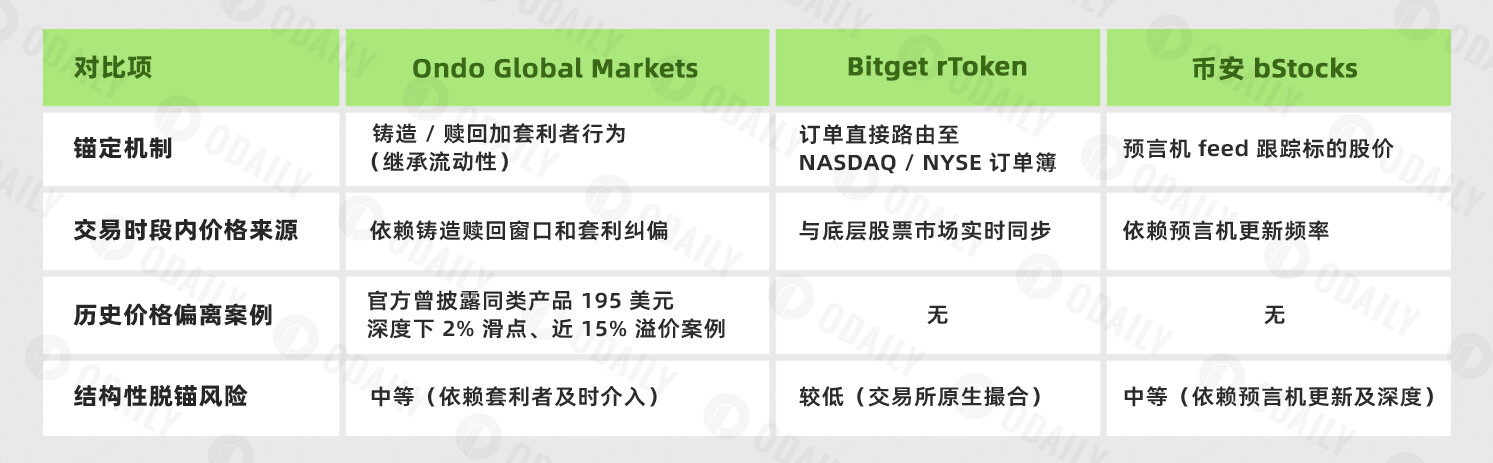
The liquidity anchoring mechanisms of the three are structurally different and suited for different use cases. Ondo's minting-redemption model is better for users accustomed to native on-chain operations and willing to accept some arbitrage correction delay, as well as arbitrageurs. bStocks' oracle tracking offers a lower barrier, suitable for ordinary users seeking convenience and broad asset coverage. rToken's direct order book connection model, from a design logic perspective, is closer to the real price, especially during regular U.S. stock trading hours, offering advantages for traders requiring high price accuracy and low slippage.
We also conducted an actual order book data test. Taking Circle (CRCL) tokenized stock as an example, the quotes and depths on the three platforms at the same time showed different strengths and weaknesses:

In this data set, all three maintained relatively narrow spreads. However, in terms of order book depth and 24-hour trading volume, rToken performed more prominently. Its model of connecting to the native order book of stock exchanges gives it a significant advantage in order absorption capacity and market activity.
Dimension 2: Trading Session and Availability
Regarding 24/7 trading capabilities, all three products claim to support round-the-clock user trading, but there are clear differences in the specific mechanisms.
Ondo Global Markets' minting and redemption window is open 24 hours a day, five days a week. On-chain transfers themselves are not time-limited, offering users flexible asset transfer capabilities, while price discovery depends on the open status of the minting and redemption window. rToken covers regular U.S. stock trading hours, pre-market, intraday, after-hours, and overnight sessions. Some popular assets further support true 24/7 trading, with liquidity provided by Bitget during closed market hours for price discovery, achieving a seamless transition from regular to closed hours. Binance bStocks also emphasizes 24/7 liquidity, near-instant settlement, and zero conversion fees. Leveraging the exchange's native user base, it makes more assets conveniently tradeable at any time.
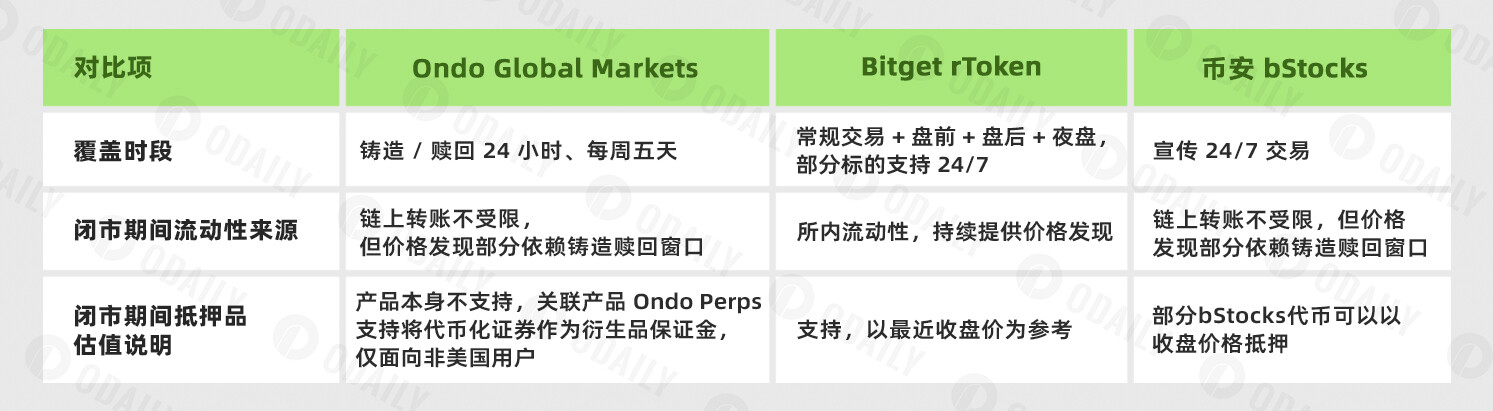
All three offer 24/7 availability as a core capability and have established mechanisms for trading and price volatility risks during U.S. market close. The overall product experience and risk management frameworks are relatively robust. In terms of pure 24/7 availability, Ondo has a slightly shorter coverage time, making Bitget rToken and bStocks potentially more suitable for everyday users.
Dimension 3: Capital Efficiency and Composability
Capital efficiency is a key consideration for institutions and professional traders when choosing tokenized stock products. This specifically concerns whether the asset can be used as margin or collateral and its flexibility for allocation across different accounts and strategies. This is where the practical value differences between products become apparent. Although this aspect is less relevant for small retail investors, it is a core concern for professional traders and institutions choosing to gain exposure to U.S. stocks through crypto assets.
Odaily's assessment results are as follows:
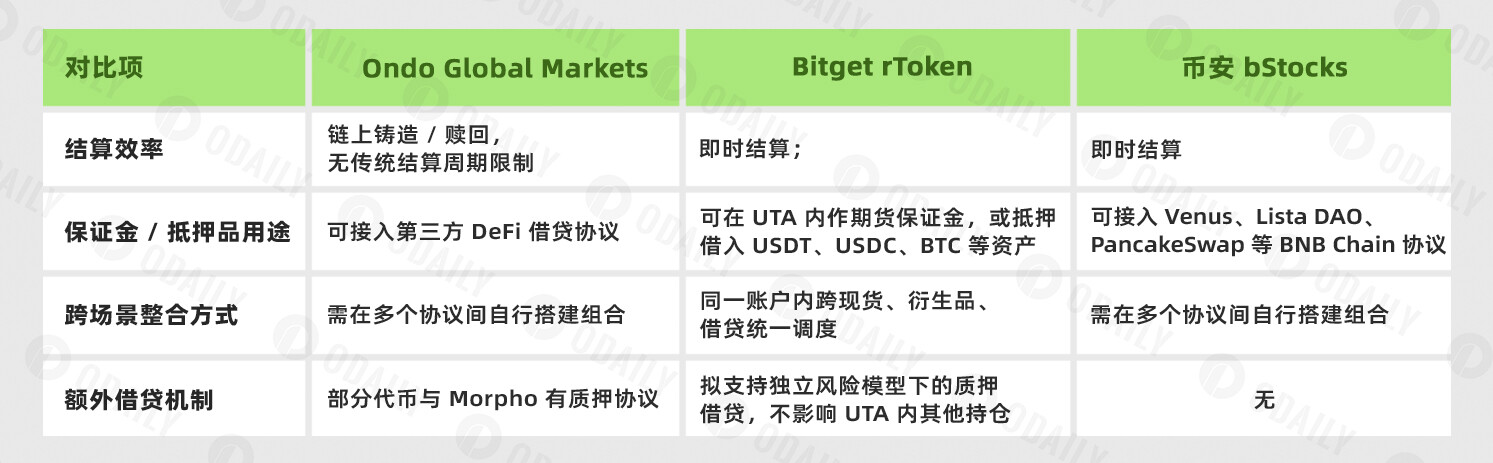
From a design perspective, the capital efficiency functions of the three are distinctly different. Ondo and bStocks lean more towards "on-chain DeFi composability," relying on third-party protocol ecosystems, requiring users to bear cross-protocol operational friction and additional smart contract risk exposure. rToken takes the route of an "institutional-grade unified margin account within the exchange," directly integrating stock positions into derivatives, lending, and other scenarios for multi-asset synergy within the same account system. For users seeking on-chain DeFi functionality, Ondo and bStocks are more suitable. Based on the practical capital efficiency needs of professional and institutional traders, rToken offers more prominent integration and convenience, and aligns better with institutional requirements for risk control.
Dimension 4: Compliance Licensing and Custody Transparency
While trading occurs on-chain, the existence and independent verifiability of the underlying U.S. stock assets are fundamental to building trust in tokenized stock products. How do the different products perform in terms of credibility in this area?
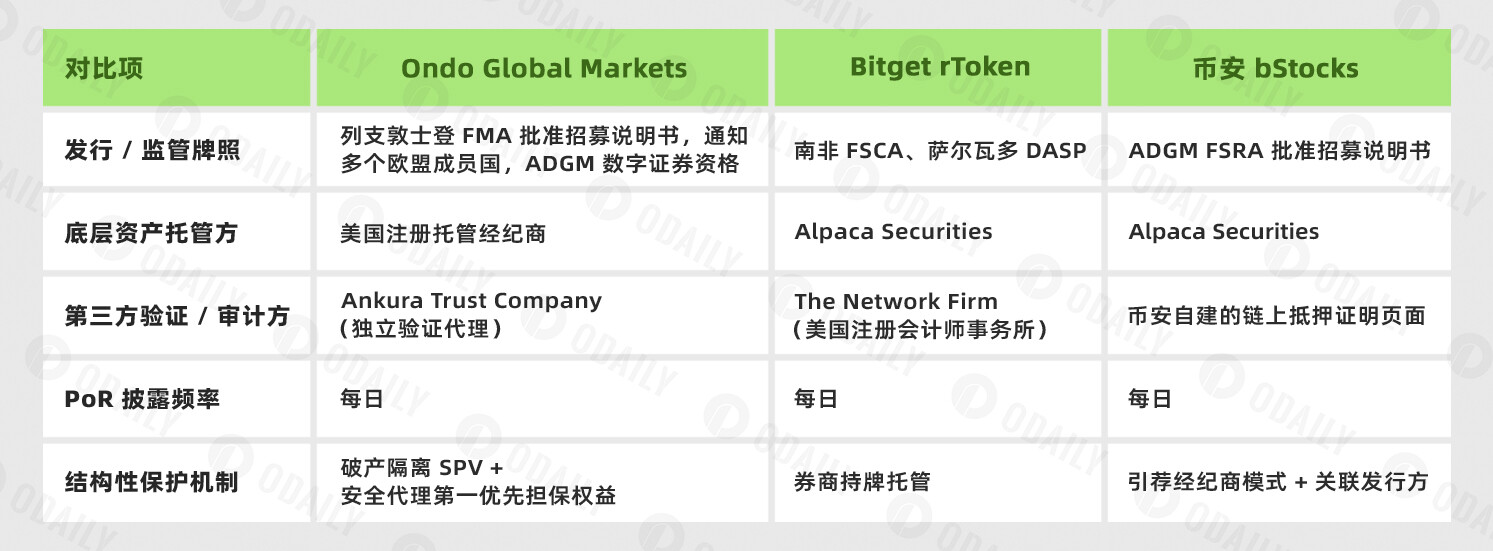
All three employ asset guarantee mechanisms that combine regulated custody with third-party independent verification, establishing relatively comprehensive frameworks in terms of compliance, transparency, and trustworthiness of underlying assets. It is evident that after several rounds of market shakeouts in the crypto space, major players in the tokenized stock sector have implemented maximum safeguards for underlying assets. The differences between them are more apparent in specific arrangements such as audit frequency, information disclosure granularity, and the identity of the third-party verifier, but the perceived user experience differences are minimal.
Conclusion: Three Platforms Cater to Different Investors, Each with Strengths and Challenges
Looking across the four dimensions and market rankings, the three paths respectively address different needs within the tokenized stock sector.
Ondo Global Markets, with its inherited liquidity model and multi-jurisdictional compliance layout, is better suited for institutions and users with high demand for European and American regulatory frameworks. Binance bStocks, leveraging the exchange's native traffic and on-chain ecosystem integration, offers convenience in trading entry points, self-custody, and on-chain circulation, making it suitable for investors already deeply embedded in the BNB ecosystem and familiar with on-chain operations. Bitget rToken, with its diverse product features, is more suitable for high-frequency traders and institutional clients who are sensitive to liquidity, capital efficiency, and cross-scenario asset allocation.
From a longer-term industry perspective, the common challenges facing tokenized stocks are perhaps more noteworthy than the differences between individual products. Issues such as cross-border financial compliance, whether real market demand can keep pace, and accurate pricing during closed market hours still need to be addressed by the industry. As regulatory boundaries gradually clarify and underlying liquidity deepens, different paths will learn from each other through competition, driving this market from early experimentation to maturity. The boundary once drawn by Wall Street is being gradually rewritten with each on-chain transaction.


