






73 lệnh bán, 0 lệnh mua - đây có phải là "chủ nghĩa dài hạn" của ban lãnh đạo Circle?


- Quan điểm cốt lõi: Chủ tịch Circle nhấn mạnh giá trị dài hạn của công ty trong các cuộc phỏng vấn công khai, nhưng dữ liệu giao dịch nội bộ cho thấy kể từ khi CRCL niêm yết, các thành viên ban lãnh đạo cốt lõi, bao gồm cả CEO, đã thực hiện tổng cộng 73 lần bán và 0 lần mua, rút về tổng cộng khoảng 664 triệu USD. Hành động và lời nói của họ có mâu thuẫn rõ rệt, làm suy yếu sức thuyết phục của thị trường đối với niềm tin vào giá cổ phiếu.
- Các yếu tố chính:
- Giá cổ phiếu CRCL đã giảm hơn 70% từ mức đỉnh 260 USD xuống còn 62 USD. Chủ tịch Tarbert phản hồi rằng "tập trung vào phát triển dài hạn", nhưng hồ sơ Form 4 cho thấy kể từ khi niêm yết, ông đã thực hiện tổng cộng 10 lần bán, rút về khoảng 30,77 triệu USD và chưa bao giờ mua vào.
- Thống kê toàn bộ giao dịch nội bộ của Circle cho thấy: tổng cộng 73 lần bán, 0 lần mua, rút về tổng cộng khoảng 664 triệu USD; CEO Jeremy Allaire bán 9 lần, rút về 139 triệu USD.
- Việc ban lãnh đạo giảm tỷ lệ nắm giữ là chuyện thường, nhưng tranh cãi cốt lõi nằm ở chỗ sau khi giá cổ phiếu điều chỉnh mạnh, không một người nội bộ nào nắm giữ lợi thế thông tin lựa chọn mua vào ở mức giá thấp, cấu trúc giao dịch có tính "một chiều" rất cao.
- Thị trường đang đánh giá lại logic định giá của Circle: thu nhập của họ phụ thuộc nhiều vào lợi nhuận từ tài sản dự trữ USDC, khả năng sinh lời đặt ra nghi vấn trong chu kỳ cắt giảm lãi suất, và sự cạnh tranh trong lĩnh vực stablecoin ngày càng gay gắt, lợi thế tuân thủ đang bị pha loãng.
- Sự trì trệ của giá cổ phiếu CRCL thực chất phản ánh sự khác biệt giữa câu chuyện "công ty cơ sở hạ tầng tài chính" của thị trường và thực tế kinh doanh hiện tại phụ thuộc vào quy mô stablecoin.
Original: Odaily Planet Daily (@OdailyChina)
Author: Azuma (@azuma_eth)
“Circle is playing the long game… If we can fulfill our mission of building a full-stack internet financial infrastructure platform, the stock price will take care of itself in the long run.”
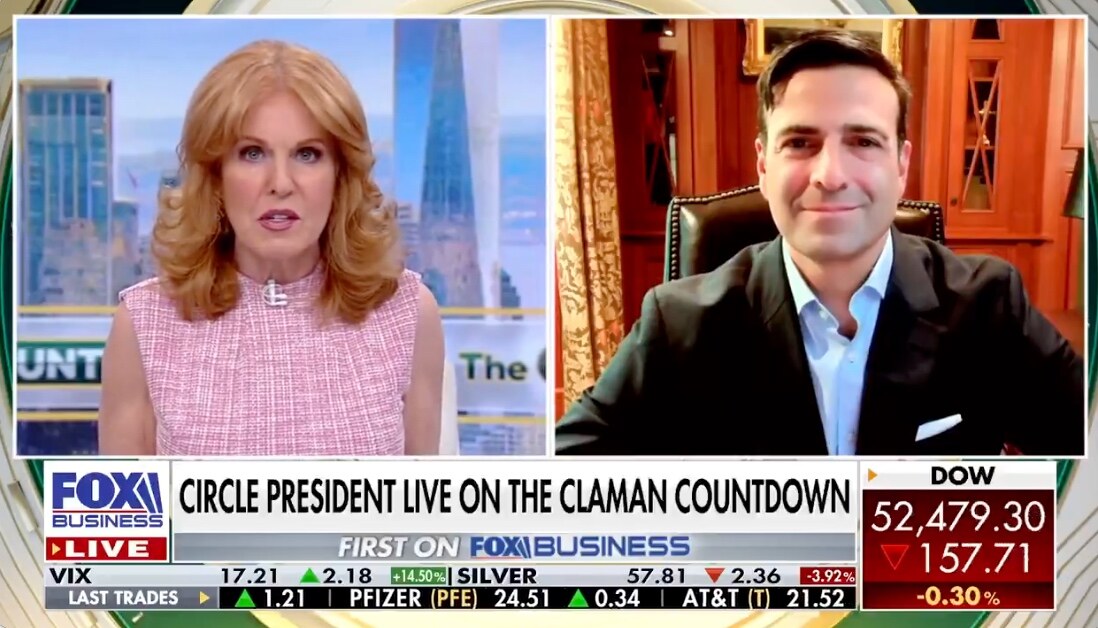
On July 14, Circle President Heath Tarbert appeared live on FOX Business. When asked by the host about “CRCL dropping from a high of $260 to $62, what would you say to trapped investors,” Tarbert gave the above response.
Championing “long-term value” seems to be the standard answer for any company experiencing a stock price slump. However, to gauge the credibility of this answer, one shouldn't simply look at how management describes the future, but rather whether they are willing to continue betting on it with their own capital.
After all, management is typically the group most familiar with the company's situation. They possess operational data, strategic plans, and future growth pathways. If they genuinely believe the current stock price is undervalued, a significant price correction should theoretically present a rare buying opportunity.
But for Circle, management's actions might reveal a different story.
73 Sells, 0 Buys: Is This What 'Playing the Long Game' Looks Like?
Following Tarbert's “long-term” rallying cry, CRCL investors delved into Circle's Form 4 filings submitted to the U.S. Securities and Exchange Commission (SEC). They uncovered a rather telling fact: The Circle president, who had just conveyed confidence in the company's long-term prospects to the market, has been continuously selling company stock since CRCL's listing.
- Odaily Note: Form 4 is a securities transaction filing required by the SEC for insiders of U.S. listed companies. It is used to disclose stock purchases and sales by directors, officers, and shareholders holding more than 10% of the company’s shares. Unlike ordinary investors who can only see public market price changes, Form 4 provides a crucial window into how insiders perceive the company's value.
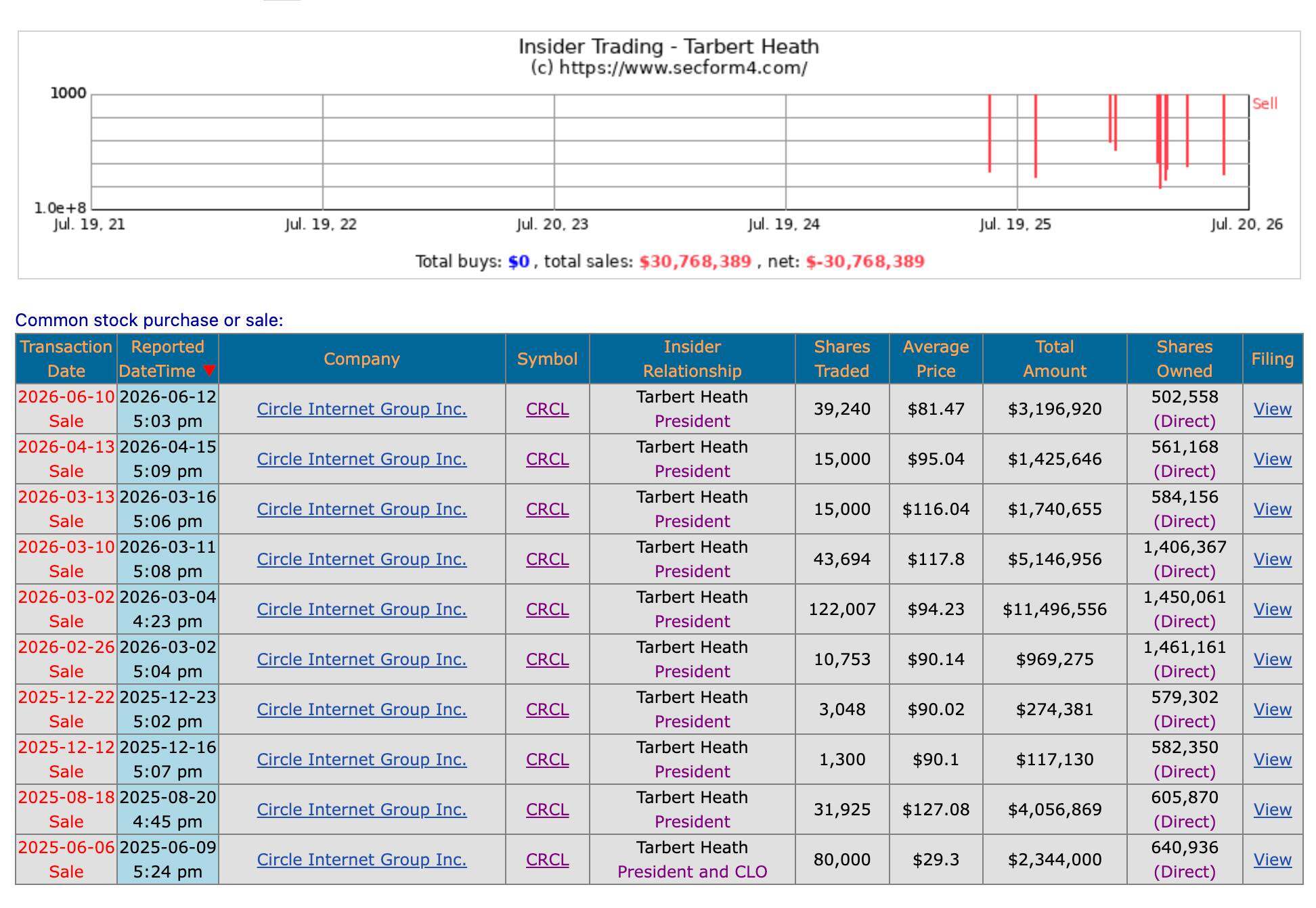
Circle's Form 4 filings show that since his first sale of CRCL in June 2025, Tarbert has sold CRCL a total of 10 times, cashing out approximately $30.77 million, with no record of any share purchases during this period.
If it were just Tarbert consistently selling, it might be one thing. However, a broader review of all insider trading records for Circle reveals a more significant pattern: From the founder and CEO, to the Chief Financial Officer (CFO), Chief Product & Technology Officer (CPTO), Chief Accounting Officer (CAO), and board members… multiple key insiders at Circle have been selling shares, totaling 73 sell transactions, zero buy transactions, and collectively cashing out approximately $664 million.
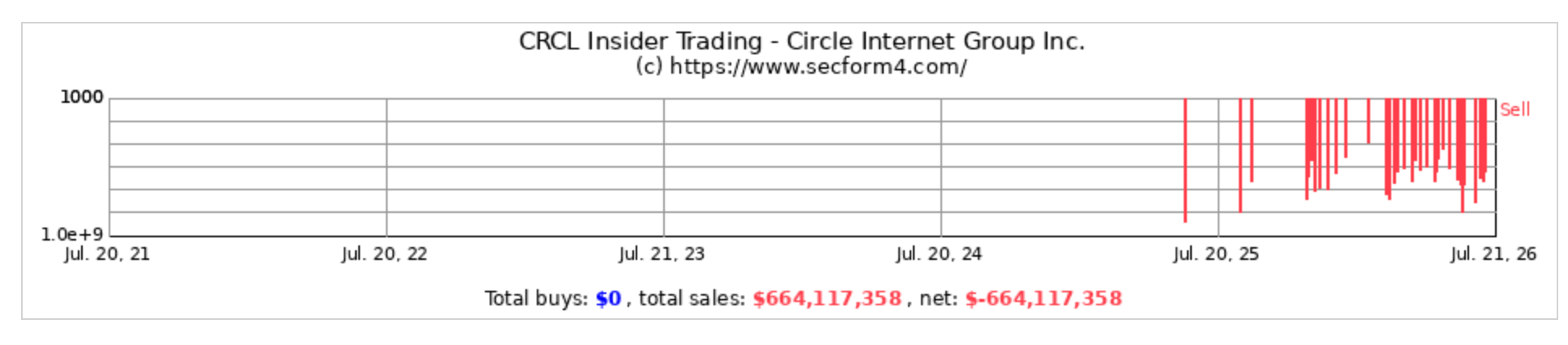
Here is a brief summary of the stock sales by these core insiders:
- Founder & CEO Jeremy Allaire sold a total of 9 times, bought 0 times, cashing out $139 million;
- Board member Burns M Michele sold a total of 12 times, bought 0 times, cashing out $276 million;
- Board member Neville Patrick Sean sold a total of 13 times, bought 0 times, cashing out $181 million;
- CFO Fox-Geen Jeremy sold a total of 9 times, bought 0 times, cashing out $22.45 million;
- CPTO Chandhok Nikhil sold a total of 12 times, bought 0 times, cashing out $69.21 million;
- CAO Schulz Tamara sold a total of 9 times, bought 0 times, cashing out $1.21 million;
- President Heath Tarbert sold a total of 10 times, bought 0 times, cashing out $30.77 million…
Clearly, when CRCL's stock price has fallen over 70% from its peak and the market begins reassessing Circle's long-term value, the group closest to the company's operations has not chosen to express confidence in future growth through share purchases.
Executive Stock Selling is Common, But the Trading Pattern is Strikingly One-Sided
It is important to note that insider stock sales cannot simply be equated with a bearish outlook on the company's future.
For management of publicly listed companies, selling shares is not uncommon. Especially after an IPO, founders, executives, and early investors often hold significant equity. Selling a portion of their shares for wealth diversification, tax planning, or personal asset allocation is a normal practice.
Therefore, simply seeing one or even multiple executives selling shares is not sufficient evidence that they lack confidence in the company's future. The real crux of the issue lies in this: After a significant price correction, are any of them willing to buy back in?
For Circle, the controversy lies precisely here.
CRCL experienced a rapid surge to over $260 post-listing, followed by a continuous decline, now down over 70% from its high. Although there was a brief rebound recently, it did not last long before falling again. According to traditional investment logic, if management truly believed the company's long-term value hadn't changed, or even believed the market was undervaluing Circle's future, the substantially lower stock price should have presented a highly attractive buying opportunity.
After all, these insiders naturally possess an absolute information advantage over ordinary investors. They know USDC's growth figures, the company's client acquisition progress, future product roadmaps, and Circle's true competitive position in the stablecoin landscape… Yet, based on publicly disclosed Form 4 data, Circle's core management has not made any purchases during the stock's low points, but has instead persistently sold shares to cash out.
This highly "one-sided" trading pattern struggles to convey the long-term confidence to the market that matches the "playing the long game" narrative from the interview.
Re-evaluating CRCL's Value: Can the Long-Term Narrative Match the Current Valuation?
Of course, even if insiders are continuously selling stock, it doesn't entirely equate to "Circle lacks long-term value." However, it can easily reinforce the market's pessimistic outlook for the company.
Especially against the backdrop of CRCL's declining stock price, there exists a significant divergence in market perception of Circle: Is Circle a future financial infrastructure company, or an issuer heavily reliant on stablecoin scale and the interest rate environment?
In the early stages of the IPO, the market's high valuation for Circle was a bet on a grander narrative – that as stablecoins become a global digital payment infrastructure, Circle has the opportunity to become a key gateway connecting traditional finance and the crypto world.
However, as the stock price has fallen from its peak, investors have begun to re-examine this logic. On one hand, Circle's current revenue remains highly dependent on yields from USDC reserve assets. Under a rate-cutting cycle, whether its profitability can maintain high growth has become a market concern. On the other hand, during a crypto market downturn, the growth potential of USDC may not align with previous expectations, introducing uncertainty. Furthermore, as more financial institutions and crypto enterprises enter the stablecoin space, Circle's once-significant compliance advantage is also being reassessed.
Therefore, CRCL's current slump can essentially be understood as the market re-evaluating its worth – whether the growth of the stablecoin industry and Circle's own business performance can support the high-growth valuation once attributed to CRCL.
In the future, Circle will still need to answer this question with its actual performance.


