






波场TRON Industry Weekly: Interest Rate Hike Expectations Loosen, BTC Briefly Breaks $64,000; An In-depth Look at Manadia, a Network Building AI and Privacy Computing


- Core Views: This weekly report analyzes the volatile recovery of the crypto market from July 6 to 12, 2026, pointing out that macroeconomic data, ETF fund flows, and institutional actions are the main market drivers for the coming week. It also highlights two potential projects, Jia and Manadia.
- Key Elements:
- The market experienced a volatile recovery influenced by macro sentiment, with BTC fluctuating in the $61,300-$63,800 range, ETH trading between $1,760 and $1,800, and trading volumes remaining cautious.
- Market focus next week will be on the US June CPI, PPI, and the Fed Chairman's testimony. A decline in CPI would be positive for risk assets, while the opposite would create pressure.
- Industry hotspots are concentrated in institutional-grade infrastructure, AI, RWA, and stablecoin yield tracks. Notable financing cases include Elliptic ($125 million) and Mercado Bitcoin ($20 million).
- Jia is a decentralized credit protocol that uses machine learning risk models to provide unsecured loans to micro, small, and medium-sized enterprises in emerging markets, generating real yields. It is led by Coinbase and TCG, which invested $7.3 million.
- Manadia is an infrastructure platform combining AI collaboration and privacy computing. Through the VERITAS protocol, AI Agent state management, and zero-knowledge proofs, it enables verifiable data settlement and the assetization of long-term states.
- Next week's key data release schedule is密集, including the US CPI, PPI, retail sales, and China's Q2 GDP, which will significantly impact global markets.
- Regarding regulation, the US is focusing on market structure and stablecoin regulation legislation. The EU's MiCA has entered a full enforcement phase, while Hong Kong, Singapore, and other regions continue to strengthen institutional access and compliance requirements.
I. Forward Look
1. Macro-Level Summary and Future Predictions
Last Week's Macro Summary (2026/07/06 – 2026/07/12):
The macro market in the US and Europe last week was primarily driven by expectations surrounding Federal Reserve policy and the pace of European economic recovery. In the US, the minutes from the June FOMC meeting showed that the Fed still sees inflation above its 2% target. Despite keeping interest rates unchanged, most officials still lean towards further tightening within the year. The market continues to focus on the impact of inflation and employment data on the subsequent policy path. Weakened by the previous non-farm payroll data and falling energy prices, market expectations for an immediate rate hike in July have cooled slightly, leading to a stronger performance in risk assets. In Europe, data such as German industrial orders and production indicated continued weakness in the manufacturing sector. However, overall inflationary pressure in the Eurozone continues to ease. The European Central Bank maintains a cautious wait-and-see stance, and the market expects policy to remain stable in the short term.
Next Week's Forecast (2026/07/13 – 2026/07/19):
The US will see the release of June CPI, PPI, retail sales, the Fed's Beige Book, and Fed Chair Kevin Warsh's first congressional testimony next week, which will be the most important pricing factor for global markets. If CPI continues to decline, it will further strengthen market expectations for a rate cut or delayed hike within the year, benefiting US stocks and global risk assets. If inflation rebounds more than expected, the USD and US Treasury yields may strengthen again, putting pressure on risk assets. In Europe, the market will focus on Eurozone industrial production and inflation data. If economic data remains weak while inflation continues to fall, it will further consolidate the market's judgment that the ECB will keep rates unchanged or even signal easing expectations.
2. Crypto Industry Market Changes and Warnings
Last Week's Summary (2026/07/06 – 2026/07/12): The crypto market showed an overall volatile recovery trend last week. On July 6th, Bitcoin briefly fell to around $61,300 following the disclosure by Strategy (formerly MicroStrategy) of selling approximately 3,588 BTC (around $216 million). Subsequently, as spot ETF funds flowed back in and buying pressure recovered, BTC bounced back to $63,163 on July 7th, briefly fell to $62,247 on July 8th, closed at $63,795 on July 11th, and was trading around $63,600 on July 12th. ETH performed relatively steadily, trading in the $1,760-$1,800 range during the week, last around $1,790. Market hotspots remained focused on AI, RWA, stablecoin infrastructure, and institutional-grade DeFi yield protocols. Overall risk appetite improved compared to the previous week, but trading volumes remained cautious.
Next Week's Forecast (2026/07/13 – 2026/07/19): The market is expected to be primarily driven by macroeconomic data, ETF fund flows, and institutional capital movements. If BTC can firmly hold above $64,000, it may further test the $65,000 – $66,000 resistance zone. If it falls below $62,000 again, it could retest the $60,000 – $61,000 support area. ETH is expected to trade in the $1,750 – $1,850 range, continuing to be driven by BTC. In the short term, sectors like RWA, stablecoins, AI Agents, on-chain Yield, and institutional infrastructure are expected to maintain high attention, but caution is needed regarding market volatility caused by macro events and large institutional fund flows.
3. Industry and Sector Hotspots
From July 6th to July 12th, 2026, the crypto industry hotspots mainly revolved around "institutional-grade infrastructure, AI, RWA, and stablecoin yields." In terms of funding, Elliptic completed a $125 million strategic funding round to further advance on-chain compliance and blockchain analysis capabilities; KOR Protocol completed a $7.5 million Series A round, focusing on digital content/IP on-chain infrastructure; Mercado Bitcoin received a $20 million strategic investment, continuing to advance RWA and institutional asset tokenization layouts.
Technologically, institutional-grade yield infrastructure, RWA yield assets, cross-chain liquidity, and AI-driven financial automation remain key industry directions. More and more projects are focusing on connecting traditional financial institutional funds with on-chain yield markets through APIs, modular architectures, and automated asset allocation, reflecting the crypto industry's continuous development towards institutionalization, asset tokenization, and the integration of AI and DeFi.
II. Market Hot Sectors and Potential Projects of the Week
1. Overview of Potential Projects
1.1. Detailed Analysis of Jia, an On-Chain Credit Network Connecting Global Capital with Real Yield from Emerging Markets, Raising $7.3 Million Led by Coinbase and TCG with Participation from Strobe, Hashed Emergent, and SAISON
Introduction
Jia is a decentralized lending protocol and fintech platform designed to connect capital with micro and small enterprises in emerging markets that have genuine yield potential.
By providing loans to micro, small, and medium-sized enterprises (MSMEs), Jia aims to bridge the gap in financial service accessibility, offering fairer and more convenient short-term financing channels for groups traditionally overlooked by the conventional financial system.
On its platform, Jia incentivizes behaviors beneficial to the ecosystem, partners with high-quality data providers, and utilizes reward token mechanisms to provide investors with a consistent and stable income stream while helping businesses in underdeveloped markets access the capital they need to grow.
Brief Protocol Mechanism Description
The Jia protocol primarily consists of four core participant types, collectively building its on-chain credit system focused on emerging markets.
1. Borrowers
Borrowers are primarily micro, small, and medium-sized enterprises (MSMEs) from emerging markets.
These businesses obtain financing through Jia's lending pools to operate and develop their businesses.
Borrowers can be referred to Jia through Partners or apply for loans directly. To secure more favorable loan terms, borrowers may also provide collateral.
From a user experience perspective, borrowers interact through a simple mobile application. The underlying blockchain technology is transparent to the user, requiring no prior experience with crypto assets.
2. Lenders
Lenders are investors who provide funds to Jia's lending pools.
By depositing funds into the protocol, they earn interest income from borrowers' repayments, thereby sharing in the Real Yield generated by the real economy of emerging markets.
3. Sponsors
Sponsors hold on-chain assets and pledge these assets as collateral for loans.
For borrowers with insufficient credit history or higher risk profiles who would otherwise struggle to pass risk control checks, Sponsors provide additional credit support to help them access funding.
Essentially, they act as a credit enhancement role within the protocol.
4. Partners
Partners are typically commercial platforms or ecosystem partners serving the borrowing businesses.
They are responsible for:
- Referring high-quality borrowers to Jia
- Providing operational and business data
- Assisting with loan risk control and credit assessment
This data is used in the protocol's loan underwriting process, helping to improve the accuracy of risk control.
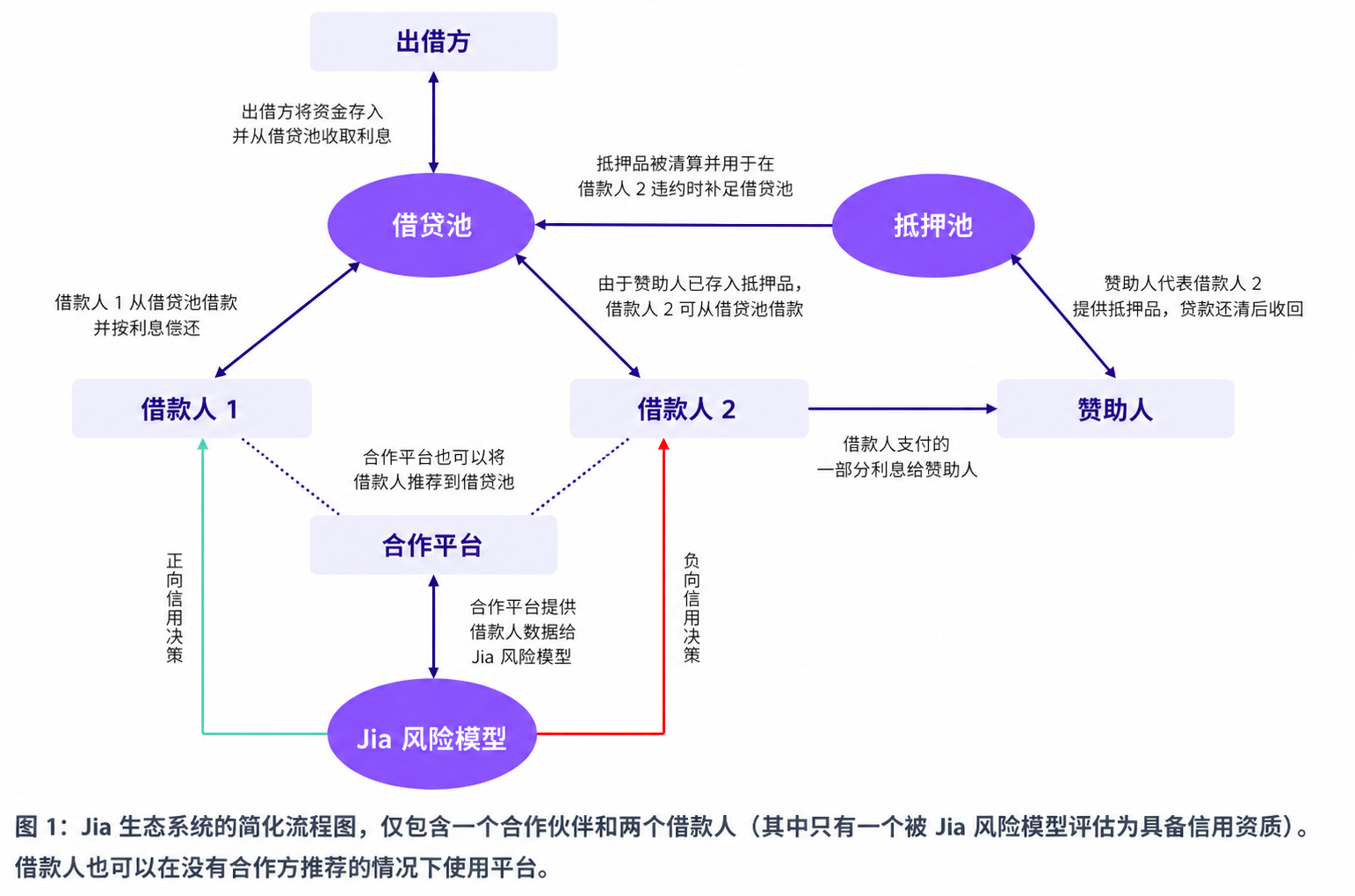
Lending Mechanics
Loan Terms
Jia primarily addresses the most pressing financing needs of MSMEs in emerging markets: short-term working capital loans.
Standard loan products typically feature:
- Loan Amount: $100 ~ $5,000
- Loan Term: 30 ~ 90 days
- Monthly Interest Rate: 2% ~ 7%
Specific loan conditions are customized based on the borrower's credit profile, business situation, and financing needs, and are continuously optimized as borrowing history accumulates.
While this interest rate level may seem relatively high to investors in US and European markets, it is a common level for commercial loans in the emerging markets Jia serves. The shorter loan cycles also help improve capital turnover efficiency, providing investors with consistent and stable returns.
Jia evaluates loan applications by integrating data from multiple dimensions, mainly including:
Partners Data
Partners are platforms that the borrowing businesses rely on for daily operations.
They can provide:
- Sales data
- Inventory data
- Revenue data
- Operational behavior data
This data helps Jia gain a more accurate understanding of the business's health.
Borrower Application Information
Borrowers need to submit loan applications and disclose:
- Income status
- Expenditure status
- Use of funds
- Business operation information
This serves as an important basis for credit assessment.
Third-party Data
Jia also integrates external financial data sources, such as:
- Local credit bureaus
- Bank data
- Financial service platforms
Further supplementing the borrower's credit information.
Underwriting (Smart Risk Control)
Unlike most DeFi lending protocols that rely on over-collateralization, Jia's core innovation lies in:
Supporting unsecured or under-collateralized credit loans.
To achieve this, Jia utilizes high-quality financial data from partners, borrowers, and third-party institutions to build a credit evaluation model based on Machine Learning.
The system comprehensively analyzes the business's:
- Operational capacity
- Income stability
- Historical repayment performance
- Cash flow status
- Credit history
Thus assessing loan risk and determining credit limits and loan terms.

User Flow
JIA Token and Community Incentive Mechanism
Jia aims not only to provide financing for MSMEs but also to make borrowers long-term participants and beneficiaries of the entire ecosystem.
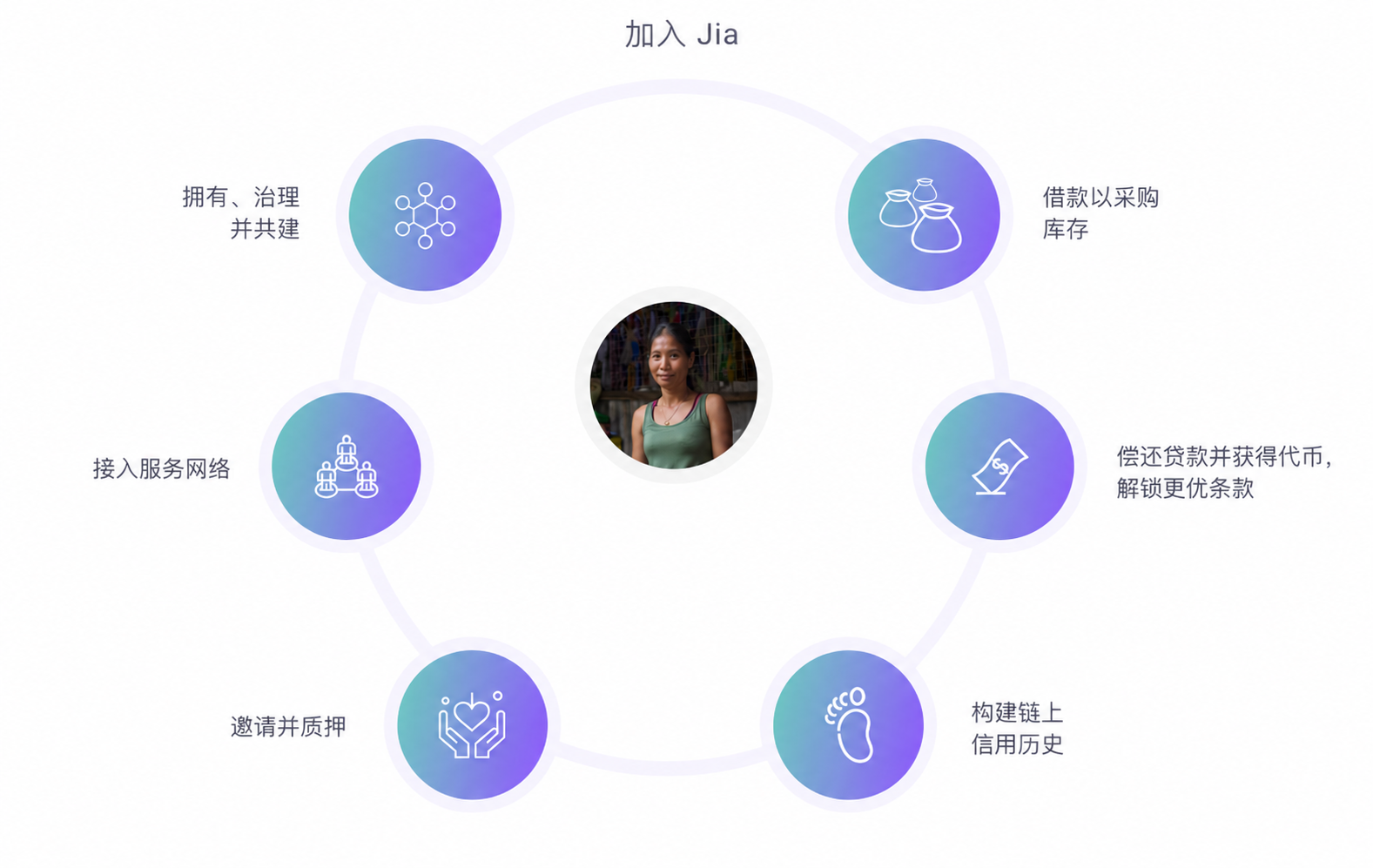
Take Alice as an example. Under the traditional financial system, due to limited financing channels, she could often only get high-cost loans, resulting in a one-way, transactional lending relationship with the financial institution. Even if her business grew, she could not share in the benefits of the platform's growth.
In the Jia system, when Alice establishes a long-term, positive borrowing relationship with the platform, she can earn JIA token rewards by participating in the ecosystem. As she accumulates JIA, her identity shifts from being just a borrower to becoming a co-builder and stakeholder in the protocol.
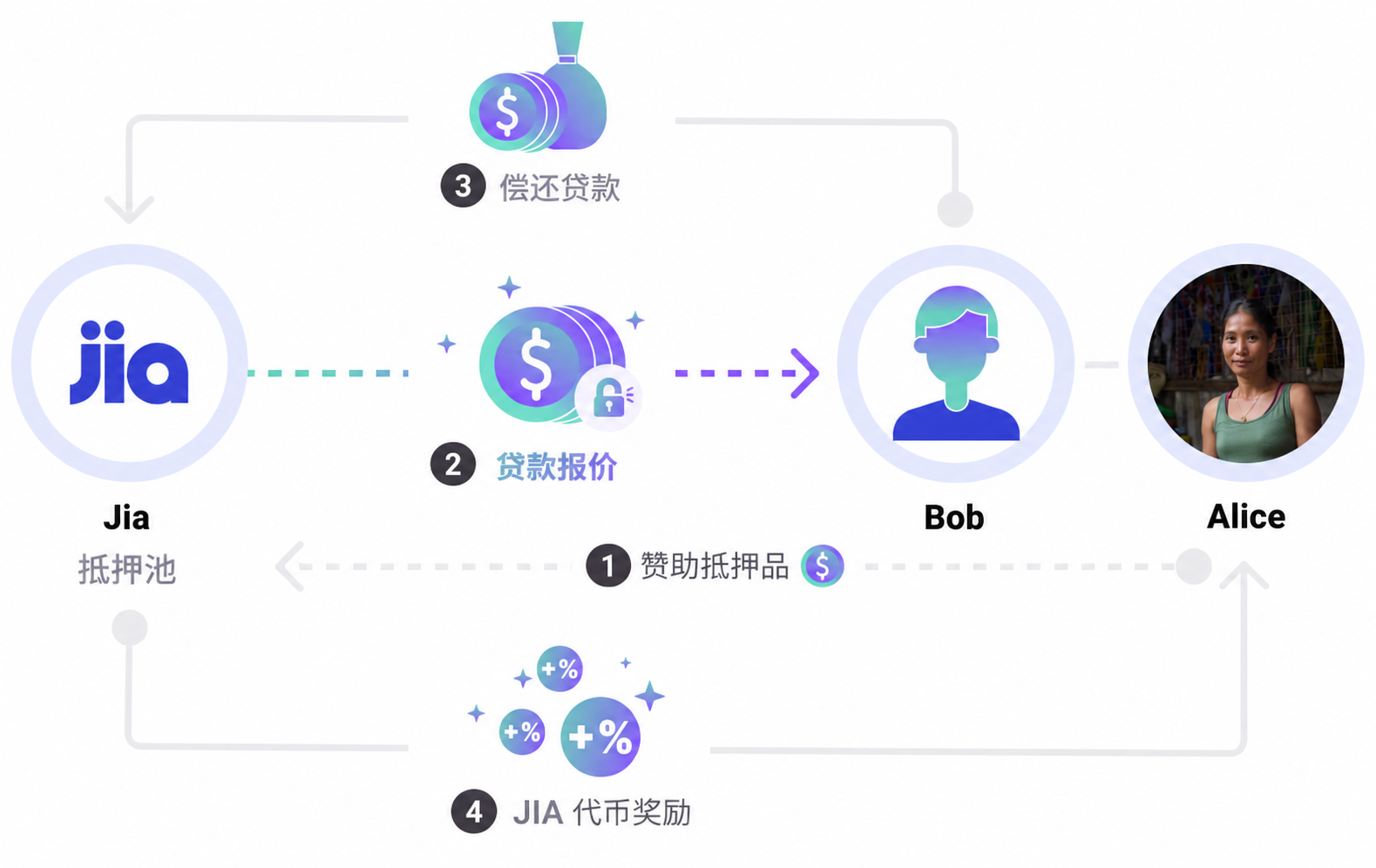
Holding JIA allows her to:
- Participate in protocol governance
- Vote on the future direction of the platform
- Share in the value generated by the protocol's long-term growth
- Align her interests with the broader ecosystem
Through this mechanism, Jia hopes to upgrade the simple "lending relationship" into a "mutual growth relationship."
Tron's Commentary
Jia's strength lies in its ability to combine DeFi capital with real economic demand in emerging markets, focusing on MSMEs long neglected by traditional finance. By leveraging partner data, third-party financial data, and machine learning risk models to offer unsecured or under-collateralized loans, it generates yields derived from real business activities (Real Yield). Simultaneously, through the JIA token incentive mechanism, it allows borrowers, investors, and ecosystem participants to share in the platform's growth value, combining inclusive finance with on-chain financial innovation.
However, its weakness is that the business is fundamentally based on credit lending, facing risks such as borrower default, data authenticity, model failure, and macroeconomic volatility in emerging markets. It also requires continuous reliance on local partners for high-quality operational data, leading to significantly higher operational complexity and compliance requirements compared to traditional over-collateralized DeFi protocols. Future scaling will also face challenges related to regional regulations and asset quality management.
2. Detailed Analysis of Key Projects of the Week
2.1. Detailed Analysis of Manadia, a Verifiable Collaboration Network Driven by AI and Privacy Computing, with Unknown Total Funding Led by AurumX
Introduction
Manadia is a Web3 infrastructure platform deeply integrating AI Collaboration and Privacy Computing. It focuses on enabling:
- Verifiable Data Settlement
- Privacy-Enhanced Value Transfer
- Efficient Cross-System Coordination
Its core goal is to break down trust barriers between on-chain and off-chain systems through standardized technical protocols and tooling, creating a reliable, secure, and verifiable collaboration environment for high-value scenarios like finance and asset digitization, all without relying on a single trusted third party.
Core System Architecture Analysis
VERITAS – Real-World Data Injection and Adjudication Protocol
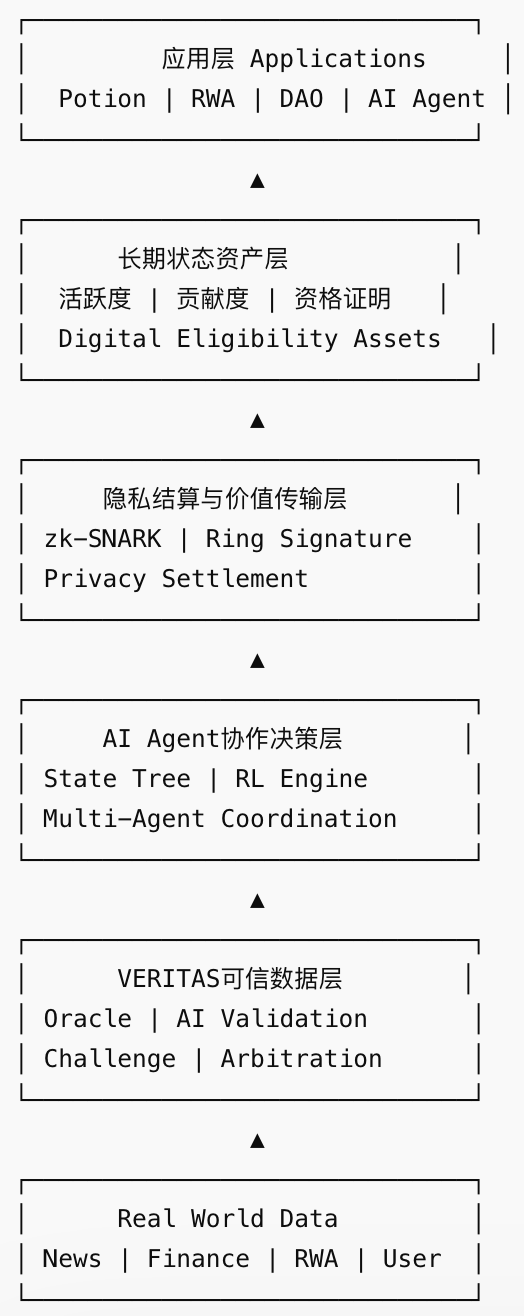
VERITAS is the core protocol for manadia to process external world input information. It aims to generate on-chain signals that are resistant to manipulation and can be challenged and verified. It combines multi-source data aggregation, economic penalty mechanisms, and hybrid verification processes, breaking beyond the traditional oracle limitation of just "providing price data."
For high-frequency price data injection, VERITAS employs a Weighted Median data aggregation algorithm. The system collects signed data from multiple nodes (pre-selected validators) and generates a consensus price through a deviation detection mechanism (calculating Z-scores, filtering outliers with a threshold greater than 3).
The economic incentive mechanism uses a Staking–Slashing model: nodes must lock $MA tokens as collateral. When the deviation of the data they provide exceeds 5%, a slashing mechanism is automatically triggered. The slashing ratio is calculated based on historical reputation combined with an exponential decay model.
Compared to Chainlink's simpler voting mechanism, this solution is more robust and can defend against flash loan attacks through time-lock delayed confirmation.
For example:
In a DeFi liquidation scenario, VERITAS can push ETH/USD prices every 5 seconds, supporting sub-millisecond derivative pricing.
For complex event verification, VERITAS introduces a hybrid model combining AI and human game theory.
First, an integrated Large Language Model (e.g., the Groq series) parses news APIs or off-chain signals and automatically generates event proposals, outputting structured assertions.
Subsequently, the system opens a fixed challenge window (e.g., 24 hours). During this period, any token holder can submit a counter-evidence and initiate a challenge, simultaneously staking an equivalent amount of $MA tokens to participate in the economic game. If the challenge is successful, the challenger receives the slashed assets as a reward.
The final adjudication is completed by one of the following two methods:
- A threshold consensus reached by more than 66% of node signatures;
- A final ruling by an Arbitration DAO.
This ensures the result is final and irreversible.
Compared to Pyth's entirely market-driven approach, VERITAS's AI-generated proposals can reduce human bias and support non-binary events, such as:
- Probabilistic distribution predictions for election results;
- Verifying complex real-world state changes.
In an RWA scenario, this mechanism could verify property status changes without needing to rely on a single custodian.
Beyond price and financial events, VERITAS is also suitable for verifying low-frequency but high-value state-type events, such as:
- Whether a participation relationship continues to exist;
- Whether a behavior pattern has been materially interrupted;
- Whether there is coordinated manipulation of cross-platform signals.
In the Potion scenario, VERITAS is used for multi-source verification and deviation filtering of engagement behavior signals provided by external platforms. This ensures that state judgments like "active," "continuously participating," and "eligible" are challengeable and final, thus avoiding systemic risks from fake volume, script simulation, and data distortion from a single platform.
VERITAS's security model is based on an improved Byzantine Fault Tolerance (BFT) mechanism.
Node selection uses:
- VRF (Verifiable Random Function) random sampling
To reduce the risk of Sybil attacks.
The target throughput of the system is:
- 1000 TPS
And gas optimization is achieved through a Rollup-like batch proof mechanism.
2. AI Agent State Management and Coordination Protocol
Manadia's technical architecture is not designed for high-frequency trading or one-off interactions. Instead, it focuses on long-term, cross-platform stateful relationship management that can be interrupted but recovered.
In


