






Sharplink CEO: Hàng triệu nhà phát triển Ethereum, ai có thể sánh kịp?


- Quan điểm cốt lõi: Lợi thế cốt lõi của Ethereum không phải là tốc độ, mà dựa vào hệ sinh thái nhà phát triển khổng lồ hơn 1 triệu người, tính khả tổ hợp, khả năng thiết lập tiêu chuẩn và tính trung lập đáng tin cậy, tạo nên một hào sâu khó có thể sao chép, củng cố vị thế là hệ điều hành mặc định của Internet tài chính.
- Các yếu tố then chốt:
- Quy mô nhà phát triển dẫn đầu: Theo dữ liệu từ Electric Capital, số lượng nhà phát triển trọn đời của Ethereum đã vượt quá 1 triệu (1.012.824), trong đó 232.000 vẫn hoạt động trong 12 tháng qua, vượt xa các hệ sinh thái khác.
- Nâng cấp giao thức cốt lõi: Bản nâng cấp Glamsterdam dự kiến vào năm 2026 sẽ tăng cường khả năng tải của Layer 1 thông qua cơ chế Tách biệt Người đề xuất-Người xây dựng (ePBS) và Danh sách truy cập cấp khối (BALs), đồng thời duy trì tính trung lập đáng tin cậy.
- Tính khả tổ hợp đồng bộ: Thông qua Rollup gốc và thiết kế "Based Rollup", cho phép các giao dịch nguyên tử giữa các Rollup, trực tiếp giải quyết vấn đề phân mảnh, giúp hàng chục mạng lưới hoạt động phối hợp với nhau.
- Dự trữ chống điện toán lượng tử: Ethereum thông qua lộ trình "Tinh gọn Ethereum", đội ngũ chuyên trách về bảo mật hậu lượng tử và kiểm tra mạng lưới máy khách, lên kế hoạch hoàn tất di chuyển mã nguồn mở vào năm 2029, dẫn đầu các hệ sinh thái chính thống.
- Tác động mạng lưới thúc đẩy: Kỹ năng EVM và Solidity có thể sử dụng trên hàng trăm mạng lưới, tạo thành một vòng xoáy tự củng cố "nhiều nhà phát triển hơn - công cụ tốt hơn - thanh khoản cao hơn - niềm tin tổ chức mạnh mẽ hơn".
- Ba lợi thế cốt lõi: Tính trung lập đáng tin cậy từ khoảng 900.000 người xác thực, thiết kế mô-đun cho phép Rollup kế thừa bảo mật của mainnet, và giá trị văn hóa thu hút các nhà nghiên cứu hàng đầu.
Original Author: Sharplink CEO Joseph Chalom
Compiled by: Odaily Planet Daily, Qin Xiaofeng (@QinXiaofeng 888 )
Editor's Note: On June 15, ETH staged a strong comeback, surging over 10% in a single day, reversing its previous downturn. Sharplink CEO Joseph Chalom published a long thread on X titled "Milestone: Ethereum Surpasses One Million Developers".
He stated that Ethereum's core advantage is not speed, but the ability to aggregate the largest and deepest talent pool; its true moat lies in the long-term ecosystem built on composability, standard-setting, and credible neutrality. These builders are focusing on cutting-edge issues like scalability and quantum resistance, continuously solidifying Ethereum's position as the default operating system for the internet of finance. (Recommended reading: "Sharplink CEO: Liquidating ETH Now is Like Selling Amazon During the Dot-Com Bubble")
Below is the original text by Joseph Chalom, compiled by Odaily Planet Daily. Enjoy~
————————
I just returned from Asia, where I met with Ethereum developers and ecosystem leaders. Special mentions to Nonce Classic, Four Pillars, and DSRV in Seoul, our friends at SNZ, and the recently opened Ethereum Community Hub in Hong Kong—the first permanent physical Ethereum community space in Asia, supported by the Ethereum Foundation.
What struck me most was not just the enthusiasm, but the rigor and ambition of the local builders. The quality of projects, the spirit of experimentation, and the long-term thinking emerging from the global Ethereum ecosystem were deeply impressive and inspiring.
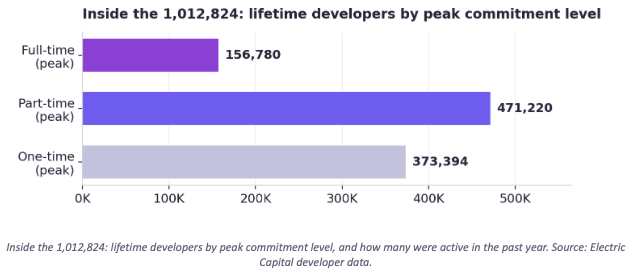
These vibrant individuals put a face to a number: According to data from Electric Capital, the lifetime number of Ethereum developers has surpassed one million—specifically, 1,012,824 distinct contributors. No other ecosystem in the crypto space comes close.
A Milestone Worth Pausing At
One million is a round number, and round numbers can often feel hollow, but not this time. It represents the largest pool of technical talent ever assembled around an open, permissionless blockchain network—and, crucially, this talent pool continues to deepen and expand.
Of this million, approximately 232,000 developers have remained active in the past twelve months.
Why Ethereum: The Truly Important Question
For years, discussions in crypto have revolved around speed, fees, and throughput. Every new chain claims to be "faster than Ethereum." But the most important question in crypto has never been "which chain is fastest?" It's this:
"Where do the best builders choose to build long-term?"
On this question, Ethereum remains unparalleled. Its advantage isn't just technical; it's institutional, cultural, economic, and compositional—a decade-long accumulation of developers, infrastructure, standards, tools, liquidity, research, applications, and social collaboration that no other ecosystem can replicate.
Ethereum has become the default operating system for programmable finance and internet-native capital formation.
What is This Million Building, and Why Does it Deepen the Moat?
A million developers matter crucially because of what they are building right now. The current focus is on the industry's hardest, highest-risk issues: core protocol scalability, privacy, quantum resistance, and the agentic systems that will run on top of it.
Glamsterdam — Guarding Core Values Amidst Innovation. The planned Glamsterdam upgrade in 2026 demonstrates how Ethereum advances while safeguarding its core values. Key changes include in-protocol Proposer-Builder Separation (ePBS), Block-level Access Lists (BALs) enabling parallel execution and higher throughput, and a potentially increased Gas limit—these will significantly boost Layer 1 capacity. Scaling for future demand while ensuring credible neutrality, security, and fair MEV—that's the moat in action.
Synchronous Composability — Making Many Rollups Feel Like One Chain. Composability has always been Ethereum's superpower; the next leap is extending it across Layer 2. Native Rollups and "Based Rollups," combined with synchronous composability, are the answer. A contract on one Rollup can directly call a contract on the mainnet or another Rollup within the same atomic transaction—no bridges, no waiting. Linea, the Ethereum Economic Zone, Gnosis, Zisk, and collaborating teams at the Ethereum Foundation are bringing this design together with real-time proofs. The result: dozens of Rollups no longer act like isolated networks but begin to operate as a single, cohesive chain. This is a direct response to the "fragmentation" criticisms.
Quantum Resistance — Ethereum's Most Significant Lead. No major ecosystem is more prepared for the post-quantum era than Ethereum. The "Lean Ethereum" roadmap, the Ethereum Foundation's post-quantum security specialist team established in early 2026, the pq.ethereum.org information hub, and over ten client teams running post-quantum interoperable devnets weekly—all constitute a coordinated open-source migration plan targeting around 2029. When quantum risk becomes a reality, institutions managing trillions in assets will care about only one thing: which chain is ready earliest and most thoroughly.
The Moat Beyond Developers: Composability, Standards, and Trust
This developer advantage is self-reinforcing, stemming from how Ethereum is built. Its deepest network effect isn't liquidity, but the depth of composability: applications act like interoperable financial Lego bricks—lending, stablecoins, exchanges, wallets, tokenized assets, oracles, Layer 2 Rollups—all interacting through shared standards, where developers never start from scratch. The EVM is crypto's application layer; Solidity skills are transferable across Base, Arbitrum, Optimism, Polygon, zkSync, Scroll, Linea, and hundreds of other networks.
Learning the Ethereum stack maximizes optionality, which drives a flywheel effect—more developers, more tools, more liquidity, more institutions, which in turn attracts more developers to build composable protocols and assets. Liquidity begets liquidity, composability begets composability.
Moreover, Ethereum dominates where true value aggregates, not just where the noise is loudest:
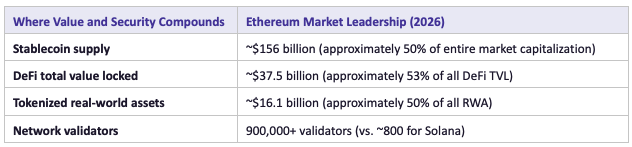
Three key forces further deepen this lead:
- Credible Neutrality — Secured by over 900,000 validators (Solana has about 800), this level of decentralization and platform neutrality is highly valued by large institutions.
- Modularity — Rollups like Base, Arbitrum, and Optimism don't fragment Ethereum; they expand it into an increasingly interconnected modular internet economy while inheriting mainnet security.
- Culture — Ethereum disproportionately attracts the top researchers, cryptographers, and EIP standard authors who set the direction for the entire industry. This final advantage is also the hardest to fork.
There is Only One Ethereum
Generating on-chain activity is one thing; being the long-term coordination layer for internet-native finance—the layer trusted by the world's largest financial institutions—is another. Ethereum holds a dominant position in the minds of large asset owners, who prioritize trust, security, and liquidity. I felt this firsthand during my tenure at BlackRock.
In technology markets, ecosystems consolidate over time around standards, liquidity, and developer mindshare. That is Ethereum's moat.
After speaking with these developers, builders, and ecosystem leaders in Seoul and Hong Kong, I am more convinced than ever of Ethereum's competitive advantage. I met the talent building the next generation of financial infrastructure—the future founders of our industry and the architects of agentic finance. It is these individuals and teams who will change the world.
Ethereum's future is happening right now.


