






Bitget CEO Gracy: AI thúc đẩy Crypto loại bỏ bong bóng, các sàn giao dịch bước vào cuộc cạnh tranh toàn diện về tài sản


- Quan điểm cốt lõi: Bitget đang thúc đẩy chiến lược UEX (Sàn giao dịch toàn cảnh), token hóa chứng khoán Mỹ thông qua giao thức RWA tự phát triển Reality, nhằm giải quyết vấn đề thanh khoản kém và cơ chế chia cổ tức không minh bạch của các token chứng khoán truyền thống, từ đó nâng cao hiệu quả sử dụng vốn của người dùng, mở rộng Crypto như một cơ sở hạ tầng tài chính nền tảng sang thị trường tài sản truyền thống.
- Các yếu tố chính:
- Reality kết nối trực tiếp với nhà môi giới được cấp phép tại Mỹ là Alpaca, cho phép lệnh đi thẳng đến Nasdaq và NYSE, thanh khoản tương đương với các công ty chứng khoán truyền thống, giải quyết vấn đề lệch giá.
- Token Reality (rToken) hỗ trợ đồng bộ chia tách cổ phiếu 1:1 và tự động chuyển đổi cổ tức bằng tiền mặt thành airdrop USDT, khắc phục những thiếu sót của ngành trong việc xử lý chia cổ tức và chia tách cổ phiếu.
- Người dùng có thể sử dụng token chứng khoán Mỹ (ví dụ: rNVDA) làm ký quỹ hợp đồng để giao dịch BTC/ETH trên Bitget, hoặc chuyển sang các ứng dụng DeFi thông qua các blockchain lớp 1 như Arbitrum, giúp kích hoạt tỷ lệ sử dụng tài sản.
- Tài sản cơ sở của Reality được Alpaca lưu ký tại một SPV độc lập, đảm bảo dự trữ đầy đủ 1:1 và được kiểm toán hàng ngày bởi bên thứ ba được cấp phép tại Mỹ. Bảng điều khiển kiểm toán thời gian thực đã được công bố trên trang web chính thức.
- Dữ liệu cho thấy, giao dịch tiền điện tử phi truyền thống đã chiếm 40% tổng khối lượng giao dịch của Bitget, khối lượng giao dịch tích lũy của hợp đồng vĩnh viễn chứng khoán Mỹ đã vượt 10 tỷ USD (đứng thứ hai toàn cầu), phản ánh xu hướng người dùng chuyển dịch từ Crypto sang tài sản truyền thống.
- Bitget đang triển khai toàn diện việc sử dụng AI nội bộ, đã đăng ký gói doanh nghiệp Claude cho toàn bộ 2.167 nhân viên, khuyến khích nâng cao năng suất thông qua các công cụ AI, đồng thời phát triển các sản phẩm AI hỗ trợ giao dịch như GetAgent.
Throughout June, major exchanges have been heavily rolling out US stock products. As the earliest and most aggressive player in this track, Bitget has also launched its own RWA platform, Reality, and made major upgrades to its US stock products. Today, we invited Bitget CEO Gracy to discuss this trend and other hot topics in the industry.
Bitget has previously integrated stock token solutions like Ondo. Now, with US Stocks 2.0, you’ve switched to Reality. What’s the biggest difference between the two? What key issues is this upgrade mainly aiming to solve?
Gracy: We started partnering with Ondo in the third quarter of last year, at one point accounting for nearly 90% of their stock token issuance market share. It wasn’t just Ondo; we also launched US stock tokens in collaboration with xStocks. But throughout this process, the most common feedback we heard from users was: liquidity wasn’t good enough, and the settlement mechanisms for dividends and stock splits weren’t clear or transparent enough.
So, we decided to step in and solve this problem ourselves. Reality is the compliant RWA protocol we launched. Its biggest difference is that it directly connects to the US-licensed broker Alpaca, with orders going straight to Nasdaq and the NYSE. Simply put, when you trade Reality's US stock rTokens, you get the same price as Apple or Tesla on the US stock market, with liquidity directly benchmarked against traditional brokers.
Additionally, Reality solves the pain points of dividends and stock splits. Cash dividends are automatically converted to USDT and airdropped to users, and stock splits are synced 1:1, eliminating the situation where token prices diverge from the actual stock price.
In the future, will users be able to use stock tokens like NVIDIA or Tesla as margin to continue trading BTC, ETH, or other futures?
Gracy: This feature was already launched on June 4th. This is also the core reason why we insist on tokenization, rather than just doing a "direct broker connection." The rNVDA that users buy, the NVIDIA rToken, can be used directly as futures margin on Bitget, or transferred out via public chains like Arbitrum and Morph for use in DeFi scenarios. What we want to do is truly activate the US stock tokens in users' hands, improving overall capital efficiency.
Recently, several exchanges have been upgrading their US stock-related products. Compared to stock products on other platforms, what are the core differences in Bitget's latest upgrade?
Gracy: Indeed, many platforms are deploying US stock products lately. But from what I’ve seen, most competitors are still competing over the "direct broker connection" model. That means users deposit stablecoins, then go open an account with a traditional broker to trade. Bitget recently launched US Stocks 2.0, and one of the key upgrade points is that we chose a more crypto-native path, which is RWA stock tokens.
The core difference is: with a "direct broker connection," the stocks you buy usually just sit in your US stock account. But on Bitget, the rTokens issued through Reality are genuine on-chain assets, currently integrated with Arbitrum and Morph. This means users can not only use them as margin within Bitget, but also withdraw them to their own wallets. In the future, they can even enter DeFi protocols for staking, yield generation, and more.
We specifically solved two problems that the industry has long failed to address. First, liquidity: our orders go straight to Nasdaq and the NYSE, with prices, order books, and depth synchronized with the real market. Second, dividend distribution and stock splits/consolidations: cash dividends are directly converted to USDT and airdropped automatically. Stock splits and consolidations are also synced 1:1, preventing token prices from diverging from actual stock prices.
More importantly, within the UEX environment, these rTokens can truly achieve higher capital efficiency. For example, a user holding rNVDA, the NVIDIA rToken, can use it directly as margin to continue trading BTC or ETH futures, allowing the same asset to function in two markets simultaneously. This is a much more native on-chain experience than what a traditional broker connection can offer.
A long-standing criticism of stock tokens is: is the user buying a tokenized representation of actual stock rights, or just a price tracking tool? How will Reality prove to users that the underlying stocks truly exist, are auditable, and traceable? Will you provide things like proof of reserves, custodian disclosures, audit reports, or broker structure explanations in the future?
Gracy: That's a really good question. Indeed, if it's just a "synthetic asset" tracking a price, it has no soul. Reality's rTokens have solid underlying asset backing. Our underlying stocks are custodied by the US-licensed broker Alpaca, held in a separate SPV, completely segregated from the platform's own assets. We maintain a 1:1 fully reserved basis.
At the same time, we have daily audits conducted by a third-party US-licensed audit firm. The Reality website already has a live audit dashboard where users can check the reserve ratio at any time. We expect to add the CPA-licensed audit firm's reports to this dashboard around August after they are ready. On top of that, Bitget has a User Protection Fund of over $300 million as a safety net, creating a triple layer of protection.
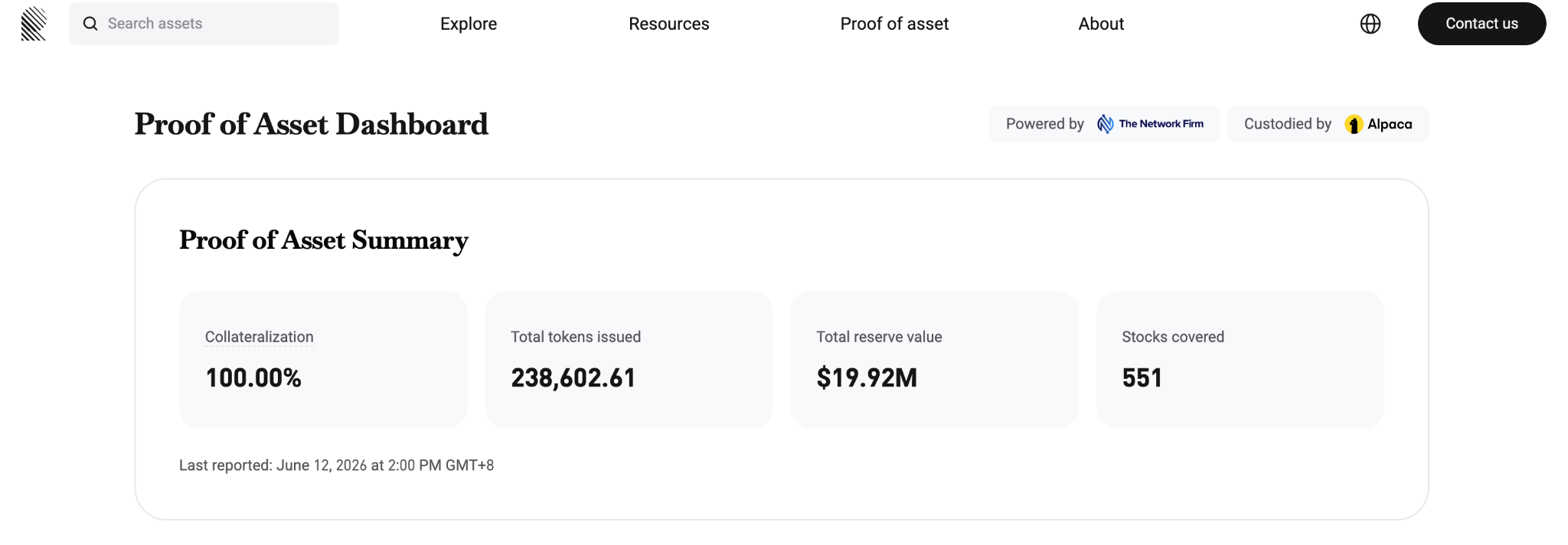
(Source: Screenshot of Reality's PoR dashboard on June 12, 2026, 2:00 PM GMT+8)
If a specific stock undergoes a stock split, reverse split, special dividend, merger, or delisting in the future, how will Reality handle it?
Gracy: Regarding the handling of Corporate Actions, this is also where we are stronger than many products on the market. Take a stock split as an example. When Netflix had a 1-for-10 split last year, tokens on some platforms didn't rebase simultaneously, causing the token price to differ from the actual stock price by ten times, confusing users. But with Reality, stock splits are synced automatically. The 1 token a user holds becomes 10 tokens, with the unit price aligning with the actual stock price, leaving the total asset value unaffected.
Cash dividends are also directly converted to USDT and airdropped into users' Bitget accounts, ensuring clarity and transparency. Whether for individual retail investors or for institutions we support later, especially participants needing hedging, valuation, liquidation, and portfolio management, this structure where "price is price, dividends are dividends" is much closer to the usage habits of the traditional financial system.
In the past few years, the main narrative for crypto users has been BTC, ETH, DeFi, NFTs, Memes, L2s, and L1 competition. But recently, it's clear that assets and companies like AI, US stocks, NVIDIA, OpenAI, and SpaceX have been sucking up vast amounts of capital and attention.
Have you observed this migration in your platform data? What is the current proportion of non-cryptocurrency trading on Bitget? And what is its growth rate?
Gracy: We have indeed observed this trend. As early as late 2024 and early 2025, we noticed altcoins underperforming, while user enthusiasm for assets like AI, US stocks, gold, and silver began to rise. This is exactly why I proposed the vision of UEX (Universal Exchange) last September.
Last December, the cumulative trading volume for our US stock perpetual futures surpassed $10 billion, ranking second globally. Early this year, the daily trading volume for our TradFi segment, including gold and forex, exceeded $2 billion for the first time. Currently, 40% of Bitget's trading volume comes from non-crypto assets.
The reason is simple: capital is profit-seeking. Capital flows wherever there is more certain growth and wealth effects. AI giants in the US stock market deliver tangible revenue and profits, while many Crypto projects are still stuck in the narrative phase.
As for whether this will reverse in the future, I don't think it's a zero-sum game. Crypto assets, like BTC as digital gold, and US tech stocks can absolutely complement each other in a user's investment portfolio. What we need to do is allow users to smoothly buy different types of assets in one account using stablecoins like USDT and USDC.
From a macro perspective, US stocks, especially AI-related assets, have seen significant gains over the past six months, with many assets multiplying tenfold. For many crypto users, they might only start paying attention to US stocks after the profit-making effect in the crypto market diminished. Entering the market at this point might actually mean facing the risk of buying at the top.
How do you view the current position of US stocks? What is the biggest mistake users transitioning from crypto to US stock trading need to avoid?
Gracy: Crypto users' biggest pain points are capital efficiency and asset fragmentation. If funds sit in an exchange earning interest, you might miss out on stock market gains. If you open a traditional brokerage account, it's hard to get those funds back to the exchange for futures trading. Our rToken product is designed to solve this: while users buy US stocks, their holdings can still be used as futures margin, keeping their capital active.
Whether US stocks are expensive depends on the user's investment timeframe. Crypto users participating in US stocks first need to realize that the US stock market, like crypto assets, is not a one-way bet. Especially for hot areas like AI, semiconductors, and tech stocks, there have already been substantial gains recently, requiring a comprehensive assessment of short-term volatility and valuation pressures.
Putting aside my CEO hat, as an investor managing my personal account, I recently shared some judgments on Twitter regarding Bitcoin's potential cycle bottom. I was questioned by many netizens: "As an exchange CEO, you shouldn't be bearish on your own business." But I want to say, every industry has cycles. I just presented the data and logic, pointing out possible cyclical changes. We are certainly long-term bullish on the crypto industry and believe tokenized assets will bring new opportunities. But being "long-term bullish" doesn't mean "always talking it up." After all, trading opportunities come from volatility. For increasingly mature investors, both ups and downs are opportunities.
From a technical perspective, there are some extreme deviations in the current market. A Bank of America (BofA) report and related charts show that the semiconductor index (SOX) is currently trading 62% above its 200-day moving average. Historically, when major market bubbles peaked, the average deviation of the relevant market index from its 200-day moving average was around 35%. The current deviation has already exceeded the 55% level the NASDAQ index was above its 200-day moving average before the 2000 dot-com bubble burst.
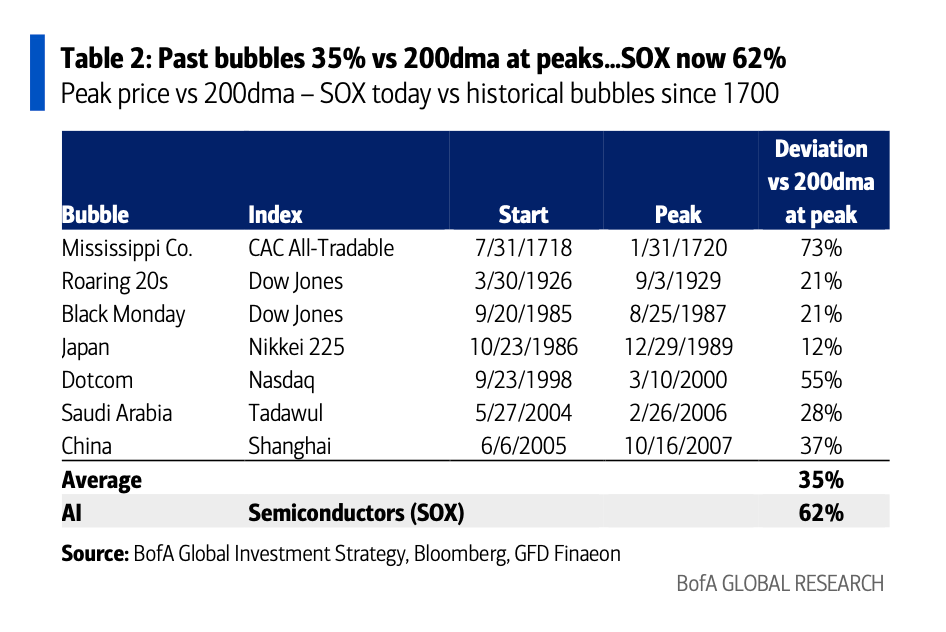
(Source: BofA The Flow Show report, May 14, 2026, 10:45 PM EDT)
At the same time, the current US stock rally is extremely dependent on a handful of tech giants. If mega IPO projects like SpaceX and Anthropic list in the future, it could further divert market liquidity.
Crypto users are used to high volatility, high leverage, and short-term trading. While US stocks also fluctuate, they fundamentally emphasize fundamentals, earnings, valuations, interest rates, and macro cycles. What trading habits do you think they most need to change?
Gracy: For users just moving from crypto to US stocks, the biggest thing I want to remind them is: don't treat US stocks like memes. In the crypto world, users might be used to following sentiment, community hype, and using high leverage for short-term trades. But the US stock market is very institutional; it values financial reports, EPS (earnings per share), interest rate environments, and macro cycles.
Users accustomed to the crypto market need to learn to closely monitor Treasury yields and inflation data. For example, when the 10-year US Treasury yield approaches 5%, it can put pressure on high-valuation tech stocks.
Additionally, users transitioning from crypto to US stocks need to change one trading habit: reduce leverage and lengthen their timeframe. Blue-chip US stocks have real earnings, cash flow, and business moats behind them. They are more suitable for asset allocation and long-term Dollar-Cost Averaging (DCA), rather than going all-in today and expecting it to double tomorrow like trading a shitcoin. Be patient, and be a friend of time. To help crypto users better adapt to the rhythm of US stocks, Bitget will continue to launch educational content related to US stocks. Welcome everyone to follow along and learn to be "sophisticated US stock traders."
In the past, crypto was one of the areas most concentrated with young talent, venture capital, tech narratives, and speculative capital. But now, AI has clearly become the stronger dominant narrative: top talent moves to AI, VCs invest in AI, secondary market capital chases AI, and US tech giants deliver real revenue and growth.
How big do you think AI's impact is on crypto? How is AI used internally at Bitget? Is it mandatory or part of performance reviews? Which AI products do you use?
Gracy: The impact is certainly there, but I prefer to see it as a "de-bubbling" touchstone for the crypto industry. In the past, making money in Crypto was too easy. Now AI is siphoning off capital and talent, which will force the crypto industry to consolidate and find truly valuable real-world applications, like stablecoin payments and RWA.
Internally at Bitget, we require all employees to fully embrace AI. AI-driven innovation is one of our three core strategies for 2026. We don't rigidly include AI usage in mandatory performance reviews because if tools are good, people will naturally use them. For example, I frequently use tools like Manus and NotebookLM to summarize materials, which is indeed addictive.
At the same time, we provide organizational support for employees using AI. Bitget has purchased enterprise-level Claude access for all its employees, covering 2,167 staff at a cost of $200 per person per month. This isn't due to external pressure, but because we observed how much AI tools boosted productivity when employees started using them, and we want to ensure our team doesn't fall behind in the AI application wave.
Even our design team, which doesn't have a technical background, has learned to use tools like Google AI Studio and has developed 6 or 7 AI tools to assist business operations, like automatically auditing external materials for UI compliance issues. On the product side, we've also launched AI tools specifically designed for traders, such as GetAgent and GetClaw.
We have AI-related training almost daily. This week alone, I participated in a "Data Team AI Product Special Sharing Session" and a "Digital Employee Plan & BG Agent Platform Introduction Sharing Session."
AI is a productivity lever. Whoever uses it well will run faster in the next cycle. Now and in the future, it will certainly be an era where silicon-based and carbon-based life work together.
More and more crypto exchanges are now offering US stocks, gold, forex, stock tokens, and Pre-IPO products. Optimistically, this is the expansion of crypto infrastructure to global assets; pessimistically, it might indicate that crypto itself lacks high-quality native assets, forcing exchanges to bring in US stocks to sustain growth.
How do you see this issue? When crypto exchanges integrate US stocks, are they enhancing the value of crypto's financial infrastructure, or are they channeling crypto user traffic towards traditional finance, ultimately becoming an outsourced market for US stock liquidity?
Gracy: I don't see this as a black-and-white issue. When crypto exchanges access US stocks, gold, forex, and Pre-IPO products, it may look like "bringing traditional financial assets into Crypto." But on a deeper level, it's verifying a question: Is Crypto just an asset class, or is it a new set of financial infrastructure?
My judgment is that the answer depends on how exchanges do it. If they simply package US stock price exposure into a trading product, it might indeed become a distribution channel for traditional financial liquidity, or simply funnel crypto user traffic to US stocks.
But if they can reorganize asset issuance, trading, clearing, custody, and risk management based on stablecoin accounts, on-chain settlements, global accessibility, fractional trading, and 24/7 markets, then they are enhancing not just a single US stock, but the value of Crypto as the next generation of financial infrastructure.
Moreover, anyone who has used many traditional financial platforms knows the barriers are high: difficult account opening, high entry thresholds, and slow capital movement. Our goal is to use stablecoin settlement and on-chain RWA protocols to bridge the underlying assets, allowing Bitget's 120 million global users to trade world-class assets with just a phone and an email.
I don't think this is outsourcing. It's using Crypto's high efficiency and low friction to improve upon the traditional brokerage experience. We aren't losing users; instead, through tokenization solutions like Reality, we are pulling real-world assets onto the chain, making them part of DeFi. This is expanding Crypto's territory. We believe that as the industry develops, the definition of Crypto is also evolving. Initially, Crypto only meant Bitcoin. Then, Crypto was the memecoin everyone was talking about. In the future, much of Crypto will be RWA. Whatever the asset, underlying technologies like blockchain are the foundation driving this new financial system. Our long-term bullish outlook on the industry partly stems from our confidence in its technology.
Bitget proposed UEX, essentially allowing users to trade crypto, stocks, gold, forex, ETFs, and more within a single account. This sounds like an expansion of exchange capabilities, but it could also be interpreted


