






Điểm lại trên chuỗi gần đây: Không có chủ đề chính, chỉ có sự giằng co


- Quan điểm cốt lõi: Thị trường Meme coin trên Solana hiện tại có cục diện giằng co giữa hai lực lượng: “Cạnh tranh chú ý (Attention PvP)” và “Tăng trưởng hữu cơ từ cộng đồng”. Lực lượng đầu phụ thuộc vào việc KOL nổi tiếng kêu gọi và các sự kiện nóng, trong khi lực lượng sau dựa vào sự đồng thuận cộng đồng thực sự và dự án liên tục mang lại giá trị, và lực lượng sau đang thể hiện sức bền mạnh mẽ hơn.
- Các yếu tố chính:
- Quán tính cạnh tranh chú ý (Attention PvP): Thị trường quen với việc dựa vào KOL nổi tiếng kêu gọi để "chạy trước", ví dụ $JOTCHUA đạt vốn hóa gần 9 triệu USD nhờ phát ngôn của KOL Ansem, nhưng cộng đồng nghi ngờ tính “hữu cơ” của nó; các dự án tương tự trên các chain khác nhau có sự phân hóa rõ rệt ($WORLDCUP trên Solana tăng lên 12 triệu USD, $PITCH trên Base giảm xuống 70 nghìn USD).
- Trường hợp cực đoan của Pump.fun: Tính năng mới “Pump Fun GO” cho phép đăng phần thưởng trả phí, dẫn đến dự án $Bountywork treo thưởng 40 SOL cho việc xăm hình để tạo热点, người tham gia cuối cùng kiếm được 48.000 USD, nhưng token sau đó về 0, phơi bày tính đầu cơ thuần túy do流量驱动.
- Sự trở lại của các token cộng đồng: Các token như $neet, $troll, $buttcoin, $triplet tồn tại từ 410-107 ngày, vốn hóa ổn định từ 6,6 triệu đến 65 triệu USD; đặc điểm chung là có cộng đồng tự phát lâu dài, không phụ thuộc vào một KOL duy nhất.
- Quan điểm của người thúc đẩy chính: KOL Ansem chỉ rõ rằng, Meme coin lành mạnh nên dựa vào cộng đồng chịu lỗ và liên tục truyền bá ý tưởng, chứ không phải dựa vào KOL nổi tiếng kêu gọi hoặc cạnh tranh tốc độ để xả hàng; dữ liệu thị trường (truyền thông xã hội, khối lượng giao dịch, số lượng holder) mới là tín hiệu đánh giá.
- Trường hợp game trên chain $KINS: Xây dựng niềm tin thông qua game MMORPG trình duyệt, bắt đầu từ vốn hóa 40.000 USD và 243 holder, liên tục cập nhật nội dung và tích hợp token cộng đồng, thu hút KOL trở thành người chơi thực sự thay vì dựa vào quảng cáo "play-to-earn".
After the ETH mainnet market gradually quieted down, degenerates have returned to Solana to be active. Despite this, it's hard to pinpoint a clear narrative on Solana. To summarize, perhaps the phrase "torn between returning to the community and engaging in attention PvP" fits best.
Attention PvP
Since Trump launched his coin, the meme coin market has long been accustomed to relying on celebrity hype, hot events, and who can trade faster.
Everyone is used to it, so even with poor liquidity, players still seek opportunities using this playbook, creating an inertia for this style of trading.
$JOTCHUA is a dog meme that gained traction in Spanish-speaking and English-speaking circles in 2021. On January 24, 2021, Instagram user @_kingorange uploaded a motivational poster featuring a rough-looking dog with the word "JOTCHUA," garnering over 29,000 likes within three months.
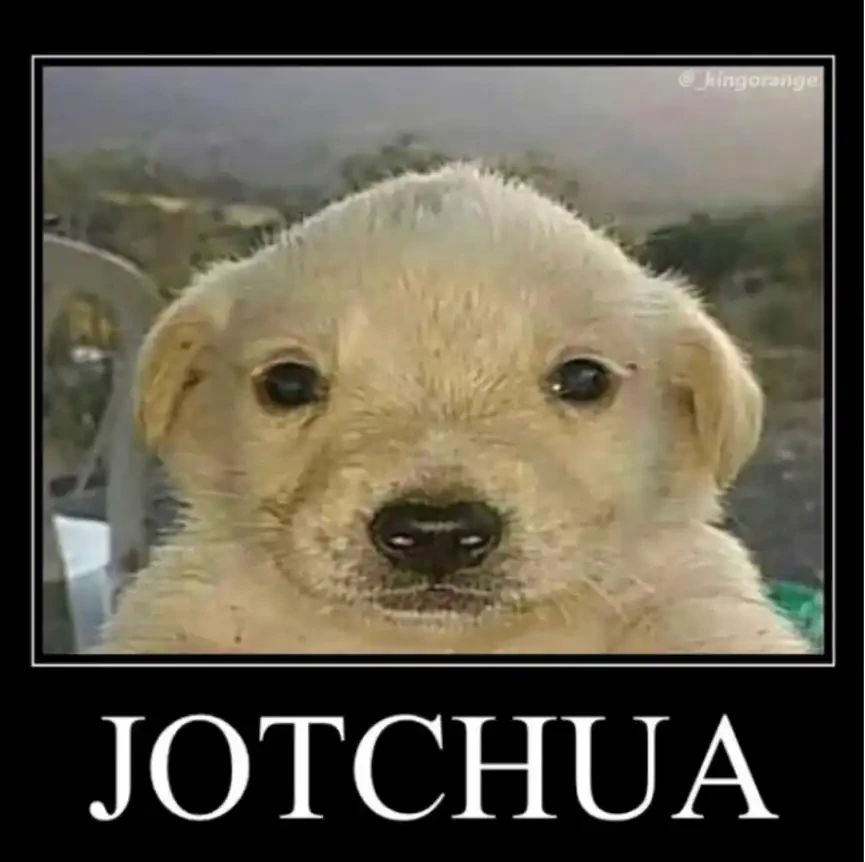
The coin's market cap briefly neared $9 million at its peak. There's significant debate within the community over whether the coin is "organic" because its launch did not occur after the meme's creator, @_kingorange, claimed it, making it hard to say that the "claim" directly caused the price surge.
Many players consider this coin another "pump and dump scheme," or because KOL Ansem claimed on June 9 that he was buying Solana meme coins for the first time in over a year, sparking market speculation linking his purchase to this coin.
Same concept, even the same ticker, but your coin just doesn't pump. The $JOTCHUA on the ETH mainnet was deployed as early as December 2023 and has sustained content and community, yet it couldn't compete with getting the creator to click a button to claim it.
A similar situation occurred with the World Cup concept. Solana's $WORLDCUP, fueled by bonkguy's purchase and analysis, surged from a market cap of around $5 million to over $12 million. Meanwhile, the World Cup concept project $PITCH on Base has dropped from a peak market cap of about $7 million to nearly $700,000.
While $PITCH does have its own issues, mainly in communication, the project isn't inactive—updates are consistent—but the dev rarely speaks out, and their X account keeps getting banned without securing a new one. Admittedly, without hype, similar concepts and gameplay lose out in the battle for attention.
pump.fun's recent new feature, pump fun GO, allows anyone to post paid bounty tasks on the platform.
This has indeed attracted mainstream media attention, but unfortunately, it reaches the public in a negative light once again.
$Bountywork peaked at a market cap of nearly $2.5 million. Its dev, @ayushquantt, focused on continuously posting new tasks on pump.fun to generate hype for the coin.
He succeeded—by offering a 40 SOL bounty for someone to tattoo $bountywork on their forehead.

An Indian man actually did it, strictly following the dev's typo in the description—missing an 'n' and misspelling the ticker as $boutywork.
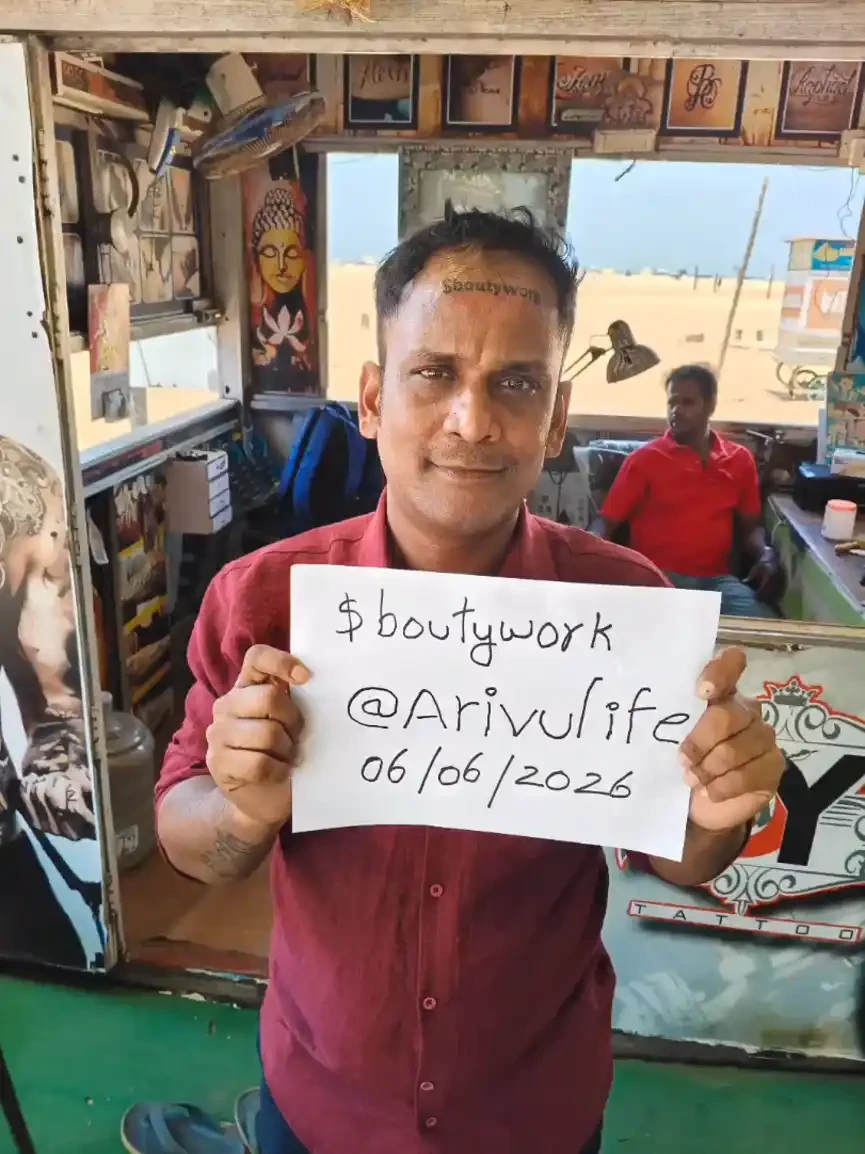
Initially, his bounty application was rejected because the tattoo was missing the letter 'n,' and the dev demanded he correct it. Then, someone else launched a new coin using the erroneous $boutywork as the ticker.
In the end, the 40 SOL reward was still given to him, along with the creator's earnings from the new coin, totaling about $48,000.
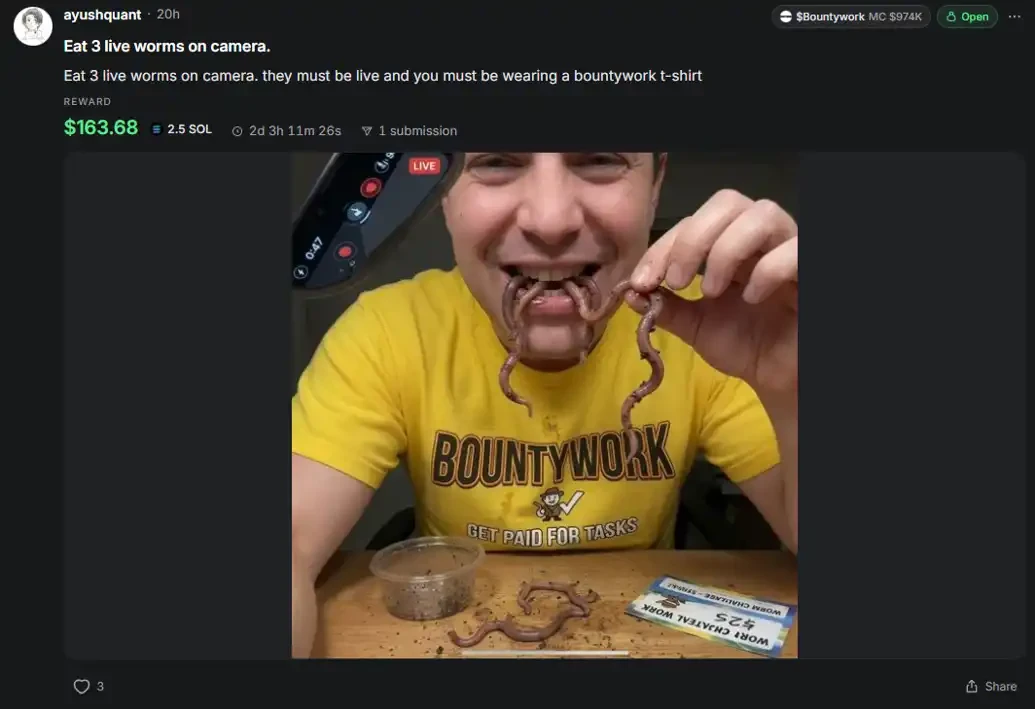
Then, as the event's hype faded, $boutywork has essentially gone to zero, while $Bountywork's dev continues posting new bounties trying to replicate this "success," such as offering a reward for someone to eat three bugs on camera while wearing $Bountywork-branded clothes.
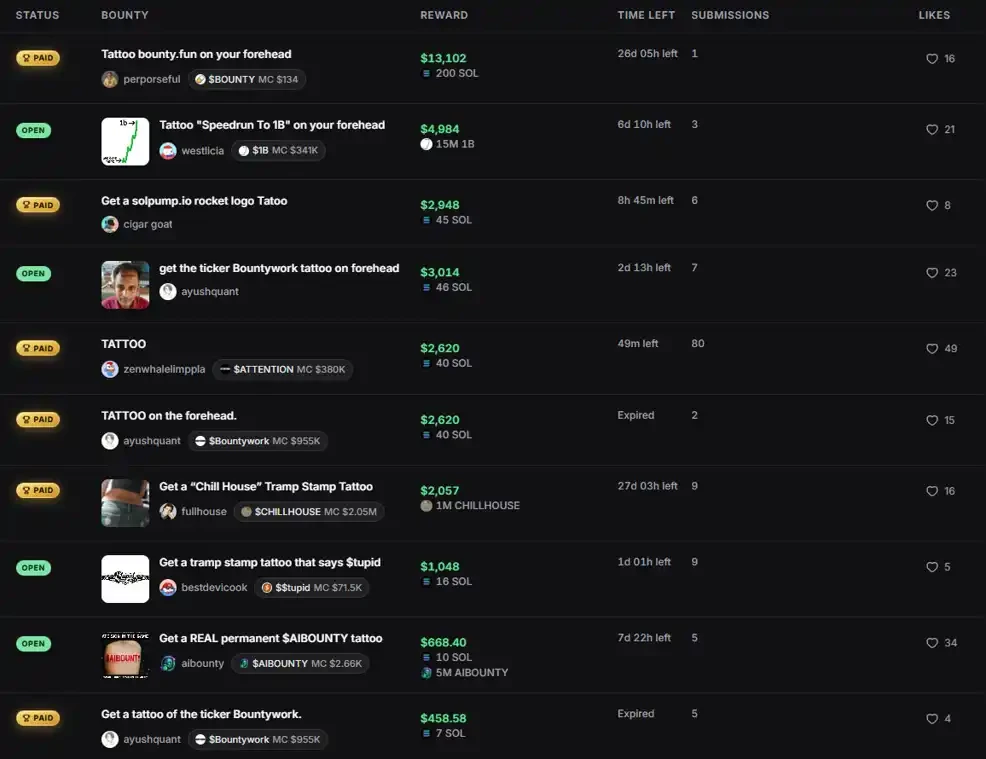
There are many similar tattoo tasks on pump.fun, with some earning up to 200 SOL by tattooing their faces.
Honestly, this isn't much different from the era on Kuaishou where top donors rewarded people for eating raw eggs or downing strong liquor...
The Return of Community
Let's continue with pump.fun's new feature. Almost all bounty tasks relate to generating attention for specific tokens. The only one not seen as a spectacle might be the bounty for $neet—organizing a "No Work" gathering in New York.
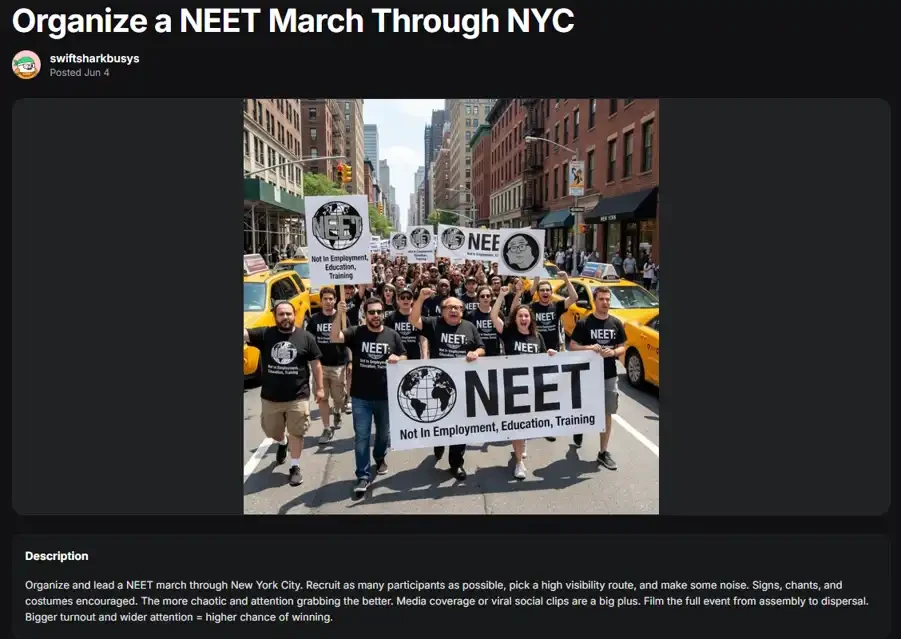
This bounty is paid in $neet, with rewards exceeding $15,000. Previously, the $neet community had spontaneously organized two offline "No Work" gatherings in the US. If this bounty is completed, it will be the third.
While the exact intent behind pump.fun's support for community-driven meme coins is unclear, their official Twitter account often promotes community-based tokens. Although their performance varies—$chillhouse, for example, has had a sluggish price for a while—the tokens pump.fun picks tend to be genuinely community-driven and organic.
Currently, tokens with relatively stable volume and price include $troll, $buttcoin, and $triplet, alongside $neet. Here's a brief overview of their survival and themes:
- $neet: Deployed 410 days ago, peak market cap ~$51 million, current market cap ~$27 million. The community's mission is to raise awareness that spending most of one's life working means losing one's own life.
- $troll: Deployed 416 days ago, owns the copyright to the classic Troll meme, listed on Coinbase. Peak market cap ~$290 million, current market cap ~$65 million.
- $triplet: Deployed 107 days ago, an abbreviation of the wildly popular "Italian Shan Hai Jing" stickman character "Tung Tung Tung Sahur." Peak market cap ~$13.6 million, current market cap ~$6.6 million.
- $buttcoin: Deployed 153 days ago, originated from a joke on a Bitcoin forum in 2011, a pun on Bitcoin becoming Buttcoin. Peak market cap ~$68.6 million, current market cap ~$27 million.
Mentioning these coins and the return of community-driven tokens brings us back to Ansem. After he said he was back buying Solana memes, someone called for him to post the CA, vowing to buy 1% aggressively.
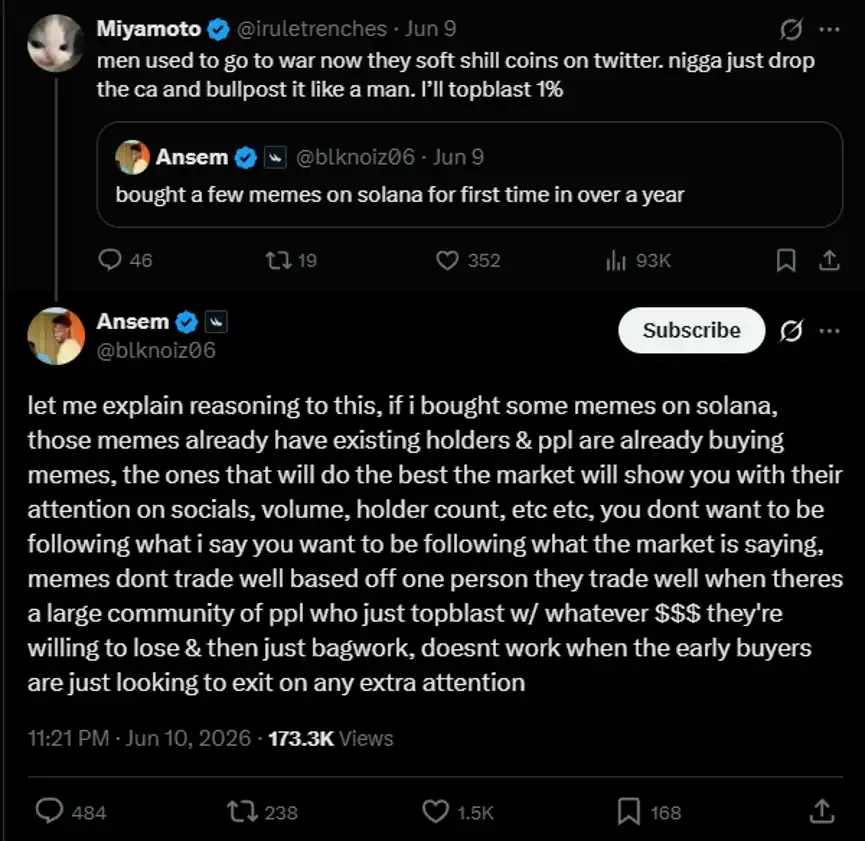
Ansem's response sparked much discussion:
"Let me explain why I won't post the CA. If I buy Solana meme coins that already have good holders, the market—through social media performance, volume, holder count, etc.—will tell you which coins are good. You shouldn't listen to me; you should listen to the market. Meme coins relying on fast-fingered, hype-driven holders waiting to dump won't thrive. Only coins with a large community willing to endure losses and tirelessly promote their holdings day in and day out will succeed. Coins dependent on a single celebrity won't work."
Besides these older coins with long survival and relatively stable prices, there's a new coin that aligns with Ansem's view: $KINS.
$KINS is the token for Kintara, a chain game. Interestingly, Kintara didn't drive Solana's gaming narrative because it succeeded not through game sophistication but by standard step-by-step actions earning community trust.
Let's briefly explain $KINS's mechanism. It's an MMORPG playable in a browser. To play, you need 1,000 $KINS in your wallet, then you can chop wood, mine, fish, buy houses, fight monsters, bosses, and engage in PvP.
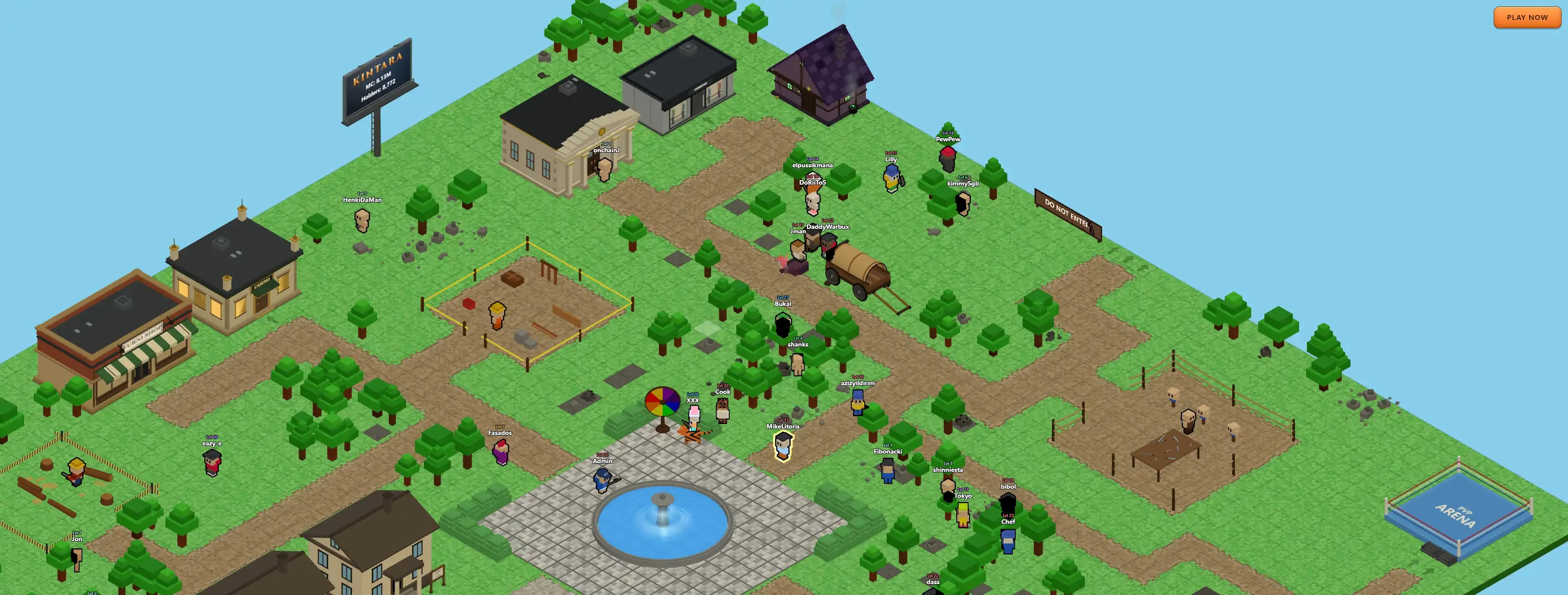
There are no extra fees in the game except for a reward wheel. If players don't want to spin just once daily, they can spend $3 worth of $KINS for additional spins. Of this revenue, 50% goes to token buyback and burn, and 50% to project maintenance and development.
The core loop involves gathering resources → crafting items → challenging tougher monsters. If players lack resources, they buy in-game currency "Gold" from others using $KINS. Players can sell "Gold" priced in $KINS, with 5% going to the treasury and 95% to the seller.
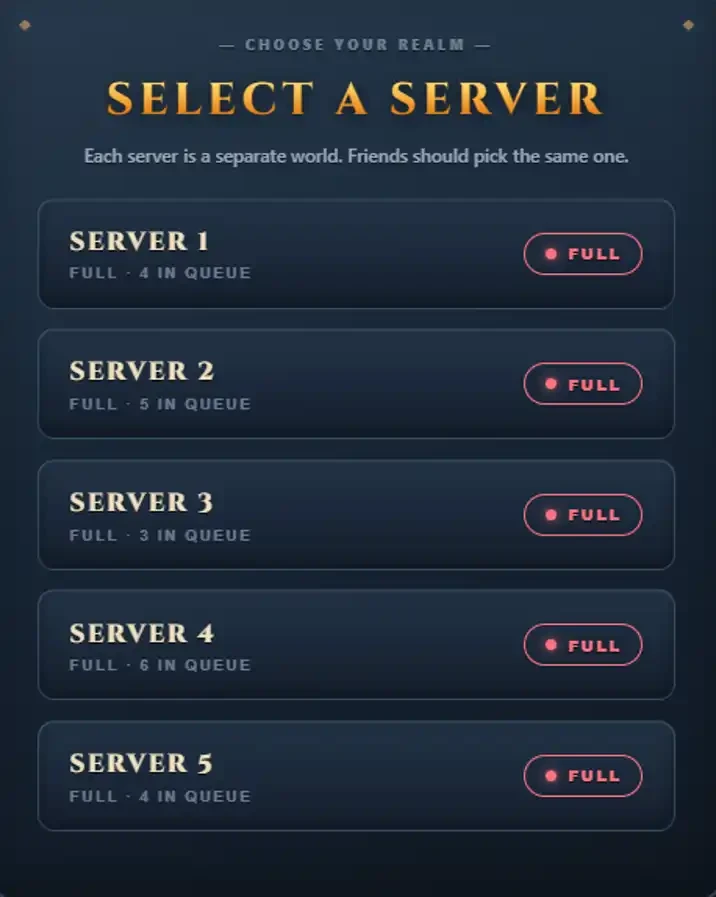
It sounds unremarkable, and the data isn't spectacular (only 0.5% of $KINS has been bought back so far). Yet, consistent delivery has built strong trust. Perhaps because the market is so disheartening, many players have genuinely engaged, with daily fishers increasing steadily. The project team has expanded to 5 servers, but queues remain...
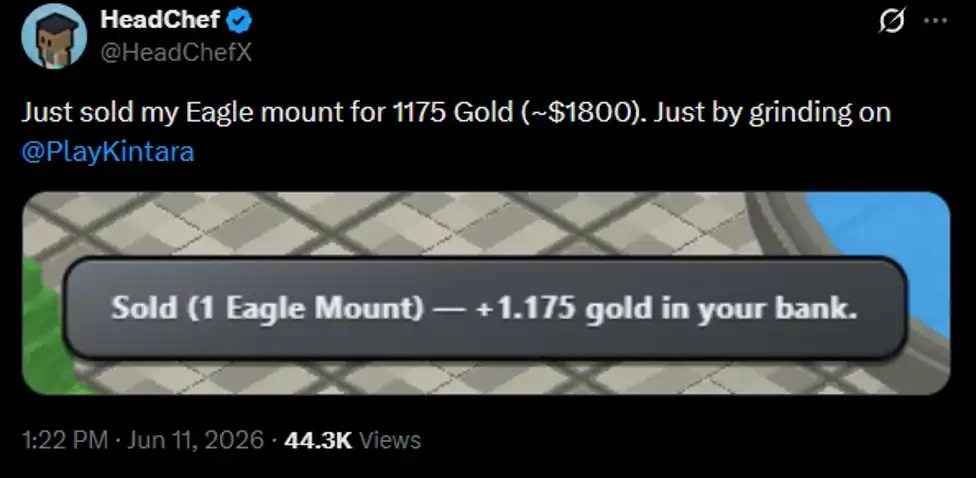
One player successfully sold a rare fishing mount for $1,800:
The game's team barely promotes "play-to-earn" but instead focuses on "building network effects and player belonging." For instance, integrating various Solana community meme coins or trending tokens into game elements, auctioning in-game luxury homes.
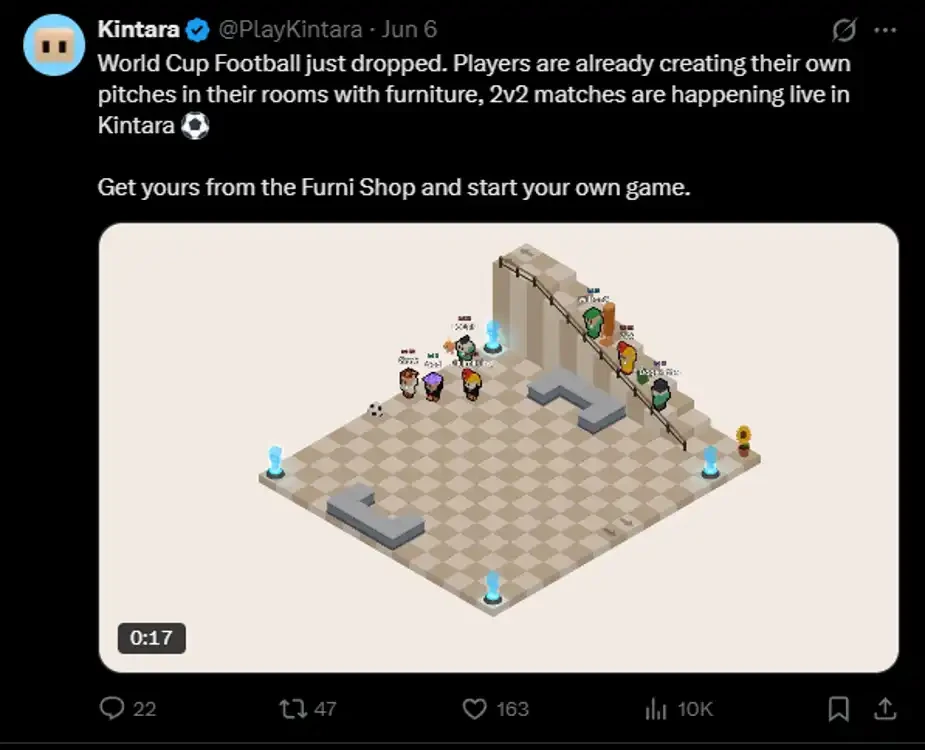
Another example: promoting World Cup-themed football matches in players' houses:
When it was still obscure, with a market cap under $40,000 and only 243 holders, this early "unknown to anyone" status was displayed on the game's main map stats board. Watching Kintara persistently update game content quickly, more people grew comfortable, gradually attracting KOLs like Gake and Ansem to become part of the player base.
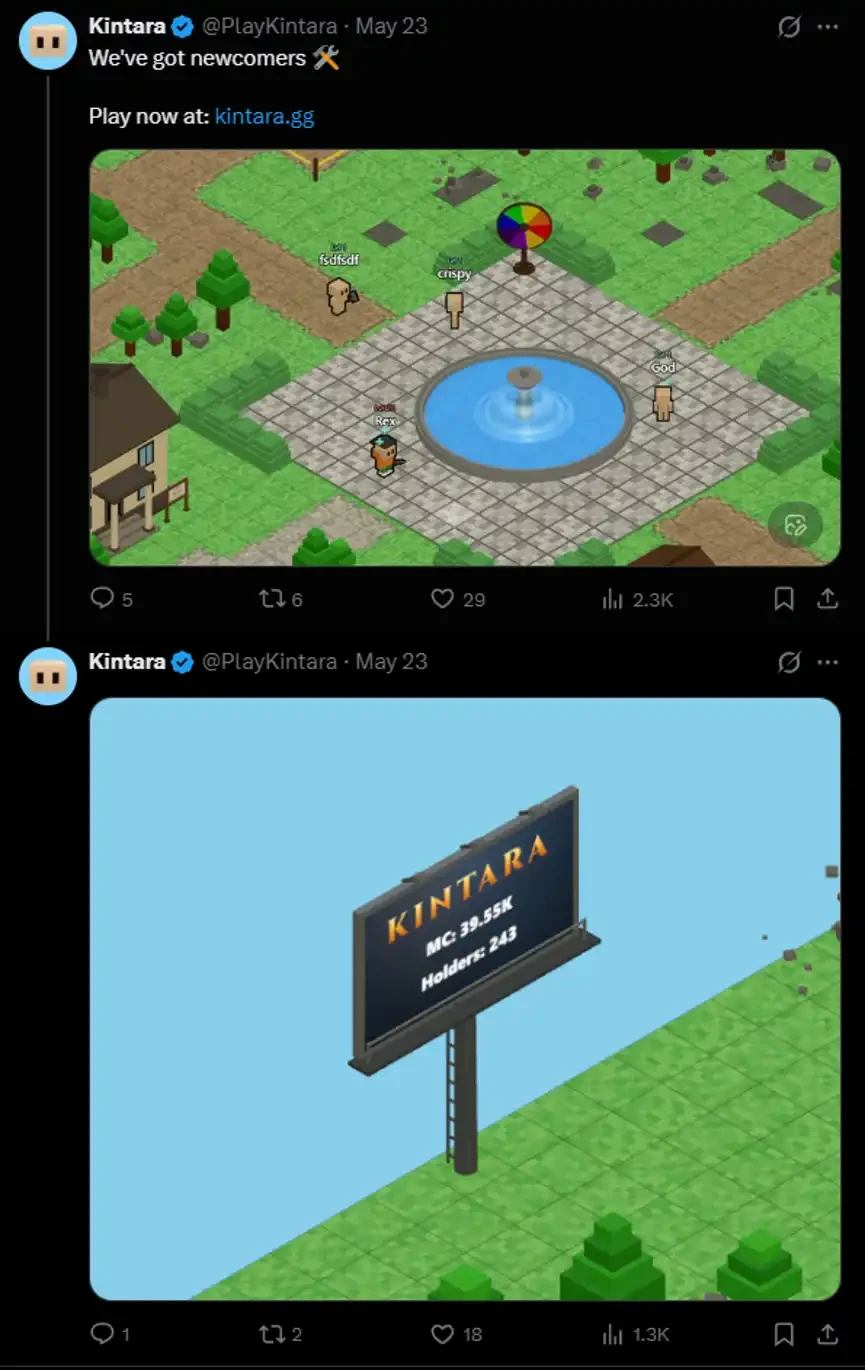
Kintara on May 23, like a newly born silent world
So, no one calls this project a "pump and dump."
"Are we endlessly chasing a game of trust, or a game of deception?"
This is Zhan Hao's recent self-questioning.
Hopefully, such introspection continues, ultimately leading to a healthier market.


