






何一最新访谈:我的野心,是有一个配得上我的世界


- Quan điểm cốt lõi: Hà Nhất chia sẻ hành trình từ một cô gái nông thôn trở thành CEO đồng sáng lập của Binance, nhấn mạnh tầm quan trọng của tính chủ thể, tham vọng và năng lực thực thi. Cô cho rằng nhận thức, năng lực thực thi, lòng can đảm và tham vọng là bốn trụ cột của sự trưởng thành, đồng thời giải thích cách Bitcoin đã định hình lại nhận thức của cô về tiền bạc và tương lai tài chính.
- Các yếu tố then chốt:
- Những trải nghiệm đầu đời của Hà Nhất (như tự chủ động xin đi học năm 4 tuổi, kiên quyết trả nợ cờ bạc sau khi thua) đã hình thành nên tính chủ thể mạnh mẽ và ý thức chủ động tranh giành của cô.
- Cô tổng kết động lực trưởng thành thành bốn trụ cột "nhận thức, năng lực thực thi, lòng can đảm, tham vọng", cho rằng chúng thúc đẩy lẫn nhau, đồng thời nhấn mạnh phương pháp luận "dám nghĩ" và "suy luận ngược từ kết quả".
- Năm 2013, sau khi nghiên cứu Bitcoin, nhận thức của cô đã bị định hình lại, coi nó như một mạng lưới tin cậy dựa trên sự đồng thuận toàn cầu, chứ không phải là một loại tiền tệ được bảo chứng bằng tín nhiệm quốc gia, từ đó quyết định dồn toàn bộ tâm huyết vào ngành blockchain.
- Khi từ bỏ sự nghiệp MC đang trên đà thăng tiến để gia nhập giới tiền điện tử, Hà Nhất cho rằng năng lực cốt lõi của cô là "tối ưu hóa và nâng cấp những thứ có sẵn lên mức tối đa", chứ không phải là sự đổi mới từ con số 0.
- Về sự phát triển của phụ nữ, cô khuyên "hãy thử trước, hiểu rõ cái giá phải trả", đồng thời phủ nhận nhãn mác "cạnh tranh nội bộ giới nữ", nhấn mạnh việc giành chiến thắng bằng thực lực trong cạnh tranh ("cạnh tranh giới tính").
Original source: Money-Making Girls
Compiled by: Deep潮 TechFlow
Key Takeaways
In this episode of "Money-Making Girls", the host chats with BINANCE co-founder and co-CEO He Yi, covering everything from childhood, growth, and career choices to ambition, cognition, execution, and how women can lift themselves up.
He Yi recalled how, as the second child in her family, she learned to proactively fight for things—demanding to go to school at age 4, reading wuxia and Yi Shu novels in her youth, and refusing to return to her hometown as a teacher after normal school. These experiences collectively shaped her strong sense of agency.
She also talked about why she went all in on Bitcoin at the peak of her hosting career: Bitcoin made her rethink "what money really is" and showed her a financial future built on a global consensus and trust network. For ordinary people, her answer is straightforward: first, understand the cost, then try courageously; iterate your cognition through execution. In life, you either gain or you learn.
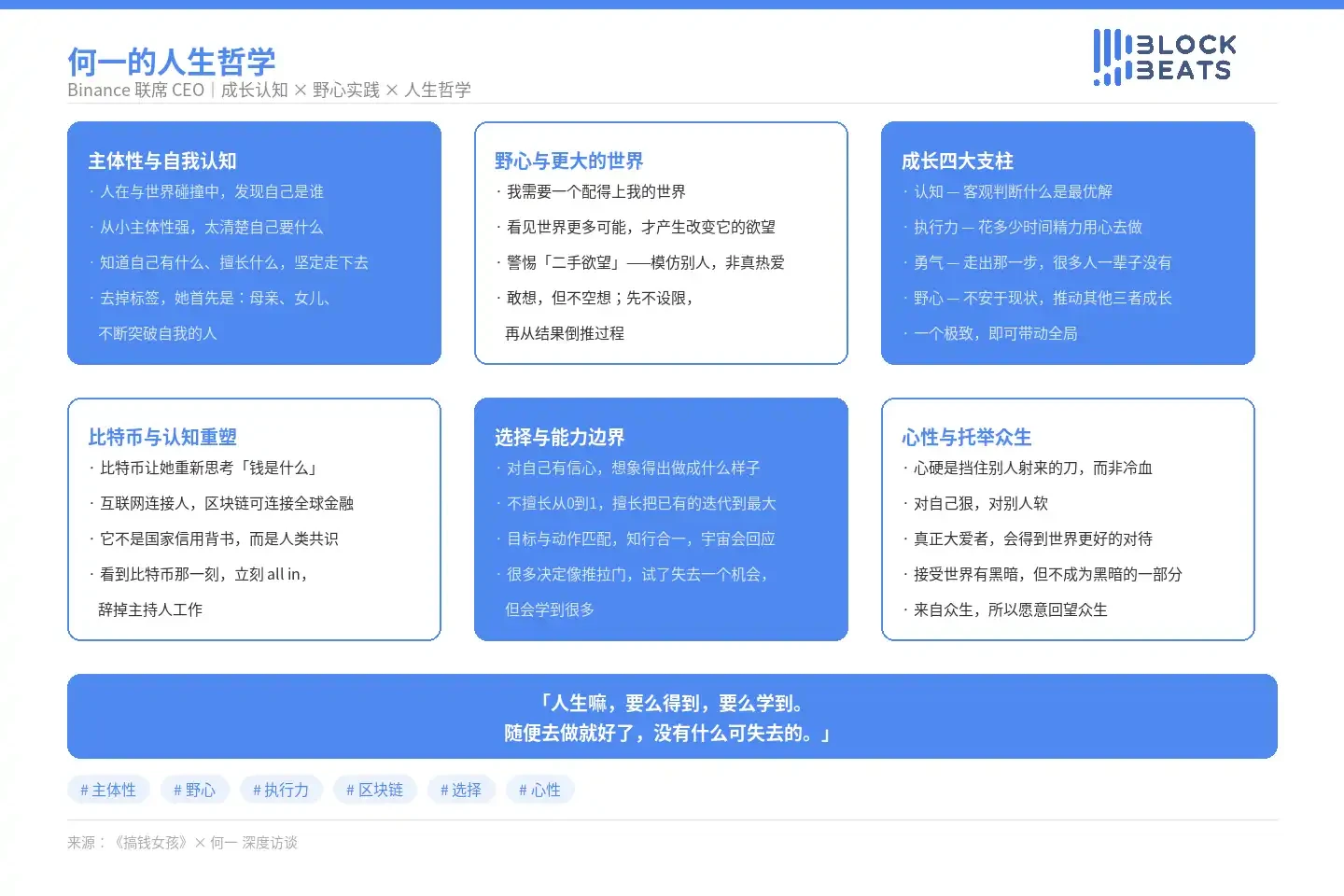
Highlights of Key Insights
On Agency and Self-Awareness
· "People are not isolated beings. It is through every collision with the world that we ultimately discover who we are. Through every interaction, every engagement, and how you face and handle it, you come to understand yourself more and more."
· "I think I have always, in today's terms, had a strong sense of agency. I've always known exactly what I want."
· "Why can only city kids appreciate beautiful things, like flowers and plants? Why can't I?"
· "Do you truly know what you have and what you don't, what you're good at and what you're not? And can you steadfastly walk that path, even when knives fall from the sky?"
On Ambition and a Bigger World
· "I might have always been a bit ambitious, always feeling like I need a world that is worthy of me."
· "When you see there are still many parts of the world you want to try and change, you start wishing for a bigger world to explore."
· "Many times, our desires are second-hand desires. We just see others doing it, so we imitate them."
· "You need to dare to dream, but not just daydream. First, set no limits, then work backward from the result to the process."
On Cognition, Execution, Courage, and Ambition
· "The so-called four pillars are cognition, execution, courage, and ambition. If one of these corners is extremely strong, it will drive the growth of another. If two parts grow, they will further propel you forward."
· "Understanding yourself means being able to objectively judge whether something is your best option, and whether you truly love it enough to keep doing it even if it doesn't make money."
· "Execution isn't just about doing something; it's about how much time and energy you invest. Are you really putting your heart into it? Can you endure the long, agonizing process of self-iteration before success?"
· "Many people think they know a lot and are just unlucky, but they might not even have the courage to take that first step."
· "If you truly love something, doing what you love feels effortless."
On Bitcoin and Reshaping Financial Perception
· "Bitcoin made me rethink what money really is—that's what touched me the most."
· "If the internet can connect people worldwide, then there could also be a trust-based network that connects global finance together."
· "It's not currency printed by a country or government based on credit backing; it's a consensus of humanity."
· "The moment I saw Bitcoin, I felt this was the right direction. I wanted to join this circle and do this thing."
On Choice, Mission, and Capability Boundaries
· "I have confidence in myself. If I joined BINANCE, I could envision what I could do—turn it into a world-class platform. Getting there was just a matter of time."
· "I may not be the best at creating something from 0 to 1, but I am very good at continuously optimizing and iterating an existing thing to its maximum potential."
· "Everyone envisions what they want to become and where they want to go. Ultimately, the universe will respond. You just need to align your knowledge with your actions, matching your goals with your moves."
· "Many decisions in life are like push-pull doors. You can regret them afterward. It's okay to try. You might lose an opportunity, but you'll learn a lot."
On Success, Inner Strength, and Lifting Ordinary People
· "Having a hard heart doesn't mean being cold to others. It means when facing different opinions or knives thrown at you, you can harden up to withstand them."
· "I am quite hard on myself, but soft with others."
· "If there is a truly divine hand in this world, it would favor those who have greater love for this world."
· "This world has light and darkness, good and evil. You must accept it as part of the world, but it doesn't mean you have to choose to become part of the darkness."
· "Life... you either gain or you learn. Just go do something; there's nothing to lose."
When you strip away all social labels, who are you?
Just Xiaohui: Today, Xiaohui is interviewing a truly legendary woman in Hong Kong, China. Born in a rural area of Yibin, Sichuan, she accidentally became an outdoor host for Travel Satellite TV, and later became known as "Customer Service Xiao He" in the blockchain industry. Now, her latest title is co-CEO of BINANCE, the world's largest blockchain trading platform and ecosystem.
How can a life make such a comeback? So I'm very curious about her upbringing. Today, please welcome BINANCE co-CEO He Yi. Welcome, Sister Yi.
He Yi: Hello everyone, I'm He Yi from BINANCE, also your customer service Xiao He.
Just Xiaohui: Most people might imagine a CEO or female president to be very domineering and imposing, but you give off a gentle, approachable vibe. So today, I'm also curious to look back and see how 'Xiao He' gradually became the Sister Yi we see today.
Recently, there's a popular self-introduction game: if you remove all social labels, how would you introduce yourself?
He Yi: I think first, a mother, a daughter, and someone who constantly breaks through their own limits.
Just Xiaohui: That's a very down-to-earth expression. For someone like me, I seem to need a lot of external validation and dimensions. If I can't define myself, I'll think about how others would define me. For example, I've received a lot of feedback saying Xiaohui is also an approachable person. Because I do interviews, people say I'm good at making others open up.
But that's also me in the eyes of others. It feels like I really need others' confirmation to figure out who I am.
He Yi: That might mean you are in the process of exploring life. People are not isolated beings. It is through every collision with the world that we ultimately discover who we are. Through every interaction, every engagement, and how you face and handle it, you come to understand yourself more and more. It means you're still young, still in your youth.
The "Second Child Rule" taught He Yi to proactively fight for things from a young age
Just Xiaohui: Before coming here, I did my homework and found a common point between Sister Yi and me. You have three kids in your family, and you're the second child; I'm the third. There's a psychological concept called the 'Second Child Rule,' which reminds me of my second sister.
My second sister has a contrasting personality to yours: she's domineering, outspoken, and mischievous. My parents found her quite a handful. I was the obedient one, more like the 'daughter' type. I wonder, looking back, did being the second child leave a mark on your personality?
He Yi: I think it's quite obvious. I myself now have three kids. Usually, when the first child is born, parents invest a lot of attention. Every little thing makes them nervous, so the eldest gets all the love, the most love. By the time the second arrives, people often say, 'Raise the first by the book, raise the second casually.' Parents worry less. They know how to handle fevers and so on; they're less tense.
The youngest is usually the baby of the family, receiving more sympathy as the precious darling. So growing up, parents definitely tell the older sister to 'give in to your little brother.' Even if you don't fight for things, they'll reflexively say to give it to the brother. The eldest has assured love, the youngest has assured love too, so the second child needs to actively fight for attention, or else they'll feel forgotten.
Sometimes, what kids call rebellion is actually a cry for help. Relatively speaking, they might become more independent and self-reliant.
The earliest awakening of agency: At age 4, she insisted on going to elementary school and was eventually 'exceptionally' admitted
Just Xiaohui: At what moment did you realize, 'I need to fight for these things myself'?
He Yi: My earliest memory now might be demanding to go to school when I was 4. My sister is 6 years older than me. When I was 4, she was in elementary school. I thought, why can my sister go to school and I can't? So I made a fuss at home every day, saying 'I want to go to school, I want to go to school,' annoying the adults to no end until they finally sent me.
My elementary school homeroom teacher was a friend of my parents. He asked them how old I was, and they lied, saying 6. Back then, they didn't check IDs or register household records. They said 'We'll deal with it later, if she does poorly, she can repeat a grade.' So I was just dumped into school. I never ended up repeating a grade and did quite well academically.
Just Xiaohui: Because you want to do something yourself, you can do it well. This might be the foundation of your personality: you are very brave in expressing what you want. If the current environment isn't what you want, you feel you need to find a suitable one.
He Yi: I have another vivid memory from childhood. Because my family lived in the countryside in Sichuan, it was all wildflowers and weeds. In elementary school, I would pick wildflowers every day, and my mom would laugh at me, saying 'Why does a country kid love these flowers and plants so much?' To them, wildflowers were very common and not worth attention. They felt it might be a privilege for city kids.
But I have a very clear memory from that time: I didn't agree with her. Why can only city kids love beautiful things, like flowers and plants? Why can't I?
I think this reflects my proactive tendency to change, or rather, to persist in being myself. In today's trendy terms, I have a strong sense of agency; my self-awareness awakened very early. I'm probably born rebellious.
Just Xiaohui: I have a similar experience. I was born left-handed, writing with my left hand. My parents tried to switch me to my right hand for a while, but luckily, my kindergarten teacher was quite open-minded. She said it's fine, let her be; she writes well enough, no need to force a change. There's also a folk saying that lefties are smarter, so the teacher protected my preference, and my parents accepted it.
But I was very stubborn throughout. I refused to change. They told me to change, and I wouldn't. But they didn't use too harsh methods on me. For you, were your parents more hands-off, or was there environmental pressure?
He Yi: My mother was very strict. But I think I have always, in today's terms, had a strong sense of agency. I've always known myself too well.
There's a very crazy thing from my childhood: I gambled before I was 10. Kids playing for pocket change, like 10 cents a game, with older kids. I ended up losing. I had no allowance and owed 5 yuan. When my mom found out, she beat me severely. Those bamboo twigs from Sichuan really hurt. After the beating, she asked, 'Are you going to gamble again?' I said no.
But later, I thought about it and realized, wait, I still owed people money. You have to be trustworthy. What to do about the 5 yuan I owed? So I switched opponents and kept playing. My mom caught me again and beat me again. But by then, I was in the process of repaying the debt and had started to slowly win back money. I kept playing, paid off the debt, and never gambled again.
Before I was 10, I understood gambling: you lose and want to win it back, you win and want to keep winning. It's endless. So I have absolutely no interest in gambling—I was practically trained out of it by age 10.
Just Xiaohui: You were very young, enduring beatings from your strict mother while figuring out how to pay off your debts. How many beatings did you end up taking?
He Yi: Not too many. Besides gambling, there was reading novels. There was a waste collector in our village with many books at home. I would borrow books from him, and later I started renting novels. When I was in middle school, just over 10, my mom caught me again.
Just Xiaohui: What were you reading? Qiong Yao novels?
He Yi: I didn't read much Qiong Yao. I read a lot of wuxia, and also some semi-classical Chinese texts like *Strange Tales from a Chinese Studio* (*Liaozhai Zhiyi*). Back then, options were limited—you read whatever the waste station had. Later, I rented novels and read a lot of Li Bihua and Yi Shu. These two Hong Kong writers influenced me quite a bit.
Li Bihua has a spooky, eccentric talent. I still remember a line of hers: 'The sixteen-character mantra for navigating the world: murder pays with life, debts must be repaid, you bet you lose, you're on your own.' I used it as my QQ status.
Yi Shu's novels can be a bit sentimental, being young adult fiction, but ultimately, they have a very important theme: buying your own flowers to wear. They all feature strong female protagonists. Her works from the 70s and 80s were like that. I feel the independence and agency of Hong Kong women were established very early on, and these things seemed to become part of my personality's foundation.
Just Xiaohui: Let's return to your career later in life. When I look at it, your life seems very unpredictable. You seem to get an opportunity, decide to go for it, without much planning. The first thing I'm curious about is, before you became a host, your childhood dream was to be a model. I remember you mentioned in an interview that you wanted to be a model before you were 16.
He Yi: Yes. I was in a normal school because my parents were teachers. They thought normal school was a good choice. After graduating, I'd become a teacher. When I was in school, a teacher once said, 'It would be a shame if you didn't become a teacher.' I said to the teacher right in front of the whole class, 'I think it would be a shame if I became a teacher.'
Ambition awakened during normal school: 'I think it would be a shame if I became a teacher'
Just Xiaohui: You're truly born rebellious. But because your grades were good, the teacher probably didn't mind too much. Why were you so sure back then that you weren't suited to be a teacher?
He Yi: It's not that I didn't think I was suited to be a teacher. Maybe I just wasn't content with merely being a teacher.
Just Xiaohui: Why? For that era, it was a good job.
He Yi: Maybe because I read a lot and saw a broader world, not just the one in front of me. I went to Yibin College. If I went back, I'd probably end up teaching in the village. I wasn't content with that.
Reading Li Bihua and Yi Shu's novels, seeing more descriptions of the world, I felt there should be a wider world out there, and I wanted to go see it.
'Second-hand desires': Often, our desires are just imitations of others
Just Xiaohui: So at


